第4章 非线性系统线性化
- 格式:ppt
- 大小:3.35 MB
- 文档页数:112

Sep. 2021Vol.2& No.92021年9月 第28卷第9期控制工程Control Engineering of China文章编号:1671-7848(2021)09」765・08DOI: 10.14107/j xnki.kzgc.20190688基于BP 神经网络的空气源热泵温度MPC 策略高龙,杨奕,任晓琳,于婿雅,韩青青 (南通大学电气工程学院,江苏南通226019)摘 要:空气源热泵系统是一个非线性强且大时滞的系统,釆用常规的PID-PID 串级控制 难以达到对出水温度预期的控制效果。
针对这一问题,建立了空气源热泵热水系统中的水流量与出水温度之间的数学模型。
釆用BP 神经网络作为模型预测控制器及拟牛顿法进行 目标误差函数数值优化,提出模型预测控制(MPC)算法与PID 控制相结合的新型MPC-PID 串级控制策略,并对空气源热泵热水系统进行跟踪性能和抗干扰性能测试。
仿真结果表明, 此控制策略提高了热泵系统的跟踪性能和抗干扰性能,还改善了系统强鲁棒性,其总体性能优于PID-PID 串级控制系统。
关键词:空气源热泵;模型预测控制;BP 神经网络;串级控制;拟牛顿法 中图分类号:TP273文献标识码:AMPC Strategy of Air Source Heat Pump Temperature Based onBP Neural NetworkGAO Long, YANG Yi, RENXiao-lin, YU Jing-ya, HAN Qing-qing(The College of Electrical Engineering, Nantong University, Nantong 226019, China )Abstract: The air source heat pump system is a system with strong nonlinearity and large time delay. It is difficult to achieve the expected control effect on the temperature of the effluent by using the conventional PID-PID cascade control. Aiming at this problem, a mathematical model of the water flow rate and water temperature in the air source heat pump hot water system is established. The BP neural network is used as the model predictive controller and the quasi-Newton method is used to optimize the target error function. A new MPC-PID cascade control strategy combining model predictive control (MPC) algorithm and PID control is proposed. The tracking performance and anti-interference performance of the air source heat pump hot water system are tested. The simulation results show that this control strategy improves the tracking performance and anti-interference performance of the heat pump system, and also improves the strong robustness of the system. Its overall performance is better than that of the PID-PID cascade control system.Key words: Air source heat pump; model predictive control; BP neural network; cascade control; quasi-Newton method1引言随着生态环境恶化和不可再生能源的急剧减少,因为具有运行费较低的优势,发展可再生能 源技术和保护生态类热源产品技术脫颖而出。
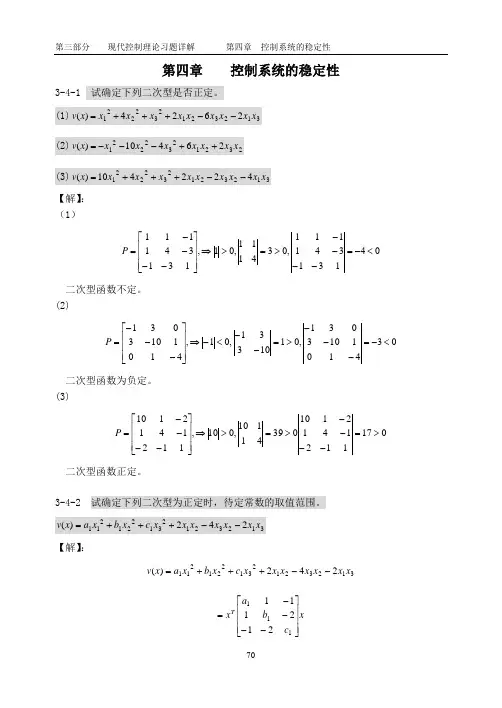
第四章 控制系统的稳定性3-4-1 试确定下列二次型是否正定。
(1)3123212322212624)(x x x x x x x x x x v --+++= (2)232123222126410)(x x x x x x x x v ++---= (3)312321232221422410)(x x x x x x x x x x v --+++= 【解】: (1)04131341111,034111,01,131341111<-=---->=>⇒⎥⎥⎥⎦⎤⎢⎢⎢⎣⎡----=P 二次型函数不定。
(2)034101103031,0110331,01,4101103031<-=--->=--<-⇒⎥⎥⎥⎦⎤⎢⎢⎢⎣⎡---=P二次型函数为负定。
(3)017112141211003941110,010,1121412110>=---->=>⇒⎥⎥⎥⎦⎤⎢⎢⎢⎣⎡----=P 二次型函数正定。
3-4-2 试确定下列二次型为正定时,待定常数的取值范围。
312321231221211242)(x x x x x x x c x b x a x v --+++=【解】:312321231221211242)(x x x x x x x c x b x a x v --+++=x c b a x T ⎥⎥⎥⎦⎤⎢⎢⎢⎣⎡----=1112121110212111,011,0111111>---->>c b a b aa 满足正定的条件为:⎪⎩⎪⎨⎧++>+>>1111111114410ca b c b a b a a3-4-3 试用李亚普诺夫第二法判断下列线性系统的稳定性。
;1001)4(;1111)3(;3211)2(;1110)1(x x x x x x x x ⎥⎦⎤⎢⎣⎡-=⎥⎦⎤⎢⎣⎡---=⎥⎦⎤⎢⎣⎡--=⎥⎦⎤⎢⎣⎡--=【解】: (1)设22215.05.0)(x x x v +=⎩⎨⎧≠≤==-=--=+=)0(0)0(0222221212211)(x x x x x x x x x x x x x v为半负定。