
5 Devices(修订)
- 格式:ppt
- 大小:4.33 MB
- 文档页数:54

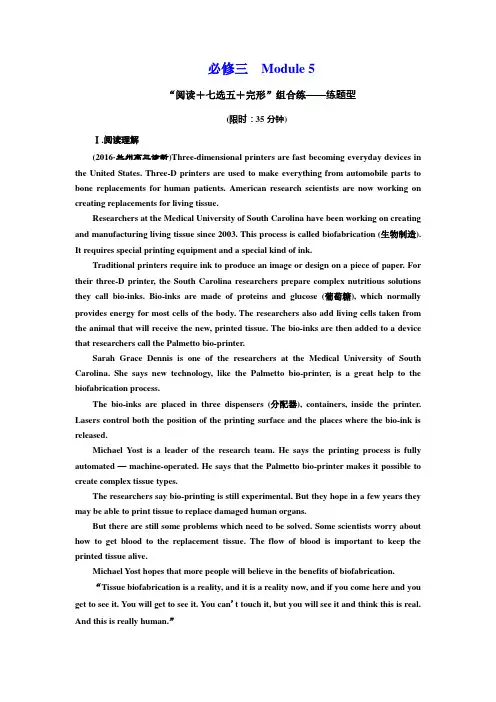
必修三Module 5“阅读+七选五+完形”组合练——练题型(限时:35分钟)Ⅰ.阅读理解(2016·兰州高三诊断)Three-dimensional printers are fast becoming everyday devices in the United States. Three-D printers are used to make everything from automobile parts to bone replacements for human patients. American research scientists are now working on creating replacements for living tissue.Researchers at the Medical University of South Carolina have been working on creating and manufacturing living tissue since 2003. This process is called biofabrication (生物制造). It requires special printing equipment and a special kind of ink.Traditional printers require ink to produce an image or design on a piece of paper. For their three-D printer, the South Carolina researchers prepare complex nutritious solutions they call bio-inks. Bio-inks are made of proteins and glucose (葡萄糖), which normally provides energy for most cells of the body. The researchers also add living cells taken from the animal that will receive the new, printed tissue. The bio-inks are then added to a device that researchers call the Palmetto bio-printer.Sarah Grace Dennis is one of the researchers at the Medical University of South Carolina. She says new technology, like the Palmetto bio-printer, is a great help to the biofabrication process.The bio-inks are placed in three dispensers (分配器), containers, inside the printer. Lasers control both the position of the printing surface and the places where the bio-ink is released.Michael Yost is a leader of the research team. He says the printing process is fully automated — machine-operated. He says that the Palmetto bio-printer makes it possible to create complex tissue types.The researchers say bio-printing is still experimental. But they hope in a few years they may be able to print tissue to replace damaged human organs.But there are still some problems which need to be solved. Some scientists worry about how to get blood to the replacement tissue. The flow of blood is important to keep the printed tissue alive.Michael Yost hopes that more people will believe in the benefits of biofabrication.“Tissue biofabrication is a reality, and it is a reality now, and if you come here and you get to see it. You will get to see it. You can't touch it, but you will see it and think this is real. And this is really human.”语篇解读:本文是一篇说明文。
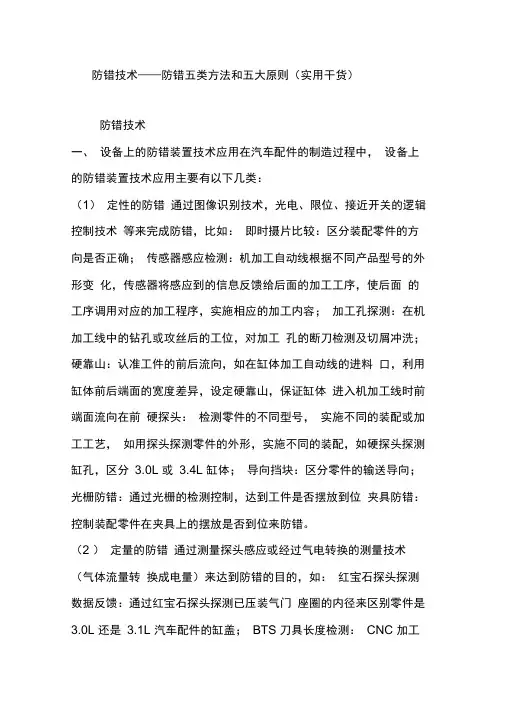
防错技术——防错五类方法和五大原则(实用干货)防错技术一、设备上的防错装置技术应用在汽车配件的制造过程中,设备上的防错装置技术应用主要有以下几类:(1)定性的防错通过图像识别技术,光电、限位、接近开关的逻辑控制技术等来完成防错,比如:即时摄片比较:区分装配零件的方向是否正确;传感器感应检测:机加工自动线根据不同产品型号的外形变化,传感器将感应到的信息反馈给后面的加工工序,使后面的工序调用对应的加工程序,实施相应的加工内容;加工孔探测:在机加工线中的钻孔或攻丝后的工位,对加工孔的断刀检测及切屑冲洗;硬靠山:认准工件的前后流向,如在缸体加工自动线的进料口,利用缸体前后端面的宽度差异,设定硬靠山,保证缸体进入机加工线时前端面流向在前硬探头:检测零件的不同型号,实施不同的装配或加工工艺,如用探头探测零件的外形,实施不同的装配,如硬探头探测缸孔,区分3.0L 或3.4L 缸体;导向挡块:区分零件的输送导向;光栅防错:通过光栅的检测控制,达到工件是否摆放到位夹具防错:控制装配零件在夹具上的摆放是否到位来防错。
(2 )定量的防错通过测量探头感应或经过气电转换的测量技术(气体流量转换成电量)来达到防错的目的,如:红宝石探头探测数据反馈:通过红宝石探头探测已压装气门座圈的内径来区别零件是3.0L 还是3.1L 汽车配件的缸盖;BTS 刀具长度检测:CNC 加工中心刀具检测可防止错误长度的刀具安装在刀库中,防止加工过程中的断刀现象,减少加工首件或加工过程中的废品出现;定位面气孔压力检测:确认工件正确到位的防错措施;泄漏测试:汽车配件如缸盖、缸体的油道以及水道的在线测试等,控制泄漏件流入下道工序;随线检具直径测量:这在机加工自动线中镗孔及铰孔后的工位应用较广,达到100% 控制不合格产品的出现;扭矩控制:汽车配件如很多螺栓固定的拧紧程度均通过扭矩枪来控制。
(3)颤动功能的防错通过颤动机的颤动,使零件随着不断的颤动并输送至判别零件的方向正确与否处,只有零件处于正确的位置方向时,才能进入送料轨道;位置方向错误的零件则掉入零件颤动料箱里,从而达到预防零件的进给方向错误,避免工件报废的目的,如:缸体凸轮轴衬套的方向验证,防止衬套压反;缸体水道闷盖的压装方向防错等。

(完整)JESD22简介+目录JESD22标准定义及意义2. A100循环温湿度偏置寿命JESD22-A100CPublished:Oct—2007 CYCLEDTEMPERATUREHUMIDITYBIASLIFETEST:TheCycledTemperature-humidity—biasLifeTesti sperformedforthepurposeofevaluatingthere liabilityofnonhermeticpackagedsolidstatedevicesinhumidenvironments。
Itemploysconditionsoftemperaturecycling,humidity,andbiasthatacceleratethepenetrationofmoisturethroughtheexternalprotectivematerial(encapsulateorseal)oralongtheinterfacebetweentheexternalprotectivematerialandthemetallicconductorsthatpassthroughit.TheCycledTemperature-Humidity—BiasLifeTestistypicallyperformed oncavitypackages(e。
g。
,MQUADs,liddedceramicpingridarrays,etc.)asanalternativetoJESD22—A101orJESD22-A110.JESD22—A100C 发布:2007 年 10月循环温湿度偏置寿命试验循环温湿度偏置寿命试验以评估非气密封装固态器件在潮湿环境中的可靠性为目的。
它使用循环温度,湿度,以及偏置条件来加速水汽对外部保护性材料(封装或密封)或沿着外部保护材料和贯通其的金属导体的界面的穿透作用。