
2013届高考一轮考点复习提高课件:选修6 Unit1 Art(新人教版)
- 格式:ppt
- 大小:221.50 KB
- 文档页数:13
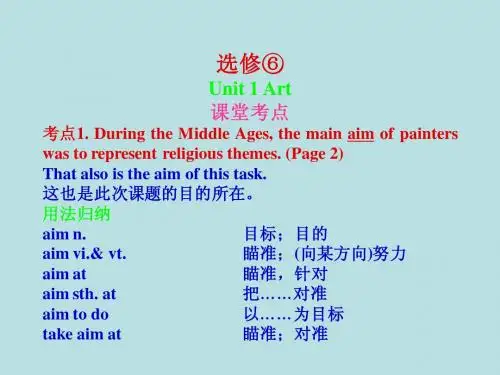

2013届高考英语一轮总复习单元精选资料人教版新课标选修6 Unit1 ArtPart one :单选1.The education program________combining brain work with manual labor is being widely spread throughout the country.A.to aim at B.aims atC.having aimed at D.aimed at2.They will start their project,________at helping the poor children to be educated in the west of China.A.aims B.aimingC.being aimed D.aimed3.—How did you ________the old valuable house?—It used to be________my uncle.He left it to me in his will.A.take possession of;in possession ofB.take the possession of;in the possession ofC.take possession of;in the possession ofD.take the possession of;in possession of4.Of the two paintings,Mr.Black chose the cheaper one out of ________,though it was not the work of a famous painter.A.possession B.techniqueC.adjustment D.preference5. The present situation is very complex,so I think it will take me some time to ________its reality.A.make up B.figure outC.look through D.put off6. —How did you like Nick’s performance last night?—To be honest,his singing didn’t ________to me much.A.appeal B.belongC.refer D.occur7. I recognized her as soon as I met her at the airport though we hadn’t se en each other for ages and she had changed________.A.a large amount B.a great manyC.a great deal D. a lot of8. We will have to work________faster in order to complete our task on time. A.a great deal of B.a great dealC.a great many of D.a great many9.________work has been done to improve the people’s living standard.A.Many B.A great manyC.A great deal of D.A large number of10.I would like a job which pays more,but ________I enjoy the work I’m doing at the moment.A.in other words B.on the other handC.for one thing D.as a matter of fact11.After graduating from college,I took some time off to go travelling,________turned out to be a wise decision.A.that B.whichC.when D.where12. —Let’s go Dutch for this supper,OK?—No,________this time,as a reward for all your help.A.it’s up to you B.it’s my treatC.let’s talk about it D.it doesn’t matter13. The good thing about children is that they______ very easily to new environments. A.adapt B.appealC.attach D.apply14. Now a lot of new technologies can ________ problems in industry.A.be applied to solve B.be applied to solvingC.apply to solve D.apply to solving15. —Does he know which team wins?—No,it makes no________to him which team wins,because he doesn’t care about it at all.A.different B.differenceC.attention D.excuse16. The little boy won’t go to sleep________his mother tells him a s tory. A.or B.unlessC.but D.whether17. It is known to all that________you exercise regularly,you won’t keep good health.A.unless B.wheneverC.although D.if18. She opened her eyes with a start and was abou t to cry out ________ she heard her father urgently telling her to keep quiet.A.while B.whenC.before D.after19. —Where’s that report?—I brought it to you________you were in Mr Black’s office yesterday.A.if B.whenC.because D.before20.—I’ll do the washingup.Jack,would you please do the floors?—________.A.Yes,please B.No,I don’tC.Yes,sure D.No,not at all21.—Do you know if Linda is willing to take charge of the program?—________,does it?A.It takes no time B.It counts for nothingC.It doesn’t hurt to ask D.It doesn’t make sense22.—________?—That woul d be great!Please drop me off at the library.A.Could you bring me the billB.Would you like me to give you a liftC.Could you tell me the postcode for ParisD.Would you like to have my email addres s23.—Excuse me,I wonder if you can help me?—Sure.________?A.What help B.What is thisC.What is it D.What do you want24.—Professor Johnson,I’m afraid I can’t finish the report within this week.—________.How about next week?A.Good for you B.It won’t bother meC.Not at all D.That’s OK25.The global warming,if not properly________,might lead to more natural disasters. A.was controlled B.controlledC.to control D.being controlledPart two :完型填空Terry was a middle-aged leather trader whose repeated failure in career made him a depressed man, often __26_ that he had been cheated by others. One day he told his wife he was so __27__ with the city that he had to leave.So his family moved to another city. It was the evening of a weekend. When Terry and his wife were busily _28_ up their new home, the light suddenly __29_. Terry was regretful to have forgotten to bring along 30__ and had to wait _31_ in a low mood. Just then he heard light, hesitant 32_ on his door that were clearly audible (听到) in the __33__ night.“Who’s it?” he wondered, since Terry was a _34__ to this city. And this was the moment he especially hated to be __35__, so he went to the door and opened it __36_. At the door was a little girl, shyly asking, “Sir, do you have candles? I’m your neighbor. ” “No,” answered Terry in anger and shut the door __37__. “What a nuisance(麻烦事)!” He complained over it with his wife. “No sooner had we settled down than the neighbor came to _38__ things.”After a while, the door was knocked again. He opened it and found the same girl outside. __39_ this time she was _40__ two candles, saying, “My grandma told me the new neighbor downstairs might need candles. She _41_ me here to give you these.” Terry was very _42__ by what he saw.At that moment he suddenly realized what caused his _43__ in life. It was his _44_ and harshness (刻薄) with other people. The person who had cheated him in life was _45__ nobody else but himself, for his eyes had been blurred (蒙蔽) by hisunsympathetic mind.26. A. complaining B. telling C. hoping D. pretending27. A. pleased B disappointed C. exhausted D. encouraged28. A. looking B. turning C. coming D. tidying29 A. went on B. went down C. went out D. went through30. A. candles B. matches C. lights D. flashlights31. A. happily B. patiently C. hopefully D. helplessly32. A. steps B. words C. knocks D. screams33. A. dark B. quiet C. noisy D. crowded34. A. newcomer B. stranger C. guest D. settler35. A. called B. disturbed C. watched D. offered36. A. surprisingly B. delightedly C. impatiently D. willingly37. A. gently B. kindly C. politely D. violently38. A. lend B. sell C. harness D. borrow39. A. And B. But C. So D. For40. A. holding B. hiding C. fetching D. lifting41. A. suggested B. commanded C. sent D. forced42. A. frightened B. pleased C. puzzled D. surprised43. A. failure B. success C. complaint D. determination44. A. warmth B. coldness C. kindness D. nearly45. A. doubtfully B. hardly C. actually D. sympathy (同情)Part three :阅读理解A篇Although men and women have been growing crops for thousands of years, they have not always had enough to eat. Even today, many people in the world go hun gry, and even die of hunger. If we are to grow enough for everybody, we have to grow more crops and better crops.Plants need the right food in order to grow. In particular, they need three chemical substances (物质) in the soil: nitrogen (氮), phosphorus (磷) and potassium (钾). They also need smaller amounts of other chemical substances like calcium. If there is too little of any of these substances in the soil, plants can’t grow well.When a plant grows, it takes up these basic substances from the soil and builds them into itself. If we remove the plant from the soil and use it for food, we are taking some of these substances away, and this means that future plants will find less of them in the soil. In time, the soil would become too poor for plants to grow in it at all.To prevent this we must put basic substances back. One way of doing this is putting manure (肥料) on the soil. This contains the remains of plants that have been eaten, and, if we add it to the soil, we are returning some of the basic substances. In Europe and in Japan, manure from animals has for long been used in this way. Unfortunately much of the animal waste in India is used as fuel because there is not enough wood to burn. This means there is less manure for the crops.Even when we use manure, we can not put back into the soil more of the basicsubstances than have been taken out. Often the soil does not have enough of them in the first place, and so we must provide extra supplies. We can use chemical fertilizers (化肥). Experiments in India have shown that, if we use a fertilizer containing a mixture of nitrogen and phosphorus, we get half as much rice again from the crops on any one piece of land.46. According to the passage, how many methods are introduced to improve the soil?A. One.B. Two.C. Three.D.F our.47. The underlined word “this” (in Paragraph 4) refers to the fact that ____________.A. the soil would become too poor for plants to grow in it at allB. we are taking some substances away from the soilC. the plant takes up these essential substances from the soilD. even today many people in the world go hungry49. To make sure that the soil has enough basic substances, people can _____________.A. remove plants from t he soilB. provide the soil with extra suppliesC. plant as many plants as possibleD. stop planting in the soil50. The passage is mainly about _____________.A. why more food is neededB. how to grow better cropsC. the fact that people have not always enough to eatD. the essential substances that plants needB篇After an earthquake or any similar disaster, parents and teachers need to help children overcome the effects of this frightening and sometimes devastating experience. Psychologists say that if children go through a disturbing event before the age of ten, they are three times as likely to suffer psychological problems as so teenagers. After a disaster children may become easily upset, shy, aggressive,or afraid of wind, rain, noises, o r darkness. They may have trouble letting go of their parents and resist going to school or daycare. Some children may even feel guilty thinking that they somehow caused the disaster through their bad behavior. Because of such common reactions, parents and others should begin as soon after the event as possible helping these children.Some suggestions include talking to the children about what happened, letting the children express their own feelings, spending extra time with them doing activities together and reassuring them that you love them and won't leave them. For some children expressing themselves through drawing pictures or writing can be useful. Do everything possible to help children get back to a normal routine; however, don't be afraid to "spoil" these children for a while after the disaster. Let them have extra privileges and more attention than usual. Encourage the children to grieve after a loss. It should be OK for them to cry. Caring families and friends can do much to heal children victims of disasters.51. This passage is mainly about_______.A. how to help traumatized children to get overB. the bad effects disasters bring to childrenC. the psychological problems children before ten are lik ely to sufferD. the importance of caring families52. According to the passage, a child who has just experienced a devastating disaster may become______.A. more matureB. less dependentC. willing to helpD. ready to attack53. Which is NOT advisable when dealing with the traumatized children?A. Allowing them freedom for some time.B. Asking them to hold their feelings.C. Encouraging them to show their grief.D. Talking them into taking care of others.1-5 DB CDB 6-10 ACBCB11-15 BBABB16-20BABBC21-25CBCDB26-45 ABDCA DCBAB CDDBA CDABC46-53 BABB ADB。

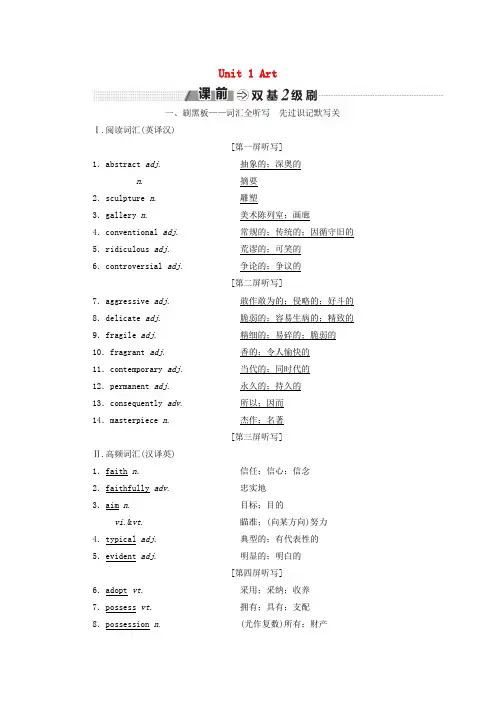
Unit 1 Art一、刷黑板——词汇全听写先过识记默写关Ⅰ.阅读词汇(英译汉)[第一屏听写]1.abstract adj.抽象的;深奥的n. 摘要2.sculpture n. 雕塑3.gallery n. 美术陈列室;画廊4.conventional adj.常规的;传统的;因循守旧的5.ridiculous adj.荒谬的;可笑的6.controversial adj.争论的;争议的[第二屏听写]7.aggressive adj.敢作敢为的;侵略的;好斗的8.delicate adj.脆弱的;容易生病的;精致的9.fragile adj.精细的;易碎的;脆弱的10.fragrant adj.香的;令人愉快的11.contemporary adj.当代的;同时代的12.permanent adj.永久的;持久的13.consequently adv. 所以;因而14.masterpiece n. 杰作;名著[第三屏听写]Ⅱ.高频词汇(汉译英)1.faith n.信任;信心;信念2.faithfully adv. 忠实地3.aim n. 目标;目的vi.&vt.瞄准;(向某方向)努力4.typical adj.典型的;有代表性的5.evident adj.明显的;明白的[第四屏听写]6.adopt vt.采用;采纳;收养7.possess vt.拥有;具有;支配8.possession n. (尤作复数)所有;财产9.superb adj.卓越的;杰出的;极好的10.technique n. 技术;方法;技能11.shadow n. 阴影;影子[第五屏听写]12.attempt n.努力;尝试;企图vt.尝试;企图13.predict vt.预言;预告;预测14.figure n. 画像;身材;数字15.allergic adj.过敏性的;过敏的16.exhibition n. 展览;陈列;展览会17.flesh n. 肉;肌肉;肉体[第六屏听写]18.preference n.喜爱;偏爱19.appeal vi.有感染力;呼吁;求助vt.将……上诉n. 呼吁;恳求20.reputation n. 名声;名誉21.civilization n. 文明;文化;文明社会22.visual adj.视觉的;看得见的[第七屏听写]23.district n.区;区域;行政区24.committee n. 委员会25.signature n. 署名;签字26.specific adj.确切的;特定的27.scholar n. 学者28.avenue n. 林荫道;道路;大街[第八屏听写]29.bunch n.束;串30.coincidence n. 巧合(的事);(事情、口味、故事等)相合31.by_coincidence 巧合地32.a_great_deal 大量33.on_the_other_hand (可是)另一方面34.in_the_flesh 活着的;本人35.appeal_to (对某人)有吸引力; (使某人)感兴趣二、刷清单——热身自盘点再过基本应用关(一)核心单词(二)常用短语(三)经典句式一、过重点单词——纵引横联超人一点1.faith n .信任;信心;信念;承诺[教材原句] Art is influenced by the customs and faith of a people. 人们的生活方式和信仰影响了艺术。

话题26 艺术〔Unit 1 Art〕晨读背诵根底知识自测一、单词拓展(A)根据音标及词义写出英文单词。
1.abstract [ˈæbstrækt] adj.抽象;深奥n.摘要2.faith [feɪθ] n.信任;信心;信念→faithful [ˈfeɪθfʊl] adj.忠实→faithfully [ˈfeɪθfʊlɪ] adv.忠实地3.aim [eɪm] n.目标;目vi. & vt.瞄准;(向某方向)努力4.typical [ˈtɪpɪkl]adj.典型;有代表性5.adopt [əˈdɒpt] vt.采用;采纳;收养→adoption [əˈdɒpʃ(ə)n] n. 采用;收养6.possess [pəˈzes] vt.拥有;具有;支配→possession7.coincidence [kəʊɪnˈsɪdəns] n.巧合(事);(事情、口味、故事等)相合→coincident [kəʊˈɪnsɪd(ə)nt] adj.同时发生;同一时间发生8. attempt [əˈtempt] n.努力;尝试;企图vt.尝试;企图9. predict [prɪˈdɪkt] vt.预言;预告;预测→prediction [prɪˈdɪkʃ(ə)n] n.预言→predictor [prɪˈdɪkt ə] n.预言者10.specific [spɪˈsɪfɪk] adj.确切;特定11.exhibition [eksɪˈbɪʃ(ə)n] n.展览;陈列;展览会12.preference [ˈprefərəns] n.喜爱;偏爱→prefer [prɪˈfɜː(r)] v.喜爱13.appeal [əˈpi:l] vi.有感染力;呼吁;求助vt.将……上诉n.呼吁;恳求14.civilization [sɪvɪlaɪˈzeɪʃ(ə)n ]n.文明;文化;文明社会→civilize [ˈsɪvɪlaɪz] v.使文明;使开化15.visual [ˈvɪʒjʊəl] adj.视觉;看得见16.contemporary [kənˈtempərərɪ ] adj.当代;同时代(B)单词活用用所给词正确形式填空。