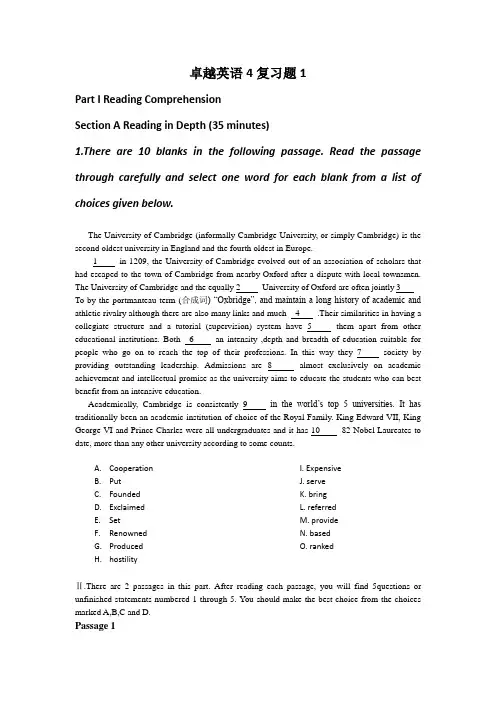
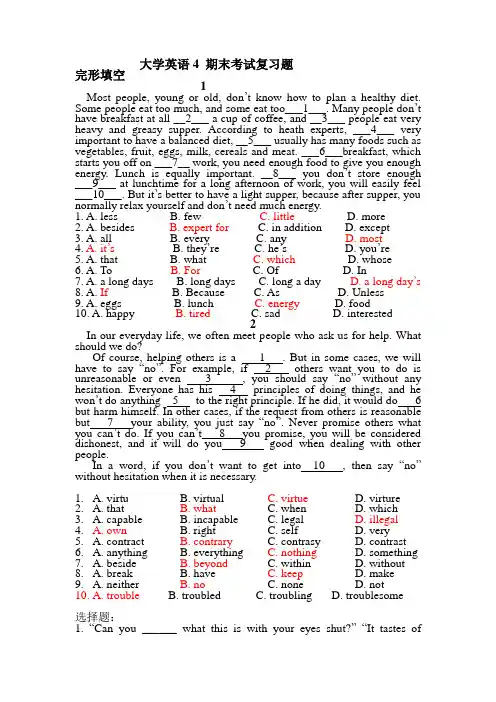
A. CooperationB. PutC. FoundedD. ExclaimedE. SetF. RenownedG. ProducedH. hostility 卓越英语4复习题1Part I Reading ComprehensionSection A Reading in Depth (35 minutes)1.There are 10 blanks in the following passage. Read the passage through carefully and select one word for each blank from a list of choices given below.The University of Cambridge (informally Cambridge University, or simply Cambridge) is the second oldest university in England and the fourth oldest in Europe.1 in 1209, the University of Cambridge evolved out of an association of scholars that had escaped to the town of Cambridge from nearby Oxford after a dispute with local townsmen. The University of Cambridge and the equally2 University of Oxford are often jointly3 To by the portmanteau term (合成词) “Oxbridge”, and maintain a long history of academic and athletic rivalry although there are also many links and much4 .Their similarities in having a collegiate structure and a tutorial (supervision) system have5 them apart from other educational institutions. Both6 an intensity ,depth and breadth of education suitable for people who go on to reach the top of their professions. In this way they7 society by providing outstanding leadership. Admissions are8 almost exclusively on academic achievement and intellectual promise as the university aims to educate the students who can best benefit from an intensive education.Academically, Cambridge is consistently 9 in the world’s top 5 universities. It has traditionally been an academic institution of choice of the Royal Family. King Edward VII, King George VI and Prince Charles were all undergraduates and it has 10 82 Nobel Laureates to date, more than any other university according to some counts.Ⅱ.There are 2 passages in this part. After reading each passage, you will find 5questions or unfinished statements numbered 1 through 5. You should make the best choice from the choices marked A,B,C and D. Passage 1I. Expensive J. serve K. bring L. referred M. provide N. based O. rankedThe Olympic Games are the greatest sports festival in the world, Every four years, a hundred or more countries send their best sportsmen to compete for the highest honors in sport , As many as 6000 people take part in over 20 sports. For the winners, there are gold medals and glory. But there is honor, too, for all who compete, win or lose. In the spirit of the Olympics, to take part is what really matters.The Olympic Games always start in a bright color and action. The teams of all the nations parade in the opening ceremony and march round the track. The custom is for the Greek team to march in first. For it was in Greece that the Olympics began. The team of the country where the Games are being held –the host country –marches in last.The runner with the Olympic torch(火炬) then enters the stadium and lights the flame. A sportsman from the host country takes the Olympic oath (宣誓) on behalf of all trhe competitors. The judge and official also take an oath. After the sportsmen march out of the stadium, the host country puts on a wonderful display.The competitions begin the next day. There are usually more than twenty sports in the Games. The main events are in track and field, but they are held a few days after the Games start. Each day the competitors take part in a different sport-ridding, shooting, swimming, and cross-country running. Points are gained for each event. Medals are awarded for the individual winners and for national teams.More and more women are taking part in the Games. They first competed in 1900, in tennis and golf, which are no longer held in the Olympics.1.Why is there honor for the losers as well as for the winners?A.Because failure is the mother of the success.B.Because losers need encouragement, too.C.Because losers and winners should be equally treated.D.Because what really matters is to take part in the Olympic Games.2.Which of the following is a long-established tradition in the opening ceremony?A.Runners enter the stadium with torchesB.Each team has to put on a wonderful displayC.The Greek team marches in firstD.Men and women wear magnificent clothes3.Who takes the Olympic oath?A. A judge from the host countryB.An official from the host countryC. A Greek sportsmanD. A sportsman from the host country4.What are the most important events in the Olympic Games?A.The track and field eventsB.The horse –riding eventsC.The swimming eventsD.The boat –racing events5.When did women start taking part in Olympic Games?A.In 1912B. In 1900C. In 1928D. In 1924Passage 2The word “recreation”brings to mind activities that are relaxing and enjoyable. Such activitiesas an evening walk around the neighborhood, a Sunday picnic with the family, and playing catch in the yard with the children seem relatively spontaneous and relaxing.Much American recreational activity, however, seems to foreign visitors to be approached with a high degree of seriousness, planning, organization, and expense. Spontaneity and thrift are absent, as far as the visitor can tell. “These crazy Americans!”a South American exclaimed on seeing yet another jogger go past her house in sub –freezing winter weather. Many Americans jog every day, or play tennis, handball, racquetball, or bridge two or three times a weed, or bowl every Thursday night, or have some other regularly scheduled recreation. They go on vacations, skit rips, and hunting or fishing expeditions that require weeks of planning and organizing. In the Americans’ view, all these activities are generally fun and relaxing, or are worth the discomfort they may cause because they contribute to health and physical fitness.Much American recreation is highly organized. There are classes, clubs, contests, leagues, newsletters, contests, exhibitions and conventions centered on hundreds of different recreational activities. People interested in astronomy, bird watching, cooking, dancing, ecology, fencing, gardening, and hiking –and so on –can find a group of like –minded people with whom to meet, learn, and practice or perform.In America, recreation is a big business. Many common recreational activities require supplies and equipment that can be quite costly. Recreational vehicles (used for traveling and usually include provisions for sleeping, cooking, and bathing) can cost as much as 35000 dollars. In 1984 Americans owned approximately 3982000 recreational vehicles, valued at about 7733 million dollars. Jogging shoes, hiking boots, fishing and camping supplies, cameras, telescopes, gourmet cookware, and bowling ball are not low –cost items. Beyond equipment, there is clothing. The fashion industry has successfully persuaded many Americans that they must be properly dressed for jogging, playing tennis, skiing, swimming, and so on. Fashionable outfits for these and other recreational activities can be surprisingly expensive.1.According to the passage, what’s Americans’ attitude towards recreation?A.Absent-mindedB. SeriousC. CriticalD. Skeptical2.How often do Americans bowl?A.Every dayB. Twice a weekC. Three times a weekD. Once a week3.Which of the following is NOT the reason that Americans take to skiing and hunting?A.They are highly organizedB.They are exciting activitiesC.They are relaxing and funD.They are beneficial to their health4.All of the following are true of American recreation EXCEPT_____A.Americans spend a lot of money on recreational vehicles and outfitsB.Most Americans approach recreation with a high degree of spontaneityC.Americans play bridge at least eight times a monthD.Americans take to recreational activities not only for fun and relaxation but also forphysical fitness.5.Why is American recreational industry profitable?A.American recreational products are exportedB.American recreational products are expensiveC.American recreational products are professionalD.American recreational products are well advertisedⅢ. After reading the following passage, you will find 5 questions numbered 1 through 5. Please answer each of the 5 questions in no more than 10 words according to the information given in the passage.In the early days of the Internet, many people worried that as people in the rich world embraced new computing and communications technologies, people in the poor world would be left stranded on the wrong side of a “digital divide”. Yet the debate over the digital divide is founded on a myth-plugging poor countries into the Internet will help them to become rich rapidly.This is highly unlikely, because the digital divide is not a problem in itself, but a symptom of deeper and more important divides of income, development and literacy. Fewer people in poor countries than in rich ones own computers and have access to the Internet simply because they are too poor and illiterate or have other more immediate concerns such as food, health care and security. So even if it were possible to wave a magic wand and cause a computer to appear in every household on earth, it would not achieve very much: a computer is not useful if you have no food or electricity and cannot read. Yet such wand-waving-through the construction of specific local infrastructure projects such as rural telecasters-is just the sort of thing for which the Urn’s new fund is intended.This sort of thing is the wrong way to go about addressing the inequality in access to digital technologies: it is treating the symptoms, rather than the underlying causes. The benefits of building rural computing centers, for example, are unclear. Rather than trying to close the divide for the sake of it, the more sensible goal is to determine how best to use technology to promote bottom-up development. And the answer to that question turns out to be remarkably clear: by promoting the spread not of PCs and the Internet, but of mobile phones.1. What is the main idea of this passage?2. What did the author mean by referring “digital divide”(Line 3, Para. 1)?3. What are the root causes of the digital divide?4. Why does the author think computer and Internet won’t help the poor become rich?5. What is the more sensible method to close the divide?Section B Skimming and Scanning(15 minutes)Go over the passage quickly and mark Y (for YES), N(for NO) or NG(for NOT GIVEN) for questions 1~7, and complete the sentences with the information given in the passage for questions 8~10.If you can read a clock, you can know the time of day. But no one knows what time itself is. We cannot see it. We cannot touch it. We cannot hear it . We know it only by the way we mark itspassing. For all our success in measuring the smallest parts of time, time remains one of the great mysteries of the universe.One way to think about time is to imagine a world without time is to imagine a world without time. There could be no movement, because time and movement cannot be separated. A world without time could exist only as long as there were no changes, for time and change are linked. We know that time has passed when something changes.In the real world –the world with time –changes never stop. Some changes happen only once in a while, like an eclipse of the moon. Others happen repeatedly, like the rising and setting of the sun. Humans always have noted natural events that repeat themselves. When people began to count such events, they began to measure time.In early human history, the only changes that seemed to repeat themselves evenly were the movements of objects in the sky. The most easily seen result of these movements was the difference between light and darkness.The sun rises in the eastern sky, producing light. It moves across the sky and sinks in the west, causing darkness. The appearance and disappearance of the sun was even and unfailing. The periods of light and darkness it created were the first accepted periods of time. We have named each period of light and darkness –one day.People saw the sun rise higher in the sky during the summer than in winter. They counted the days that passed from the sun’s highest position until it returned to that position. They counted three hundred sixty –five days. We now know that is the time the earth takes to move once around the sun. We call this period of time a year.Early humans also noted changes in the moon. As it moved across the night sky, they must have wondered: Why did it look different every night? Why did it disappear? Where did it go?Even before they learned the answers to these questions, they developed a way to use the changing faces of the moon to tell time.The moon was “full” when its face was bright and round. The early humans counted the number of times the sun appeared between full moons. They learned that this number always remained the same –about twenty –nine suns. Twenty-nine suns equaled one moon. We now know this period of time as one month.The divisions of time we use today were developed in ancient Babylonia four thousand years ago. Babylonian astronomers believed the sun moved around the earth every three hundred sixty-five days. They divided the trip into twelve equal parts, or months. Each month was thirty days. Then, they divided each day into twenty-four equal parts, or hours. They divided each hour into sixty minutes, and each minute into sixty seconds.Humans have used many devices to measure time. The sundial was one of the earliest and simplest. A sundial measures the movement of the sun across the sky each day. It has a stick or other object that rises above a flat surface. The stick, blocking sunlight, creates a shadow. As the sun moves, so does the shadow of the stick across the flat surface. Marks on the surface show the passing of hours, and perhaps, minutes.The sundial works well only when the sun is shining. So, other ways were invented to measure the passing of time.One device is the hourglass. It uses a thin stream of falling sand to measure time. The hourglass is shaped like the number eight –wide at the top and bottom, but very thin in the middle. In a true “hour” glass, it takes exactly one hour for all the sand to drop from the top to the bottomthrough a very small opening in the middle. When the hourglass is turned with the upside down, it begins to mark the passing of another hour.By the eighteenth century, people had developed mechanical clocks and watches. And today, many of our clocks and watches are electronic.Some scientists say time is governed by the movement of matter in our universe. They say time flows forward because the universe is expanding. Some say it will stop expanding some day and will begin to move in the opposite direction, to grow smaller. Some believe time will also begin to flow in the opposite direction –from the future to the past. Can time move backward?Most people have no trouble agreeing that time moves forward. We remember the past, but we do not know the future. We know a film is moving forward if it shows a glass falling off a table and breaking into many pieces. If the film were moving backward, the pieces would re-join to form a glass and jump back up onto the table. No one has ever seen this happen except in a film.Some scientists believe there is one reason why time only moves forward. It is a well –known scientific law –the second law of thermodynamics. However, not all scientists believe time is governed by the second law of thermodynamics. They do not agree that time must always move forward. The debate will continue about the nature of time. And time will remains a mystery.1. Although we know how to measure the smallest parts of time, time remains one of the great mysteries of the universe.2. Without movement and change, there will be no time.3. The ancient Egyptians developed the way to use the changing faces of the moon to tell time.4. Ancient people used to believe there are 29 days in a month.5. The hourglass was one of the earliest and simplest devices to measure time.6. Three devices to measure time are introduced in this passage.7. All the scientists believe that time moves forward.8. Ancient people noticed that the only changes that seemed to repeat themselves evenly were_____________________________9. Astronomers in Babylonian time thought that the sun moved around the earth _________________________________10. It takes exactly one hour for all the sand in a true “hour” glass _____________________________________through a very small opening in the middle.Part Ⅱ Cloze (15 minutes)There are 20 blanks in the following passage. For each blank there are four choices marked A,B,C and D. Please choose the one that best fits into the passage.1 forty –three years, the Smithsonian Folk life Festival has been bringing cultures from the United States and from 2The world to Washington, D. C. 3 to this year’s outdoor festival can explore the music, history, art and food of Wales. This small country in the United Kingdom is known 4 its music, sports, beautiful natural areas and ancient history. Visitors to the festival can also 5 the country’s language and industry.Visitors to the Smithsonian Folk life Festival can start their 6 of Wales by learning about its 7 language, Welsh. Welsh is one of the oldest 8 in the world.The Welsh people are serious about language and the 9 word. They 10 competitions to celebrate their language in literature and music. At the Smithsonian 11 ,there is an area forstory tellers to perform. Here, a writer 12 a poem he wrote in Welsh about his grandfather.Wales is also known for its 13 beauty. It has hundreds of lakes and over one thousand kilometers of coastline. The government and organizations work hard to 14 this environment.The festival events also tell 15 Welsh industries. You can see an expert 16 thread out of wool from a sheep. Or you might learn about 17 Welsh building materials like slate. There is also a 18 where Welsh musicians 19 .Finally, no visit to Wales would be 20 without a pub where people can sit down and drink beer.1. A. In B. Suring C. For D. Within2. A. all B. over C. throughout D. around3. A. Passengers B. Visitors C. Guests D. Customers4. A. for B. to C. as D. with5. A. learn B. know C. know about D. learn about6. A. study B. visit C. exploration D. tour7. A. local B. own C. native D. official8. A. languages B. countries C. districts D. counties9 . A. In B. Suring C. For D. Within10. A. hold B. perform C. give D. have11 . A. holiday B. activity C. celebration D. festival12. A. talks B. speaks C. reads D. sings13. A. urban B. rural C. artificial D. natural14. A. reserve B. protect C. preserve D. retain15. A. of B. / C. about D. on16. A. make B. draw C. reel D. spin17. A. modern B. ancient C. traditional D. fashionable18. A. area B. stage C. field D. place19. A. play B. perform C. meet D. work20. A. complete B. satisfying C. pleasant D. interestingPart Ⅲ Translation (5 minutes)Complete the sentences by translating into English the Chinese given in brackets.ernments as well as individuals should_______________________________________(采取一些可行的措施来保护环境)2.if your friends know you are in trouble, they will certainly come to your help._______________________________________ (但是如果他们不知道呢)?3.The speaker’s cheerful and humo rous talk_______________________________________ (使死气沉沉的会议顿添生机)4._______________________________________(他在哈佛大学的经历以及他的多元文化背景)has helped to shape who he is today.5.I had thought that Japanese, which is similar to Chinese in many ways, was easy to learn,_______________________________________(但结果并不是那样)。