
The Oscillation Thing
- 格式:ppt
- 大小:134.00 KB
- 文档页数:21

![英语单词详解系列[高中人教必修3单元2]七十三](https://imgs-1438308264.cos.ap-hongkong.myqcloud.com/059f44466edb6f1afe001f04.webp)
英语单词详解系列[高中人教必修3单元2]七十三breast音标_ _ _ _ _ _ _ _ _ _ _ _ _ _ _ _ _ _ _ _ _ __ _ _ _ _ _ _ _ _ _ _ _ _ _ _ _ _ _ _ _ _ _ _ _ _ _ _ 英[brest] 美[brɛst]释义_ _ _ _ _ _ _ _ _ _ _ _ _ _ _ _ _ _ _ _ _ __ _ _ _ _ _ _ _ _ _ _ _ _ _ _ _ _ _ _ _ _ _ _ _ _ _ _ n. 乳房,胸部;胸怀;心情vt. 以胸对着;与…搏斗短语_ _ _ _ _ _ _ _ _ _ _ _ _ _ _ _ _ _ _ _ _ __ _ _ _ _ _ _ _ _ _ _ _ _ _ _ _ _ _ _ _ _ _ _ _ _ _ _ breast feeding:母乳喂养;喂哺母乳;人乳哺育;喂养母乳breast line:跟胸线;中央系索;横缆;腰缆breast fleece:绒布胸衬;有绒毛的棉布胸衬;热熔衬single breast:单排钮;单工祖Breast Men:双峰英雄;妙手隆胸breast rail:艛栏杆;艛端扶手;船楼侧拦杆;船楼端栏杆Clean breast:盘托出breast nursing:喂母乳;母乳例句_ _ _ _ _ _ _ _ _ _ _ _ _ _ _ _ _ _ _ _ _ __ _ _ _ _ _ _ _ _ _ _ _ _ _ _ _ _ _ _ _ _ _ _ _ _ _ _1.N-COUNT A wo man’s breasts are the two soft, round parts on her chest that can produce milk to feed a baby. (女性的) 乳房例:She wears a low-cut dress which reveals her breasts.她穿着一件低胸露乳的连衣裙。

请老外帮助的10大经典英语句子1.Could you help me with my English ?你能帮助我学英语吗?2.Could you speak a little more slowly ?你可以说慢一点吗?3.How do you pronounce this word ?这个单词怎么发音?4.How do you say this in English ?这个用英语怎么说?5.Please be frank with me about my English .You can be straightforward with me .I won’t be offended .请实话告诉我,我的英语怎么样.你可以直说,我不会生气的.6.Can you read this sentence for me ?你能把这个句子给我读一下吗?7.Could you give me some advice on my pronunciation?听我读一读这些句子,好吗?8.Can you give me some advice on my pronunciation?你能就我的发音提一些建议吗?9.Please correct my mistakes when I speak to you .我跟你说话的时候请纠正我的错误10. Do you have any advice for learning English ?你对学英语有什么建议吗?我与英语有个"误会"(1)1、Could you keep this close to you vest? This is between you and me.[误]把这个贴身存放吗?它在你我之间。
[正]慎重小心些好吗?这是我们之间的秘密。
2、Come on,Jane,shake a leg,or you are going to be late.[误]抖抖腿,简,否那么你就要迟到了。

雅思阅读主题分类整理雅思阅读考试的题材比较多,文章的主题范围也比较广泛。
今天小编为大家带来的是雅思阅读主题分类总结内容,希望帮助到各位考生在备考中结合有效的练习提升阅读水平,在雅思阅读考试中能拿到一个更高的分数。
雅思阅读主题分类整理雅思阅读主题最新分类1。
自然(14篇)(01) V67-2:英国绿色农业(04) V59-2:圣婴现象(ENSO)「圣婴」一词源自西班牙文,(英文翻译为Christ Child),意为上帝之子,是100多年前南美洲秘鲁和厄瓜多的渔民用来称呼发生于圣诞节前后,祕鲁附近海域海温异常偏暖的现象。
科学研究显示不仅和祕鲁附近海温的变化有关,也和热带东太平洋和西太平洋之间的海面气压的分布有关,就以 El Nino Southern Oscillation(简称ENSO)来表示热带太平洋大气和海洋之间的变化,也就是一般所谓的圣婴现象。
(07) V35-2:圣婴现象(10) V29-2:减少闪电危害Reduce lightning hazards(13) V25-1:自然周期与生物(02) V66-1:自然周期与生物(05) V38-3:海沙流失Sea Sand loss(08) V35-2:欧洲森林保育European forest conservation(11) V29-3:南非黄金开采(14) V23-2:探索太空生物(03) V63-1:海底热资源Hydrothermal resources(06) V36-1:热带雨林Tropical rain forest(09) V34-1:火山爆发Volcanic eruptions(12) V28-3:全球气候暖化Global warming2。
科技(14篇)(01) V65-3:海底探测船Submarine spacecraft(04) V36-3:摩斯密码Morse code(07) V35-1:桥梁修复Bridge repairment(10) V55-1:计算雅思阅读主题最新分类_文档下载///b-9c8272c2f90f76c661371a8d.html 机化交通系统Computerized traffic system(13) V28-1:人造丝制造The manufacture of rayon(02) V62-2:澳洲医疗与中医Australian medical and TCM(05) V31-2:电信技术发展The development of telecommunications technology (08) V26-1:染料与颜料Dyes and Pigments(11) V54-2:交通工具发展The development of transport(14) V27-1:房屋构造与用途Housing construction and function(03) V43-3:澳洲皮肤癌Skin cancer in Australia(06) V31-3:非洲交通改革计划African transport reform plan(09) V56-2:信息技术与运输Information technology and transport(12) V53-2:城市交通问卷Urban Transport questionnaire3。
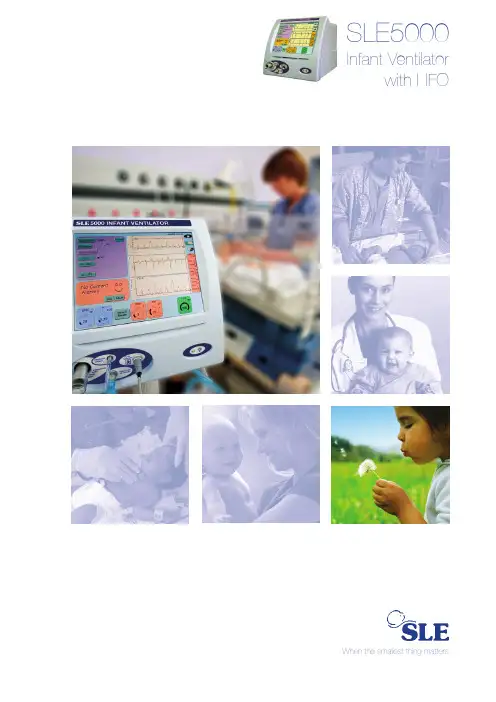
SLE5000 Infant Ventilatorwith HFOWhen the smallest thing mattersSLE5000 - The Total Solution for Infant VentilationShown on optional roll stand.Ventilator may be mountedeither way round on stand. SLE is a world leader in the design and manufacture of neonatalventilators. Years of ventilation experience have given the company an understanding of the challenges facing clinicians when caring for the tiniest and most critical babies.From being pioneers of neonatal Patient Triggered Ventilation (PTV) in the 1980’s, to the introduction of combined HFO (High Frequency Oscillation) in the 1990’s, SLE has maintained a position of leadership in neonatal ventilation.The company’s guiding principle is to support clinical and nursing staff in their everyday work. SLE has developed close relationships with leading universities, hospitals and other specialists and has created a ventilator that meets the highest standards using innovative solutions to clinical challenges.The knowledge and experience gained during years of development is evident in the SLE5000 ventilator: the result of SLE’s ongoing commitments to innovation, competency and care.Modes include: CPAP, CMV+ TTV, PTV, PSV, SIMV+ TTV + PSV, HFO, HFO+CMV• Ability to preset parameters in all modes of operation• Powerful HFO with active expiration to cover a wide range of patients• Full colour, total touch-screen operation• Integral flow monitoring measuring lung mechanics and displaying of loops and waveforms• Trending of measured parameters• Standard patient circuit for all modes including HFO (except with NO therapy)• Unique, patented valveless technology• Integral battery with up to 60 minutes operating capability• Software based, allowing for upgrading to versions with new or improved functionsTargeted Tidal Volume (TTV)There is increasing clinical evidence to suggest that it is volutrauma that causes lung injury, which is worsened by barotrauma. It is also evident that efficient gaseous exchange is dependant on the delivery of appropriate tidal volumes.Targeted Tidal Volume enables the user to select a target volume that they wish to achieve, allowing the ventilator to adjust PIP and Ti to achieve and maintain the selected tidal volume.Main benefits of TTV:• Reduction in volutrauma• A stable tidal volume accommodating changes in resistance and compliance• A more stable PaCO 2,at the lowest possible pressure resulting in reduced episodes of hypocapnia and hypercapnia • Reduction in barotrauma • Ability to self weanPressure Support Ventilation (PSV)In this mode of ventilation the infant has the ability to trigger andterminate every breath. The main aim of PSV is to reduce the ‘work of breathing’ (WOB) in the spontaneously breathing infant.Main benefits of PSV:• Reduced WOB• Improved infant/ventilator synchrony • Reduced need for sedation• Retraining of respiratory musculature • Reduced time to weanPSV is designed and used in the weaning process and can be used with or without Synchronous Intermittent Mandatory Ventilation (SIMV).High Frequency Oscillation (HFO)In the SLE5000, HFO is powerful enough to cater for a wide range of patients from 300 g to 20 kg, dependant on lung mechanics. The SLE5000 provides sinusoidal ventilation with active expiration.Main benefits of HFO:• Improves ventilation at lower pressures• Higher levels of PEEP can be used without having to use high peak airway pressures to maintain appropriate levels of CO 2• Produces more uniform lung recruitment • Reduces airleaks• Improved oxygenation in infants with severe RDSWithout flow terminationWith flow terminationAdvanced Ventilator FeaturesFeatures and FunctionsAudible and Visual AlarmsThe alarm panel provides an immediate audible and pictorial view of thelast 100 conditions.Pre-Setting FacilityParameters can be preselected for the next mode whilst continuing to ventilate the patient in the current mode of ventilation.User Interfacesequence allowing quick, smooth adjustments.Mode PanelThe mode panel is the user’s interface to all mode related functions.Patient Circuit Connections Front panel mounted patient circuit connections with(autoclavable) exhalation block.Principles of operation of the SLE5000 valveless systemA constant flow of fresh gas is supplied to the patient circuit at 8 lpm. The expiratory manifold has three jets (➊, ➋ and ➌). The front jet (➊) is used to generate an opposing flow to the fresh gas in the exhalation manifold and thereby creates CPAP/PEEP .The rear jet (➋) is used to generate the Peak Inspired Pressure (PIP) in the same way.A third (reverse) jet (➌) is used during High Frequency Oscillation (to produce an active negative pressure) in addition to helping eliminate excess circuit pressure.To avoid gas dilution these jets are supplied with the same oxygen concentration as the fresh gas supply. Sophisticated software controls the rate and duration of the flow of driving gas into the exhalation manifold in opposition to the fresh gas flow. The opposing flow acts as a pneumatic piston and creates a pressure wave at the ET manifold.Since the opposing flow pressure is set by pressure regulators it automatically compensates for patient and circuit compliance changes.Simulated PictureGraphic SelectReal-time Data Display Real-time lung mechanics measurements and ventilatory data.This allows for continuous feedback for making crucial clinical decisions.Night Mode and Screen Lock A low-level light mode for night time environments with automaticscreen locking.Auto activation on an alarm condition.Screen PauseFreezes waveforms for review.How does it work...?➊➋➌Exhalation blockThe illustration shows the exhalation block removed from its mountings in the ventilator. When replaced, the jets (➊ and ➋) can create a positive pressure on flow from the patient circuits’s expiratory limb. Jet ➌ is used to create a negative pressure and gives true active expiration.Since there are no valves or other blockages in the system, there is minimal resistance to the patient.Fewer moving parts means there is less to clean and less risk in terms of wrong assembly or infection.BC5188/100Single use breathing circuit for use with SLE4000 andSLE5000 infant ventilators. Temperature port 100 mm fromET manifold (single use). Circuit comes complete with filter connection kit and adaptors.Sold in box quantity of 15BC5188/400Single use breathing circuit for use with SLE4000 andSLE5000 infant ventilators. Temperature port 400 mm fromET manifold (single use). Circuit comes complete with filter connection kit and adaptors.Sold in box quantity of 15BC5288/DHWDual heated wire breathing circuit for use with SLE4000 andSLE5000 infant ventilators. Temperature port 400 mm fromET manifold (single use). Circuit comes complete with filter connection kit and adaptors.Sold in box quantity of 15BC5488/DHWDual heated wire smooth bore breathing circuit for use withSLE4000 and SLE5000 infant ventilators. Temperatureport 170 mm from ET manifold (single use). Circuit comes complete with filter connection kit and adaptors.Sold in box quantity of 15SLE5000 Patient CircuitsBC6216Nitric Oxide delivery kit, set of connectors (Paediatric delivery).BC2508Nebuliser kit (Paediatric delivery).BC4110/KITNitric Oxide adaptor kit for BC5188/100 and BC5188/400 breathing circuits (SLE4000 and SLE5000 infant ventilators).Sold in box quantity of 5BC4110/ASYNitric Oxide dual hose scavenging filter assembly for SLE4000 and SLE5000 infant ventilators.Sold in box quantity of 1Ventilation Modes: Conventional CPAP / PTV / PSVInspiratory Time: 0.1 to 3.0 sec CPAP Pressure: 0 to 20 mbar Inspiratory Pressure: 0 to 65 mbar Volume Targeting: 2 to 200 mlFiO2: 21% to100%CMV / SIMVBPM: 1 to 150I:E Ratio: (11.2:1 to 1:600) Inspiratory Time: 0.1 to 3.0 sec PEEP Pressure: 0 to 20 mbar Inspiratory Pressure: 0 to 65 mbar Volume Targeting: 2 to 200 mlFiO2: 21% to 100% Ventilation Modes: HFO Ventilation HFO OnlyFrequency Range: 3-20 HzI:E Ratio: 1:1Delta Pressure range: 4 to 180 mbar Mean airway range: 0 to 35 mbarFiO2: 21% to 100% HFO+CMVBPM: 1 to 150 Inspiratory Time: 0.1 to 3.0 Frequency Range: 3-20 HzI:E : (11.2:1 to 1:600) Inspiratory Pressure: 0 to 65 mbar Delta Pressure range: 4 to 180 mbar Mean airway range: 0 to 35 mbarFiO2: 21% to 100% Monitoring Parameters Measurement of Flow and Volume Flow Sensor Type: 10 mm dual-hot-wire anemometer (autoclavable or single use)Flow Rate: 0.2 to 32 lpm(Accuracy ±8%) Expiratory TidalVolume: 0 to 999 ml Expiratory MinuteVolume: 0 to 18 litres Deadspace: 1 mlWeight: 10 g Conventional Ventilation and combined modes only:Tube Leakage: 0 to 50% (Resolution: 5%, averaged over 5 breaths) Breath Rate (total): 0 to 150 BPM Dynamic Compliance: 0 to 100 ml/mbar (Resolution: 1 ml/mbar)C20/C: Resolution 0.1 Sampling Time: 2 ms Resistance: 0 to 1000 mbar.second/l Triggering: Inspiratory flow(0.2 to 10 lpm)The above values are measured under ATPD (ambient temperature and pressure, dry) conditions.Oxygen ConcentrationRange: 21 to 100%(Resolution 1%)PressureReal-time Pressuremeasurement: Resolution 1 mbarSampling time: 2 msPeak Pressure: 0 to 175 mbar(resolution 1 mbar)PEEP Pressure: 0 to 175 mbar(resolution 1 mbar)Mean Pressure: -175 to 175 mbar(resolution 1 mbar)In HFO combined mode, Delta P ismeasured during expiration onlyUser Settable alarmsHigh PressureAutoset when patient pressure controls areadjusted or can be manually adjustableRange: 10 to 110 mbarResolution: 0.5 mbarCycle FailAutoset when patient pressure controls areadjusted or may be manually adjustedLow PressureAutoset when patient pressure controls areadjusted or can be manually adjustableRange: -10 mbar(Conventional)-70 mbar(HFO modes) to10 mbar belowhigh pressurethresholdLow Tidal VolumeRange: 0 to 200 mlResolution: 0.2 mlLow Minute VolumeRange: 0 to 0.02 litresbelow High MinuteVolume thresholdResolution: 0.1 litreHigh Minute VolumeRange: 0.02 to 18 litresResolution: 0.1 litreApnoea timeSettable only in CPAP or when Backuprate is less than 20 BPMRange: 3 to 60 secResolution: 1 secondPower, Dimensions, Standards etc.Power RequirementsVoltage : 100-250 V50-60 HzPower : 115 VABattery back up: 45-60 minutes(dependant on mode of operation)Battery charging: Full charge 24hours, 80% charge after 8 hoursOutputsRS-232CAir and O2inputPressures: 3-5 barFresh Gas Flow: 8 litres/minMaximum gas flow: 60 litres/minOperating EnvironmentTemp: 10-40 ºCHumidity: 0-90%(non-condensing)DimensionsSize, ventilator only: 330mm W x330mm H x470mm DHeight on short stand: 114 cmHeight on tall stand: 131 cmWeight, ventilator only: 21.8 kgConstructed to conform to:BS EN 475:1995BS EN 60601-1:1990BS EN 60101-1-2:1993BS EN 60601-1-4: 1996BS EN 60601-1-12:2006Medical Devices Directive (93/42/EEC)European conformity mark: CE 0120Environmental storage conditionsWhen packed for transport or storage:Ambient Temperature: -40 °C to +70 °CRelative Humidity : 10% to 90%(non-condensing)Atmospheric Pressure: 500 hPa to1060 hPaTechnical SpecificationSLE Limited.Twin Bridges Business Park, 232 Selsdon Road,South Croydon Surrey CR2 6PL UKTelephone:+44 (0)20 8681 1414 • Fax: +44 (0)20 8649 8570E-mail: sales@ • Web: CSD0006/Issue 1。