
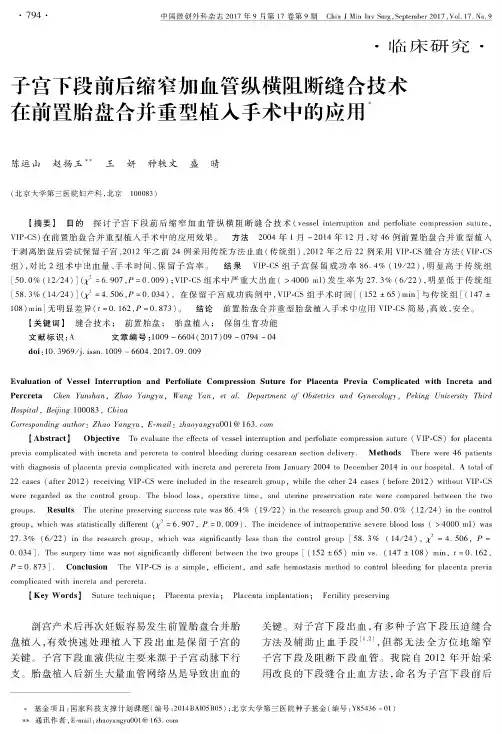
子宫下段前后缩窄加血管纵横阻断缝合技术在前置胎盘合并重型植入
- 格式:pdf
- 大小:1.21 MB
- 文档页数:4

2021前置胎盘的诊断与处理指南(2020版)
前置胎盘是一种妊娠晚期常见的并发症,容易引起出血和早产等问题,因此对其诊断和处理非常重要。XXX于2013年发布了“前置胎盘的临床诊断与处理指南”,并在2020年进行了更新。本文将介绍前置胎盘的定义、分类、高危因素以及临床表现。
一、前置胎盘的定义
前置胎盘是指胎盘下缘毗邻或覆盖子宫颈内口。应在妊娠28周后诊断前置胎盘,因为妊娠中期发现的胎盘前置常因胎盘“移行”而发生变化。妊娠中期诊断的低置胎盘,妊娠晚期可移行至正常位置;胎盘覆盖子宫颈内口的范围>15 mm,分娩时前置胎盘的可能性较大。需要特别注意的是,既往有剖宫产术史的孕妇,前置胎盘的风险增加3倍。
二、前置胎盘的分类
为了使分类简单易行,本指南推荐将前置胎盘分为两种类型:前置胎盘和低置胎盘。前置胎盘包括完全性和部分性前置胎盘,胎盘完全或部分覆盖子宫颈内口。低置胎盘是指胎盘附着于子宫下段,胎盘边缘距子宫颈内口的距离<20 mm。需要注意的是,前置胎盘的分类可随妊娠及产程的进展而变化,建议以临床处理前的最后1次检查来确定其分类。
三、前置胎盘的高危因素
前置胎盘的高危因素包括流产、宫腔操作、产褥感染,既往前置胎盘、既往剖宫产术等病史,多胎、多产、高龄、吸烟、摄入可卡因、辅助生殖技术等。既往剖宫产术史增加了前置胎盘的发生风险,且风险与剖宫产术的次数呈正相关。因子宫内膜异位症或输卵管因素采取辅助生殖技术治疗的孕妇发生前置胎盘的风险明显升高。
四、前置胎盘或低置胎盘的临床表现
前置胎盘或低置胎盘的临床表现包括出血、腹痛、胎动减少或消失等。需要及时进行诊断和处理,以避免出血和早产等并发症的发生。对于前置胎盘的处理,应根据具体情况进行选择,如保守治疗、剖宫产或紧急剖宫产等。
对于胎盘广泛位于子宫前壁的情况,可以选择子宫下段及体部斜切口或子宫底部横切口进行手术。在胎儿娩出后,需要立即使用止血带捆扎子宫下段,并使用宫缩剂帮助子宫收缩。剥离胎盘时需要避免暴力,采用各种缝合止血技术,如子宫下段防波堤样缝合术、编织样缝合成形术、子宫下段环形蝶式缝合术、子宫下段前后缩窄加血管纵横阻断缝合术、子宫下段多方位螺旋缝合成形术、漏斗加压缝合术等方法止血。手术过程中需要注意孕妇失血及流血情况,随时了解孕妇生命体征,若采取各项止血措施均无效时应果断切除子宫。术后需要严密监测孕妇的身体状况,包括心肺等重要器官的功能、腹腔、流血情况、血常规、凝血功能、尿常规、电解质等。对于低置胎盘孕妇在进行试产时,需要做好行紧急剖宫产术和输血的准备,建议在有条件的医疗机构备足血源,严密监测下行试产。在产程中需要密切注意胎心变化,必要时采用连续胎心电子监护,若产程进展不顺利,应立即改行剖宫产术。

• 12
•实用妇产科杂志 2021
年 1
月第 37
卷第 1
期如q/ C.y7im
,/og.v 2021
■/肌 Vol. 37, \o. 1
区域,识别子宫颈内u
并利用周围健康的子宮肌层组
织进行子宵修复的手术。2012年Chandraharan等提
出了针对胎盘植入避免子宫切除的“Triple-P”手术方
法,“Triple-P”法是一种PAS新型子宫保留法,H的是
避免切开血管性胎盘静脉窦,切除伴有PAS组织的子
宫肌层,并重建子宫。
我国生育政策的实施,人们有生育要求及保留子
宫的意愿增多,需要不断探索能够保留生育功能的微
创治疗方式,如血管介入技术、H1FU等。对于PAS患
者,只有在经过专业团队洋细的风险评估、不确定的
益处和疗效咨洵,并知情选择情况下,选择合适的保
守治疗方式,N
时需要确保定期复查和急沴救治,以
防患者出现并发症。子宫保守手术只能由具备相应
技术专业的团队进行
,一个由多学科构建的团队协作
干预处理PAS能够显著降低PAS相关并发症的发生
率,并最终降低孕产妇的病死率。
参考文献
[1 ] Durukan H.Dumkan OB.Giirkan YF. Placenta accreta spectrum dis
order^ comparison between fertility-sparing techniques and hysterec
tomy [ J/OL]. Journal of Obstetrics and Gynaecology, [ 2020-06-05 ].
https:///10. 1080/01443615.2020. 1755629.
[2 | Jauniaux E, Alfirevic- Z,Bhide AG,et al. Placenta praevia and placen
ta accreta:diagnosis and management [J/OI. . BJOG ,[ 2018-09-27 ].

介入放射学杂志2013年12月第22卷第12期J Intervent Radiol 2013,Vo1.22,No.12
・临床研究 Clinical research・
腹主动脉阻断联合子宫动脉栓塞在九例前置胎盘并
胎盘植入剖宫产手术中的应用
杨厚林, 唐 仪, 方主亭, 陈良生, 吴少杰
【摘要】 目的探讨球囊低位临时阻断腹主动脉联合双侧子宫动脉栓塞控制前置胎盘合并胎盘植 入术中出血的效果。方法2010年6月一2Ol3年3月9例前置胎盘合并胎盘植入患者剖宫产手术过程 巾应用球囊低位临时阻断腹主动脉联合双侧子宫动脉栓塞(球囊组),并与2008年3月一2010年5月8 例未行血管阻断的前置胎盘合并胎盘植入患者(对照组)进行比较,比较术中出血量、输血量、子宫壁缝 合时间。结果球囊组术中出血量(786±135)ml, 血多在球囊阻断之前,输血量(422±83)ml,子宫壁 缝合时间(27.9±6.9)min,球囊阻断时间(27.9±6.9)min。无明显并发症发生。对照组术中}}{血量(3 181± 387)ml,输血量(1 487±333)ml,子宫壁缝合时间(67.4±l5.4)rain。两组间出血量、输血量、子宫壁缝合 时间差异有统计学意义(P<0.05)。结论球囊低位临时阻断腹主动脉联合双侧子宫动脉栓塞技术能有 效减少前置胎盘合并胎盘植人术中出血,是一项有临床实用价值的微创技术。 【关键词】前置胎盘;胎盘植入;球囊;栓塞;出血 中图分类号:R714.43文献标志码:B文章编号:1008—794X(2013).12—1036—03
The clinical application of occlusion of the lower abdominal aorta combined with uterine artery embolization in treating placenta previa associated with placenta accreta:initial experience in 9 cases YANG Hou—lin,TANG Yi,FANG Zhu—ting,CHEN Liang—sheng, 『,Shoo—fie.Department of Interventional Radiology,Fujian Provincial Hospital,Fuzhou,Fujian Province 350001,China Corresponding author:FANG Zhu—ting,E—mail:411601072@qq.COBb 【Abstract】Objective To investigate the effect of temporary balloon occlusion of the lower abdominal aorta combined with bilateral uterine artery embolization in controlling bleeding during the treatment of placenta previa with placenta acereta.Methods From June 2010 to March 2013 a total of 9 cases of placenta previa with placenta aecreta were treated with temporary balloon occlusion of the lower abdominal aorta as well as bilateral uterine artery embolization(balloon group).Another eight cases of placenta previa with placenta acereta,who were encountered at authors’hospital during the period from March 2008 to May 2010 and did not receive balloon occlusion of the lower abdominal aorta,were used as control group.The anlount of blood loss and blood transfusion,and the time used for uterine suture were determined.The results were compared between the two groups.Results The amount of blood 1OSS and blood transfusion,and the time used for uterine suture in the balloon group were(786±135)ml,(422±83)ml and(27.9±6.9)min respectively,while those in the control group were(3 181-4-387)ml,(1 487±333)ml and(67.4±15.4) rain respectively.The differences between the two groups were statistically significant fP<0.05).Conclusion Temporary balloon occlusion of the lower abdominal aorta combined with bilateral uterine artery embolization can effectively reduce the amount of blood loss in treating placenta previa with placenta aecreta.This technique is minimally—invasive and clinically—practica1.(J Intervent Radiol,2013,22:1036—1038) 【Key words】placenta previa;placenta aeereta;balloon;embolization;bleeding

・436・ 国际妇产科学杂志2011年10月第38卷第5期 JIntObstetGynecol,October 2011,Vo1.38,No.5
子宫下段横形环状压迫缝合术治疗中央性前置胎盘
剖宫产后出血
包怡榕应 豪 黄一颖 庄绿怡 王德芬 ・论著・
【摘要】 目的:探讨子宫下段横形环状压迫缝合术(TACS)治疗中央性前置胎盘剖宫产时子宫下段胎盘剥 离面出血的止血效果。方法:回顾性分析2006年1月一201O年12月满足研究入选条件的中央性前置胎盘患者 60例,分为宫腔纱条填塞组(UP组,24例)和TAcs组36例。比较两组出血量、干预时间、有效率等。结果:①uP 组和 I CS组分娩时妊娠周、新生儿出生体质量、前壁胎盘比例和胎盘粘连比例差异均无统计学意义(均P> 0.05)。②两组缩宫素使用量差异无统计学意义(P>0.05),但是uP组的欣母沛使用量显著多于TACS组-(P< 0.05)。③两组产前出血比例、产前出血量差异无统计学意义;但uP组干预前出血量、干预时出血量、干预后出血 量和剖官产期间总出血量显著高于TACS组,差异有统计学意义(均P<0.01)。UP组输血百分比显著高于TACS 组(P<0.01),输血量也多于TACS组(P<0.05)。④uP组干预时间显著长于TACS组(P<0.01);两组止血成功率 分别为91.7%和97.2%,差异无统计学意义(P>0.05)。@rACS组的抗生素使用时间和术后住院时间显著短于uP 组(均P<0.01)。结论:TACS是治疗中央性前置胎盘剖官产时子宫下段胎盘剥离面出血的简便、有效、快速的方法。 【关键词】前置胎盘;剖官产术;产后出血;缝合技术;治疗
Clinical Research on Transverse Annular Compression Sutures in the Lower Uterine Segment to Control Post- partum Hemorrhage at Cesarean Delivery for Complete Placenta Previa BAO Yi-tong,YING Hao,HUANG Yi- ying,ZHUANG胁g-yi,WANG De fen.Department ofObstetrics,Shanghai First Maternity and Infant Hospital,Tonal University,School ofMedicine,Shanghai 200040,China Correspondingauthor:YING Hao,E-mail:stephenying2Oll@gmail.com 【Abstract】Objective:To evaluate the efficacy oftransverse annular compression sutures(TACS)in the lower uterine segment in achieving homeostasis to control bleeding during cesarean delivery in women with complete placenta previa (CPP).Methods:Retrospectively analyze 60 cases who met the inclusion criteria with CPP during 2006.January to 2010,December.Allthe patientswere dividedintotwo groups:subsequent administration ofeitheruterine packing(UP)or TACS.Blood loss,intervention time,and clinical efficacy were compared.Results:①There was no statistic difference between the UP group and the TACS group in gestational age at delivery,birth weight,the proportion of anterior placenta and the incidence of placenta accreta(P>0.05).②No diference was found between the groups in oxytocin dose(P> 0.05).However,carboprost usage amount was much more in the UP group(P<0.05).⑧No diference was f0und between the groups in percentage of ante partum hemorrhage and the blood loss of antepartun.But there was greater blood loss in the UP group compared with the TACS group before the intervention,during the intervention,after the intervention,and throughout the cesarean delivery procedure(P<0.01).The percentage and quantity of blood transfused was also signifi— cantlyhigherintheuP groupthanintheTACS group(P<0.05 orP<0.01). ̄Thetimetakent0performtheuterine packing was significant longer than the time taken to perform TACS(P<0.05).The Success rates were 91.7%and 97.2%for UP and TACS,respectively(P>0.05).⑧Antibiotics using time and post—operative hospitalization time was significantly shorter in the TACS group than in the UP group(P<0.01).Conclusions:TACS appears to be a simple,effective and quick method in achieving homeostasis in women with CPP during cesarean delivery. 【Key words】Placenta previa;Cesarean section;Postpartum hemorhage;Suture techniques;Therapy (I,/nt Obstet Gynecol,201 1,38:436-438)