柯大观-信号与系统课件1(公办)
- 格式:ppt
- 大小:2.80 MB
- 文档页数:47


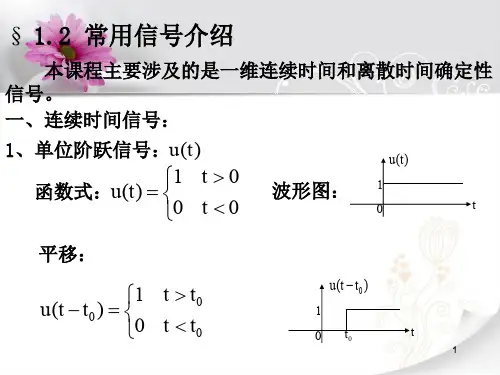
The CT Unit Step and Unit Impulse Functions The CT Unit Step and Unit Impulse Functions⎧The CT unit step function⎨><=00)(t t u ⎩01t The unit step is discontinuous at =0The unit step is discontinuous at t = 0.(单位冲激)Sampling property of the CT Unit Impulse-=-∞∞t 000()()()()f t t t f t t t δδ()(0)()()t f dtt f t dt δδ-∞∞-∞===⎰⎰)(f )0(f (0)(0())f dt f t δ-∞⎰0d ∞t00()()()t t f t dt f t δ-∞-=⎰i i Si C C i Building-Block Signals Can Be Combined to Make a Rich Population of Signals(因果的)(反因果的)σ>Example1-+()(4)x t e t δ=Answer:Example()0()0t t t δδ=⨯=×0ata --==()()()e t et t δδδ∞∞-----313011()()t et dt et dt eδδ⨯-∞-∞==⎰⎰Examples .Calculate the following integrals 0()()x t t t dt δ∞-∞-⎰1)0()x t =t ω∞-2)0[()()]j t t t dt eδδ-∞--⎰)0()()j t j t t dt t t dt e e ωωδδ∞∞---∞-∞-=--⎰⎰01j t e ω=-121(f)122()HW :1.21(f), 1.22(e)ConclusionsSignal categories —dimensionality, CT & DT, real & complex, periodic & aperiodic, causal & anti-causal, energy & power, even & odd, etc.Building block signals —complex exponentials and impulse functions (can be superimposed to represent virtually any signal of physical interest, to be illustrated in later chapters).I t d ti t S tIntroduction to SystemsOutline:Interconnection of systemsInterconnection of systemsDynamic analogies of systemsPhysical problem → mathematical model → solution →physical interpretationphysical interpretationProperties of systemsInterconnection of SystemsSeries (串联),System1System2,cascade (级联)System1+Parallel (并联)System2Block diagram (方框图)System1System2System3System4+Hybrid (混联)System1+Feedback (反馈联结)S t 2System2Many real systems are built as interconnections of several y ysubsystemsWe can synthesize complex systems out of simpler, basic We c sy es e co p e sys e s ou o s p e ,b s c building blocksExample -Robot CarRobot Car Block DiagramRobot Car Block DiagramComplex man-made systems are often built upon hierarchically divided blocks (modules).hi hi ll di id d bl k(d l)Block input/output relations provide communication mechanisms for team projects.mechanisms for team projectsDynamic Analogies of SystemsDynamic Analogies of Systems Method: physical problem→mathematical model→solution→interpretation 1. CT system:Mechanics -Summing Element ForcesCircuit -Summing Element CurrentsCT System Representation:Differential Equation –Analogous dynamics for mechanical and electrical CT System Representation: Differential Equation systemsConclusions:⏹Dramatically different physical systems can be modeled with substantially identical system equations.I d i i h d l i l l f ⏹In order to investigate the underlying general rules, we often focus on mathematical analysis with the concrete physical implications dropped implications dropped.2、DT system:Population ProblemDT P l i P bly[k] = y[k-1] + ay[k-1] –by[k-1] + f[k][k]: immigrant population y[k]: population of the k th year f]i i t l ti]l ti f thk: year no. a: birth rate b: death rateThis is a first order difference equation:This is a first-order difference equation:y[k] –(1 + a–b)y[k–1] =f[k]Conclusion:Difference equations can be used as mathematical models of DT systems.HW: 1.46p yProperties of Systems Memoryless system(无记忆系统), system without memoryIdentity:system(恒等系统):y(t) = x(t) or y[n] = x[n] at any time.Memory system(记忆系统), system with memoryIs y[n] = x[2n] an invertible system?]]i ibl?Causal and Noncausal Systems (因果与非因果系统)系统Causal or not?n x n =-RLC circuits [][]y RLC circuits ×√[][][1]y n x n x n =-+[][][1]y n x n x n =--×√()(2)y t x t =[][]n k y n x k =-∞=∑×√Observations on CausalityObservations on Causality•All real-time physical systems are causal, because time only moves forward. Consequences occur after causes. (Imagine if you own a noncausal system whose output depends onif you own a noncausal system whose output depends ontomorrow’s stock price.)•Systems processing spatially varying signals do not have to be causal. (We can move both left and right, up and down.)•Causality also does not apply to systems processing recordedg g p p gsignals, e.g. taped sports games vs. live broadcast.Stable and Unstable Systems(稳定与不稳定系统)系统A system is (BIBO)stable if every b ounded i nput leads to a b ounded o utput.Stable or not?[][]nk y n x k =-∞=∑()()t y t x d ττ-∞=⎰××[][1]y n x n =-()()y t tx t =×√Time-Invariance (TI)•For DT: A system x [n ] → y [n ] is time-invariant (时不变的)if for any input x n ] and any time shift n ,不变的y p []y 0,Similarly a CT system ))is time invariant ifx [n –n 0] →y [n –n 0]•Similarly, a CT system x (t ) →y (t ) is time-invariant if for any input x (t ) and any time shift t 0,)x (t –t 0) →y (t –t 0)E lExamplei O iFact:If the input to a TI System is periodic then the output is Interesting Observation Fact: If the input to a TI System is periodic, then the output is periodic with the same period.“Proof”: Suppose x (t + T ) = x (t )and x (t ) →y (t )Then by TIx (t + T ) →y (t + T )So these must be ↑↑These are the So ese us be the same output,i.e., y (t ) = y (t + T ).ese e esame input!Linear SystemsLinear Systems(线性系统)f i SKey Property of Linear Systems SuperpositionIfThenExampleExample -Multiplier×Multiplier linearityp yMultiplier –time varying1Example –constant additionIncrementally Linear System y y(增量线性系统)zero-input response(零输入响应)0()y t linear system ()x t ()w t ()y t linear systemzero-state response(零状态响应)零状态响应0()y t ⊕linear system()x t ()w t ()y t B AB110()()()x t w t y t −−→+B220()()()x t w t y t −−→+effective 2121()()()()()()x t x t x t y t w t w t ∆=-−−−→∆=-A-−−-Equivalence in effect 2121()()()()x t x t w t w t →Linear Time-Invariant(LTI)SystemsLinear Time-Invariant (LTI) Systems(线性时不变系统)•Main focus of our course-Practical importance-The powerful analysis tools associatedwith LTI systems• A basic fact: If we know the response of an LTI system toA basic fact:If we know the response of an LTI system tosome inputs, we actually know its response to many inputsExample DT LTI System Example –DT LTI SystemProperties of LTI SystemsProperties of LTI Systems Derivative property of CT LTI systemsSystem A System ASys eSystem A Integral property of CT LTI systemsSystem A-∞-∞System AExampleLet y1(t) be the response of an LTI system to the input signal f1(t). Please plot the response y2(t) of this LTI system to f2(t).f2(t)Example pSolution: since , there must be 21()()t f t f d ττ-∞=⎰21()()ty t y d ττ-∞=⎰f2(t)HW: 1.27(b, c), 1.28(b, g)Project 01Project 01•Produce and play a sound signal of 6 secondswith a sampling rate of 8000dots/s by using MATLAB, with the frequency ()exp(6)sin(2)f t t Ft π=-⨯F being 494, 440, 392, 440, 494 and 494Hz in order. Each frequency should last for 1 second.•MATLAB commands that may be useful:MATLAB commands that may be useful:sym, subs, linspace, sound•Note:1.2~4 students per group2.The report should be written in WORD or in PDF according to the template that will be uploaded to FTP soon with a file name like template that will be uploaded to FTP soon, with a file name like “G<group_no>-P<proj_no>.doc/pdf”, e.g. “G01-P01.doc”.3.The report should be uploaded to the appropriate directory of the ftp, b f (d i l di )1t A ilbefore (and including) 1st April.Conclusions。