
阿司匹林联合氯吡格雷双抗治疗在TIA和缺血性卒中患者中的应用-0922 终版共53页文档
- 格式:ppt
- 大小:4.81 MB
- 文档页数:53


心肌梗死治疗中氯吡格雷与阿司匹林联合应用分析心肌梗死是一种常见的心脏疾病,也是一种危及生命的严重疾病。
在心肌梗死的治疗过程中,药物治疗是非常重要的一环。
氯吡格雷和阿司匹林是两种常用的抗血小板药物,它们在心肌梗死治疗中联合应用能够取得良好的治疗效果。
本文将从氯吡格雷和阿司匹林的药理作用、联合应用的临床研究结果、副作用和注意事项等方面对这两种药物的联合应用进行分析。
一、氯吡格雷和阿司匹林的药理作用1. 氯吡格雷氯吡格雷是一种氨甲环酸类的抗血小板药物,它通过抑制血小板的凝聚和聚集,阻断血栓形成的过程,从而起到抗凝血的作用。
氯吡格雷主要通过抑制ADP受体来发挥抗血小板作用,降低血栓形成的风险。
2. 阿司匹林二、氯吡格雷与阿司匹林联合应用的临床研究结果大量的临床研究表明,氯吡格雷和阿司匹林联合应用在心肌梗死的治疗中具有良好的疗效。
一项名为《氯吡格雷和阿司匹林联合应用于急性冠状动脉综合征的临床疗效观察》的研究显示,联合应用氯吡格雷和阿司匹林能够显著降低患者的心血管事件发生率,减少心肌梗死的风险。
还有一项名为《氯吡格雷和阿司匹林联合用药对急性冠状动脉综合征患者PCI术后血小板功能的影响》的研究表明,联合应用氯吡格雷和阿司匹林能够有效地抑制血小板的活化和聚集,减少血栓形成的风险,提高患者的治疗效果。
以上临床研究结果表明,氯吡格雷和阿司匹林联合应用在心肌梗死的治疗中能够显著改善患者的预后,降低心血管事件的发生率,提高患者的生存率,是一种安全有效的治疗方案。
1. 副作用氯吡格雷和阿司匹林联合应用在心肌梗死治疗中常见的副作用包括出血、消化道不适、头晕、恶心等。
出血是最常见的副作用,特别是消化道出血和皮下出血。
心肌梗死患者常常存在出血的风险,因此在使用氯吡格雷和阿司匹林联合应用时需要密切监测患者的出血情况,避免出现严重的出血并及时处理。
2. 注意事项在氯吡格雷与阿司匹林联合应用时,需要注意以下几点:(1)患者的出血风险评估:在开始氯吡格雷与阿司匹林联合应用前,需要对患者进行出血风险评估,特别是对于老年患者、溃疡病史患者、出血性疾病史患者等高危人群,需要更加谨慎地选择用药。
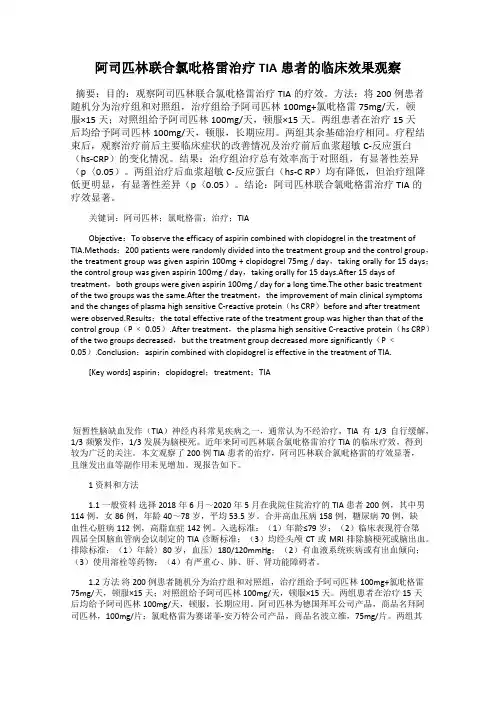
阿司匹林联合氯吡格雷治疗TIA患者的临床效果观察摘要:目的:观察阿司匹林联合氯吡格雷治疗TIA的疗效。
方法:将200例患者随机分为治疗组和对照组,治疗组给予阿司匹林100mg+氯吡格雷75mg/天,顿服×15天;对照组给予阿司匹林100mg/天,顿服×15天。
两组患者在治疗15天后均给予阿司匹林100mg/天,顿服,长期应用。
两组其余基础治疗相同。
疗程结束后,观察治疗前后主要临床症状的改善情况及治疗前后血浆超敏C-反应蛋白(hs-CRP)的变化情况。
结果:治疗组治疗总有效率高于对照组,有显著性差异(p〈0.05)。
两组治疗后血浆超敏C-反应蛋白(hs-C RP)均有降低,但治疗组降低更明显,有显著性差异(p〈0.05)。
结论:阿司匹林联合氯吡格雷治疗TIA的疗效显著。
关键词:阿司匹林;氯吡格雷;治疗;TIAObjective:To observe the efficacy of aspirin combined with clopidogrel in the treatment of TIA.Methods:200 patients were randomly divided into the treatment group and the control group,the treatment group was given aspirin 100mg + clopidogrel 75mg / day,taking orally for 15 days;the control group was given aspirin 100mg / day,taking orally for 15 days.After 15 days of treatment,both groups were given aspirin 100mg / day for a long time.The other basic treatmentof the two groups was the same.After the treatment,the improvement of main clinical symptoms and the changes of plasma high sensitive C-reactive protein(hs CRP)before and after treatment were observed.Results:the total effective rate of the treatment group was higher than that of the control group(P ﹤ 0.05).After treatment,the plasma high sensitive C-reactive protein(hs CRP)of the two groups decreased,but the treatment group decreased more significantly(P ﹤0.05).Conclusion:aspirin combined with clopidogrel is effective in the treatment of TIA.[Key words] aspirin;clopidogrel;treatment;TIA短暂性脑缺血发作(TIA)神经内科常见疾病之一,通常认为不经治疗,TIA有1/3自行缓解,1/3频繁发作,1/3发展为脑梗死。

阿司匹林联合氯吡格雷对缺血性轻度颈动脉狭窄患者脑卒中二级预防的作用分析目的研究和探討阿司匹林联合氯吡格雷对缺血性轻度颈动脉狭窄患者脑卒中二级预防的作用。
方法选取2015年11月~2016年10月在本院确诊为缺血性轻度颈动脉狭窄患者,所有确诊的患者均经过全脑血管造影术(DSA)检查其狭窄率小于50%,所有患者均服用他汀类药物,将阿司匹林联合氯吡格雷进行治疗的患者设定为双联抗血小板药物组(双抗组),将单独使用阿司匹林或者氯吡格雷进行治疗的患者设定为单联抗血小板药物组(单抗组)。
比较分析两组在入院时经过改良之后的Rankin评分(mRS评分)结果、美国国立卫生研究院关于卒中神经功能残损情况的评分(NIHSS)结果以及电话随机访问调查出院后1年的患者所呈现的mRS评分结果、卒中复发情况和不良血管时间等方面的差异性。
结果此次研究共搜集了151例缺血性轻度颈动脉狭窄患者,其中双抗组有99例,单抗组有52例,排除10例已经失访调查的患者,双抗组的患者改为93例,单抗组的患者改为48例。
根据研究结果显示,双抗组与单抗组的同侧卒中复发率分别为2.20%和8.40%;非同侧卒中复发率分别为1.20%和2.20%;病死率分别为2.10%和4.10%,且两组之间的差异性存在无统计学意义(P>0.05);出血发生率分别为11.70%和0,且两组之间的差异性存在统计学意义(P<0.05)。
结论针对颈动脉狭窄率小于50%的患者,单独采用阿司匹林或者氯吡格雷进行预防治疗,其治疗过程会更加安全。
Abstract:Objective To investigate the effect of aspirin combined with clopidogrel on secondary prevention of stroke in patients with ischemic mild carotid artery stenosis.Methods From November 2015 to October 2016 in our hospital diagnosed with mild stenosis of carotid artery in patients with ischemic,all patients were diagnosed by cerebral angiography(DSA)examination of the stenosis rate of less than 50%,all patients were taking statins,the combination of aspirin and clopidogrel treatment were set to dual antiplatelet drugs group(double antibody group),the use of aspirin or clopidogrel alone for the treatment of patients with set single antiplatelet therapy group(mAb group).The results of the National Institutes of Health’s assessment of stroke neurological impairment(NIHSS)and the randomized visit to patients who were hospitalized 1 year after discharge were compared with the results of the Rankin score(mRS score)stroke recurrence and poor vascular time.Results This study collected 151 cases of carotid artery mild stenosis of ischemic,the double resistance group had 99 cases,mAb group had 55 cases,10 cases had lost investigation excluded,double resistance group of patients to 93 cases,monoclonal antibody group of patients to 48 cases.According to the results of the study,the recurrence rate of ipsilateral stroke was 2.20% and 8.40% in the double antibody group and the monoclonal antibody group,respectively.The recurrence rate of the ipsilateral stroke was 1.20% and 2.20% respectively,and the fatality rate was 2.10% and 4.10% respectively,and the difference between the two groups has no statistical significance(P>0.05);bleeding rates were 11.70% and 0,and the differencebetween the two groups has statistical significance(P<0.05).Conclusion For patients with carotid stenosis rate of less than 50%,the treatment of aspirin or clopidogrel alone will be more safe.Key words:Aspirin;Clopidogrel;Stroke缺血性脑血管疾病是一种较为常见的多发性疾病,其致残率和致死率都较高,对患者造成了极大的影响[1]。
