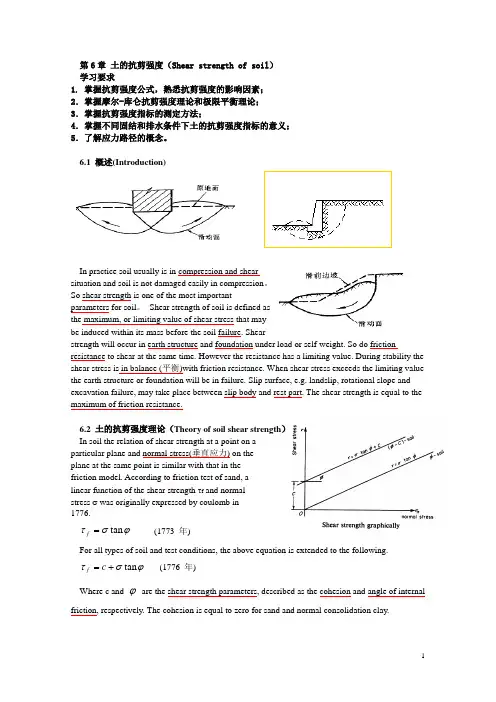
第6章土的抗剪强度(Shear strength of soil)学习要求1. 掌握抗剪强度公式,熟悉抗剪强度的影响因素;2.掌握摩尔-库仑抗剪强度理论和极限平衡理论;3.掌握抗剪强度指标的测定方法;4.掌握不同固结和排水条件下土的抗剪强度指标的意义;5.了解应力路径的概念。
6.1 概述(Introduction)In practice soil usually is in compression and shearsituation and soil is not damaged easily in compression。
So shear strength is one of the most importantparameters for soil。
Shear strength of soil is defined asthe maximum, or limiting value of shear stress that maybe induced within its mass before the soil failure. Shearstrength will occur in earth structure and foundation under load or self-weight. So do friction resistance to shear at the same time. However the resistance has a limiting value. During stability the shear stress is in balance (平衡)with friction resistance. When shear stress exceeds the limiting value the earth structure or foundation will be in failure. Slip surface, e.g. landslip, rotational slope and excavation failure, may take place between slip body and rest part. The shear strength is equal to the maximum of friction resistance.6.2 土的抗剪强度理论(Theory of soil shear strength)In soil the relation of shear strength at a point on aparticular plane and normal stress(垂直应力) on theplane at the same point is similar with that in thefriction model. According to friction test of sand, alinear function of the shear strength τf and normalstress σ was originally expressed by coulomb in1776.τtanσϕ(1773 年)=fFor all types of soil and test conditions, the above equation is extended to the following.τtanσϕ(1776 年)+=cfWhere c and ϕare the shear strength parameters, described as the cohesion and angle of internal friction, respectively. The cohesion is equal to zero for sand and normal consolidation clay.6.2.2 摩尔-库仑强度理论及平衡条件(Mohr-Columb ’s failure criterion)As shown in the below figure , for a soil element ,the coordinates of shear stress τ and normal stress σon a plane with a slope α to the major principle stress can be represented by the major and the minor principle stress 31,σσ as the following equations. on x direction: 0cos sin sin 3=+-ατασασds ds ds on y direction: 0sin cos cos 1=--ατασασds ds ds arrange the above two equations: ασστ2sin 231-=ασσσσσ2cos 223131-++=2312231)2()2(σστσσσ-=++-From the material mechanics, the relationship between σ,τ and the two principle stresses31,σσcan also be represented by Mohr ’s stress circle.If the stress circle in soil mass at one point and f τline were known, it could be determined whether soil was in failure at this point. When stress circle is in right hand of f τ line it means shear stress on all planes through this point is less than shear strength of soil and this point is stability, not in failure. When stress circle is tangential to the f τ line it means that shear stress on a couple of planes through this point reaches the shear strength of soil and soil at this point is in failure. This stress circle is termed as critical stress circle.As shown in the above stress circle figure, in the figure )(21cot )(21sin 3131σσϕσσϕ++=-==c RD AD RD ADSo thatϕσσϕσσsin )](21cot [)(213131++=-c()()ϕσσσσϕcot 2/sin 3131c ++-=the above equations can be rewritten as ϕϕϕϕσσsin 1sin 12sin 1sin 131-++-+=c)245tan(2)245(tan )245tan(2)245(tan 213231ϕϕσσϕϕσσ---=+++=ooooc c for cohesionless soils c=0, 3131sin σσσσϕ+-=)245(tan )245(tan 213231ϕσσϕσσ-=+=ooIf a number of stress states are known, each producing shear failure in the soil, according to the criterion, a common tangent to all stress circles can be drawn and is called failure envelop.In the failure criterion the intermediate princ iple stress can not be considered and it does not have influence on the shear strength of soil. But it is very simple and widely used in practice although it is not only one possible failure criterion for soils. The soil failure is not an exact straight line in certain cases but a straight line approximation can be taken over the stress range of interest. Shear strength theory can be summarized:(a) shear strength on a plane is a function of normal stress on the plane.(b) The function can be expressed with straight line over a certain stress range.(c) If shear stress at a point on one plane has reached shear strength of soil then the point is infailure. Example6.3 土的抗剪强度试验(Shear strength test)A variety of shear tests are available, some for the laboratory and some for the in-situ. There are summarized as direct shear test, triaxial compression, unconfined compression, ring shear test in laboratory and shear vane in situ. It is difficult to exactly measure the shear strength of soil in laboratory and in situ. Because the shear strength not only depends on soil type, but on density, water content ,stress history, boundary condition of drainage et al. Great care should be taken in obtaining, packaging, and transporting samples from site to laboratory where undisturbed samples are required, in which the in-situ structure, density and water content must be preserved.6.3.1 直接剪切试验(The direct shear test)In this test the normal and shear stresses on the failure surface are measured directly. The specimen is confined in a metal box of circular cross-section split into two halves horizontally at mid- height. This test is sometimes termed a shear box test. In the standard type of apparatus the box is the height of 2cm and the area of 30cm2.Porous ceramic stones are placed below and on the specimen if it is fully or partially saturated to allow free drainage. If the specimen is dry, solid metal plates may be used. A pressure pad is placed on top and the box is itself placed on roller bearings. A vertical load is then applied to the specimen by means of static weight hanger. After removing the screws holding the two halves of the box together, the soil specimen is sheared by applying a horizontal force with a screw jack at constant rate of displacement. The magnitude of the shearing force is measured by means of a proving ring or electronic load cell. The relation curve of shear stress with displacement can be plotted. Peak stress or stress at some displacement is adopted as the failure stress. This displacement has been determined by standard as 4mm in the above of shear box.. A number of specimens of the soil are tested under different vertical force, and the value of shear stress at failure is plotted against the normal stress for each test. The shear strength parameters are then obtained from the best line fitting the plotted points.There are quick, consolidated-quick and consolidate-slow shear methods for direct shear test. The advantage of direct shear test(a)it is a simple and conventional test to determine the strength of soil.(b)Both the shear stress and the normal stress on the failure plane are measured directly.(c)It is possible to maintain a constant normal load throughout the test.(d)It is easier to test cohesionless soil at a short time.(e)It is possible to carry out test involving large displacement, including residual strength test.The disadvantages of direct shear test(a)The distribution of shear stress over the failure plane is assumed to be uniform, in fact it isnot.(b)It is not possible to control the drainage from the sample or to measure the pore pressurewithin the sample. The quick test is only suitable for soil with permeability coefficient lessthan 10-7cm/s.(c)The shear area of sample is reduced throughout the test.(d)The failure plane is fixed, if there is not a weak plane in soil.6.3.2 三轴剪切试验(T riaxial compression test)The triaxial compression test is the most widely used shear strength test. It is suitable for all types soil except for very sensitive clays and allows a number of different test procedures.The specimen is sealed by a rubber membrane between specimen and cell and placed on porous or solid disc, which is placed on the central pedestal. The rubber membrane is sealed on the central pedestal by O-rings. On top of the specimen other porous or solid disc and a load cap are placed sequentially. An all-round pressure to specimen is applied by compression equipment and axial load by ram. The pore pressure or drainage volume can be measured during the test.In the triaxial test all-round pressure is the minor principle stress and remains constant. The sum of all-round pressure and added axial stress is the major principle stress. When axial load is applied the displacement and pore pressure or drainage volume of specimen are monitored and the curve of difference of principle stress versus strain can be plotted.In the triaxial compression test many procedure may be controlled but there are three main types as follows(1) Unconsolidated-undrained(UU). This type of test is similar to quick shear test in the directshear test. The parameters are termed as c u , u ϕ. (2)Consolidated-undrained(CU). This type of test is similar to consolidated-quick shear test in the direct shear test. The parameters are termed as c cu , cu ϕ. (3)Consolidated-undrained(CD). This type of test is similar to consolidated-slow shear test in the direct shear test. The parameters are termed as c d , d ϕ.It is obvious that the consolidation stage is for all-round pressure and drainage is for principle stress difference6.3.3 无侧限抗压强度试验(unconfined compression test)This is a special case of the triaxial test, which is zero at all-round pressure. The all-round pressure is the minor principle stress and keeps zero during test.2u u fq c ==τ6.3.4 十字板剪切试验(the vane shear test)self-study2u fq ≈τ6.4 三轴压缩试验中的孔隙压力系数 (pore pressure coefficient in the triaxial test)Pore water pressure coefficient are used to express the response of pore water pressure to changes in total stress under undrained conditions. Pore water pressure coefficient B is used to describe the change of pore water pressure under all-round pressure. And pore water pressure coefficient A is used to express the change of pore water pressure under the difference of the main principal stress.In the triaxial test soil sample is consolidated under all-round pressure cσ' to simulate the initialstress under the ground and the pore water pressure u 0=0 . When a building is constructed,increments of minor and major principal stress 3σ∆and 1σ∆are loaded to soil at the same time. In the test the increments 3σ∆and 31σσ∆-∆are applied consequently. And pore water pressure is not zero under undrained conditions. The pore water pressure in the triaxial test is shown in the below figure. .In the triaxial test increment of pore water pressure 3u ∆results from increment of all-round pressure 3σ∆. It can be expressed with coefficient B as:33σ∆=∆B u )/1/(1s v C nC B += (see p.161)The value of B is in rang of 0~1.In the triaxial test increment of pore water pressure 1u ∆results from increment of difference of main principal stress 31σσ∆-∆, can be expressed with coefficient A as:()311σσ∆-∆=∆AB uThe coefficient A can also be determined experimentally. In the test the increment of pore water pressure 1u ∆ can be measured during application of the principal stress difference under undrained conditions. The change of the principal stress difference can be controlled and the corresponding change of pore water pressure can be measured.For normally consolidated soils the value of A is positive. For overconsolidated clays and dense sands the value of A may be negative.The total water pressure in the triaxial test can be expressed as310u u u u ++=Generally only the saturated soils are discussed in the triaxial test. The coefficient B is equal to 1and the initial pore water pressure is zero if sample is consolidated under all-round pressure cσ'to simulate the initial stress. In unconsolidated-undrained test (B=1), the total pore water pressure isexpressed as()313σσσ∆-∆+∆=A uIn consolidated-undrained test (03=∆u ), the total pore water pressure is expressed as()31σσ∆-∆=A uIn consolidated-drained test, the total pore water pressure is expressed as 0=u6.5 饱和粘性土的抗剪强度 (shear strength of saturated clay)6.5.1不固结不排水抗剪强度(Unconsolidated-undrained strength)In the triaxial test under unconsolidated-undrained condition, firstly all specimens areconsolidated under the same all-round pressure cσ' to restore soil sample to the original stress state. The different increments of all-round pressure are loaded on all saturated specimens. Under theincrement of all-round pressure any consolidation doesn ’t take place. The increase of all-round pressure results in an equal increase in pore water pressure and the effective stress in the specimen remains unchanged. All total stress circles in failure state are shown in the below figure. From the figure we can see that)(21031σστϕ-===u fu cAnd if the values of pore water pressure at failure were measured for all specimens, the related effective stresscircles would be obtained. In principle, only one effective stress circle is obtained and the effective strength parameters couldn ’t be determined by this shear test.C B A )()()(31313131σσσσσσσσ-=-=-='-'6.5.2 固结不排水抗剪强度(Consolidated-undrained strength)In the triaxial test under consolidation-drained condition the saturated specimens are consolidated at different all-round pressures firstly and then the principal stress differences increase until failure under undrained condition. For normal consolidation the higher the all-round pressure is, the higher the shear strength is. The failure envelope under consolidated-undrained condition is a line through the origin and the angle of this line is cu ϕ.For specimens in overconsolidation there is less void ratio before shear than in normalconsolidation and pore water pressure at failure is less than in normal consolidation and even is negative. The effective stress is lager than in normal consolidation and the shear strength is higher. Its interception c ' and ϕ' are termed as effective strength parameters under consolidated -undrained condition. The total failure envelope cu cu fc ϕστtan +=The effective failure envelope cu cuf c ϕστ''+'='tan6.5.3 固结排水抗剪强度(Consolidated-drained strength)In the triaxial test under consolidated-drained condition all specimens are consolidated under different all-round pressures and the principal stress differences are applied so slowly to keep the pore water pressure unchanged until failure takes place. The increase of shear strength is linear with the increase of all round pressure and the failure envelope is through the origin for normally consolidated soil. 0=d c and d ϕ are the strength parameters under consolidated-drained condition. The shear strength of the specimen in overconsolidation is higher than in normal consolidation at the same all-round pressure. The failure envelope in overconsolidation part is curvature and isn ’t through the origin. It is an approximate line and its intersection d c and angle d ϕ are termed as strength parameters under consolidated-drained condition. They are just effectivestrength parameters. The failure envelope d d fc ϕστtan +=紧砂(密砂)松砂紧砂(密砂)松砂6.5.3抗剪强度指标的选择(self-study)6.6应力路径在强度问题中的应用(self –study)6.7无粘性土的抗剪强度 (shear strength of cohesionless soil)The shear strength characteristics of sand can be determined by the triaxial or direct shear test. Typical curves of principal stress difference with axial strain for dense and loose sand specimen in drained triaxial compression test are shown in the below figure.6.1,6.2,6.3,6.4, 6.7,6.10。