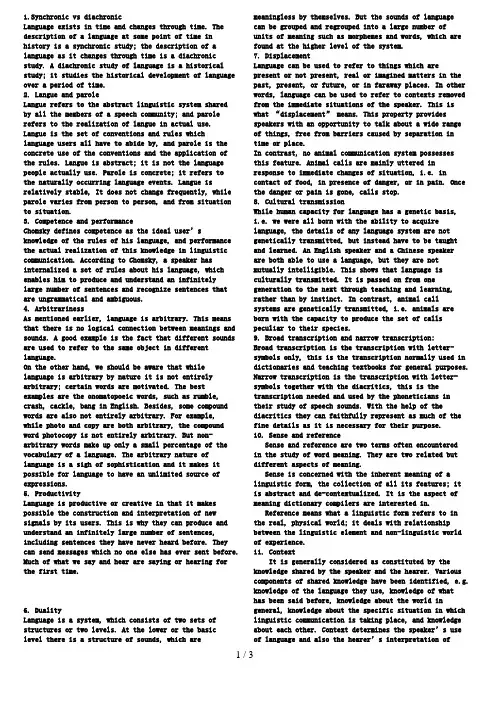
英语语言学概论The RestorationThe bourgeois dictatorship was established, and Cromwell became the Protector of the English Commonwealth After the death of Cromwell, the Parliament recalled Charles II to England in 1660.Only when Charles II threatened to restore the old absolute monarchy that bourgeoisie expelled him and invite William, Prince of Orange, from Holland, to be King of England in 1688: Glorious Revolution(光荣革命)——Glorious because it was bloodless and there was no revival of the revolutionary demands.Paradise LostIt is a long epic(史诗)in 12 books,written in blank verse.Plot:Although defeated by God,Satan is not discouraged, he chooses the Garden of Eden for the battlefield ,where live the first man and woman, Adam and Eve, who are allowed by God to enjoy the supreme beauties of Paradise, if they do not eat the fruit that grows on the Tree of Knowledge of Good and Evil. Satan desires to tear them away from the influence of God and make them tools in his struggle against God’s authority.Satan assumes the shape of a serpent and appears before Eve, He persuades her to break God’s command. Eve eats an apple from the forbidden tree and plucks(摘)another for Adam. God sees all this, and Adam and Eve are both deprived of immortality, exiled(逐出)from Paradise and doomed to an earthly life full of hardship and sufferings.Paradise Lost is Milton’s masterpiece. The story were taken form the Old Testament: the creatio n, the rebellion in Heaven of Satan and his fellow-angels; their defeat and expulsion fromHeaven; the creation of the earth and of Adam and Eve; the fallen angels in hell plotting against God; Satan’s temptation of Eve; the departure of Adam and Eve from EdenThemeThe poem, as we are told at the outset, was “to justify the ways of God to man,” to advocate submission to the Almighty. But after reading it one gets the impression that the main idea of the poem is a revolt against God’s authority.characterizationGod: a selfish, cruel, and unjust despot.In the poem God is no better than a selfish despot, seated upon a throne with a chorus of angels about him eternally singing his praises. His long speeches are never pleasing. He is cruel and unjust in his struggle against Satan. His Archangel is a bore. His angels are silly. The Angles never think of expressing any opinions of their own, resembles the court of an absolute monarch.Adam and Eve: embody Milton’s belief in the powers of man. Their craving fo r knowledge is highly praised. Satan: real hero, brave, strong-minded, represent the spirit questioning the authority of God.The rebel Satan who rose against God and , though defeated, still sought for revenge, is the most striking character in the poem. Satan is the real hero of the poem. Like a conquered and banished giant, he remains obeyed and admired by those who follow him down to hell. He is firmer than the rest of the angels. It is always from him that deep counsels, unlooked-for resources and courageous deeds proceed. Satan and his followers freely discuss all the issues in council, bear close resemblance to a republican Parliament. It is he who, passing the guarded gatesand boundless chaos, amid so many dangers, and across so many obstacles, makes man revolt against God. Though defeated, he prevails, since he has won from God the third part of his angels, and almost all the sons of Adam. Though wounded, he triumphs for the thunder which hit upon his left his heart invincible.Samson AgonistesSamson Agonistes is a poetical drama modeled on the Greek tragedies. It deals with the story from the “Book of Judges”(士师记)in the Old Testament. Samson was an athlete of the Israelites. He stood as their champion fighting for the freedom of his country. But he was betrayed by his wife Dalilah and blinded by his enemies the Philistines. Led into the temple “to make them sport” he wreaked his vengeance upon enemies by pulling down the temple upon then and upon himself in a common ruin.There is much in common between Samson and Milton. Like Samson, Milton has also been embittered by an unwise marriage, persecuted by his enemies, has suffered from blindness and yet is unconquerable. Samson’smiserable blind servitude among his enemies, his agonizing longing for sight and freedom, and the last triumph all strongly suggests Milton’s passionate longing that he too could bring destruction down upon the enemy at the cost of his own life, Samson is Milton.John Bunyan约翰.班扬(1628—1688)Life Experience1628 born in a poor family whose father is a tinker (make and mend kettles and pot)"My descent was of a low and inconsiderable generation, my father's house being of that rank that is meanest and most despised of all the families of the land".1635 receiving educatio n at his father’s house and later with other country boys at local school.1640 choosing a job like his father by adopting the trade of tinker1644 joining the parlimentary army during the revolution time and become a preacher1661 tried by the local magistrate for not attending the parish church and for holding unlawful meeting ,later was sentenced for 12 years.While he was in jail, he was starting his most famous work pilgrim’s progress1672 released and licensed as a teacher1678 Pilgrim’s Progress was published1688 died of a chillJohn Bu nyan’s masterpiece The Pilgrim’ Progress was probably written in prison, but for some reason he did not publish till 1678 long after his release. The Pilgrim’ Progress is a religious allegory.The first partChristian the Pilgrim, setting out in his search for salvation(救赎), is accompanied by Pliable, Mr. Evangelist, Faithful and then Hopeful.On the way he meets with many pitfalls like the Slough of Despond(绝望的深渊), V anity Fair , Doubting castle and so on On the way he meets with many hindrances like Mr. Worldly Wiseman, Apollyon(恶魔) and Judge Hategood, and Giant Despair.After many narrow escapes and numerous tests of his steadfastness(坚定不移)he finally arrives at Celestial city(天国).The second partThe great popul arity of the book led the author to write a sequel. The second part of The Pilgrim’s Progress, dealing with similar adventures of Christian’s wife Christiana and her children in their pilgrimage to the celestial city, is much inferior to the first part.The Story of the First PartThe story starts with a dream in which the author seesChristian the Pilgrim, with a heavy burden on his back,reading the Bible. When he learns from the book that the city in which he and his family live shall be burnt down in a fire, Christian tries to convince his family and his neighbors ofthe oncoming disaster and asks them to go with him insearch of salvation, but most of them simply ignore him. So he starts off with a friend, Pliable. Pliable turns back afterthey stumble into a pit, the Slough of Despond. Christianstruggles on by himself. Then he is misled by Mr. WorldlyWiseman and is brought back onto the right road by Mr.Evangelist. There he joins Faithful, a neighbor who has setout later but has made better progress.The two go on together through many adventures, including the great struggle with Apollyon, who claims them to be his subjects and refuses to accept their allegiance to God. After many other adventures they come to the V anity Fair where both are arrested as alien agitators. They are tried and Faithful' is condemned to death.Christian, however, manages to escape and goes on his way, assisted by a new friend, Hopeful. Tired of the hard journey, they are tempted to take a pleasant path and are then captured by Giant Despair. Finally they get away and reach the Celestial City,where they enjoy eternal life in the fellowship of the blessed.V anity Fair(名利场)The vivid picture of Vanity Fair, where all things are bought and sold(including honors, titles, wisdoms, lusts pleasures and lives)and where cheating and roguery(坏事)and murders and adulteries(通奸)are normal, everyday occurrences, is a biting satire on the English society with which the writer was familiar."The V anity Fair," An Excerpt from Part 1 of The Pilgrim's ProgressThen I saw in my dream, that when they were got out of the wilderness, theyPresently saw a town before them, and the name of that town is V anity; and atthe town there is a fair kept, called V anity Fair; it is kept all the year long; ithearth(1) the name of V anity Fair because the town where it is kept is lighterthan vanity; and also because all that is there sold, or that cometh thither, isvanity. As is the saying of the wise, "All that cometh is vanity".Almost five thousand years ago, there were pilgrims walking tothe Celestial City, as these two honest persons are; and Beelzebub,Apollyon, and Legion, with their companions, perceiving by thepath that the pilgrims made, that their way to the city lay throughthis town of V anity, they contrived to set up a fair; a fair whereinshould be sold all sorts of vanity, and that it should last all the yearlong. Therefore at this fair are all such merchandise sold, as houses,lands, trades, places, honors, preferment, titles, countries, kingdoms,lusts, pleasures, and delights of all sorts, as whores, bawds, wives,husbands, children, masters, servants, lives, blood, bodies, souls,silver, gold, pearls, precious stones, and what not.And, moreover, at this fair there is at all times to be seen juggling,cheats, games, plays, fools, apes, knaves, and rogues, and that ofevery kind. Here are to be seen, too, and that for nothing, thefts,murders, adulteries, false swearers, and that of a blood-red color.Theme1. Describes the spiritual suffera nce of the poor people at a time of great changes, and their aspiration for “the land that flow with milk and honey” .”There you will not see such things as sorrow, sickness, affliction, and death”.2. Pilgrim’s Progress is a biting satire on the Englishsociety with which the writer was familiar. It is not onlyabout something spiritual but also bears much relevance to the time. The objects that Christian meets are homely and commonplace, and the scenes presented are typicalEnglish ones, but throughout the allegory a spiritualsignificance is added to the commonplace details. Here the strange is combined with the familiar and the trivial joined to the divine.3. It reveals Bunyan’s Puritan ideal.Reading comprehensionNow, as I said, the way to the Celestial City lies just through this town where this lusty fair is kept; and he that will go to the city, and yet not go through this town, must needs "go out of the world". The Prince of princes himself, when here, went through this town to his own country, and that upon a fair-day, too, yea, and as I think, it was Beelzebub, the chief lord of this fair, that invited him to buy of his vanities; yea, would have made him lord of the fair, would he but have done him reverence as he went through the town. Y ea, because he was such aman of honor, Beelzebub had him from street to street, and showed him all the kingdoms of the world in a little time, that he might, if possible, allure the Blessed One to cheapen and buy some of his vanities; but he had no mind to the merchandise, and therefore left the town, without laying so much as one farthing upon these vanities. This fair, therefore, is an ancient thing, of long standing, and a very great fair.Where is this passage chosen form?John Bunyan: The Pilgrim’s Progress.Jesus Christ.John Bunyan is talking about vanity, one of the evils of human life. The idea that everybody is potentially vain and vanity is something that the “world” encourages, and that is takes courage and effort to get rid of one of vanity. Even Jesus Christ(the Prince of Princes) was troubled by vanity, but he stood the test and conquered it. Thus Christians should do like Christ ifthey wish to reach the kingdom of God.What is the theme of John Bunyan’s The Pilgrim’s Progress?John Donne,the founder of the Metaphysical school of poetry.Main works: Devotions Upon Emergent Occasions (shows the intense interest Donne took in the spectacle of mortality under the shadow of death, a vision that haunted him perpetually, and inspired the highest of his eloquence. )The Songs and Sonnets, by which Donne is probably best known, contains most of his early lyrics. Love is the basic theme. Donne holds that the nature of love is the union of soul and body. Donne's interest lies in dramatizing and illustrating the state of being inlove.Donne's chief power as a religious poet is shown in the Holy Sonnets and the last hymns.Death, Be Not ProudDeath, be not proud, though some have called theeMighty and dreadful, for thou art not so;For those whom thou think'st thou dost overthrowDie not, poor Death, nor yet canst thou kill me.From rest and sleep, which but thy pictures be,Much pleasure; then from thee much more must flow,And soonest our best men with thee do go,Rest of their bones, and soul's delivery.Thou art slave to fate, chance, kings, and desperate men,And dost with poison, war, and sickness dwell,And poppy or charms can make us sleep as wellAnd better than thy stroke; why swell'st thou then?One short sleep past, we wake eternallyAnd death shall be no more; Death, thou shalt die.Reading comprehensionOne short sleep past, we wake eternallyAnd death shall be no more; thou shalt dieQuestions:1.Identify the poet and the poem.2.What does the phrase “one short sleep” mean?3.What idea does these two lines express?Answers:1.It is taken from John Donne’s Death, Be Not Proud.2.It means death.3.It means that shortly after we die we will wake up (as from sleep) and live eternally. It reveals the poet’s beli ef in life after death: death is but momentary while happiness after death is eternal.Other MetaphysicalsGeorge Herbert, “the saint of the Metaphysical school.” was a devout Anglican clergyman who believed that a poet should sing the glory of God. He describes his joys, fears and doubts in a symbolic way. Many of his poems overloaded with far-fetched conceits, too obscure to be appreciated. (The Altar) Andrew Marvell, another Metaphysical poet, was a puritan who served as Milton’s assistant in the Commonwealth. He wrote poems on nature. (To His Coy Mistress)To the Virgins, to Make Much of Time by Robert HerrickGather ye rosebuds while ye may,Old Time is still a-flying:And this same flower that smiles to-dayTo-morrow will be dying.The glorious lamp of heaven, the sun,The higher he's a-getting,The sooner will his race be run,And nearer he's to setting.That age is best which is the first,When youth and blood are warmer;But being spent, the worse, and worstTimes still succeed the former.Then be not coy, but use your time,And while ye may, go marry:For having lost but once your prime,Y ou may for ever tarry.Some Prose-WritersThe seventeenth century was a period of revolution and restoration. Much of the prose was devoted to political and religious controversies. Nevertheless, besides Milton and other militant pamphleteers, there are still some other prose writers who reflected their age from different angles and whose works carry quite different message with them.Robert BurtonHis masterpiec e “The Anatomy of Melancholy” . Nominally, it claims to offer the definition, symptoms, causes, properties and cure of melancholy, that is, human disorder, especially love melancholy and religious melancholy.But in reality the book is an enormous collection of detached essays on the whole life and thought of man, and on man’s dissatisfaction with the world and the ways to mitigate it, illustrated with the best stories in the world. Other Prose-Writers Thomas BrowneReligio Medici (a collection of opinions on a vast number of opinions on a vast number of subjects more and less connectedwith religion, expressed from a distinctly personal viewpoint ) Jeremy TaylorHe is famous for his Holy Living and Holy dying, Both written to help the Anglican royalists during the reign of the Commonwealth.Holy Living offers rules of conduct for the Royalists under the difficulties of the age. Holy Dying warns that human life is short and it is necessary to begin preparing for death while still healthy.Thomas Browne and Jeremy Taylor have been called two representative baroque prose writers in English literature for their elaborate and magnificent style.Baroque literature: It is the transition from Renaissanceto classicism.It began in Italy, Spain and flourished in France and thenEngland. It has direct influence on 19th romanticistliterature.It is called in 18th-century as “Rococo Style”, the style of painting, writing and decoration characterized by lightness, delicacy, and elaborate ornamentation.Exercise One I. Name the Writers by the given passages. (10%) ( ) 1. What man art thou,quoth he, That lookest as thou wouldst find a hare; For ever on the ground I see thee stare.( ) 2. Here where nothing is private, the common affairs be earnestly looked upon...?There where all things be common to every man, It is not to be doubted that any an shall lack anything necessary for his private use, so ?that ?the ?common ?storehouses bars be sufficiently stored ( ) 3. ...What though the field be lost? All is not lost; the unconquerable will And study of revenge, immortal hate, And courage never to submit or yield...( ) 5. It sucked me first, and now sucks thee, And in this flea, our two bloods mingled be; This flea is you & I,& this Our marriage-bed, marriage temple is.II.True & False statement. (20%)( ) 1. Chancer's contribution to English poetry lies chiefly in the fact he introduced from France the rhymed stanza in Iambic meter to English poetry.( ) 2. Hamlet,the great tragedy of Shakespear, with perfect artistry, studys the big question "to be or no to be.“( ) 3. Bacon was the founder of modern science & also famous for his "essays."( ) 4. Milton's Areopagistica is a pamphlet about religious abuse.( ) 5. University wits contribute a lot in prose writing as well as drama writing.( ) 6. Romance is a typical kind of noble literature & has nothing to do with common people.( ) 7. Sperser's "Faerie Queene", Sidney's "Astrophel & Stella "& Shakespeare's?"Sonnets" are the most famous sonnet sequences of Elizabethan Age.( ) 8.Blank verse is the most popular literary form in 11th-14th century.( ) 9. Marlowe was the greatest pioneer of English drama & it was Marlowe ?who ?first made blank verse the principal instrument of English drama.( ) 10.The eighteenth century is an enlightenment century that most of the writers show great interest on reasoning, rationality & classicism (Neo-classicism)Representatives of the Restoration1. Sir George Etherege乔治·埃恩里奇爵士The man of Mode《时髦男子》2. William Wycherley 威廉·威彻利Love in a Wood《林中之爱》The Country Wife《乡村妇女》The Plain Dealer《坦率的人》Representatives of the Restoration3.Sir John Vanbrugh约翰·范布勒爵士The Relapse, or Virtue in Danger 《故态复萌》The Provoked Wife《恼怒的妻子》4. William Congreve威廉·康格里夫The Double Dealer《两面派》Love for Love 《以爱还爱》The Way of the World 《如此世道》Representatives of the Restoration5. Jeremy Collier杰雷米·科利尔, a non-conformist(非国教的) clergymanA Short View of the Immorality and Profaneness of the English Stage《略论英国舞台上的不道德和亵渎》现代语言学一绪论1 Linguisitics :Linguistics is generally defined as the scientific study of language2 Phonetics : The study of sounds which are used in linguistics communication is called phonetics.For example,vowels and consonants3 Phonology" : The study of how sounds are put together and used in communication is called phonology.For example,phone,phoneme,and allophone.4 Morphology :The study of the way in which morphemesare arranged to form words is called morphology.For example,boy and "ish"---boyish,teach---teacher.5 Syntax : The study of how morphemes and words are combined to form sentences is called syntax.For esample,"John like linguistics."6 Semantics: The study of meaning in language is called semantics. For example,:The seal could not be found.The zoo keeper became worried." The seal could not be found,The king became worried." Here the word seal means different things.7 Pragmatics: The study of meaning in context of use is called pragmatics.For example, "I do" The word do means different context.8 Sociolinguistics: The study of language with reference to society is called sociolinguistics.For example,regional dialects,social variation in language.9Psycholinguistics: The study of language with reference to workings of mind is called psycholinguistics.二音系学1 Phonetics: The study of sounds that are used in linguistic communication is called phonetics.2 Phonology: The study of how sounds are put together and used in communication is called phonology.3 Phone: Phone can be simply defined as the speech sounds we use when speaking a language. A phone is a phonetic unit or segement. It does not necessarily distinguish meaning; some do,some don't.4 Phoneme: Phonology is concerned with the speech sounds which distinguish meaning. The basic unit in phonology is called phoneme;it is a unit that is of distinctive value.5 allophone: The different phones which can represent aphoneme in different phonetic environment are called the allophones of that phoneme.6 Complementary distribution: These two allophones of the same phoneme are said to be in complementary distribution.7 Minimal pair: When two different forms are identical in every way except for one sound segement which occurs in the same place in the stings, the two words are said to form a minimal pair.8 Stress: When a certain syllable of a word is stressed, it means that the syllable is prounced with great force than the other or others.9 tones: Tones are pitch variation, which are caused by the different rates of vibration of the vocal cords. Pitch variations can distinguish meaning just like phoneme; therefore, the tone is a suprasegemental feature.10 intonation: When pitch, stress and sound length are tied to the sentence rather than the word in isolation, they are collectively known as intonation. Intonation plays an important role in conveying meaning in almost every language,especially in a language like English{$isbest}三形态学1 morphology: Morphology is a branch of grammer which studies the internal structure of words and the rules by which words are formed.2 inflectional morphology: Inflectional morphology studies the inflections of word-formation.3 derivational morphology: Derivational morphology is the study of word-formation.4 morpheme: Morpheme is the smallest meaningful unit of language.5 free morpheme: Free morpheme are the morphemes which are independent units of meaning and can be used freely all by themselces or in combination with other morphemes.6 bound morpheme: Bound morphemes are the morphemes which cannot be used independently but have to be combined with other morphemes, either free or bound, to form a word.7 root: A root is often seen as part of a word; it can never stand by itself although it bears clear,definite meaning; it must be combined with another root or an affix to form a word.8 affix: Affixes are of two types: inflectional and derivational.9 prefix: Prefix occur at the beginning of a word.10 suffix: Suffixes are added to the end of the stems; they modify the meaning of the original word and in many cases change its part of speech.11 derivation: Derivation affixes are added to an existing form to creat a word.Derivation can be viewed as the adding of affixes to stem to form nes words.12 compounding: Like derivation, compounding is another popular and important way of forming new words in English. Compounding can be viewed as the combination of two or sometimes more than two words to creat new words.四句法学1 linguistic competence: Comsky defines competence as the ideal user's knowledge of the rules of his language,and performance the actual realization of this knowledge in linguistic communication.2 sentence : A sentence is a structurally independent unit that usually comprises a number of words to form a complete statement question or command.3 transformation rules: Syntactic movement is governed bytransformational rules. The operation of the transformational rules may change the syntactic representation of a sentence.4 D-structure : A sentence may have two levels of syntactic representation. One exists before movement take place, the other occurs after movement take place. In formal linguistic exploration, these two syntactic representation are commonly termed as D-structure.5 Move а : Just as there is a general rule for all phrase structure rules,i,e. the X-bar schema, there is a general movement rule accounting for the syntactic behavior of any constituent movement. This movement rule is called M ove а{$isbest}五语义学1 semantics: Semantics can be simply defined as the study of meaning in language.2 sense : Sense is concerned with the inherent meaning of the linguistic form. It is the collection of all the features of the linguistic form; it is abstract and decontextualized.3 reference : Reference means what a linguistic form refers to in the real, physical world; it deals with the relationship between the linguistic element and the non-linguistic world of experience.4 synonymy : Synonymy refers to the sameness or close similarity of meaning. Words that are close in meaning are called synonymy.5 polysemy : Polysemy refers to the fact that the same one word may have more than one meaning.A word having more than one meaning is called a polysemic word.6 antonymy : Antonymy refers to the oppositeness of meaning. Words that are opposite in meaning are called antonyms.7 homonymy : Homonymy refers to the phenomenon that words having different meanings have the same form,i.e. different words are identical in sound or spelling, or in both.8 hyponymy : Hyponymy refers to the sense relation betweena more general, more inclusive word and a more specific word.9 componential analysis : Componential analysis is a way to analyze wprd meaning. It was proposed b y structural semanticists.10 grammatical meaning : The grammatical meaning of a sentence refers to its grammaticality,i.e. its grammatical well-formedness. The grammaticality of asentence is governed by the grammatical rules of the language.11 semantic meaning : The semantic meaning of a sentence is governed by rules called selectional restrictions.12 predication : In semantic analysis of a sentence, the basic unit is called predication. The predication is the abstraction of the meaning of a sentence.六语用学1 pragmatics: Pragmatics can be defined as the study of how speakers of a language use sentences to effect successful communication.2 context: The notion of context is essential to the pragmatic study of language. Generally speaking, it consistsof the knowledge that is shared by the speaker and the hearer.3 utterance meaning: Utterance is based on sentence meaning; it is realization of the abstract meaning of a sentence in a real situation of communication, or simply in a context.4 locutionary act: A locutionary act is the act of utterance words,phrases,clauses. It is the act of conveying literal meaning。