
B4U3早读学案
- 格式:ppt
- 大小:169.00 KB
- 文档页数:5

高一英语b3u3学案3学习目标:掌握本学案中所涉及的重点单词(5个)、短语(2个)、句型(2个)的用法,自主、合作、探究,通过练习,进一步巩固所学词汇在语境中的作用,积极参与,激情投入。
学法指导:1.预习案中的第一题全部来自于词汇表,请同学们参阅P.94-95,然后填空。
2.典型句式全部来源于两篇课文,请同学们从课文中找出其句型,并在课文中用双色笔勾出来,课后背诵。
3.探究案及训练案中的单词、短语、句型预习方法应遵循研究读例句→归纳总结用法→练习巩固的步骤。
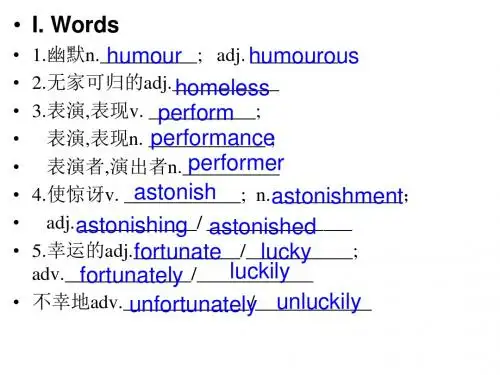
第一部分:预习案1.根据要求写出下列词汇的不同形式或词组互译。
1) adventure n.___________→adj.____________ 2) permit v._______ →P. _______P.P.________3) spot vt.___________ n.___________ →P. ______P.P.______4) seek _______→P. _____P.P.______5) unbelievable 反义词_____________ 6) __________for 导致;作出解释7) _______ at 盯着看;凝视8)go ahead__________________ 9) by___________偶然;无意中10) on the ________ 与此相反;正相反11) _______a chance 冒险12)_______ for 关于;至于13)in______衣衫褴褛2. 典型句式;仿照句式将括号中的汉语翻译成英语。
1) find+宾语+宾语补足语Well,towards nightfall I ________________________(发现自己被刮进了海里) by a strong wind.2) h ad just done…when…刚做完某事…这时…The next morning I’d just about given myself up for lost _______________(此时我被发现) by a ship.3) 强调句式And ____________________(就是那艘船) brought you to England.4) it作形式主语的主语从句Well,________________(众所周知) that Americans like to eat a lot.5) 疑问词+ever引导的让步状语从句和名词性从句You must come ___________(无论你什么时候想要) and have ____________(你喜欢的任何东西).我的收获:____________________________________________________________________________我的疑惑:____________________________________________________________________________第二部分:探究及训练案一、重点单词及用法1.scene n. (戏剧)一场;现场;场面;景色(教材P.17) Act I, Scene 3[寓词于境]1)The happy scene of children playing in the garden disappeared, and it was quiet again.2)Firefighters were on the scene immediately.3)This play has three acts, and each act has three scenes.请写出上面三句中划线部分的汉语意思:1)________, 2).__________ 3). __________[易混辨析]scene: (the place where something happens;a part of a film/movie, play or book) 场面;片段;镜头scenery: (natural) 风景view: (what you can see from a particular place or position) 景色,风景,观点sight: (the interesting places)名胜;风景,常用作复数[即学即练]1)We are going to Paris for weekend to see the ______.2)There is a fine _______of the mountains from our hotel window.3)It’s a happy _______ of children playing in the garden.4)The _______ of the West Lake is beautiful.2. permit vt.&vi. 许可;允许;准许(教材P.2)Permit me to lead the way, sir.[寓词于境]1)Without a drivers’ permit, you are not permitted to drive.2)We’ll discuss all the questions if time peimits.3)You can’t take photos without permission.4)We do not permit smoking in the office.5)I’ll come tomorrow, weather permitting=if weather permits[自我归纳] permit[C]____(词性) without one’s permission未经某人许可permission[U] ask for permission 请求允许permitpermit sb. ___________ 允许某人做某事____(词性) permit _____________ 允许做某事weather permitting 天气允许的话[即学即练]1)Jimmy’s parents didn’t _____him to go swimming in the river alone.A. letB. promiseC. permitD. hope2)We don’t ______ photos there.A. permits to takeB. permit to takeC. permitting takingD. permit taking3. fault n. 责任;过错;缺点;故障vt. 对…挑毛病(教材P.18)It was all my fault.[寓词于境]1)Somehow, people seem to think it’s my fault for letting him in.2)Every man has his faults. 人无完人,金无足赤[自我归纳]1) It’s all my fault. 这都是我的错。
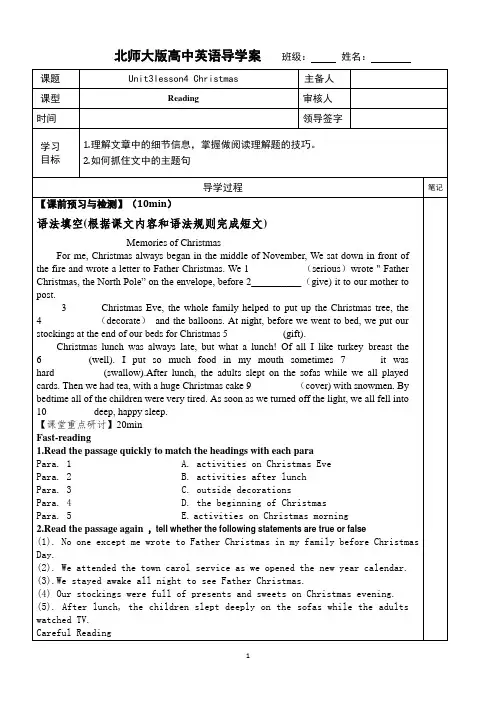

单元课题:B4U4 Body language(COMMUNICATION: NO PROBLEM?)编制: Gao Yu Wang Qian Wang Li Zhang Chun 审阅:Wang Xin 使用日期:第16周第5课时【课前预习案】【Learning Aims学习目标】1.To master new words and expressions from the context.2.To improve the reading abilities: scanning, skimming, careful reading.I.【夯基固本】夯实词汇,学习之本A 重点掌握(达到默写程度)1.陈述/说明n. ____________________v. ___________________ 2.代表/象征vt. ___________________n./ adj. _______________ 3.好奇的adj. _____________________adv. _____________________n. _______________________4.靠近/方法v./ n.__________________5.保卫vt. ________________________n. _______________________ 6.主要的adj./ v./n. ________________多数n. __________________ 7.误会vt.________________________过去式_________________________ 过去分词_______________________ n. _____________________________ 8.简单地/只adv. __________________adj. ___________________ 9.口语的adj. _____________________v. _____________________ 过去式_________________________过去分词______________________现在分词______________________书面的adj. ____________________v. ____________________ 过去式________________________过去分词______________________现在分词______________________ 10.可能的adj. ____________________不可能的adj. __________________ 11.雇员n. _______________________雇主n. _______________________雇用/就业n. ___________________雇佣/忙于v. ___________________解雇/失业v. ___________________n.___________________12.安逸/减轻n./v. _________________13.真正地adv. ____________________adj. _____________________n.真相___________________ 14.怒气n. ________________________adj. _______________________B 识记词汇1.greet____________2.association_______3.dormitory________4.canteen__________5.flight___________6.adult____________7.facial ___________8.function _________9.false ____________10.respectful ________11.subjective________12.rank ____________C 重点短语(达到默写程度)1.保卫…以免受________________2.很可能______________________3.总的来说____________________4.舒适________________5.丢脸________________6.背对________________D 短语汇总(方法指导:在课本P17-18用荧光笔标出,课前达到默写程度)1.look around 四周看2.introduce sb to sb 把…介绍给3.put up举起张贴4.reach one’s hand out to向…伸出手5.shake hands 握手6.on the contrary正相反;恰好相反Ⅱ【自主预习静心悦读】方法指导:快速阅读文章P26, 写出最佳答案。

Book III Unit4阅读导学案Class : Group : No. Name: 组内评价: 教师评价:______ 【学习目标】1.牢固掌握文中的基础知识,深入理解课文,培养快速阅读和整体理解的能力。
2.通过自主学习,合作探究,掌握查找细节和总结文章大意的方法。
3.激情投入,全力以赴,了解更多关于人类起源和生物进化的知识,享受英语学习的快乐。
【使用说明及学法指导】1.先快速浏览了解文章的大意并完成Task I 。
2.再快读课文1遍,学案上出现的短语和句子要在课文中划出,重点理解,完成 Task II 。
3.难于理解的句子要结合课后注释做好理解,仍未解决得的要用问号标注出来,等待课堂质疑解决。
【分层目标】★ C 层 :掌握基础知识,理解文章大意。
★ ★ B 层 :掌握基础知识和文章结构,理解课文并总结课文。
★★★A 层 :掌握基础知识,能够分析长难句,宏观掌握课文结构并回归课本背诵全文。
【重难点】1. 总结全文并能陈述人类的起源和生物的进化。
2. 阅读技巧与长难句分析。
【课前预习】自主学习,限时阅读,完成T ask I , II 。
T ask I: Read the text and choose the best answer . 1. How were stars and other bodies created? A. Atoms combined to create them. B. Clouds of dust combined to create them. C. W ater combined to create them.2. Which is the most important for life appearing on the earth? A. fire B. rock C. water3. It can be known from the passage that ________. A. Plants appeared later on the earth than animals. B. Early shellfish appeared earlier than plants.【学法指导】第一步: 把握文章结构和主旨大意的能力。