
topic 1 1introduction to ICC
- 格式:ppt
- 大小:347.50 KB
- 文档页数:16

1 INCOTERMS®20101 – Introduction to changes from INCOTERMS 2000 The ICC reviews INCOTERMS from time to time to ensure that they reflect and respond to current trade practices and trends. INCOTERMS® 2010 will be the eighth revision of INCOTERMS since their inception in 1936. IN GENERAL What is INCOTERMS? A series of internationally recognised standardised trade terms published by the International Chamber of Commerce (ICC) and widely used in international contracts of sale. They are also increasingly used in domestic trade. Why INCOTERMS® 2010 are called “Rules”? This is to recognize their contractual nature and also to be in line with general ICC policy – which calls its publications “Rules” (UCP 600, URDG 758, etc.). What do INCOTERMS cover? Who does what, who pays for what, when risk in the goods passes from seller to buyer, when delivery occurs, as well as issues such as insurance, export and import clearance and the allocation of other costs pertaining to the delivery of goods. What do INCOTERMS not cover? There is nothing on ownership/title to the goods, nothing in detail on payment obligations (when, how, what security, against what documents), nothing on detailed vessel requirements, force majeure, termination, insolvency. In short INCOTERMS do not constitute a complete contract of sale, but rather provide convenient, internationally recognised rules for the sale of goods. They work well as general outline of the contract of sale which is to be specified and adjusted with further terms and conditions of the contract. How are they used? They are incorporated into contracts of sale by express reference (e.g. "FCA 38 Cours Albert 1er, Paris, France Incoterms® 2010”). 1 „Incoterms“ is registered trademark of International Chamber of Commerce – see 2 Why are they changing? To take account of the spread of customs-free zones, the increase in use of electronic communications, concerns about security following 9/11 and latest developments in global transport and trade since the 2000 version. When are they changing? The new rules are coming into force from 1 January 2011. What about contracts already entered into? For existing contracts, INCOTERMS 2000 will continue to apply (when incorporated into the contract) even if performance of the contract will be made in 2011 or even later. After 1 January 2011, it might be assumed any reference to "INCOTERMS" in new contracts is a reference to INCOTERMS 2010 but whether actually Incoterms 2000 or 2010 will apply will depend on all circumstances of the contract of sale. Any uncertaintity and possible disputes are to be ruled out by the clear incorporation of INCOTERMS 2010 into the contract of sale! Can we still use INCOTERMS 2000 after 1 January 2011? Certainly you can. Incoterms (whether 2010 or 2000) are contractual rules, it is up to contract parties (the seller and the buyer) to decide to use them and thus expressly incorporate them into their contract of sale. They can choose whichever revision they want! However it is strongly recommended to start using the new Incoterms 2010 as early as possible, as they represent modern, upto date rules, which take into account last developments in global trade. Previous revisions are outdated and lack the precision of the new Incoterms 2010! Do I really need to bother about INCOTERMS 2010? You will need to: • check your standard contract forms; • consider changes in 2010 INCOTERMS; • make any necessary consequent changes (for example changing DES or DDU INCOTERMS 2000 to DAP INCOTERMS 2010) to your standard forms for new contracts; and • publicise the changes to your counterparties and to your traders and execution people; • start using INCOTERMS 2010 as your standard in your new contracts of sale. 3 What are the main changes in INCOTERMS® 2010 that you should be aware of? 1. Removal of four terms (DAF, DES, DEQ and DDU) and introduction of 2 new terms (DAP - Delivered at Place and DAT - Delivered at Terminal). 2. Formal creation of two classes of INCOTERMS - (1) rules for any mode or modes of transport and (2) rules for sea and inland waterway (INCOTERMS 2000 had four categories). 3. Formal recognition that these rules are to serve both domestic and international trade (as the case maybe). Term EXW is clearly stated to be suitable only for domestic trade. 4. Express reference to the use of "equivalent electronic records", if the parties agree or it is customary. 5. Amended insurance cover to reflect the alterations made to the Institute Cargo Clauses (as per recent changes to Institute Cargo Clauses LMA/IUA2 made in 2009). 6. Allocation of parties' respective obligations to provide or render assistance in obtaining any documents and information in order to obtain security-related clearances. 7. Responsibility for Terminal handling charges expressly allocated. 8. Including an obligation to "procure" goods to reflect current practices in string sales (sale of goods afloat – i.e. when already on board of a vessel). IN DETAIL 1. Removal of four terms from INCOTERMS 2000 The onward march of containerisation and point-to-point deliveries appear to have persuaded the ICC to make significant changes and introduce two new "Delivered" terms: • Delivered At Place (DAP) which should be used in place of DAF, DES and DDU; and • Delivered At Terminal (DAT) which replaces DEQ. These terms may be used irrespective of the agreed mode of transport. Part of the reasoning for fewer terms, simplification was that traders often chose the "wrong" term or muddled terms, leading to contradictory or unclear contracts. 2 Lloyd's Market Association (LMA) and International Underwriting Association of London (IUA).
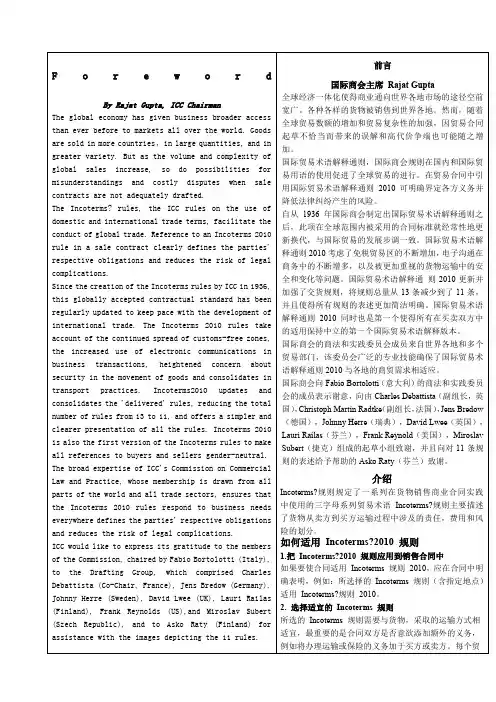
Foreword
By Rajat Gupta, ICC Chairman
The global economy has given business broader access
than ever before to markets all over the world. Goods
are sold in more countries,in large quantities, and in
greater variety. But as the volume and complexity of
global sales increase, so do possibilities for
misunderstandings and costly disputes when sale
contracts are not adequately drafted.
The Incoterms? rules, the ICC rules on the use of
domestic and international trade terms, facilitate the
conduct of global trade. Reference to an Incoterms 2010
rule in a sale contract clearly defines the parties'
respective obligations and reduces the risk of legal
complications.
Since the creation of the Incoterms rules by ICC in 1936,
this globally accepted contractual standard has been
regularly updated to keep pace with the development of
1
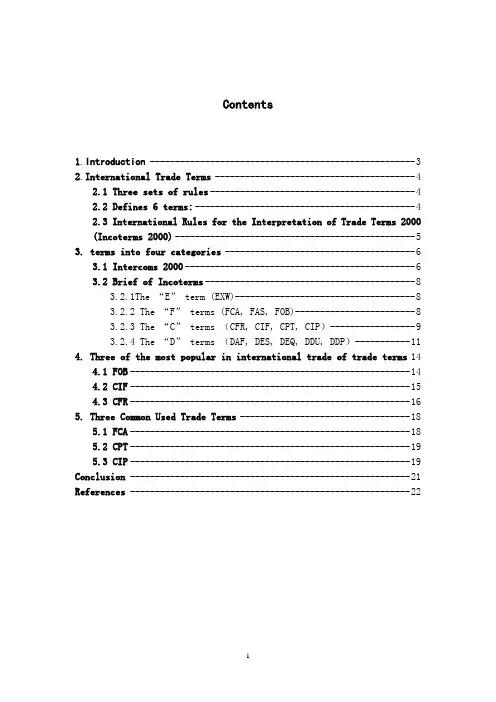
Contents
1.Introduction ----------------------------------------------------- 3
2.International Trade Terms ---------------------------------------- 4
2.1 Three sets of rules ----------------------------------------- 4
2.2 Defines 6 terms: -------------------------------------------- 4
2.3 International Rules for the Interpretation of Trade Terms 2000
(Incoterms 2000) ------------------------------------------------ 5
3. terms into four categories -------------------------------------- 6
3.1 Intercoms 2000 ---------------------------------------------- 6
3.2 Brief of Incoterms ------------------------------------------ 8
3.2.1The “E” term (EXW)------------------------------------ 8
3.2.2 The “F” terms (FCA, FAS, FOB)------------------------ 8
3.2.3 The “C” terms (CFR, CIF, CPT, CIP)----------------- 9

外贸函电范文
CIF+L/C
1.出口商或进口商取得对方联系方式后发信函请求与对方建立业务关系,此处由出口商发信函请求建交(出口商要有一套建交函电模板,可参考外贸英语函电课本)
Introduction
Dear madam,
We knew your name and address from the website of
/doc/5f6883103.html, and note with pleasure
the items of your demand just fall within the scope of our
business line. First of all, we avail ourselves of this opportunity to
introduce our company in order to be acquainted with you.
Our firm is an exporter of various WOMEN'S CARDIGAN. We
highly hope to establish business relations with your esteemed
company on the basis of mutual benefit in an earlier date. We are
sending a catalogue and a pricelist under separate cover for your
reference. We will submit our best price to you upon receipt of
your concrete inquiry.
We are looking forward to receiving your earlier reply.
Yours faithfully,
Xiaomin ma, Manager