
upgrade presentation_martin(B)-最终稿
- 格式:pptx
- 大小:104.08 KB
- 文档页数:6


DFMEA第三版--Third Edtion--Presentation 本参考手册及报告格式是由克莱斯勒、福特和通用汽车公司的失效模式及后果分析〔FMEA〕工作组编写的。
这项工作是在美国质量操纵协会〔ASQC〕汽车部和汽车工业行动集团〔AIAG〕主持下进行的。
ASQC/AIAG授权编写组将克莱斯勒、福特和通用汽车公司在其各自的供方质量体系中应用的参考手册、程序、报告格式和技术术语进行标准化处理。
因此,供方在其设计/生产过程中应用FMEA技术时,应采纳经克莱斯勒、福特和通用汽车公司批准和认可的本手册及报告格式。
过去,克莱斯勒、福特和通用汽车公司各有指南和格式来保证供方FMEA的一致性。
这些指南和格式的差异导致了对供方资源的额外要求。
为了改善这种状况,克莱斯勒、福特和通用汽车公司同意编写这本手册,并通过AIAG发行。
负责手册编写的工作组由福特汽车公司的George Baumgartner领导。
本手册提供了编制FMEA的总体指南,并没有给出如何完成每一FMEA项目的具体说明,这些具体工作应由每一FMEA小组来完成。
本手册也并非是综合性的FMEA的参考资料或培训资料。
尽管这些指南意在覆盖所有在设计时期或过程分析中通常发生的情形,但依旧不能幸免一些问题的显现。
这些问题应直截了当向顾客的供方质量保证部门〔SQA〕反映。
假如不知如何与有关SQA部门联系,那么顾客采购部的采购员可提供关心。
专门工作组衷心感谢克莱斯勒汽车公司副总裁Thoma.T.Stallkamp、福特汽车公司副总裁Norman F. Ehlers和通用汽车公司副总裁J.Ignasio Lopezde Arriortua 的领导和参与;感谢AIAG在本手册的起草、出版和发行中所提供的关心,以及专门工作组负责人Russ Jacobs〔克莱斯勒〕、Steve Walsh 〔福特〕、Dan Reid〔通用〕的指导;感谢ASQC 汽车部读物组的协助。
该小组由 TrippMartin〔Peterson Spring〕领导,对本手册的技术内容及准确性进行了批阅并在格式和内容方面提出了完善意见。

恩玲中学第十一届优质课评选获奖材料一、教师简介:(150—200字)张霞,女,大学本科,中共党员,中学二级教师。
2009年毕业于西北师大。
执教以来,一直担任英语教学工作。
在工作中注重对教学方法的探索,对教育方式的研究,以爱心感染学生,以真诚感动家长。
所带班级成绩突出,受到学校和家长的好评。
喜欢教书,寓教于乐,尊重、信任学生,充分发挥学生的主体作用,让学生做课堂的主人,营造轻松活泼的气氛,展现课堂的无穷魅力,深受学生喜爱。
教学格言:爱心献给学生,诚心送给家长,信心留给自己。
二、说课稿说课稿 --- 高考完型填空解题步骤及技巧指导与训练【教学时间】45分钟【学生情况分析】学生目前已经完成高中三年基础语言知识和主要语法项目的学习,转入高三一轮复习阶段。
从过往的情况来看,完型填空题的正确率是不太理想的,原因主要在于两个方面:一是词汇搭配和语义辨析不过关,遗忘率较高;二是没有根据题型特点运用适当的解题策略,往往由于脱离上下文,偏离主线而出错。
前者要在下一轮的复习中继续巩固积累;后者则需要进行有效策略的指导,这正是本节课的目标定位,让学生学会充分利用篇章,句子,词汇提供的信息命中正确选项。
同时在以往的教学中发现教师讲,学生听的方式效果不理想,学生听完就忘了,所以还是应把训练落实到做上,从做中去体验,思考和学习。
【教学材料分析】本节课选编的材料分为三个部分,第一部分是按照教师所给句子,启发学生依据前后文进行填空;第二部分引出完形填空解题步骤以及五种技巧,按照所用技巧分类的练习,让学生集中训练五种技巧,全部节选自历届高考题;第三部分是几篇完型填空的文章部分,要求学生依据所学技巧及微课的帮助下完成练习;三个部分由简入难,环环相扣,让学生顺着教师的指引进行训练。
【教学目标】本节课是针对高考题型完型填空的专题训练课,目的在于帮助学生形成正确清晰的解题思路,掌握有效的技巧,从而增强备考的信心,并明确今后努力的方向。
在教学策略上贯彻“在做中学,学中做”的教学策略,让学生在课堂上通过亲身体验各种解题技巧形成自己的策略,得到思维的锻炼。
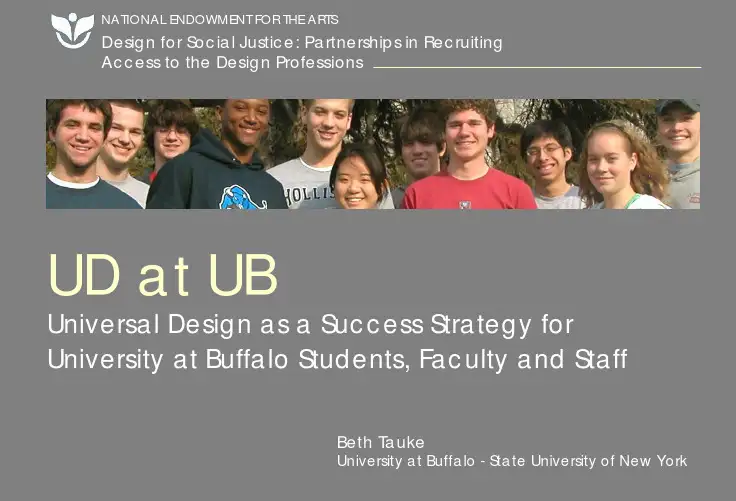
Access to the Design ProfessionsUD at UBUniversal Design as a Success Strategy for University at Buffalo Students, Faculty and StaffBeth TaukeUniversity at Buffalo -State University of New YorkAccess to the Design ProfessionsTo understand something, learn it more than one way.Marvin MinskyCo-founder of The Artificial Intelligence LaboratoryMassachusetts Institute of Technology (MIT)Access to the Design ProfessionsPrimary objectives to help faculty develop presentation material that benefits not only students with documented disabilities, but all students to offer course methods that encourage all students to participate regardless of their learning styles and abilities to discuss ways to encourage inclusive education in both traditional and non-traditional academic settings 1_2_3_Access to the Design ProfessionsPrimary objectives to help faculty develop presentation material that benefits not only students with documented disabilities, but all students to offer course methods that encourage all students to participate regardless of their learning styles and abilities to discuss ways to encourage inclusive education in both traditional and non-traditional academic settings 1_2_3_Access to the Design ProfessionsPrimary objectives to help faculty develop presentation material that benefits not only students with documented disabilities, but all students to offer course methods that encourage all students to participate regardless of their learning styles and abilities to discuss ways to encourage inclusive education in both traditional and non-traditional academic settings 1_2_3_Access to the Design ProfessionsMany [students] struggle because the way they are being taught is incompatible with the way they learn.Peter SengeDirector, Center for Organizational LearningSloan School of Management (MIT)Access to the Design ProfessionsOur UB students have:• A variety of cultural, ethnic, and racial background •Distinct learning styles•Different primary languages•Different abilitiesAccess to the Design ProfessionsBecause of these many factors, our students receive, process, remember, and apply concepts and information in various ways.As conscientious educators, we need to establish basic equity in the classroom by using multiple modes of learning.Access to the Design ProfessionsUniversal Design is the design of products, environments, information and systems that are usable by all people, to the greatest extent possible, without the need for adaptation or specialized design.Access to the Design ProfessionsThe Seven Principles of Universal Designwere developed in 1997 by a group of architects, product designers, engineers, and environmental design researchers to provide guidance in the planning, design and production of our world.Their goal was to promote design for all.Access to the Design ProfessionsSince that time, the principles have been used by educators as well. They have termed the concept Universal Design for Learning (UDL)orUniversal Design for Instruction (UDI).Access to the Design ProfessionsUniversal Design for Learningis an evolving practice that focuses on meeting the learning needs of all students while maintaining high academic standards.Access to the Design ProfessionsLet’s look at the Seven Principles of Universal Design and how they can be applied to learning situations.Access to the Design ProfessionsPrinciples of Universal Design1 Equitable UseEqually usable by everyoneDoes not isolate or stigmatize any groupAccess to the Design ProfessionsExample: Universal Design for Learning1 Equitable UseA professor ensures that all students can learn course material by using multiple modes (visuals, audios, text, discussion, hands-on experience, etc.).Access to the Design ProfessionsPrinciples of Universal Design2 Flexibility in UseProvides choice in methods of useAccommodates a wide range of individual preferences and abilitiesAccess to the Design ProfessionsExample: Universal Design for Learning2 Flexibility in UseCourses are designed to respond to what is actually happening in the class. In other words, professors develop Plan Bs and Cs that are directed at students’interests and needs.Access to the Design ProfessionsPrinciples of Universal Design3 Simple and Intuitive UseEasy to understand, regardless of the user's experience, knowledge, language skills, or concentration levelAccess to the Design ProfessionsExample: Universal Design for Learning3 Simple and Intuitive UseCourse materials are presented as clearly and directly as possible. Course tools (texts, websites, calculators, microscopes, etc.) are designed to be straightforward and understandable.Access to the Design ProfessionsPrinciples of Universal Design4 Perceptible InformationPresents essential information in a variety of sensory modesConsiders various ambient conditions and the user's sensory abilitiesAccess to the Design ProfessionsExample: Universal Design for Learning4 Perceptible InformationInstructors verbally describe images, objects, or procedures to ensure that those with low vision can understand. Presentation text is spoken, and is large enough to be read in the back of the room.Access to the Design ProfessionsPrinciples of Universal Design5 Tolerance for ErrorReduces hazards and the adverse consequences of accidental or unintended actionsMinimizes inconvenienceAccess to the Design ProfessionsExample: Universal Design for Learning5 Tolerance for ErrorStudents are given opportunities to learn from their mistakes. For example, an incorrect response on a quiz could prompt an explanation of the correct response.Access to the Design ProfessionsPrinciples of Universal Design6 Low Physical EffortCan be used efficiently and comfortably, and with a minimum of fatigueIncorporates safetyAccess to the Design ProfessionsExample: Universal Design for Learning6 Low Physical EffortCourse material is provided in segments to avoid attention ‘burn out’. Students are provided with breaks to stretch and get fresh air/water.Access to the Design ProfessionsPrinciples of Universal Design7 Size and Space for Approach and Use Incorporates appropriate size and space forapproach and use regardless of the user's body size, posture, or mobilityArranges elements for use by allAccess to the Design ProfessionsExample: Universal Design for Learning7 Size and Space for Approach and UseFaculty make certain that all students have clear access to course material.Tools and furniture are arranged so that all students can use them. Websites have enough ‘white space’for easy navigation.Access to the Design ProfessionsExample: Steel Beam Connection Assembly Hearing itAccess to the Design ProfessionsExample: Steel Beam Connection Assembly Reading itIn steel construction, the typical connection between a column and a beam requires several different elements: 2 T-sections, 2 elbows, and 24 bolts with nuts and washers. The conventional process includes drilling holes in the column, beam, Ts and elbows. One T is bolted to the column below where the beam is to be located as a support for the weight of the beam. The beam is set on this support to hold it in place while the other T at the top and the 2 elbows, one on each side of the webbing of the beam, are bolted in place. Thus, all four sides of the beam are connected to the column.Access to the Design ProfessionsExample: Steel Beam Connection Assembly Seeing itAccess to the Design ProfessionsExample: Steel Beam Connection Assembly Doing itAccess to the Design ProfessionsHow can the learning experiences that you design for your students become more inclusive?Access to the Design ProfessionsRemember that Universal Design is an evolving practice that strives to meet the learning needs of all students.Small changes can lead to big results.Access to the Design ProfessionsShort Term Outcomes Raise awareness among university faculty, about universally designed approaches to teaching and learning Increase number of faculty who incorporate inclusive teaching/learning practices into their courses1_2_Access to the Design ProfessionsShort Term Outcomes Raise awareness among university faculty, about universally designed approaches to teaching and learning Increase number of faculty who incorporate inclusive teaching/learning practices into their courses1_2_Access to the Design ProfessionsLong Term Outcomes Increase the number of universally designed courses at the university level Increase the academic success of allUniversity at Buffalo students 1_2_Access to the Design ProfessionsLong Term Outcomes Increase the number of universally designed courses at the university level Increase the academic success of allUniversity at Buffalo students 1_2_Access to the Design ProfessionsOur aspirations are our possibilities.Samuel JohnsonEnglish Poet, Critic, and Writer1709-1784Access to the Design ProfessionsAccess to Design Professions is a project of the Institute for Human Centered Design/Adaptive Environments and funded in part by the National Endowment for the Arts.Access to the Design ProfessionsThis presentation is available atUniversal Design Education Online andAccess to the Design ProfessionsFor more information, contactProf. Beth TaukeCenter for Inclusive Design and Environmental Access (IDEA) Department of ArchitectureUniversity at Buffalo -State University of New York tauke@Access to the Design ProfessionsResourcesFollette Story, M., Mueller, J.L., & Mace, R.L. (1998). The universal design file: Designing for people of all ages and abilities. Raleigh, NC: North Carolina State University, The Center for Universal Design.Pope, C. (2007). Universal design for learning. Pittsburgh, PA: LDA 44th Annual International ConferenceScott, S., McGuire, J.M., & Shaw, S. (2001). Principles of universal design for instruction. Storrs, CT: Center on Postsecondary Education and Disability.Access to the Design ProfessionsImage Descriptions and Photography CreditsS1:Faces of twelve 1st year UB architecture students on the South Campus of UB. Photo: Beth TaukeS2:Three different methods of learning1. Left –hands on learning with the help of a teacher. Photo:Flickr Creative Commons:/photos/bdamgaard/446717942/2. Middle –auditory learning, photo of girl with headphonesPhoto: Flickr Creative Commons:/photos/rouleau/2218280995/3. Right –learning by reading, person reading a book. Photo:Photo: Flickr Creative Commons:/photos/slow_boat_to_china/301818731 9/Access to the Design ProfessionsS6:Person learning in traditional classroom. Depiction of potential issues associated with un-accommodating teaching style.Photo: Flickr Creative Commons/photos/foundphotoslj/466722575/S7: UB students conversing on UB property in large gathering.Photo: Frank Miller, UB ArchivesS8: Many identical seats in classroom. Depiction of the nature of standardization of learning for students who may need differing modes of teaching. Photo: Flickr Creative Commons/photos/dcjohn/74907741/Access to the Design ProfessionsS9: Adjustable public telephone. Proposal in the R1 IDEA center study at the University at Buffalo. Photo: G.S. Danford, D.M.SchoellS10: Diverse people in crowd. Photo: Flickr Creative Commons /photos/untitlism/22800371/S11: Two University Students conducting experiment in laboratory.Photo: Frank Miller, UB ArchivesS12: One male and one female UB architecture student working with a male faculty member. Photo: Beth TaukeAccess to the Design ProfessionsS13: Crowd of diverse people reflected in a crystal ball held in an adult’s hand. Photo: Flickr Creative Commons/photos/bbphotog/774619240/sizes/l/S14: Icon for the 1st Principle of Universal Design –Equitable Use.Icon shows an equal sign on a black background. ©Copyright –Beth Tauke, Center for Inclusive Design and EnvironmentalAccess, 2000.S15: Five media students and their professor discussing animations that they are viewing on a computer screen and othermonitors. Photo: Frank Miller, UB Archives.Access to the Design ProfessionsS16: Icon for the 2nd Principle of Universal Design –Flexibility in Use.Icon shows a flexible spring on a black background. ©Copyright –Beth Tauke, Center for Inclusive Design andEnvironmental Access, 2000.S17: Two graduate students and their professor demonstrate new flexible building materials. Photo: Doug Levere, UB Archives.S18: Icon for the 3rd Principle of Universal Design –Simple and Intuitive Use. Icon shows two puzzle pieces that fit together on a black background. ©Copyright –Beth Tauke, Center forInclusive Design and Environmental Access, 2000.S19: Person using cellular phone. Photo: Frank Miller, UB ArchivesAccess to the Design ProfessionsS20: Icon for the 4th Principle of Universal Design –Perceptible Information. Icon shows an eye on a black background. ©Copyright –Beth Tauke, Center for Inclusive Design andEnvironmental Access, 2000.S21: UB student conduction experiment in science facility. Photo: Doug Levere, UB Archives.S22: Icon for the 5th Principle of Universal Design –Tolerance for Error. Icon shows a life preserver on a black background. ©Copyright –Beth Tauke, Center for Inclusive Design andEnvironmental Access, 2000.S23: Microsoft error textbox. Photo: Beth TaukeAccess to the Design ProfessionsS24: Icon for the 6th Principle of Universal Design –Low Physical Effort. Icon shows a feather on a black background. ©Copyright –Beth Tauke, Center for Inclusive Design andEnvironmental Access, 2000.S25: UB student sleeping in University facility on notes. Photo:Doug Levere, UB Archives.S26: Icon for the 7th Principle of Universal Design –Size an Space for Approach and Use. Icon shows a larger person next to asmaller person on a black background. ©Copyright –BethTauke, Center for Inclusive Design and Environmental Access, 2000.S27: UB students attending class in computer lab. Photo: Doug Levere, UB Archives.Access to the Design ProfessionsS28: Mouth and ear with motion depicting sound between them.Photo: Ghada Mohamad.S30: Computer animation of steel beam connection assembly.Animation: Shahin VassighS31: Two workers connecting steel beams on site.Photo: Flickr Creative Commons/photos/myconstructionphotos/15267531 92/S32: Three UB students and on professor experimenting with material capabilities in architecture studio facility. Photo: Doug Levere, UB Archives.。
