features of context
- 格式:ppt
- 大小:802.00 KB
- 文档页数:13

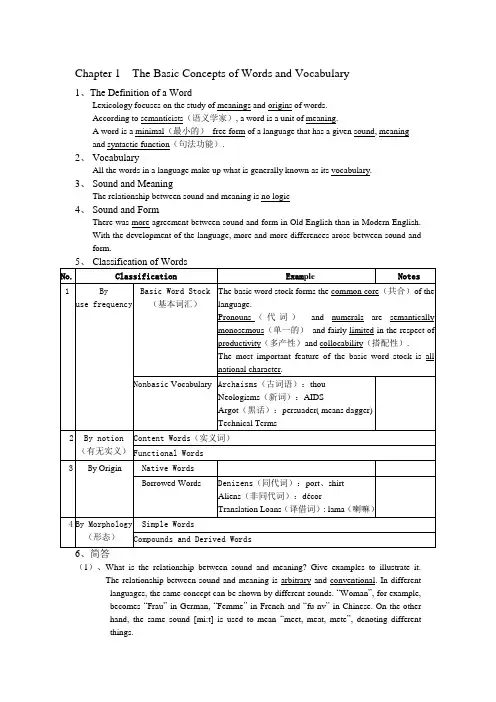
Chapter 1 The Basic Concepts of Words and Vocabulary1、The Definition of a WordLexicology focuses on the study of meanings and origins of words.According to semanticists(语义学家), a word is a unit of meaning.A word is a minimal(最小的)free form of a language that has a given sound, meaningand syntactic function(句法功能).2、 VocabularyAll the words in a language make up what is generally known as its vocabulary.3、 Sound and MeaningThe relationship between sound and meaning is no logic4、 Sound and FormThere was more agreement between sound and form in Old English than in Modern English.With the development of the language, more and more differences arose between sound and form.(1)、What is the relationship between sound and meaning? Give examples to illustrate it.The relationship between sound and meaning is arbitrary and conventional. In differentlanguages, the same concept can be shown by different sounds. “Woman”, for example,becomes “Frau” in German, “Femme” in French and “fu nv” in Chinese. On the otherhand, the same sound [mi:t] is used to mean “meet, meat, mete”, denoting differentthings.(2)、What are the four major reasons for the differences between sound and form?The first reason (he internal reason) is that there are more phonemes (音素)than lettersin English. Another reason is that the pronunciation has changed more rapidly thanspelling over the years. The third reasons that some of the differences more created bythe early scribes. The fourth reason is the borrowing.(3)、How are words classified in the course book?Words can be classified by different criteria and for different purposes. Words may fallinto: the basic word stock and nonbasic vocabulary by use frequency; content words andfunctional words by notion; native words and borrowed words by origin; simple words,compounds and derived words by morphology.(4)、What is the difference between denizens and aliens?Denizens are words borrowed early in the past and now are well assimilated(完全同化)into the English language. But aliens are borrowed words which have retained their original pronunciation and spelling. These words are immediately recognizable as foreign in origin.Chapter 2 The Development of the English Vocabulary1、The Indo-European Language FamilyThe prehistoric Indo-European parent language, thought to be a highly inflected (内部曲折语)language.The first peoples who inhabited the land were Celts.The second language known in English was Latin of the Roman Legions.(1)、Old English(450-1150)In the 9th century England was invaded by Norwegian and Danish Vikings.(2)、Middle English(1150-1500)The French influence on English vocabulary was one of the significant points of theMiddle English period.The most important fact of the Middle English period was the steady erosion of theinflectional systems of Old English.(3)、Modern English(1500-present)In the early period of Modern English, Europe saw a new upsurge of learning ancientGreek and Roman classics.It is estimated that about one fourth of modern English vocabulary has come from French.3、 Foreign Elements in the English VocabularyIn earlier stages of English, Latin, Greek, French and Scandinavian were the four major contributors.The simultaneous existence of French, Latin and English lasted for a century.4、 Modes of Vocabulary DevelopmentModern English vocabulary develops through three channels: creation, semantic change(旧词新义)and borrowing.Creation is the most important way of vocabulary expansion.5、简答What are the characteristics of Old English?Old English also known as the Anglo-Saxon, has a vocabulary of about 50000 to 60000 words, which are almost monogeneous and entirely Germanic with only a few borrowings from Latin and Scandinavian. Old English was a highly inflected language.It was a synthetic language(综合性语言).(Modern English is an analytic language)Chapter 3 Morphological Structure of English Words1、 MorphemesThe minimal meaningful units in English are known as morphemes(词素).Morphemes are abstract units, which are realized in speech by discrete units known as morphs.4、 Allomorphs(词素变体)An allomorph refers to a member of a set of morphs, which represent one morpheme.6、A root is the basic form of a word which cannot be further analyzed without total loss ofidentity.7、简答(1)、What is the difference between free morphemes and bound morphemes?Free morphemes which have complete meanings in themselves and can be used as freegrammatical units in sentences are independent of other morphemes, but boundmorphemes which cannot occur as separate. Words are bound to other morphemes to form words or to perform a particular grammatical function.(2)、What is the difference between derivational morphemes and inflectional morphemes?Derivational morphemes are used to derive new words, but inflectional morphemes areemployed used to indicate the syntactic (句法)relationship between words and functionas grammatical markers.Chapter 4 Word FormatioThe most productive ways of creating new words are affixation, compounding, and conversion. 1、AffixationThe words created by adding word forming or derivational affixes to bases are calledderivatives.2、Compounding(复合法)Example: workfare(work+welfare)In adjective-plus-noun compounds, the adjective element cannot take inflectional suffixes.Verb compounds are created either though conversion or through back-formation.3、Conversion(转类法)The conversion that takes place between nouns and verbs is the most productive.The conversion of two syllable nouns into verbs involves a change of stress.Nouns fully converted from adjectives have all the characteristics of nouns.4、 Blending(拼缀法)The overwhelming majority of blends are nouns5、Back-formation(逆身法)Back-formation is considered to be the opposite process of suffixation.6、简答(1)、What is the main difference between prefixes and suffixes?Unlike prefixes which primarily effect a semantic modification of the base, suffixeshave only a small semantic role, their primary function being to changes thegrammatical function of a base, i.e. the change of the word class with a slightmodification of meaning.(2)、What are the three main features of compounds?The three main features of compounds are phonological features, semantic features and grammatical features. The word stress of a compound usually occurs on the first element.Each compound should express a single idea just as one word. A compound tends to playa single grammatical role in a sentence.(3)、What is back-formation? What are the characteristics of back-formation?Back-formation is the method of creating words by removing the supposed suffixes.Words created through back-formation are verbs. Stylistically, back-formed words are largely informal and some of them have not successfully gained currency.(4)、What is acronymy? What is the difference between initialisms and acrnyms?Acronymy is the process of forming new words by joining the initial letters of composite names of social and political organizations or phrases used as technical terms. Words formed in this way are called initialisms or acronyms. Initialisms are pronounced letter by letter, but acronyms are pronounced as normal words7、论述题1、“Medicare” and “sitcom” are blends. “Medicare” is formed by combining the head of “medical’and the word “care”, and “sitcom” is formed by combining the head of “situation” and that of “comdey’.2、”Memo” and “flu” are clipped words. “Memo” is formed by clipping the lack of“memorandum” and “flu” is formed clipping the front and lack of “influenza”.3、”TB” and “NATO” are new words created through acronymy. “TB” from “tuberculosis” is aninitialism, while “NATO” from “the North Atlantic Treaty Organization” is an acronym.Chapter 5 Word Meaning and Componential Analysis(成份分析法)1、ReferenceWords are but symbols, many of which have meaning only when they have acquiredreference.2、Concept(概念)Meaning and concept are closely connected but not identical.Concept, which is beyond language, is the result of human cognition, reflecting the objective world in the human mind.3、SenseUnlike reference, sense denotes the relationships inside the language.4、Motivation(理据)(1)、What is reference? What are the characteristics of reference?Reference is the relationship between language and the world. By means of reference, a speaker indicates which things in the world are being talked about. The reference of a word to a thing outside the language is arbitrary and conventional. Although reference isa kind of abstraction, yet with the help of context, it can refer to something definite.(2)、What is conceptual meaning? What are the characteristics of conceptual meaning?Conceptual meaning known as cognitive, denotative, or designative is the meaning given in the dictionary and forms the core of word meaning. Being constant and relatively stable, conceptual meaning forms the basis for communication as The same word generally has the same conceptual meaning to all the speakers of the same speech community. (language).(3)、What is the difference between conceptual meaning and associative meaning?Conceptual meaning known as cognitive, denotative, or designative is the meaning given in the dictionary and forms the core of word meaning. But Associative meaning is the secondary meaning supplemented to the conceptual meaning. It differs from the conceptual meaning because it is open-ended and indeterminate, liable to the influence of such factors as culture, experience, religion, geographical region, class background, education, etc. .(4)、What is collocative meaning? What are the characteristics of collocative meaning?Collocative meaning is that part of the word meaning suggested by the words with which it co-occurs. It is again noticeable that collocative meaning overlaps with connotative and affective meaning because in a sense both connotative and affective meanings are revealed by virtue of collocations or contextuality.Chapter 6 Sense Relations(语义关系)The first meaning of a word is called primary meaning. Later meanings are called derived meaningsThe meaning of a more specific word is include in that of another more general word.简答What is the difference between radiation and concatenation(连锁型)?Unlike radiation where each of the derived meanings is directly connected to the primary meaning, concatenation describes a process where each of the later meanings is related only to the preceding one like chains.Chapter 7 Changes in Word MeaningThe vocabulary is the most unstable element of a language as it is undergoing constant changes both in the sign-shapes and sign contents.(1)、What is semantic transfer? What are the four main types of transfer?Some words which were used to designate/indicate one thing but later changed to meansomething else have experienced the process of semantic transfer. The four main typesof transfer are the associated transfer, the transfer between abstract and concretemeanings, the transfer between subjective and objective meanings and the synesthesim.(2)、What are the two factors causing changes in meanings? How are they classified?The two major factors that cause changes in meaning are the extra-linguistic factors andthe linguistic factors. The extra-linguistic factors include the historic reason, the classreason and the psychological reason. The linguistic factors include shortening,borrowing and analogy.(类比)Chapter 8 Meaning and Context(语境)1、 Types of ContextWithout context, there is no way to determine the meaning that the speaker intends to convey.When we talk about context, we usually think of linguistic context, hardly aware of theAmbiguity often arises due to polysemy, homonymy and grammatical structure. When a word with multiple meanings is employed in inadequate context, it creates ambiguity.3、简答(1)、what is the difference between linguistic context and extra-linguistic context?Linguistic refers to the words, clauses, sentences in which a word appears and it is known as linguistic context or co-text may extend to embrace a paragraph, a whole chapter and even the entire book. But extra-linguistic or non-linguistic context refers to the participants, time, place, and even the whole cultural background(2)、What is the difference between lexical context and grammatical context?Lexical context refers to the words that co-occur with the word in question. The meaning of the word is often affected and defined by the neighbouring words. But grammaticalcontext refers to the structure which may influence the meaning of a polysemant.4、论述题Read the sentence carefully. If you find anything inappropriate, explain the reasons and then improve the sentence.a.He is a hard businessman.John ran the egg and spoon race.1、The sentence is ambiguous. The ambiguity is caused by polysemy.2、The word “hard” in this sentence can be understood as “hardworking” or “difficult”.The context fails to narrow down the meaning so that it is difficult for the reader todecide what exactly the speaker means.3、The ambiguity can be eliminated by altering the context a little. There would be nomisunderstanding of the original sentence if it is expanded as “He is a hardbusinessman to deal with ”, or “He is a hard businessman and he is often praised by hisemployer”.(participated or organized John ran the egg and spoon race and got second place. orJohn ran the egg and spoon race and gain a larger number of money.)b.They saw her duck.The ball was attractive.1、The sentence is ambiguous. The ambiguity is caused by homonymy.2、The word “ball” in this sentence can be understood as a noun, which refer to “roundobject to play in a game” or a “dancing party”. The context fails to narrow down themeaning so that it is difficult for the reader to decide what exactly the speaker means.3、The ambiguity can be eliminated by altering the context a little. It is clear if it isexpanded as “The ball was attractive with nice music and a lot of peoples ”, or “Theball made of leather of different colors was attractive”.(kind of poultry or verb meaning ”lower one’s head or body quickly, dodge”They saw her duck or swimming in the river or They saw her duck her body.)c、The fish is ready to eat.I like Mary better than Jean.1、The sentence is ambiguous. The ambiguity is caused by inadequate grammaticalstructure..2、The sentence has two different interpretations. It may mean “the fish is cooked orserved, so ready for people to eat or a “the fish is ready to eat things”. The context fails to narrow down the meaning so that it is difficult for the reader to decide what exactly the speaker means.3、The sentence can be improved as “How nice the fish smell! The fish is ready to eat.” or“The fish is ready to eat things.(I like Mary better than I like Jean or I like Mary better than Jean likes MaryI like Mary better than Jean does. or I like Mary better than I do Jean.)Chapter 9 English IdiomsStylistically, idioms are generally felt to be informal and some are colloquialisms(口语体)and slang.(1)、What are the characteristics of English idioms?The two main characteristics of English idioms are semantic unity and structural stability.Idioms each consist of at least two or more constituents, but each is a semantic unity. The structure of an idiom is to a large extend invariable.(2)、What are the rhetorical features of English idioms?The rhetorical features of English idioms include the phonetic manipulation, the lexicalmanipulation and the semantic manipulation. The phonetic manipulation includesalliteration and rhyme(叠韵). The lexical manipulation includes reiteration, repletionand juxtaposition. The semantic manipulation includes (Figures of speech) Simile,Metaphor, Metonymy, Synecdoche, Personification, Euphemism.Chapter 10 English DictionariesThe main body of a dictionary is its definitions of words.3、Dictionaries(1)、Longman Dictionary of Contemporary English-English-Chinese(LDCE《朗文高级当代英语词典英汉双解》)Features: Clear Grammar Codes, Usage Notes, Language Notes, New words(2)、Collins COBUILD English Dictionary(CCED《柯林斯COBUILD英语词典》)Features: Definition, Extra Column, Frequency Marker, Pragmatics(词语用法说明)4、British or AmericanAmerican dictionaries contain more encyclopaedic information in the main body than British one whereas British dictionaries, especially learner’s dictionaries, embrace more grammatical information.5、简答What is a dictionary? What is the relationship between a dictionary and lexicology?A dictionary is a book which presents in alphabetical order the words of English,with information as to their spelling, pronunciation, meaning, usage, rules of grammar, and in some, their etymology. It is closely related to lexicology because both deal with the same problems: the form, meaning, usage and origins of vocabulary units.。

2112019年06期总第446期语言文化研究ENGLISH ON CAMPUSContext 和Co-text 的术语辨析文/唐艳瑢何兆熊(1989)把“语境”描述为两种知识:内在语言知识(一套构成人们说话和理解语言能力基础的规则)和外部语言知识(包括说话人和听话人共享的知识以及话语的总体非语言语境)。
2.Context的内涵。
回顾了“语境”的相关研究后,我们需要知道“语境”到底什么。
不同的学者对此也有不同的说法。
例如:“语境”不仅仅是一种参考,更是一种行为。
“语境”是为了让我们的话语具有真正的语用意义,有真正的语用行为(Mey,2001)。
“语境”通常被认为是由说话者和听者共享的知识构成的(戴炜栋、何兆雄,2006)。
一个单词或句子前后的单词,能帮助理解其含义的就是“语境”(Longman,2010)。
3.Context的分类。
不同学者对“语境”的分类如下:第一种是Malinknowski的划分。
他认为“语境”可划分为“文化语境”和“情景语境”(Malinknowski,1923),后者又可分为(1)言语与身体活动相关的情景;(2)叙述情景;(3)用语言来填补语言空白的情景(胡壮麟,2001)。
第二种分类是Firth提出的。
根据他的观点,“语境”有两种类型:“语言语境”和“情景语境”。
前者包括语音、语义、语法等,后者包括社会环境、时代背景、交流的自然环境(冯广义,1998)。
Verschueren(2000)认为语境有两种类型:“交际语境”,即语言使用者(说话者和听话者,以及与交际有关的人)、心理世界(认知和情感因素)、社会(社会环境、制度、语言行为的原则和规则类型)和物理世界(时间和空间);第二类是“语言语境”,在严格意义上被称为“上下文”。
胡壮麟(1994)对于“语境”的分类是:“语言语境”,“情景语境”和“文化语境”。
语言语境是语篇的内在状态。
情景语境:指话语发生的物理情境,包括社会行为的性质、参与者的角色、时间、地点、方式等;文化语境:指说话人所在语言环境的社会文化习俗。

The Notion of “Context” in Language Education * M.A.K. HallidayProfessor Emeritus, University of Sydney AbstractThe principle that language is understood in relation to its environment is nowhere more evident than in the activities of language education. This principle was explicitly recognised when scholars first began observing spoken language, since it was impossible to interpret spoken text in isolation from its context; but it is equally true of all text, spoken or written. It is true also of the linguistic system that lies behind the text; but whereas the environment for language as text is the context of situation, the environment for language as system is the context of culture. In the course of education, language figures in three different guises : as substance (learning language : mother tongue, second/foreign language), as instrument (learning through language : school subjects such as science, history ...), and as object (learning about language : grammar, styles/registers, history of words, ...). If the context is theorised in linguistic terms as another stratum in the organisation of language itself, this enables us to model its variation and complexity, taking account of the differing suituational contexts for different levels and kinds of teaching/learning activities, as well as the processes and the institutions of education and the different cultures within which these are located.1.1 Language and Language educationMy concern here is with “context” as a notion that is useful for thinking with when one is investigating language. But I want to consider it, not in relation to linguistics as a whole but in relation to one particular domain of linguistic activity, namely language education. This does not mean that theoretical issuesThe Notion of …Context‟ Halliday2will be absent; but they will be approached from a specific angle.------------------------------------------------------* This chapter is a revised version of a paper presented at the International Conference on “Language Education : Interaction and Development”, held in Ho Chi Minh City, Vietnam, in 1991. I am grateful to the Editor for the opportunity to include it in the present volume.The Notion of …Context‟ Halliday 3 Education, I take it, means enabling people to learn; notjust to learn in the natural, commonsense ways in which we learn in our daily lives, but to learn in an organized, progressive, and systematic manner according to some generally accepted principles about what people ought to know.So when we qualify this as “language education”, what havewe added to the definition?In one sense, nothing at all; all education takes place through the medium of language. I don't mean all learning: human beings learn a great deal without the medium of language. But all educational learning is mediated through language; so why “language education”? We have come to usethis term, over the past 10 - 15 years, partly to make explicitthat very point: to bring to the foreground a motif that emergedin the 1960s, of “language across the curriculum”, when it wasfirst widely recognized that there was an essential language component in learning science or learning history or learning anything else that had a place in school. But at the same time,in talking of language education we are asserting that there is a relationship between language as a medium of learning, in this sense of “language across the curriculum”, and language as the substance of what is being learnt, in the teaching of foreign or second languages, of the mother tongue, of reading and writing, of grammar, composition and so on.What is common to all these activities is expressed, inpart at least, by the word “language”. Language is implicated in some way or other in all educational activity; so we need to be aware of it, to recognize when learning problems are in some sense problems of language, and to conduct theory-based research into the linguistic aspects of educational processes.We know that this view is coming to be shared by the community when we see developments like the Centre for Studies of Language in Education at the Northern Territory University in Australia, or the Institute of Language Educationin Hong Kong. This tells us that there is a field of activity, or research and development, identified as the study of languagein education, where we investigate how language functions in various educational contexts, and by doing so, seek to improveour educationa1 practice.The Notion of …Context‟ Halliday4I used the expression of language “functioning ineducational contexts”, and I think we have to bring this notion of language functioning in context explicitly into the discussion. What is distinctive about “educational linguistics”, if I may be allowed to use that term as a shorthand for investigating language for educational purposes, is that we are concerned always with language in context (Martin 1993;Rothery, in Hasan and Williams, eds., 1996). We are identifying certain kinds of activity in which language has a central place, and finding out just how language comes to play its part. What do people actually read, and listen to, and say, and write, when they are being “educated”? what do they expect to achieve through using language? and how do we tell, and how do they tell, whether they have achieved it or not?We generally take this notion of “context” for granted.The context is some sort of environment; it's what's going on around, where language is somehow involved. And if we're talking English we then manipulate this in the typical English way, expanding the word by various derivations: we have the adjective contextual, as in contextual features or parameters;then the verb contextualize; and since language can be contextualized, it can also be decontextualized, and then of course recontextualized over again. And each of these, in turn, can become an abstract object, like recontextualization. So I think we should put this word “context” in inverted commas fora while and ask what it actually means: problematize it, if youlike.1.2 Context of situationOriginally, the context meant the accompanying text, the wording that came before and after whatever was under attention. In the nineteenth century it was extended to things other than language, both concrete and abstract:the context of the building, the moral context of the day;but if you were talking about language, then it still referred to the surrounding words, and it was only in modern linguistics that it came to refer to the non-verbal environment in which language wasThe Notion of …Context‟ Halliday 5 used. When that had happened, it was Catford, I think, who suggested that we now needed another term to refer explicitlyto the verbal environment; and he proposed the term “co-text”.But how did context come to be extended in this way?Here is Malinowski writing in 1923, about what at that timewas referred to as a “primitive” (that is, unwritten) language.He writes “In a primitive language the meaning of any single word is to a very high degree dependent on its context. ... [An expression such as] we paddle in place demands the context ofthe whole utterance, ... [and] this latter again, becomes only intelligible when it is placed within its context of situation, if Imay be allowed to coin an expression which indicates on theone hand that the conception of context has to be broadenedand on the other hand that the situation in which words are uttered can never be passed over as irrelevant to the linguistic expression” (Malinowski, 1923: 306). (In passing, we mightnote that on the very next page he also wrote “The conceptionof meaning as contained in an utterance is false and futile”.)Ten years or so later, Malinowski had changed his view thatthis was a special feature of “primitive” languages; writing in 1935 he said all languages were alike in that “the real understanding of words is always ultimately derived from active experience of those aspects of reality to which the words belong” (Malinowski, 1935:58; cf. Hasan, 1985). By this time Malinowski is extending the notion of context still further: overand beyond the context of situation lies “what we might call [the] context of culture”, so that “the definition of a word consists partly of placing it within its cultural context” (ibid.:18). What this means is that language considered as a system - its lexical items and grammatical categories - is to be related to its context of culture; while instances of language inuse - specific texts and their component parts - are to be relatedto their context of situation. Both these contexts are of course outside of language itself.Although Malinowski was the first to use the expression context of situation, the concept of “situation”, in the sense ofthe events and actions that are going on around when people speak, had been invoked before in linguistics, in a very different domain of inquiry, namely dialectology. LinguisticThe Notion of …Context‟ Halliday6field studies were not only of culturally exotic, unwritten languages such as those studied by anthropologists; they were also carried out with rural dialects, and the Swiss dialectologist Wegener had developed a “situation theory” to account for the “special” features of informal, spoken language - that is, features that appeared special at a time when the only form of text that was recognized in linguistics was a written text, preferably written in a language long since dead (ie., no longer spoken at all) (Firth, 1957b). What led linguists to take account of the situation was when they turned their attention to speech.Here, they had to recognize factors like reference to persons, objects and events within the speaker‟s attention (technically, “exophoric deixis”), as well as other, more oblique forms of dependence on and interaction with the environment. What Malinowski was saying was that because of these things, in spoken language the “situation” functioned by analogy as a kind of context. The situation was like the text by which a piece of spoken discourse was surrounded.Malinowski was an anthropologist, who became a linguist in the service of his ethnographic pursuits. His younger colleague J.R. Firth, who was a linguist, saw the possibility of integrating this notion, of the “situation” as a kind of context, into a general theory of language. Firth was also interested in spoken language; but not as something quaint or exotic like rural dialects and aboriginal languages. On the contrary; Firth was concerned with the typical -what he referred to as “typical texts in their contexts of situation” (Firth, 1957a:224), by which people enacted their day-to-day interpersonal relationships and constructed a social identity for themselves and the people around them. A text was an object of theoretical study in its own right; and what Firth did was to map the notion of “context of situation” into a general theory of levels of language. All linguistic analysis, Firth said, was a study of meaning, and meaning could be defined operationally as“function in context”; so to study me aning you took each of the traditional divisions of linguistic theory - phonetic, phonological, lexical, morphological, syntactic - and treated it as a kind of context. You could then include the situation as just another linguistic level. But the context of situation didThe Notion of …Context‟ Halliday 7 have a special place in the overall framework, since it was herethat the text as a whole could be “contextualized”. (And if itwas a written text it could be tracked through time, as it cameto be “recontextualized” with changes in the co ntexts in whichit was read and the cultural background and assumptions of those who read it.)1.3 Context of cultureWhat about the “context of culture”? Firth made very little useof this idea. Although, to use Robins' words (Robins, 1963:17),Firth considered that a language was “embedded in the life and culture of its speakers”, he was actually very skeptical about general notions like “the language” and “the culture”, becausehe didn't see either a language or a culture as any kind of homogeneous and harmonious whole. The notion of culture asa context for a language - for language considered as a system - was more fully articulated in the work of their contemporaries Sapir and Whorf. Sapir did not use the expression context of culture; but he did interpret a language as expressing the mental life of its speakers, and from this starting point he and Whorf developed their powerful view of the interplay between language and culture, the so-called “Sapir - Whorf hypothesis”. In this view, since langua ge evolved as part - moreover the most unconscious part - of every human culture, it functioned as the primary means whereby the deepest perception of the members, their joint construction of shared experience into social reality, were constantly reaffirmed and transmitted. Thus in this sense the culture provided the context within which words and, more generally, grammatical systems were interpreted. (Many of Whorf's examples involved what he called “cryptotypes”: systems of meaning that were hidden rather deep beneath the surface construction of the grammar and could only be revealed by a penetrating and thorough grammatical analysis.) (Whorf, 1956)These two founding traditions of the study of language in context, the British, with Malinowski and Firth, on the one hand, and the American, with Sapir and Whorf, on the other,The Notion of …Context‟ Halliday8are in an important way complementary to each other. The former stress the situation as the context for language as text;and they see language as a form of action, as the enactment of social relationships and social processes. The latter stress the culture as the context for language as system; and they see language as a form of reflection, as the construal of experience into a theory or model of reality. From these two sources, taken together, we have been able to derive the foundations of a functional semantics : a theory of meaning that is relevant to applied linguistic concerns.2.1 Language and context, system and instanceSo we come back to language education; but there is just one more general theoretical point to be made first. A functional semantics needs to be grounded in a functional grammar: a grammar which is likewise related to the contexts of language and language use. Here a major contribution came from a third source, this time on the European continent, namely the Prague school, whose founder Mathesius, another contemporary of Sapir and Malinowski, showed for the first time how the grammar of spoken language was organized so that it related systematically to the surrounding context, including both the context in its traditional sense - the “co-text”, in Catford's term - and the context of situation. And now we can take the interpretation somewhat further and show that the entire construction of the grammar - the way all human languages are organized for creating meaning - is critically bound up with the situational and cultural contexts in which language has been evolving. As I wrote myself many years ago, language is as it is because of what it does : which means, because of what we do with it, in every aspect of our lives. So a theory of language in context is not just a theory about how people use language, important though that is. It is a theory about the nature and evolution of language, explaining why the system works theThe Notion of …Context‟ Halliday 9 way it does; but with the explanation making reference to its use. ( I should make it clear that this is not a teleological explanation; it says nothing about purpose or design.It is a functional explanation, based on a social-semiotic interpretation of the relations and processes of meaning.) And I think this last point is fundamental in relation to language education work.In all language education, the learner has to build up a resource. It is a resource of a particular kind: a resource for creating meaning. I call it a “meaning potential”. Whether someone is learning the mother tongue, learning to read and write, learning a second or foreign language, learning the language of science or mathematics, or learning the styles of written composition - all these are forms of meaning potential. What the learner has to do is to construe (that is, construct inthe mind) a linguistic system. That is what is meant by “language as system”: it is language as stored up energy. It is a language, or some specific aspect of a language, like the language of science, in the form of a potential, a resource thatyou draw on in reading and writing and speaking and listening - and a resource that you use for learning with. Howdo you construe this potential, and how do you use it whenyou've got it? You build it up, and you act it out, in the form of text. “Text” refers to all the instances of language that you listen to and read, and that you produce yourself in speakingand in writingI have suggested that the context for the meaning potential - for language as a system - is the context of culture.We will of course have to problematize this term culture as well; I will come back to that later on. The context for the particular instances - for language as processes of text - is the context of situation. And just as a piece of text is an instance of language, so a situation is an instance of culture. So there is a proportion here. The context for an instance of language (text)is an instance of culture (situation). And the context for the system that lies behind each text (language) is the system which lies behind each situation - namely, the culture. (See Figure 1.)10The Notion of …Context‟ HallidayinstantiationSYSTEMINSTANCECONTEXT context of context ofculturesituation(cultural(situationdomain) type)(register) (texttype)LANGUAGE languagee as language astextFigure 1. Language and context; system and instanceNote : Culture instantiated in situation, as system instantiatedin text.Culture realised in / construed by language; same relation asthat holding between linguistic strata (semantics :lexicogrammar : phonology : phonetics).Cultural domain and register are “sub-systems” : likenessviewed from “system” end.Situation ty pe and text type are “instance types” : likenessviewed from “instance” end.2.2 The relation between system and instance : instantiationHowever, there is a hidden trap to watch out for at this point. We have these pairs of terms, like culture and situation, or language as system and language as text; we need them in order to talk about what we do. But the implication is that these are two different things: th at the “system” is one thing, and the “text” is something else, something different. Let me return to this concept of a “potential”. The system is not some independent object; it is simply the potential that lies behind all the various instances. Although the actual texts that you process and produce will always be limited, the potential (for processing and producing texts) has to reach the stage where it is unlimited, so that you can take in new texts, that you haven't heard or read before, and also interact with them - interrogate them, so to speak, argue with them, and learn from them. (That, of course, is a high standard to attain.) And we can apply the same thinking to the situation and the culture. These also are not two different things; they are the same thing seen from different points of view. A situation, as we are envisaging it, is simply an instance of culture; or, to put it the other way round, a culture is the potential behind all the different types of situation that occur. We can perhaps use an analogy from the physical world: the difference between “culture” and “situation” is rather like that between the “climate” and the “weather”. Climate and weather are not two different things; they are the same thing, which we call weather when we are looking at it close up, and climate when we are looking at it from a distance. The weather goes on around us all the time; it is the actual instances of temperature and precipitation and air movement that you can see and hear and feel. The climate is the potential that lies behind all these things; it is the weather seen from a distance, by an observer standing some way off in time. So of course there is a continuum from one to the other; there is no way of deciding when a “long term weather pattern” become s a “temporary condition of the climate”, or when “climatic variation” becomes merely “changes in the weather”.And likewise with “culture” and “situation”: a school, for example, is clearly a cultural institution, a matrix of social practices governed by cultural norms and values. But we can also look at it as an assembly of situations: it consists of regular events called “lessons” in which people in certain role relationships (teachers and pupils) take part in certain forms of interaction in which certain kinds of meanings are exchanged. We can look at it as system (this is what we mean by education: the school considered systemically), or as text, repetitive instances of the processes of teaching and learning. We may choose to look at this phenomenon from either end; but it is still a single phenomenon, not two.2.3 The situational context in language educationSo much for the horizontal dimension. What about the vertical dimension: the relation between culture and language, and between situation and text? This is what we are calling the relationship of “context”: culture and situation as the context, respectively, for language as system and for instances of language as text. But I have been talking for long enough in abstract terms; so let me now approach this question through some examples of language education practice. And since we are talking about language in context, let me start with one where we may feel that the language is somehow functioning out of context - a typical adult foreign language class. (Many among us might feel that this is one of the most intractable problems on the language education scene!)In traditional textbooks, single sentences and even single words were often presented in isolation : out of context, in the original sense of the term. Actually they had their own linguistic context: in a structure drill, for example, the context of a given sentence was the set of all the other sentences displaying a similar structure:(1) Although they were poor, (yet) they were happy.(2) Although the light was on, (yet) I fell asleep.(3) Although she got the highest mark, (yet) she was not given a prize.More recently, these tended to give way in favour of sentences having a similar function, as in the English lessons on Singapore Chinese radio:(4) How long does it take to get to Silvertown?(5) How long will it take me to get to Silvertown?(6) How long does the journey to Silvertown take? There is a co-text here; but since people don't go around talking in paradigms, the only context of situation is the one that is created by the language activity itself.In the 1960s, when the theory of context became familiar in applied linguistics, teachers set out to improve learning materials by “contextualizing” them, and one early result of this was what came to be known as the “situational” approach. Instead of sentences related by grammatical structure this offered coherent passages having a recognizable situational setting, like “at the post office”, “in a restaurant” or “in hospital”. The parts of the text were now held together by the unities of the situation.These materials were much criticized, on the grounds that the sentences were still ready-made; people sensed that this conflicted with the basic notion of functioning in a context of situation. I don't myself share that objection; there are many situations in which the text is ready-made, and I think ready-made text has an important place in learning a foreign language. But there was a more serious objection to them, which was that the context of situation had been interpreted simply as a setting. But “context of situation” is not just equivalent to setting. The context of situation is a theoretical construct for explaining how a text relates to the social processes within which it is located. It has three significant components: the underlying social activity, the persons or “voices” involved in that activity, and the particular functions accorded to the text within it. In informal terms, the situation consists in what's going on, who are taking part, and where thelanguage comes in. (These are referred to technically as the “field”, the “tenor” and the “mode”.) The setting, on the other hand, is the immediate material environment. This may be a direct manifestation of the context of situation, and so be integrated into it: if the situation is one of, say, medical care, involving a doctor and one or more patients, then the setting of hospital or clinic is a relevant part of the picture. But even there the setting does not constitute the context of situation; whereas the materials presented in the “situational” approach tended to relate exclusively to the setting and not to the culturally defined social processes that lay behind it.The point is, that the actual setting in which these texts had to function was not, in fact, a post office or a hospital; it was a classroom. And this illustrates the contradiction that is inherent in “teaching a language”. Consider an adult language class such as is typical of Australia and other countries where immigrants arrive knowing nothing of the majority language. What is the context of situation for the discourse of their language classes? The immediate situation is the activity of learning a foreign language, involving teacher, learner and fellow-students, with the text functioning as instructional material (interspersed with other discourse, such as the teacher's classroom management); and in this context, the natural setting is a classroom. But beyond this immediate situation lies another layer of situation of which the learners are always aware, namely that of participating effectively in the life of their new community; and here the natural settings would be those of the workplace and the shopping centre.2.4 The learning situation as contextSo how have language educators tried to resolve this contextual contradiction? One early approach was to engage with the setting of the classroom: to teach the students to survive in a world made of books and pens and blackboards. This obviously has its limitations! But note that it is possible to move on from there while still remaining within the immediate situation: that is, exploiting the language learning context, but going beyondthe setting to the situation proper - using language which relates to learning language, to the roles of teacher and student, and even to the discourse itself. I have in mind the sort of work where students critique their own and each others' presentations, and reflect on and monitor their own learning experiences (cf. Jones et al. in Hasan and Martin, eds., 1989). Or - a third option - one may exploit the outer situation, that of participating in the community: following up the “situational approach” but again moving beyond the setting to engage with the social processes of which this situation is actually constituted. The value of “communicative” approaches is that they are based on a context of situation, not just on a setting; hence they do embody a real conception of text - language that is effective in relation to the social activity and the interpersonal relationships (cf. Breen and Candlin, 1980). Applying this principle to the outer situation, one can simulate the workplace or shopping centre not just as physical surroundings but as the location where particular processes of production and exchange take place and particular kinds of interpersonal relationship are enacted.To say “simulating” the workplace implies, of course, that the teaching is still actually taking place in a classroom. There is another way of dealing with the contextual contradiction, which is that the teachers move the operation out of the classroom altogether and teach the language in place, in the factory or the department store or the office. If this is done the activity becomes less like language teaching and more like language apprenticeship - though it is still a form of language education: it is guided and structured by a professional language educator, so that the learner is not simply left to the casual goodwill of the workmates. You have to do without the facilities that the classroom offers (whether computer and tape recorder and reference books, or just the security of your own bit of personal space); but you avoid this huge disjunction between the immediate setting and what is perceived as the “real” - that is, the outer - context of situation.2.5 Exploring and creating the learning context。