
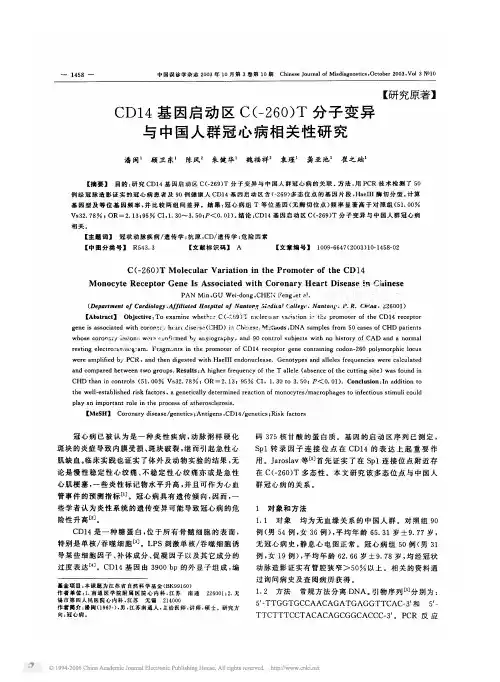
CD14基因启动区C(-260)T分子变异与中国人群冠心病相关性研究
- 格式:pdf
- 大小:213.35 KB
- 文档页数:2

鞘磷脂与动脉粥样硬化陈学颖综述邹云增葛均波审校复旦大学附属中山医院上海市心血管病研究所,上海200032【摘要】鞘磷脂是血清脂蛋白和细胞膜上脂质的主要成分之一,血清鞘磷脂水平对脂蛋白代谢和动脉粥样硬化有重要意义。
此外,鞘磷脂是细胞膜上脂质微结构的组成成份,参与细胞内信号转导。
本文综述国内外文献,阐述鞘磷脂与脂质代谢和动脉粥样硬化之间的关系。
【关键词】鞘磷脂;鞘磷脂合成酶2;脂质代谢;动脉粥样硬化Impact of Sphingomyelin on AtherosclerosisCHEN Xue-ying, ZOU Yun-zeng, GE Jun-boZhongshan Hospital,Fudan University,Shanghai Institute of Cardiovascular Diseases,Shanghai 200032,China【Abstract】Sphingomyelin is one of the major lipids both in plasma lipoproteins and cell membranes, which plays an important role in the lipid metabolism and atherosclerosis. Moreover, sphingomyelin is an important component of plasma membrane microdomains that regulates cellular signal transduction. This article reviewed sphingomyelin characteristics and its impact on lipid metabolism and atherosclerosis. 【Key words】Sphingomyelin;Sphingomyelin Synthase 2 (SMS2);Lipid metabolism;Atherosclerosis1. 鞘磷脂的生理功能和作用鞘磷脂是体内含量第二的磷脂,血清中18%的磷脂为鞘磷脂,它存在于所有主要的脂蛋白中,由鞘氨醇、脂酸、磷酸胆碱构成,以鞘胺醇为骨架,与一条脂肪酸链形成疏水尾部,亲水头部由胆碱与磷酸结合。

2023遗传因素在特应性皮炎中的研究进展摘要特应性皮炎(AD)是由遗传、免疫和环境因素相互作用引起的慢性瘙痒性、炎症性疾病。
AD具体发病病因及机制尚不完全明确,因其遗传易感性,AD的遗传和表观遗传学研究受到很多关注。
遗传学研究已经确定了多个AD遗传易感基因位点及相关候选基因。
例如皮肤屏障功能障碍基因、2型T辅助淋巴细胞(Th2)型免疫相关基因等。
这些遗传方面的研究有利于进一步明确AD发病机制并可能为AD的治疗提供新的方向。
特应性皮炎(atopicdermatitis,AD)是一种慢性炎性皮肤疾病,其特征是剧烈瘙痒和反复性湿疹病变,儿童发病率高达20%[1]o AD与食物过敏、过敏性鼻炎和哮喘均属于特应性疾病,特应性是个人或家族对环境触发因素产生IgE 抗体或致敏倾向。
它们具有变应原致敏、皮肤屏障异常和2型免疫应答这些共同特征[2]o疾病的发展受到遗传和环境因素的共同影响,有人对2009年6月之前AD的遗传学研究进行了全面综述,分析了5项连锁研究和111项靶向基因关联研究的结果[3]o最近全基因组关联研究(GWAS)成为阐明人类复杂疾病遗传易感性的流行方法。
为了阐明AD发病机制的遗传因素,在此期间进行了候选基因关联研究,全基因组关联研究(GWAS)和转录组学分析测定[4]o迄今为止,候选基因关联研究表明,丝聚蛋白(F1G)基因突变是AD最重要的已知危险因素,2型T辅助淋巴细胞(Th2)信号通路中的基因是AD的第2个遗传危险因素。
GWAS研究确定了31个AD风险位点,这些位点还表明免疫反应和表皮皮肤屏障功能中的基因与AD有关。
此外,基因分析显示AD与表皮分化复合基因的基因表达降低以及Th2和Th17基因升高有关。
同时基因表达的表观遗传调控也参与了AD发病。
1候选基因关联研究1.1 F1G皮肤屏障功能障碍是AD发病机制的一个基本特征。
皮肤屏障破坏后,微生物、过敏原、毒素和污染物等会产生相应的皮肤炎症、过敏原致敏和细菌定植。

doi:10.3971/j.issn.1000-8578.2021.20.0911·临床研究·非小细胞肺癌患者外周血和肺癌组织中ZIC1启动子甲基化检测的临床意义徐瑶1,刘世国1,张畅1,张黎2,姜姗2,张军霞1,彭黎1Clinical Significance of Detection of ZIC1 Promoter Methylation in Peripheral Bloodand Cancer Tissues of Non-small Cell Lung Cancer Patients XU Yao1, LIU Shiguo1, ZHANG Chang1, ZHANG Li2, JIANG Shan2, ZHANG Junxia1, PENG Li11. Department of Laboratory, The Third People’s Hospital of Hubei Province, Wuhan 430033,China; 2. Department of Pathology, The Third People’s Hospital of Hubei Province, Wuhan430033, ChinaCorrespondingAuthor:LIUShiguo,E-mail:****************Abstract: Objective To investigate the methylation status of ZIC1 gene in peripheral blood and lung cancer tissues of NSCLC patients and its prognostic significance. Methods We took the peripheral blood, cancer tissues and adjacent tissues of 95 NSCLC patients. The peripheral blood of 95 healthy people was taken as control group. MSP was used to compare the detection rate of ZIC1 methylation between peripheral blood and cancer tissues. And we analyzed the correlation of ZIC1 methylation in peripheral blood and cancer tissues with the clinicopathological factors of NSCLC patients. Results The methylation detection rates of ZIC1 in peripheral blood and lung cancer tissues in NSCLC patients were significantly higher than those in peripheralblood of healthy people and adjacent tissues of NSCLC patients (P<0.05), and the sensitivity and specificityof ZIC1 methylation in the diagnosis of tumor tissues were higher. The positive rate of ZIC1 gene methylation in peripheral blood and tumor tissues of NSCLC patients was significantly correlated with tumor diameter,metastasis, stage and pleural effusion (P<0.05). Conclusion The methylation of ZIC1 gene is related to the occurrence, development, metastasis and stage of NSCLC. It may be used as a diagnostic and prognostic indicator of NSCLC.Key words: ZIC1 methylation; MSP; Non-small cell lung cancer; Lung cancer tissueFunding: General Projects of Natural Science Foundation of Hubei Province (No. 2016CFB694); Research Fund Project of Wuhan Health and Family Planning Commission (No. WX16Z07)Competing interests: The authors declare that they have no competing interests.摘 要:目的 探讨ZIC1基因在NSCLC患者外周血和肺肿瘤组织中的甲基化状态,及其对NSCLC的预后评估意义。

CD14与肿瘤的相互关系及研究进展李康【摘要】CD14为白细胞表面分化抗原,在介导机体免疫应答及炎性反应中具有重要作用.近年来研究发现CD14的基因多态性能够影响多种肿瘤的易患性,同时其免疫调节功能与肿瘤的发生、发展密切相关,但其详细的作用机制仍未明确.该文针对CD14多态性与肿瘤、CD14与肿瘤免疫逃逸、CD14与肿瘤发生、发展的关系研究现状展开综述,期望为CD14在抗肿瘤中的作用研究提供理论支持.【期刊名称】《医学综述》【年(卷),期】2014(020)015【总页数】3页(P2726-2728)【关键词】CD14;肿瘤;基因多态性;免疫逃逸【作者】李康【作者单位】西藏自治区人民医院消化内科,拉萨850000【正文语种】中文【中图分类】R34分化抗原群(cluster of differentiation antigen 14,CD14)为细胞表面糖蛋白家族成员之一,最初被发现为白细胞表面分化抗原,是单核细胞、中性粒细胞和巨噬细胞的特异性表面标志物[1]。
哺乳细胞中CD14为革兰染色阴性菌脂多糖(lipopolysaccharide,LPS)的高亲和受体,能够参与机体对革兰染色阴性菌的吞噬与消化,在介导机体的免疫应答以及炎性反应中均发挥着重要作用[2-3]。
近年来,多项研究指出CD14的基因多态性与肿瘤的易患性密切相关。
随着研究的深入,CD14与肿瘤免疫逃逸以及肿瘤发生、发展的关系也逐渐受到关注。
基于CD14对免疫应答及细胞因子的调控作用,深入探讨CD14的功能及作用机制对于抗肿瘤研究具有非常重要的意义。
1 CD14的结构人CD14基因位于第5号染色体长臂5q23~31区,长约3900 bp,包含2个外显子和较长的5′端以及3′端非编码序列。
CD14蛋白包含375个氨基酸残基,其成熟肽长356个氨基酸,其中包含19个氨基酸长度的信号肽,4个N型糖链黏部位,约占整个相对分子质量的20%。
此外,CD14的氨基酸序列中还包含一个重复10次的富含亮氨酸的特异性序列,可能与CD14分子的膜结合以及与其他蛋白质的结合有关。