
新概念第二册英语Lesson4课件
- 格式:pptx
- 大小:2.27 MB
- 文档页数:48

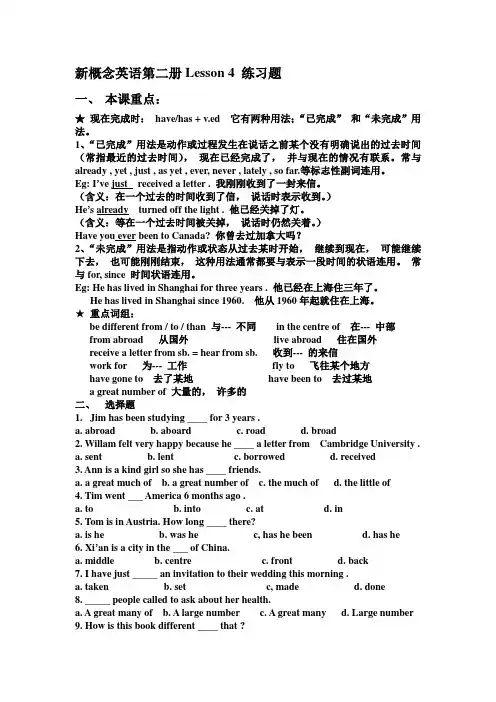
新概念英语第二册Lesson 4 练习题一、 本课重点:
★ 现在完成时: have/has + v.ed 它有两种用法;“已完成” 和“未完成”用法。
1、“已完成”用法是动作或过程发生在说话之前某个没有明确说出的过去时间(常指最近的过去时间), 现在已经完成了, 并与现在的情况有联系。常与already , yet , just , as yet , ever, never , lately , so far.等标志性副词连用。
Eg: I’ve just received a letter . 我刚刚收到了一封来信。
(含义:在一个过去的时间收到了信, 说话时表示收到。)
He’s already turned off the light . 他已经关掉了灯。
(含义:等在一个过去时间被关掉, 说话时仍然关着。)
Have you ever been to Canada? 你曾去过加拿大吗?
2、“未完成”用法是指动作或状态从过去某时开始, 继续到现在, 可能继续下去, 也可能刚刚结束, 这种用法通常都要与表示一段时间的状语连用。 常与for, since 时间状语连用。
Eg: He has lived in Shanghai for three years . 他已经在上海住三年了。
He has lived in Shanghai since 1960. 他从1960年起就住在上海。
★ 重点词组:
be different from / to / than 与--- 不同 in the centre of 在--- 中部
from abroad 从国外 live abroad 住在国外
receive a letter from sb. = hear from sb. 收到--- 的来信
work for 为--- 工作 fly to 飞往某个地方

新概念英语第二册lesson4课文及翻译和习题和词汇练习语法总结
An exciting trip
An exciting trip 激动人心的旅行
课文内容:
I have just received a letter from my brother, Tim. He is in
Australia. He has been there for six months. Tim is an engineer.
He is working for a big firm and he has already visited a great
number of different places in Australia. He has just bought an
Australian car and has gone to Alice Springs, a small town in the
centre of Australia. He will soon visit Darwin ,from there, he will
fly to Perth. My brother has never been abroad before, so he is
finding this trip very exciting.
参考译文
我刚刚收到弟弟蒂姆的来信,他正在澳大利亚。他在那儿已经住了6个月了。蒂姆是个工程师,正在为一家大公司工作,并且已经去过澳大利亚的不少地方了。他刚买了一辆澳大利亚小汽车,现在去了澳大利亚中部的小镇艾利斯斯普林斯。他不久还将到达尔文去,从那里,他再飞往珀斯。我弟弟以前从未出过国,因此,他觉得这次旅行非常激动人心。
Notes on the text 课文注释
1 He has been there for six months. 他在那儿已经住了6个月了。关于动词的现在完成时。
2 a great number of…, 许多…,用于修饰复数可数名词。

新概念英语第⼆册 课后答案 第四课 Lesson 41. d
根据课⽂内容Tim is an engineer. He is working for a big firm..., 只有d. Tim is working for a big firm as an engineer 是对的,其他3个与⽂章不符合。 2. b
根据课⽂的最后⼀句My brother has never been abroad before…,应该选b.其他3个选择都与课⽂内容不符合。 3. a b. in(在……⾥⾯)不能和动词go连⽤;c. at(在……地⽅)也不能同go 连⽤;d. into(进⼊……内)可以与go连⽤,但是到某个
国家不能⽤go into; 只有a. to 同动词go 连⽤ go to 才能表⽰到某个地⽅去,如国家,城市等,所以选a. 4. b
本句是问“他在那⼉呆了多久”。因为说话时他还在那,所以应该⽤现在完成时态。 a. is he 是⼀般现在时;c. has he 中没有过去分词been, 不符合语法;d. was he 是⼀般过去时;只有b. has he been 是现在完
成时, 所以选b. 5. b a. for 只有同表⽰⼀段时间的词连⽤时候才能⽤在完成时中,如for six months, for one year等. c. from 常与介词to连⽤表⽰"从……到……",它很少⽤于现在完成时; d. by 可以表⽰时间“到……为⽌”,常⽤于过去完成时中和将来完成时中,但是它⽤在本句意思不对;只有b. since(从……以
来)可以⽤在完成时态中,选b.才能使句⼦的时态和意思正确并且合乎逻辑。 6. a
本句的意思是“他刚刚买了⼀辆澳⼤利亚⼩汽车”强调买的时间短,⽤just来表⽰。 b. a long time ago(很久以前)与原来句⼦不符合。 c. last year(去年)也跟原来句⼦不符合。 d. six months ago(6个⽉前)也不对,句⼦中没有明确说明;
小T
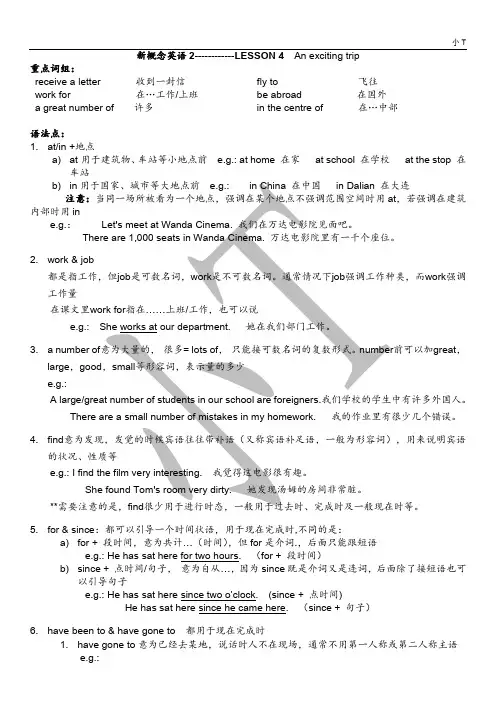
新概念英语2------------LESSON 4 An exciting trip
重点词组:
receive a letter 收到一封信
work for 在…工作/上班
a great number of 许多 fly to 飞往
be abroad 在国外
in the centre of 在…中部语法点:
1. at/in +地点
a) at用于建筑物、车站等小地点前 e.g.: at home 在家 at school 在学校 at the stop 在车站
b) in用于国家、城市等大地点前 e.g.: in China 在中国 in Dalian 在大连
注意:当同一场所被看为一个地点,强调在某个地点不强调范围空间时用at,若强调在建筑内部时用in
e.g.: Let's meet at Wanda Cinema. 我们在万达电影院见面吧。
There are 1,000 seats in Wanda Cinema. 万达电影院里有一千个座位。
2. work & job
都是指工作,但job是可数名词,work是不可数名词。通常情况下job强调工作种类,而work强调工作量
在课文里work for指在……上班/工作,也可以说
e.g.: She works at our department. 她在我们部门工作。
3. a number of意为大量的, 很多= lots of, 只能接可数名词的复数形式。number前可以加great,large,good,small等形容词,表示量的多少
e.g.:
A large/great number of students in our school are foreigners.我们学校的学生中有许多外国人。