新概念英语第二册Lesson4
- 格式:pdf
- 大小:95.82 KB
- 文档页数:3
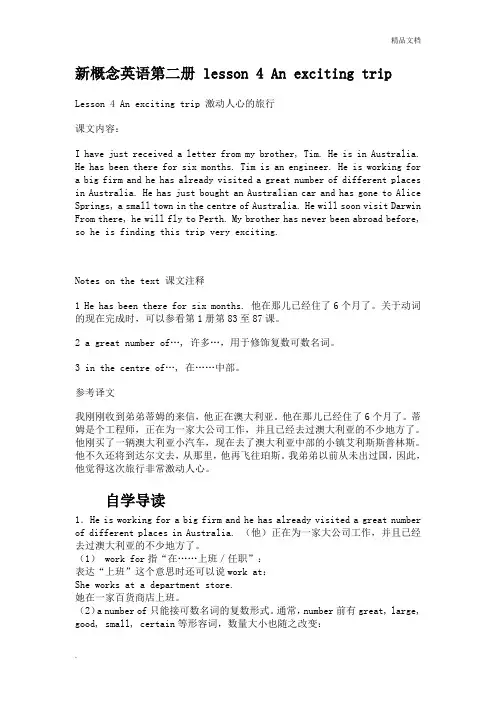
新概念英语第⼆册Lesson4Lesson 4
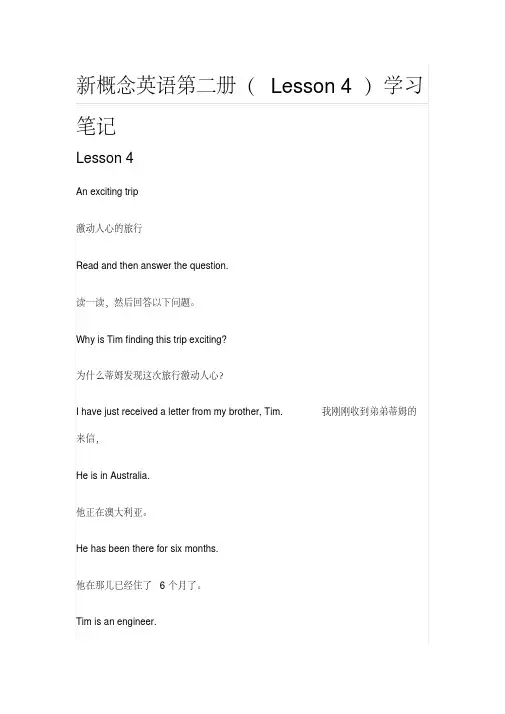
An exciting trip
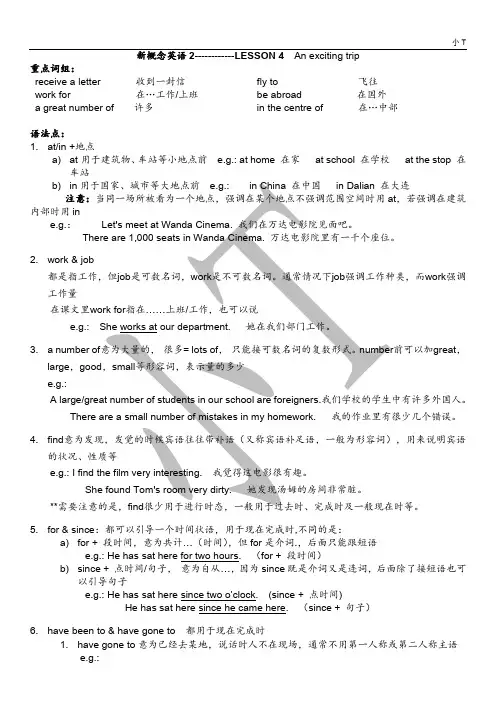
Phrase:
1. receive…from 从…收到
2. a great number of 许许多多
3. work for a firm 为⼀家公司⼯作
4. in the centre of 在…的中⼼
Intensive Reading:
1. a great/ large number/ many of许许多多,修饰可数名词复数,eg. There are a great number of students in the hall.
2. a small town in the centre of Australia是宾语Alice Springs的同位语,⽤来补充说明宾语。我们必须⽤逗号把同
位语与其它成分隔开。3.He is finding this trip very exciting. 此句中find经常⽤于“动词+宾语+宾补”的句型中。宾补⼀般是形容词或分
词。eg. I find English very difficult.
Key Structure:
1.⼀般现在完成时:
1). ⽤法:A. 描述发⽣在过去不确定的时间内的⾏为动作(正确的时间不重要或没有提供),但是动作的结果
现在还很明显,汉语中常⽤“了”“过”来表⽰。B. ⽤来询问对⽅是否⼲了某事,eg. Have you had lunch?
C. 表⽰动作发⽣在过去并且⼀直延续到现在,甚⾄还有可能延续下去。这时,常和“for+⼀段时间”
或“since+过去时间点”连⽤,for表⽰动作或状态持续多长时间,⽽since则表⽰动作或状态是
什么时候开始的。eg. He has been there for six months. 他在那⾥待了六个⽉了。He has been there since March. 从三⽉份起,他⼀直在这⼉。
D. 表⽰相类似的动作在过去已经做过的次数。
注意:瞬间动作不能与表⽰⼀段时间的时间状语连⽤。eg. He has joined the army. (√) He has joined the army for 3 years. (×)
2). 形式:have/ has + P.P.(过去分词)
3). 时间状语:already, just, not…yet, never, ever, so far, up to/ till now, for, since, lately, recently, never…before
4). have gone to和have been to的区别:have gone to表⽰⽬前在那个地⽅,或正在去那⾥的路上;have been to
表⽰曾经去过那个地⽅,但现在不在那⾥了。have been to之后只能跟名词,假如后⾯跟副词或介词短语,必须省略to。eg.He has neverbeen there/ abroad.
Discrimination:1.receive/ take/ accept:
receive 表⽰“收到、得到、接到”,宾语常是寄送的东西,如信件、包裹、礼物等。还可表⽰“接受”,但主要是指动作的承受者,也就是说含有被动的意义,如接受治疗或教育。与主观意愿⽆关,收到的东西不⼀定都收下。take 表⽰“带⾛、拿⾛”,当表⽰“接受”之意时,常与accept换⽤。accept 指接受,收下,强调主观性。
2.different/ various:
different 意思是不同的、相异的,⽤于不同的⼈或事物,表⽰各有各的特征或互相对照,可与单、复数名词连⽤。various 意思是不同的、各式各样的,着重指种类、类型等不同,⽽不强调相互之间的差别,只跟复数名词连⽤。
Exercise:
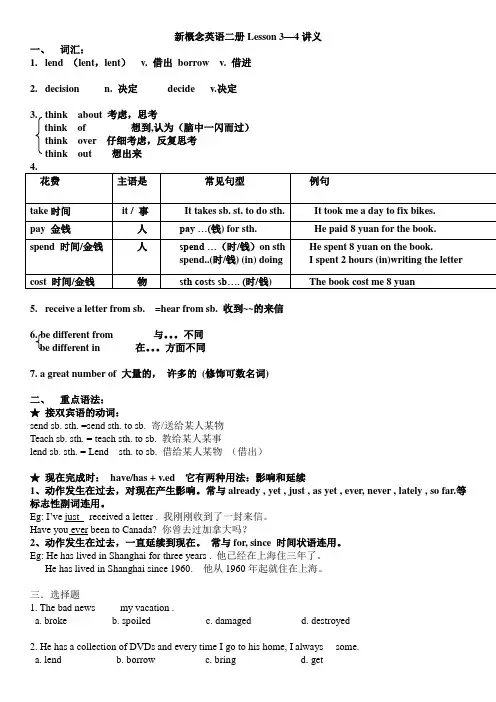
⼀、单项选择:1.My family has lived here over ten year. A. in B. after C. for D. since
2. The tall tree there for many years but it has been cut down. A. has been B. was C. has been in D. was in
3. “you there before?” A. Have…been B. Have…gone C. Have…been to D. Have…gone to
4. Because he was very hungry, he ate of food. A. a great number B. a few C. little D. a lot
5. Tim a great number of different places in Australia.
A. already has visited
B. has already visited
C. has visited already
D. has ever visited
⼆、⽤括号内动词的适当形式填空:1. They just (arrive) by train.
2. you ever (be) to Shanghai before?
7
3. He (visit) many places since he (come) to China last year.
4. So far, we (learn) 4 lessons.
5. We (study) English for 2 years.
6. Where you (be) lately?
7. He already (finish) the book. Now, he (play) basketball.
8. I (read) the novel many times.
9. He (be) in hospital since his accident.
10. How long you (know) Mr. Pitt? I (know) him for 10 years.
11. I (not finish) my letter yet.
12. He just (go) out.
13. Someone (take) my bike.
14. He already (refuse) me.
15. My brother (write) several plays. He just (finish) his second tragedy.三、⽤适当的介词或副词填空:1. whom did you receive a letter just now?
2. I have lived in Shanghai more than 30 years.
3. Xi’an is the centre of China.
4. The foreign friends will fly Beijing next Monday.
5. Have you been to the Great Wall?
6. They have lived in France 1974.
7. Things have changed I was a girl.
8. The strike has lasted six months.
9. Nobody has seen him last week.
10. I’ve known that man a long time.
11. We’ve fished two hours.
12. That man has stood there six o’clock..
13. She has slept twelve hours.
The price of wisdom is above rubies. 智慧是宝中宝。8