
新概念英语第二册lesson2课件
- 格式:ppt
- 大小:311.00 KB
- 文档页数:16
新概念英语第二册课文全文大全
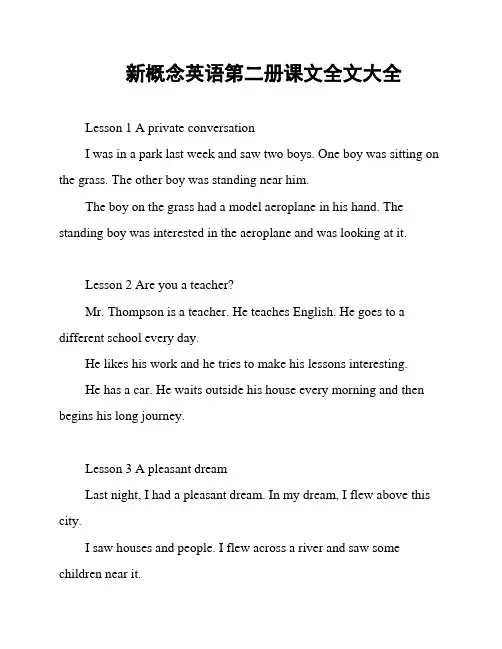
Lesson 1 A private conversation
I was in a park last week and saw two boys. One boy was sitting on
the grass. The other boy was standing near him.
The boy on the grass had a model aeroplane in his hand. The
standing boy was interested in the aeroplane and was looking at it.
Lesson 2 Are you a teacher?
Mr. Thompson is a teacher. He teaches English. He goes to a
different school every day.
He likes his work and he tries to make his lessons interesting.
He has a car. He waits outside his house every morning and then
begins his long journey.
Lesson 3 A pleasant dream
Last night, I had a pleasant dream. In my dream, I flew above this
city.
I saw houses and people. I flew across a river and saw some
children near it. They were sailing little boats in the water. I flew into the sky, but
soon I woke up.
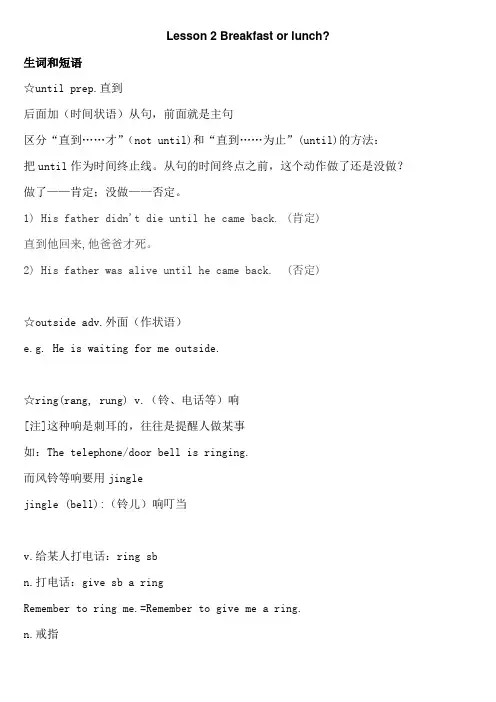
Lesson 2 Breakfast or lunch?
生词和短语
☆until prep.直到
后面加(时间状语)从句,前面就是主句
区分“直到„„才”(not until)和“直到„„为止”(until)的方法:
把until作为时间终止线。从句的时间终点之前,这个动作做了还是没做?
做了——肯定;没做——否定。
1) His father didn't die until he came back. (肯定)
直到他回来,他爸爸才死。
2) His father was alive until he came back. (否定)
☆outside adv.外面(作状语)
e.g. He is waiting for me outside.
☆ring(rang,rung) v.(铃、电话等)响
[注]这种响是刺耳的,往往是提醒人做某事
如:The telephone/door bell is ringing.
而风铃等响要用jingle
jingle(bell):(铃儿)响叮当
v.给某人打电话:ring sb
n.打电话:give sb a ring
Remember to ring me.=Remember to give me a ring.
n.戒指
☆aunt n.姑,姨,婶,舅母
所有长一辈的女性都用这个称呼
与此相同,男性则是uncle
他们的孩子:cousin:堂兄妹(不分男女)
cousin的孩子:nephew:外甥,niece:外甥女[记:“捏死”]
☆look out of
out of是固定搭配
☆感叹句
What+a/an+adj.+n+主语+谓语
省略:1.主、谓随时可省
eg. What a good girl (she is)!
2.省形容词
[注]有上下文和一定的语境,才能省略形容词。不能给对方造成误解。
如本文的What a day!根据上下文的It was dark outside.和It's raining again .可以推断出省略的是terrible.
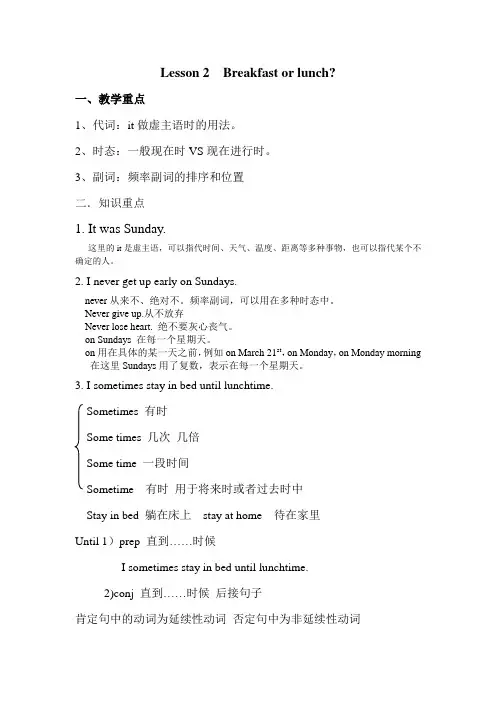
Lesson 2 Breakfast or lunch?
一、教学重点
1、代词:it做虚主语时的用法。
2、时态:一般现在时VS现在进行时。
3、副词:频率副词的排序和位置
二.知识重点
1. It was Sunday.
这里的it是虚主语,可以指代时间、天气、温度、距离等多种事物,也可以指代某个不确定的人。
2. I never get up early on Sundays.
never从来不、绝对不。频率副词,可以用在多种时态中。
Never give up.从不放弃
Never lose heart. 绝不要灰心丧气。
on Sundays 在每一个星期天。
on用在具体的某一天之前,例如on March 21st,on Monday,on Monday morning
在这里Sundays用了复数,表示在每一个星期天。
3. I sometimes stay in bed until lunchtime.
Sometimes 有时
Some times 几次 几倍
Some time 一段时间
Sometime 有时 用于将来时或者过去时中
Stay in bed 躺在床上 stay at home 待在家里
Until 1)prep 直到……时候
I sometimes stay in bed until lunchtime.
2)conj 直到……时候 后接句子
肯定句中的动词为延续性动词 否定句中为非延续性动词 I won't stop shouting until you let me go.
Continue in this direction until you see a sign
4. Last Sunday , I got up very late.
Get up 起床 go to bed 去睡觉 fall asleep 睡着
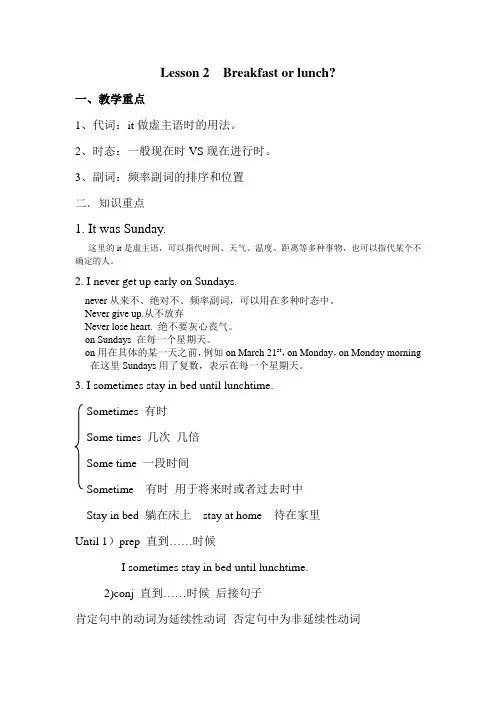
Lesson 2 Breakfast or lunch?
一、教学重点
1、代词:it做虚主语时的用法。
2、时态:一般现在时VS现在进行时。
3、副词:频率副词的排序和位置
二.知识重点
1. It was Sunday.
这里的it是虚主语,可以指代时间、天气、温度、距离等多种事物,也可以指代某个不确定的人。
2. I never get up early on Sundays.
never从来不、绝对不。频率副词,可以用在多种时态中。
Never give up.从不放弃
Never lose heart. 绝不要灰心丧气。
on Sundays 在每一个星期天。
on用在具体的某一天之前,例如on March 21st,on Monday,on Monday morning
在这里Sundays用了复数,表示在每一个星期天。
3. I sometimes stay in bed until lunchtime.
Sometimes 有时
Some times 几次 几倍
Some time 一段时间
Sometime 有时 用于将来时或者过去时中
Stay in bed 躺在床上 stay at home 待在家里
Until 1)prep 直到……时候
I sometimes stay in bed until lunchtime.
2)conj 直到……时候 后接句子
肯定句中的动词为延续性动词 否定句中为非延续性动词 I won't stop shouting until you let me go.
Continue in this direction until you see a sign
4. Last Sunday , I got up very late.
Get up 起床 go to bed 去睡觉 fall asleep 睡着