初高衔接英语句子成分
- 格式:doc
- 大小:41.00 KB
- 文档页数:4
1 句 子 成 分
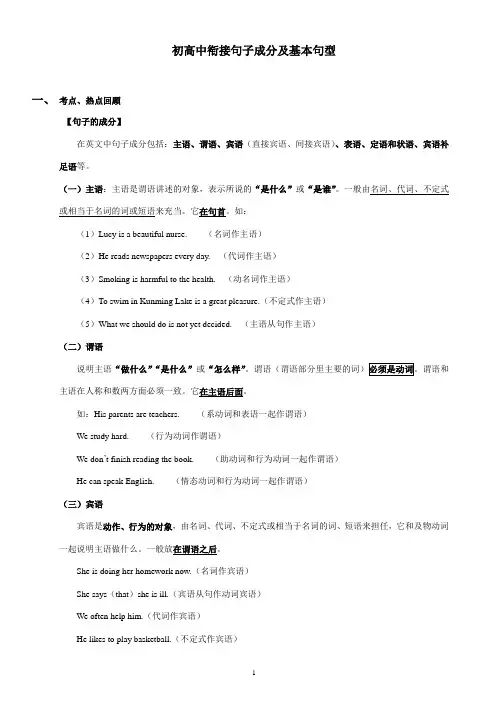
英语的基本成分有七种:
英语句子的基本结构可以归纳成五种基本句型及其扩大、组合、省略或倒装。
掌握这五种基本句型,是掌握各种英语句子结构的基础。
一: S V
二: S V P
三: S V O
四: S V o O
五: S V O C
基本句型 一:S V
1. The sun│rose.
2. Who │cares?
3.They │talked for half an hour.
4. The pen │writes smoothly
5.Twenty years is a short time in history.
6.Seeing is believing.
7.To see is to believe.
8.What he needs is a book.
9.It is very clear that the elephant is round and tall like a tree.
基本句型 二: S V P
此句型的句子有一个共同的特点:句子谓语动词都不能表达一个完整的意思,必须加上一个表明主语身份或状态的表语构成复合谓语,才能表达完整的意思。这类动词叫做连系动词。
系动词分两类:be, look, keep, seem等,表情况;get, grow, become, turn等属另一类,表变化。
be 本身没有什么意义,只起连系主语和表语的作用。其它系动词仍保持其部分词义。
感官动词多可用作连系动词:look well/面色好, sound nice/听起来不错,feel good/感觉好,smell bad/难闻
1. This │is │an English-Chinese dictionary.
2. The dinner │smells │good.
3. Everything │looks │different.
4. His face │turned │red. 想一想,什么可以作表语? 总结,主语一般是?
2 5. The picture is │ on the wall.
6. Is your father │ in?
7. Your job is │ to look after my baby.
8. His suggestion is that we should stay calm.
There be 结构: There be 表示‘存在有’。这里的there没有实际意义,不可与副词‘there那里’混淆。
此结构后跟名词,表示‘(存在)有某事物’
试比较:There is a boy there.(那儿有一个男孩。)
基本句型 三: S V O
此句型句子的共同特点是:谓语动词都具有实义,都是主语产生的动作,但不能表达完整的意思,必须跟有一个宾语,即动作的承受者,才能使意思完整。这类动词叫做及物动词。
1. Who │knows │the answer?
2. He │has refused │to help them.
3. He enjoys reading.
4. He said "Good morning."
5. He │admits │that he was mistaken.
基本句型 四: S V o O (主+谓+间宾+直宾)
有些及物动词可以有两个宾语,eg:give/pass/bring/show。这两个宾语通常一个指人(间接宾语);一个指物(直接宾语)。
She │ordered │herself │a new dress.
2. He │brought │you │a dictionary.
3. I │showed │him │my pictures.
4. I │told │him │that the bus was late.
5. He │showed │me │how to run the machine.
基本句型 五: S V O C (主+谓+宾+宾补)
此句型的句子的共同特点是:动词虽然是及物动词,但是只跟一个宾语还不能表达完整的意思,必须加上一个补充成分来补足宾语,才能使意思完整。
The war made him a soldier.
New methods make the job easy.
I often find him at work.
The teacher asks the students to close the windows.
I saw a cat running across the road.
3 We find it hard to learn English well.
1,Pleas tell us a story._______
2, She smiled.______
3.Why should we learn English ?______
4. His job is to train swimmers._____
5. He noticed a man enter the room._____
但常用的英语句子并不都象基本句型这样简短,除了基本句型的成分不变外,通常是在这些成分的前面或后面增加一些修饰语而加以扩大。这些修饰语可以是单词(adj./adv./num.数词)短语(主要是介词短语、不定式短语和分词短语)。我们称之为:定语、状语
The little boy needs a blue pen.
一、 定语:
定语是
定语通常位于被修饰的成分前。
复合不定代词(something/nothing)之后;
不定式/分词短语/从句作定语时要放在被修饰的成分后;
副词用作定语时须放在名词之后。
Two boys need two pens.
His name is Tom.
The boy in blue is Tom.
The boy there needs a pen.
The boy needs a ball pen.
There is nothing to do today.
The pen bought by her is made in China.
The boy you will know is Tom.
二、状语:
状语修饰动词、形容词、副词或全句的句子成分,说明方式、因果、条件、时间、地点、让步、方向、程度、目的等
1.The boy needs a pen now.
2.The boy needs a pen very much.
3.In the classroom, the boy needs a pen.
4.The boy needs a pen to do his homework.
4 5.On Sundays, there is no student in the classroom.
6.I like English because it is interesting.
7.He sits there, asking for a pen.
三.同位语
当两个指同一事物的句子成分放在同等位置时,一个句子成分用来说明和解释另一个句子成分,这个句子成分就叫做它的同位语。
We students should study hard.
(students是we的同位语,都是指同一批‘学生’)
We all are students.
(all是we的同位语,都指同样的‘我们’)
四、独立成分:
与全句没有语法关系的句子成分叫做句子的独立成分
感叹词:oh, hello, aha, ah,等。
肯定词:yes
否定词:no
称呼语:称呼人的用语。
插入语:一些句中插入的 I think , I believe,等。
如: The story, I think, has never come to the end. 我相信,这个故事还远没结束.
一) 挑出下列句中的宾语
My brother hasn't done his homework.
People all over the world speak English.
The old man sitting at the gate said he was ill.
(二) 挑出下列句中的表语
He is an English teacher.
-- The leaves have turned yellow.
(三) 挑出下列句中的定语
1. The beautiful girl is my sister.
2. I don’t know the boy in blue.
3. The man downstairs was trying to sleep.
4. I am waiting for the sound of the other shoe!
(四) 挑出下列句中的宾语补足语
They call me Lily sometimes.
I saw Mr Wang get on the bus.
(五) 挑出下列句中的状语
① There was a big smile on her face.
② Every night he heard the noise upstairs.
③ He began to learn English when he was eleven.
④ The man on the motorbike was traveling too fast.