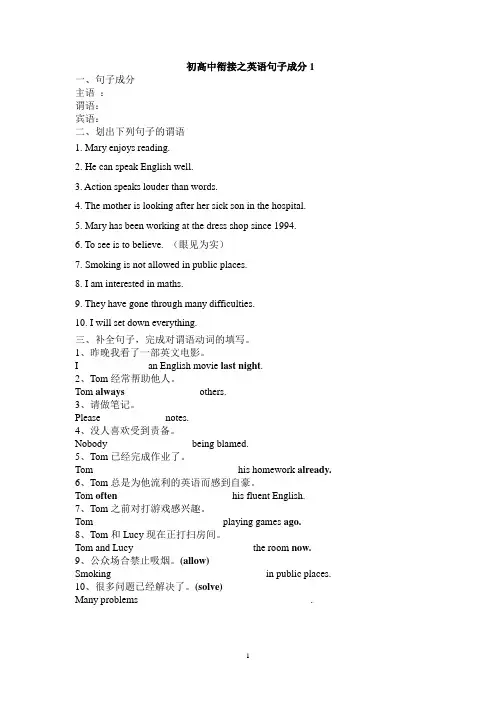
初高中英语衔接导学案---句子成分
- 格式:doc
- 大小:62.00 KB
- 文档页数:5
2013级英语科学案 编辑人 卜德霞 审核人 高一英语组 日期2013.9 班级 组别 学生姓名 教师评价 编号N0 2
1 初高中英语衔接导学案
第二节:句子成分
【学习目标】学会划分成分句子(初级目标);
能书写出正确无误的句子(高级目标)
【重点难点】重点:谓语;难点:状语
【使用说明】1.请同学们在上课之前,提前完成【预学】案。
2.请同学们在上课之前,准备好红笔。
【预学】
【预学内容】划分以下句子成分:
1.We always work hard at English。
—— —— —— —— ——————
2. He said he didn"t come.
——— ——— ——— ——————
3.They love each other.
—— —— ——————
4.What did you bye?
—— —— —— ——
5.She watched her daughter playing the piano.
—— ———— —————— —————————
6.your job today is to help the old.
———— ——- —— —————
7.Speaking doesn"t mean doing.
———— —————— ——
8.By the time I got to the station,the train had left.
———————————————— ————— ————
【导学】
英语句子成分的定义:构成句子的各个部分叫做句子成分。句子成分有主要成分和次要成分;主要成分有 和 ;次要成分有
(二)在下列例句中,用红线标出该种句子成分
一、主语(subject): 句子说明的人或事物。
The sun rises in the east. (名词) He likes dancing. (代词)
Twenty years is a short time in history. (数词)
Seeing is believing. (动名词)
To see is to believe. (不定式)
What he needs is a book. (主语从句)
It is clear that the elephant is round and tall like a tree
(It形式主语,主语从句是真正主语)
二、谓语(predicate):说明主语的动作、状态和特征。
动词在句中作谓语,一般放在主语之后。一句话语法: 谓语由 充当.
有很多同学在写作的时候容易犯的错误就是要么乱用be动词,要么句子没有谓语动词. 谓语的构成如下:
1、简单谓语:由一个动词或动词短语构成。如:We study English
2、复合谓语:由情态动词或其他助动词加动词构成。
You may keep the book for two weeks.
He has caught a bad cold.
三、表语(predicative):系动词之后的成分,表示主语的性质、状态和特征。
He is a teacher. (名词)
Seventy-four! You don’t look it. (代词)
Five and five is ten. (数词)
He is asleep. (形容词)
His father is in. (副词)
The picture is on the wall. (介词短语)
My watch is gone / missing / lost. (形容词化的分词)
To wear a flower isto say“I’m poor,I can’t buy a ring.(不定式)
The question is whether they will come. (表语从句)
【重难点】常见的系动词有: be, (听起来), (看起来), (摸起来), (闻起来), (尝、吃起来), (保持,仍是), (感觉)
It sounds a good idea. 2013级英语科学案 编辑人 卜德霞 审核人 高一英语组 日期2013.9 班级 组别 学生姓名 教师评价 编号N0 2
2 The sound sounds strange.
Her voice sounds sweet.
Tom looks thin.
The food smells delicious.
The food tastes good.
The door remains open.
Now I feel tired.
四、宾语(object):
1)动作的承受者——
I like China. (名词)
He hates you. (代词)
How many do you need? We need two. (数词)
We should help the old and the poor.(形容词)
I enjoy working with you. (动名词)
I hope to see you again. (不定式)
Did you write down what he said? (宾语从句)
2)介词后的名词、代词和动名词——
Are you afraid of the snake?
Under the snow, there are many rocks.
3) 双宾语——间宾( )和直宾( )
He gave me a book yesterday.
Give the poor man some money.
【一句话语法】:宾语由名词性的词充当,宾语分为动词宾语和介词宾语,分别构成动宾结构和介词结构,这点非常重要,务必要牢记.
五、宾补(Objective complement)对宾语的补充,全称为宾语补足语。
We elected him monitor. (名词) We all think it a pity that she didn’t come here. (名)
We will make them happy. (形容词)
We found nobody in. (副词)
Please make yourself at home. (介词短语)
Don’t let him do that. (省to不定式)
His father advised him to teach the lazy boy a lesson. (带to不定式)
Don’t keep the lights burning. (现在分词)
I’ll have my bike repaired. (过去分词)
六、主补(Subjective complement):对主语的补充。
He was elected monitor.(名词)
She was found singing in the next room.(现在分词)
He was advised to teach the lazy boy a lesson.(不定式)
七、定语(attribute):修饰或限制名词或代词的词、词组或句子。
Ai Yanling is a chemistry teacher.(名词)
He is our friend. (代词)
We belong to the third world. (数词)
He was advised to teach the lazy boy a lesson.(形容词)
The man over there is my old friend.(副词)
The woman with a baby in her arms is my sister. (介词)
The boys playing football are in Cla2. (现在分词)
The trees planted last year are growing well now. (过去分词)
I have an idea to do it well. (不定式)
You should do everything that I do. (定语从句) 2013级英语科学案 编辑人 卜德霞 审核人 高一英语组 日期2013.9 班级 组别 学生姓名 教师评价 编号N0 2
3 八、状语(adverbial):用来修饰v., adj., adv., or 句子。 表示时间、地点、原因、目的、结果、程度、条件、方式、让步、伴随和比较。
【要求】用红笔在下列句子中标出状语成分,并区分是哪种状语:
I will go there tomorrow.
The meeting will be held in the meeting room.
The meat went bad because of the hot weather.
He studies hard to learn English well.
He didn’t study hard so that he failed in the exam.
I like some of you very much.
If you study hard, you will pass the exam.
He goes to school by bike.
Though he is young, he can do it well.
She came in with a dictionary in her hand.
I am taller than he is.
九.同位语(appositive):同位语是在名词或代词之后并列名词或代词对前者加以说明的成分,近乎于后置定语。
We students should study hard.(students是we的同位语,都是学生)
We all are students. (all是we的同位语,都指同样的‘我们’)
【固学】
【当堂检测】指出下列句子划线部分是什么句子成分:
1. The students got on the school bus.
2. He handed me the newspaper.