
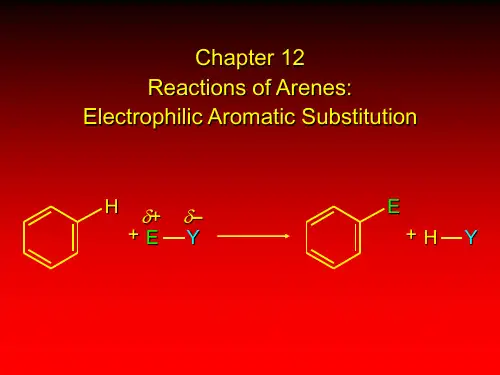
惯-Chapter 12Reactions of ArenesElectrophilic Aromatic Substitut
- 格式:ppt
- 大小:301.50 KB
- 文档页数:49

新编语言学教程Chapter 12答案Applied Linguistics1. Define the following terms briefly.(1)applied linguistics: the study of language and linguistics in relation to practicalissues, e.g. speech therapy, language teaching, testing, and translation.More often than not nowadays, it is used in the narrow sense, and refers tolanguage teaching in particular.(2)grammar-translation method: a method of foreign or second languageteaching which makes use of translation and grammar study as the mainteaching and learning activities.(3) audiolingual method: the teaching of a second language through imitation,repetition, and reinforcement. It emphasizes the teaching of speaking andlistening before reading and writing and the use of mother tongue in theclassroom is not allowed.(4)communicative language teaching: an approach to foreign or second languageteaching which emphasizes that the goal of language learning is toachieve communicative competence.(5)testing: the use of tests, or the study of the theory and practice of their use,development, evaluation, etc.(6)achievement test: a test which measures how much of a language someone haslearned with reference to a particular course of study or program of instruction.(7)validity: (in testing) the degree to which a test measures what it is supposedto measure, or can be used successfully for the purposes for which it is intended.A number of different statistical procedures can be applied to a testto estimate its validity. Such procedures generally seek to determine what thetest measures, and how well it does so.(8)reliability: (in testing) a measure of the degree to which a test gives consistentresults; a test is said to be reliable if it gives the same results when it isgiven on different occasions or when it is taken by different people.(9)proficiency test: a test which measures how much of a language someone haslearned without considering the syllabus, duration and manner of learning.(10) subjective test: a test which is scored according to the personal judgment ofthe marker, such as essay writing or translation.(11) objective test: a test that can be marked without the use of the examiner’spersonal judgment.(12) language aptitude test: a test which measures a person’s aptitude for secondor foreign language learning and it can be used to identify those learners who are most likely to succeed.(13) diagnostic test: a test which is designed to show what skills or knowledge alearner knows and doesn’t know. For example, a diagnostic pronunciationtest may be used to measure the learner’s pronunciation of English sounds.It would show which sounds a student is and is not able to pronounce. Diagnostictests may be used to find out how much a learner knows or to measure how successful an instruction program has been.(14) backwash effect: Tests strongly affect what actually occurs in the classroomand the effect of tests on classroom L2 teaching and learning is known as thebackwash effect.2. The advantages of grammar-translation method:(1)As the grammars described in this method contain very detailed descriptionsof the correct construction of phrases and sentences of a language, accuracyis stressed and improved.(2)Students’ ability to read and write is encouraged and improved since themethod focuses on the written work.(3)This method is less demanding than some other approaches for a teacherwhose oral proficiency may not be adequate.(4)This method is popular with people who would like to study English independently,especially the adult learners who want to learn grammar rules anduse them to approach new materials by themselves.The disadvantages of grammar-translation method:(1)It emphasizes language at the sentence level regardless of context, so the organizationof language above the sentence level is not so carefully studied.(2)As the focus is on written work, oral fluency and spontaneity is not so welldeveloped and common everyday language is not taught enough.(3)The basic techniques in this method are rote learning of the rules and vocabulary,and grammar rules are taught deductively as general statements tobe applied in particular exercises in translation, so the learners may find itboring to learn.(4)With the emphasis on grammar, students typically know a lot about the languagebut are unable to actually use it. As a result, their use of the new languageoften tends to be literal or unnatural.3.Changes required would include:(1)Change in teacher’s role. The teacher can no longer be the source of knowledgeand trut h about the language. The teacher’s role has more to do withinitiating activities.(2)Change in learner’s role. The learner can no longer be passive. The learnermust actively participate in the activities.(3)Change of materials. These should, as far as possible, preserve the features ofauthentic instances of language use.(4)Change of techniques. These should emphasize the tasks (not drills) to beperformed and identify the skills being practiced.(5)Change in attitude. If the above are to be achieved then we are involved inchanging our attitudes towards teaching and learning in general.4.Achievement tests are based on a particular language syllabus, or part of a syllabus,or chapters in a textbook that learners are known to have studied and theyaim to know how well learners know what they have been taught. For example,the Chinese MET test, which is based on the Middle School English Syllabus andtaken by students leaving Senior Middle School, and Mid-Term tests, designed forUniversity English Majors based on just a few chapters from a textbook.5.The validity of a test relates to what the test claims to measure and how well itdoes so. If we know that a test is valid, then we know what we can confidently sayabout a person who passes or fails it. The two most important aspects of validityare content validity and construct validity. If a test has content validity it meansthat the test questions cover a fair sample of the language structures and skillsthat the test claims to be measuring. If a test has construct validity, it shows that itmeasures only what it claims to measure and nothing else.6.A test is said to be reliable if it gives the same results when it is given on differentoccasions or when it is taken by different people. There are two aspects to reliability:test reliability and scorer reliability. Test reliability refers to how consistent scoresare on a test. If, for example, there are two versions of a particular test and the sameperson takes them on consecutive days and his scores are almost the same on eachversion, then such a test has test reliability. A test has scorer reliability if there is ahigh level of agreement between different people marking the same test paper.。


小学下册英语第1单元测验试卷考试时间:90分钟(总分:120)B卷一、综合题(共计100题共100分)1. 听力题:My dad works in an ________.2. 选择题:What do we call the time when the sun sets?A. DawnB. DuskC. NoonD. Midnight3. 填空题:I have a collection of ________ (邮票). Each one tells a ________ (故事) about different places.4. 听力题:The color of a solution can indicate its ______.5. 选择题:What do we call the process of a caterpillar becoming a butterfly?a. Metamorphosisb. Evolutionc. Growthd. Development答案:a6. 听力题:The chemical formula for calcium hypochlorite is ______.7. n River flows through __________. (巴西) 填空题:The Amaz8. 选择题:What do you call a person who plays a sport professionally?A. AmateurB. ProfessionalC. CoachD. Referee答案: B9. 填空题:I want to learn how to ________ (画画) better.10. 听力题:A _______ is a type of machine that can make work easier.11. 听力题:The bat flies at _____.12. 听力题:Sugar dissolves in water to form a ______.13. 填空题:The ancient civilization of ________ is revered for its artistic achievements.14. 选择题:What is the name of the imaginary line that divides the Earth into the Eastern and Western Hemispheres?A. EquatorB. Prime MeridianC. International Date LineD. Tropic of Cancer答案:B15. 填空题:The __________ (历史的回顾) informs our present.16. 填空题:A _______ (小嗓子) sings beautifully during spring.17. 填空题:A ____(national landmark) holds historical significance.18. 选择题:What do we call the time it takes for the Earth to complete one orbit around the sun?A. DayB. MonthC. YearD. Season答案: C19. 选择题:What do bees produce?a. Milkb. Honeyc. Eggsd. Silk答案:b20. 听力题:A ____ is often kept as a pet and enjoys being around people.21. 听力题:The _______ of light can create shadows.22. 填空题:I like to bake ______ (蛋糕) for my f riends’ birthdays.23. 填空题:The sunflower always turns towards the _____ (太阳).24. 填空题:I have a toy _______ that can bounce high.25. 填空题:The ______ (松鼠) collects acorns in the fall.26. 选择题:What is the name of the boundary surrounding a black hole?A. Event HorizonB. SingularityC. Accretion DiskD. Photon Sphere27. 填空题:A _____ (植物成长) can lead to community beautification.28. 填空题:A ______ (风景如画) garden can be a great place to relax.29. 听力题:The study of Earth's geological history is important for understanding ______.30. 选择题:What do we call the process of making a new plant from a seed?A. GerminationB. PropagationC. CultivationD. Pollination31. 选择题:What do we call the study of the relationship between organisms and their environment?A. EcologyB. BiologyC. ZoologyD. Botany32. 选择题:What do we call the process of removing trees from a forest?A. DeforestationB. ReforestationC. AfforestationD. Conservation答案: A. Deforestation33. 听力题:The chemical formula for carbon monoxide is __________.34. 填空题:I feel happy when my mom calls me . (当我妈妈叫我____时,我感到很快乐。