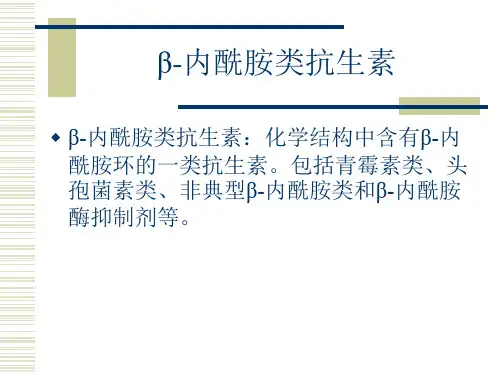
β-内酰胺
- 格式:pdf
- 大小:216.83 KB
- 文档页数:9
Beta-LactamaseRudolf Then Actelion Pharmaceuticals Ltd,Allschwil,Switzerlandã2007Elsevier Inc.All rights reserved.Version 2.IntroductionBeta-lactamases are an important group of bacterial enzymes,which preferentially cleave the beta-lactam ring of penicillins,cephalosporins,or other medically important beta-lactam antibiotics (Fig.1).Production of beta-lactamases is the most prevalent mechanism of resistance against these antibiotics.Beta-lactamases are serine-proteases Ghuysen (1991),and together with the important transpeptidases,which crosslink the peptide side chains in the peptidogly-can network of the bacterial cell wall,form the so-called group of Penicillin-Sensitive Enzymes (PSE).A very large number of distinct beta-lactamases are known today,differing in their genetic localization,their prevalence,primary sequence,their substrate and inhibition profiles,and their metal content.Their number currently approaches 400Bush (2001).Several classification schemes have been proposed Coulton and Francois (1994).Based on amino acid sequence and molecular size,Ambler Ambler (1980)divided them into three groups,which comprise class A,which have sizes of approximately 30kDa and preferentially hydrolyse penicillins,class B,which are broad-spectrum metallo beta-lactamases and class C,which have sizes of 39kDa and comprise chromosomally coded cephalosporinases of gram-negative bacteria.Bush Bush (1989),Bush (2001)grouped these enzymes into five major groups and 11subgroups,based on functional and structural characteristics.The largest groups being the functional group 1cephalosporinases (mostly on the chromosome but also on plasmids),the metallo-beta-lactamases,and the extended-spectrum beta-lactamases.Metallo beta-lactamases exhibit the broadest spectrum and are able to hydrolyze penicillins,cephalosporins,and even carbapenems,and they are not inhibited by clavu-lanic acid or tazobactam Rasmussen and Bush (1997),Bush (2001).Metallo beta-lacta-mases able to hydrolyze the otherwise stable carbapenems have recently spread and are now found in a variety of species such as P.aeruginosa ,Acinetobacter spp.,Klebiella spp.,and others.Point mutations are frequently observed in beta-lactamases from clinical isolates,and these often confer altered substrate or inhibitionprofiles.Fig.1Hydrolysis of benzylpenicillin by beta-lactamase to form penicilloic acid.1Bacteria often produce more than one beta-lactamase,which may complement each other in their substrate profiles.Combinations of a beta-lactamase susceptible beta-lactam antibiotic with a beta-lactamase inhibitor have become a very successful therapeutic strategy,and several of such combinations are in medical use.The most frequently used is Augmentin,a combi-nation of amoxicillin with clavulanic acid Sutherland (1995),Cole (1981),Coleman et al (1989).Other combinations are piperacillin with tazobactam and ampicillin with sulbac-tam.The medically important inhibitors are shown in Fig.2.NomenclatureSuperfamily Enzymes Family HydrolasesTypeActing on carbon-nitrogen bonds,other than peptide bonds SubtypesClassification Numbers EC 3.5.2.6Alternate or Previous Names Penicillinase,cephalosporinaseCommentsFig.1Hydrolysis of benzylpenicillin by beta-lactamase to form penicilloicacid.Fig.2.Chemical structures of benzylpenicillin as a substrate of beta-lactamase and three beta-lactamase inhibitors.Beta-Lactamase2Beta-Lactamase3Fig.2Hydrolysis of benzylpenicillin by beta-lactamase to formpenicilloic acid.Target StructureProtein InformationHigh-resolution crystal structures are available for more than200of these enzymes,(see /entrez/query.fcgi?CMD=search&DB=structure)suchas the Class A Bacillus licheniformis749/beta-lactamase Knox and Moews(1991),Strepto-myces albus G Dideberg et al(1987)Staphylococcus aureus PC1Herzberg(1991)or E.coliTEM-1Jelsch et al(1993),Strynadka et al(1992).Arg-244plays an important mechanisticrole and its guanidinium group is held in place by a hydrogen bond from Asn-276.A high resolution structure of a SHV-1beta-lactamase bound to sulbactam or clavu-lanic acid revealed a linear trans-enamine intermediate covalently attached to the activesite S70residue Padayatti(2005).The staphylococcal PC1beta-lactamase consists of two closely associated domains.Oneforms a five-stranded antiparallel beta-sheet with three helices packing against a face of thesheet.The active site is located in the interface between the two domains Herzberg(1991).Protein Sequence InformationNumber or Name CommentsSubunit Name Strain PC1;Enzyme has preferential penicillinaseactivityStrain PC1;Organism Name StaphylococcusaureusEnzyme has preferential penicillinaseactivityGene Accession#Gene:blaZSwissProt Accession#P0087/cgi-bin/niceprot.pl?P00807#of Amino Acid Residues 281MW:31349DaProtein Sequence Motifs Chromosomal LocalizationEncoded on plasmid pI258,several transposons (Tn4002,Tn552)Number or NameCommentsSubunit NameStrain K-12Enzyme has preferential cephalosporinase activity Organism NameEscherichia coliStrain K-12Enzyme has preferential cephalosporinase activity Gene Accession #AMPC,AMPASwissProt Accession #P00811/cgi-bin/niceprot.pl?P00811#of Amino Acid Residues 377MW:41555DaProtein Sequence Motifs Chromosomal LocalizationOn E.coli chromosomeNumber or NameCommentsSubunit Name TEM-1beta-lactamase Organism Name E.coli TEM-1beta-lactamaseGene Accession #SwissProt Accession #P00810/cgi-bin/get-sprot-entry?P00810#of Amino Acid Residues 286MW:31515Da Protein Sequence Motifs Chromosomal LocalizationOn many plasmidsNumber or NameComments Subunit Name Strain P99Organism Name Enterobacter cloacae Strain P99Gene Accession #SwissProt Accession #P05364/cgi-bin/get-sprot-entry?P05364#of Amino Acid Residues 381MW:41301DaProtein Sequence Motifs Chromosomal LocalizationOn E.cloacae chromosomeLocalizationProteinBeta-lactamases are located either in the periplasm,as in the gram-negative bacteria,or are excreted into the surrounding medium,as in gram-positive bacteria.Beta-Lactamase4mRNABeta-lactamases,which are excreted,are expressed as inactive preproteins with an N-terminal leader peptide Roggenkamp et al(1985).Ligands,Substrates,IonsSubstratesName Km value Kmunits Reference RemarksBenzylpenicillin 6.0Æ1m M Christensenet al(1990)S.aureus PC1beta-lactamase Benzylpenicillin42m M Christensenet al(1990)RTEM beta-lactamaseBenzylpenicillin0.6Æ0.1m M Galleni andFrere(1988)E.cloacae P99enzyme (cephalosporinase)Ampicillin0.4Æ0.05m M Galleni andFrere(1988)E.cloacae P99enzyme (cephalosporinase)Nitrocefin25Æ1m M Galleni andFrere(1988)E.cloacae P99enzyme (cephalosporinase)Cephaloridine70Æ4m M Galleni andFrere(1988)E.cloacae P99enzyme (cephalosporinase)Cefotaxime0.010Æ0.004m M Galleni andFrere(1988)E.cloacae P99enzyme(cephalosporinase)Enzymatic ReactionA beta-lactam+H2O=a substituted beta-aminoacidEndogenous RegulationProtein ExpressionMay be either constitutively expressed,such as ampC beta-lactamase in E.coli or most plasmid-derived beta-lactamases,or induced,as ampC enzymes in E.cloacae,Citrobacter,or Pseudomonas aeruginosa.In these cases,the ampC gene is regulated by a trans-acting protein,called amp R.Induction is intimately linked to the cell wall recycling pathway,and severalgenes are involved,such as amp R,amp D,and amp G Normark(1995),Hanson and Sanders (1999),Pfeifle et al(2000).High levels of beta-lactamase are usually produced in E.coliwith the respective genes located on multicopy plasmids.Transcription/TranslationBeta-Lactamases,which are excreted,usually are produced with an N-terminal leader peptide,which is cleaved off by a leader peptidase upon export.The unprocessed preprotein is enzymatically inactive Roggenkamp et al(1985).Beta-Lactamase5Other FactorsInduction of chromosomally coded ampC beta-lactamases is mediated by several mur-opeptides Pfeifle et al(2000).Physiological FunctionBeta-Lactamases confer resistance to beta-lactam antibiotics and thus constitute a useful selective advantage Wilke(2005).Their original role and function in bacterial physiology is still speculative.Pharmacological RegulationAntagonist/InhibitorValue Units Organism Organ Tissue Cell Line/Type Reference Comments Agent:Clavulanic acidIC50:0.28m M S.aureus Strain Russell Payne et al(1994) Antagonist/InhibitorValue Units Organism Organ Tissue Cell Line/Type Reference Comments Agent:Sulbactam(penicillanic acid sulfone,CP-45,899)IC50:26m M S.aureus Strain Russell Payne et al(1994) Antagonist/InhibitorValue Units Organism Organ Tissue Cell Line/Type Reference Comments Agent:TazobactamIC50: 2.3m M S.aureus Strain Russell Payne et al(1994) Antagonist/InhibitorValue Units Organism OrganTissueCell Line/Type Reference CommentsAgent:Clavulanic acidIC50:0.09m M E.coli,TEM-1Payne et al(1994)TEM-1beta-lactamaseBeta-Lactamase 6Antagonist/InhibitorValue Units Organism OrganTissueCell Line/Type Reference CommentsAgent:SulbactamIC50: 6.1m M E.coli,TEM-1Payne et al(1994)TEM-1beta-lactamaseAntagonist/InhibitorValue Units Organism OrganTissueCell Line/Type Reference CommentsAgent:TazobactamIC50:0.04m M E.coli,TEM-1Payne et al(1994)TEM-1beta-lactamaseAntagonist/InhibitorValue Units Organism OrganTissueCellLine/Type Reference CommentsAgent:Clavulanic acidIC50:>50m M E.cloacaeP99Coleman et al(1989)Tested with preincubation.P99beta-lactamase.Antagonist/InhibitorValue Units Organism Organ Tissue Cell Line/Type Reference CommentsAgent:SulbactamIC50:5m M E.cloacaeP99Coleman et al(1989)Tested withpreincubation.P99beta-lactamaseAntagonist/InhibitorValue Units Organism Organ Tissue Cell Line/Type Reference CommentsAgent:TazobactamIC50:0.93m M E.cloacaeP99Coleman et al(1989)Tested withpreincubation.P99beta-lactamaseBeta-Lactamase7Research ToolsProbesAntibodies and Other ProbesMonoclonal antibodies directed against class A beta-lactamases and other beta-lactamases have been produced Bibi and Laskov (1990).DNA probes have been developed for several beta-lactamases Boissinot et al (1987)Mutant TargetsMany point mutations have been described both for beta-lactamases found in clinical isolates as well as in laboratory mutants.Because these mutations confer altered substrate properties and modify susceptibility to inhibitors,they are clinically very important.In recent years a significant proportion of Gram-negative bacteria harbours ‘‘extended spectrum beta-lactamases’’(ESBL),which confer resistance to ceftazidime and other third generation cephalosporins.Among the ESBL there are enzymes derived from TEM (now more than 130),SHV (more than 50),OXA and others Turner (2005).AssaysMolecular /CellularChromogenic substrates,such as nitrocefin,are frequently used to assay the activity of beta-lactamase or measure its inhibition Payne et al (1994).The change in absorbance of various beta-lactamsubstrates in the course of hydrolysis is commonly used Christensen et al (1990).Several disc methods have been employed for detecting AmpC beta-lactamases in clinical isolates Brenwald (2005).Genetically Engineered OrganismsSeveral beta-lactamases from different organisms have beenengineered to better adapt to certain substrates Zawadzke et al (1995).DisordersHuman serum albumin exhibits some beta-lactamase activity Nerli and Pico (1994).Other Information –Web Siteshttp://www.md.huji.ac.il/biology/lactamase.html ;http://www.matfys.kvl.dk/~antony/Journal CitationsAmbler,R.P.,1980.The structure of beta-lactamases.Philos.Trans.R.Soc.London Ser.B ,289,321–331.Bibi,E.,Laskov,R.,1990.Selection and application of antibodies modifying the function of beta-lactamases.Biochim.Biophys.Acta ,1035,237–241.Boissinot,M.,Mercier,J.,Levesque,R.C.,1987.Development of natural and synthetic DNA probes for OXA-2and TEM-1beta-lactamases.Antimicrobial Agents Chemother.,31,728–734.Brenwald,N.P.,Jevons,G.,Andrews,J.,Ang,L.,Fraise,A.P.,2005.Disc methods for detecting AmpC beta-lactamase-producing clinical isolates of Escherichia coli and Klebsiella pneumoniae.J.Antimicrob.Chemother.,56(3),600–601.Bush,K.,2001.New beta-lactamases in Gram-negative bacteria:diversity and impact on the selection of antimicrobial therapy.Clin.Inf.Dis.,32,1085–1089.Beta-Lactamase8Beta-Lactamase9 Bush,K.,1989.Classification of beta-lactamases:groups1,2a,2b,and2b0.Antimicrob.AgentsChemother.,33,264–270.Christensen,H.,Martin,M.T.,Waley,S.G.,1990.Beta-Lactamases as fully efficient enzymes.Determination of all the rate constants in the acyl-enzyme mechanism.Biochem.J.,266,853–861.Cole,M.,1981.Inhibitors of bacterial beta-lactamases.Drugs of the Future,6,697–727.Coleman,K.,Griffin,D.R.J.,Page,J.W.J.,Upshon,P.A.,1989.In vitro evaluation of BRL42715,a novelbeta-lactamase inhibitor.Antimicrob.Agents Chemother.,33,1580–1587.Dideberg,O.,Charlier,P.,Wery,J.P.,Drehottay,P.,Dusart,P.,Erpicum,T.,Frere,J.M.,Ghuysen,J.M.,1987.The crystal structure of the beta-lactamase of Streptomyces albus G at0.3nm resolution.Biochem.J.,245,911–913.Galleni,M.,Frere,J.M.,1988.A survey of the kinetic parameters of class C beta-lactamases.Penicillins.Biochem.J.,255,119–122.Hanson,N.D.,Sanders,C.C.,1999.Regulation of inducible AmpC beta-lactamase expression among enterobacteriaceae.Curr.Pharm.Des.,5,881–894.Herzberg,O.,1991.Refined crystal structure of beta-lactamase from staphylococcus aureus PC1at2.0^ resolution.J.Mol.Biol.,217,701–719.Jelsch,C.,Mourey,L.,Masson,L.,Samama,J.M.,1993.Crystal structure of Escherichia coli TEM1beta-lactamase at1.8^resolution.Proteins Struct.Func.Genet.,16,364–383.Knox,J.R.,Moews,P.C.,1991.beta-Lactamase of Bacillus licheniformis749/C.Refinement at2^resolution and analysis of hydration.J.Mol.Biol.,220,435–455.Nerli,B.,Pico,G.,1994.Evidence of human serum albumin beta-lactamase activity.Biochem.Mol.Biol.Int.,32,789–795.Normark,S.,1995.Beta-lactamase induction in Gram-negative bacteria is intimately linked topeptidoglycan recycling.Microb.Drug Resist.,1,111–114.Padayatti,P.S.,Helfand,M.S.,Totir,M.A.,Carey,M.P.,Bonomo,R.A.,van den Akker,F.,2005.Highresolution crystal structure of the trans-enamine intermediates formed by sulbactam and clavulanic acidand E166A SHV-1beta-lactamase.J.Biol.Chem.,280(41),34900–34907.Payne,D.J.,Cramp,R.,Winstanley,D.J.,Knowles,D.J.,parative activities of clavulanic acid, sulbactam,and tazobactam against clinically important beta-lactamases.Antimicrob.AgentsChemother.,38,767–772.Pfeifle,D.,Janas,E.,Wiedemann,B.,2000.Role of penicillin-binding proteins in the initiation of the ampCbeta-lactamase expression in Enterobacter cloacae.Antimicrob.Agents Chemother.,44,169–172.Rasmussen,B.A.,Bush,K.,1997.Minireview:Carbapenem-hydrolyzing beta-lactamases.Antimicrob.Agents Chemother.,41,223–232.Roggenkamp,R.,Dargatz,H.,Hollenberg,C.P.,1985.Precursor of beta-lactamase is enzymaticallyinactive.Accumulation of the preprotein in Saccharomyces cerevisiae.J.Biol.Chem.,260,1508–1512. Strynadka,N.C.J.,Adachi,H.,Jensen,E.E.,Johns,K.,Selecki,A.,Betzel,C.,Sutoh,K.,James,M.N.G.,1992.Molecular structure of the acyl-enzyme intermediate in beta-lactam hydrolysis at1.7A resolution.Nature,359,700–705.Sutherland,R.,1995.Beta-lactam/beta-lactamase inhibitor combinations:development,antibacterialactivity and clinical applications.Infection,23,191–200.Turner,P.J.,2005.Extended-spectrum beta-lactamases.Clin.Infect.Dis.,41(Suppl.),273–275.Wilke,M.S.,Lovering,A.L.,Strynadka,N.C.,2005.Beta-lactam antibiotic resistance:a current structural perspective.Curr.Opin.Microbiol.,8(5),525–533.Zawadzke,L.E.,Smith,T.J.,Herzberg,O.,1995.An engineered Staphylococcus aureus PC1beta-lactamase that hydrolyzes third-generation cephalosporins.Protein engineering,8,1275–1285.Book CitationsCoulton,S.,Francois,I.,1994.Beta-Lactamases:Targets for drug design.Ellis,G.P.,Luscombe,D.K.(Ed.)Progress in Medicinal Chemistry,pp.297–349.Elsevier,New York.Ghuysen,J.M.,1991.Serine beta-lactamases and penicillin-binding proteins.Ann.Revs.Microbiol.,pp.37–67.Ann Revs.Inc..。