
独立主格结构与with复合结构
- 格式:pdf
- 大小:2.71 MB
- 文档页数:18


I. 独立主格结构的基本概念由一个名词或代词作为逻辑主语,加上一个分词、形容词、副词、动词不定式或介词短语作为逻辑谓语构成,这种结构在形式上与主句没有关系,通常被称为独立主格结构。
独立主格结构是由一个相当于主语的名词或代词加上非谓语动词、形容词(副)词、或介词短语构成的一种独立成分。
该结构不是句子,也不是从句,所以它内部的动词不能考虑其时态、人称和数的变化,它与其主句之间既不能通过并列连词连接也不能有从句引导词引导,常用逗号与其主句隔开。
独立主格结构主要起状语作用,相当于一个状语从句,多用来表示行为、方式、伴随等情况,有时也可用来表示时一、独立主格结构的构成形式1、逻辑主语+V-ing : 逻辑主语是分词的动作执行者。
如:Time permitting, we can have a walk around the playground after supper.①.______no bus, we had to walk home. A. There being B. Being C. Having been D. There was②._______no bus, we had to walk home. A. As there being B. As there was C. Being D. There was③._______Sunday, the library doesn't open. A. Being B. There being C. It being D. Having been④.______Sunday, the library doesn't open. A. As it being B . Being C. It is D. As it isABCD2、逻辑主语+V-ed 该构成形式内部的逻辑主语是分词的动作承受者。
如:The experiment done, the students went on to take notes in the experiment report.①._____, the train started. A. The signal given B. Giving the signal B. The signal being given D. The signal giving②._____, the train started.A. After having given the signalB. After the signal givenC. Giving the signalD. After the signal was given③._________, the text became easier for us to learn.A. Explaining new wordsB. New words explainedC. Being explained new wordsD. Having explained new words④.______________, the text became easier for us to learn.A. When new words were explainedB. Explaining new words B. New words explaining D. Being explained new words ADBA3、逻辑主语+形容词(副词)该结构相当于一个未带动词的“主—系—表”结构。
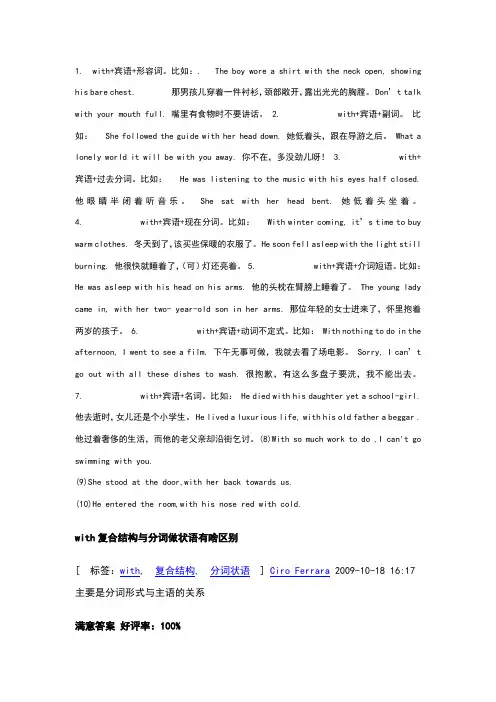
1. with+宾语+形容词。
比如:. The boy wore a shirt with the neck open, showing his bare chest. 那男孩儿穿着一件衬衫,颈部敞开,露出光光的胸膛。
Don’t talk with your mouth full. 嘴里有食物时不要讲话。
2. with+宾语+副词。
比如:She followed the guide with her head down. 她低着头,跟在导游之后。
What a lonely world it will be with you away. 你不在,多没劲儿呀!3. with+宾语+过去分词。
比如:He was listening to the music with his eyes half closed. 他眼睛半闭着听音乐。
She sat with her head bent. 她低着头坐着。
4. with+宾语+现在分词。
比如:With winter coming, it’s time to buy warm clothes. 冬天到了,该买些保暖的衣服了。
He soon fell asleep with the light still burning. 他很快就睡着了,(可)灯还亮着。
5. with+宾语+介词短语。
比如:He was asleep with his head on his arms. 他的头枕在臂膀上睡着了。
The young lady came in, with her two- year-old son in her arms. 那位年轻的女士进来了,怀里抱着两岁的孩子。
6. with+宾语+动词不定式。
比如: With nothing to do in the afternoon, I went to see a film. 下午无事可做,我就去看了场电影。
Sorry, I can’t go out with all these dishes to wash. 很抱歉,有这么多盘子要洗,我不能出去。

独立主格和with的复合结构和非谓语的区别独立主格和with的复合结构以及非谓语动词是英语语法中常见的三种结构。
独立主格是指包含一个名词或代词和一个动词分词的结构,该结构通常用于修饰整个句子的一部分。
例如,“天空阴沉着,他走进了房间”,其中“天空阴沉着”是独立主格,用来描述整个句子的气氛。
与独立主格类似的是with的复合结构。
它由一个名词或代词和一个带有介词with的短语组成,通常也用来修饰整个句子的一部分。
例如,“与他一起工作的人都很聪明”,其中“与他一起工作的人”是with的复合结构。
非谓语动词则是指动词的一种形式,不带有主语和谓语,通常用于修饰名词或代词。
例如,“我喜欢看漫画书”,其中“看漫画书”是非谓语动词。
虽然这三种结构相似,但它们之间还是有区别的。
独立主格和with的复合结构通常用来修饰整个句子或一个名词或代词,而非谓语动词则通常用来修饰名词或代词。
同时,非谓语动词还可以用来表示时间、原因、目的等概念。
因此,在使用这些结构时,需要根据具体的语境和需要来选择合适的结构。
- 1 -。

with的复合结构和独立主格的异同with的复合结构和独立主格是英语中两种常见的短语结构,它们都可以用来表示伴随关系。
但是,它们在语法和用法上有着一些明显的异同点。
一、with的复合结构1. 语法结构with的复合结构由with引导,并且包括一个名词短语或代词作为宾语,后面跟着一个动词或动词短语。
例如:- She walked to the park with her dog.- He went to the concert with his girlfriend.2. 用法with的复合结构通常用来表示伴随关系,即两个行为同时发生或在同一时间内进行。
它还可以表示附加信息或补充说明。
例如:- With a smile on her face, she greeted me warmly.- He left the party early with a headache.二、独立主格1. 语法结构独立主格是指一个名词短语或代词加上一个动名词,它们之间没有任何连接词。
例如:- The sun having set, we made our way back home.- Me being sick, I couldn't go to work today.2. 用法独立主格也表示伴随关系,但它更侧重于描述先决条件或原因。
通常情况下,独立主格放在句子的开头,用逗号与主句分开。
例如:- The weather being nice, we decided to have a picnic.- Her parents having died, she was left alone in the world.三、异同点1. 语法结构with的复合结构和独立主格在语法结构上有很大的差别。
前者是一个介词短语加上一个宾语和动词,后者则是一个名词短语或代词加上一个动名词。
2. 用法虽然两种结构都可以表示伴随关系,但是它们在用法上有一些不同。