
英法复习
- 格式:ppt
- 大小:135.50 KB
- 文档页数:9
法英复习
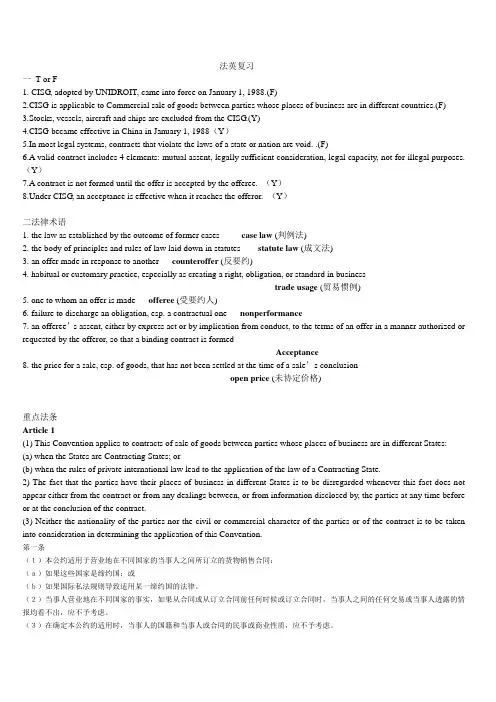
一 T or F
1. CISG, adopted by UNIDROIT, came into force on January 1, 1988.(F)
2.CISG is applicable to Commercial sale of goods between parties whose places of business are in different countries.(F)
3.Stocks, vessels, aircraft and ships are excluded from the CISG.(Y)
4.CISG became effective in China in January 1, 1988(Y)
5.In most legal systems, contracts that violate the laws of a state or nation are void. .(F)
6.A valid contract includes 4 elements: mutual assent, legally sufficient consideration, legal capacity, not for illegal purposes.
(Y)
7.A contract is not formed until the offer is accepted by the offeree. (Y)
8.Under CISG, an acceptance is effective when it reaches the offeror. (Y)
二法律术语
1. the law as established by the outcome of former cases case law (判例法)
2. the body of principles and rules of law laid down in statutes statute law (成文法)
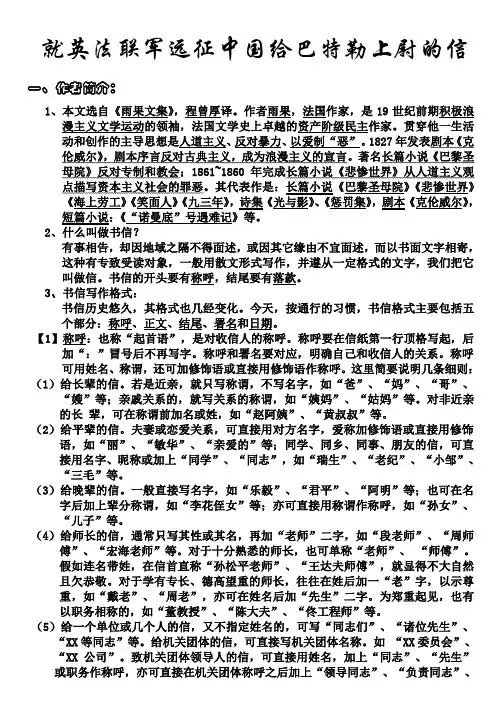
就英法联军远征中国给巴特勒上尉的信
一、作者简介:
1、本文选自《雨果文集》,程曾厚译。作者雨果,法国作家,是19世纪前期积极浪漫主义文学运动的领袖,法国文学史上卓越的资产阶级民主作家。贯穿他一生活动和创作的主导思想是人道主义、反对暴力、以爱制“恶”。1827年发表剧本《克伦威尔》,剧本序言反对古典主义,成为浪漫主义的宣言。著名长篇小说《巴黎圣母院》反对专制和教会;1861~1860年完成长篇小说《悲惨世界》从人道主义观点描写资本主义社会的罪恶。其代表作是:长篇小说《巴黎圣母院》《悲惨世界》《海上劳工》《笑面人》《九三年》,诗集《光与影》、《惩罚集》,剧本《克伦威尔》,短篇小说:《“诺曼底”号遇难记》等。
2、什么叫做书信?
有事相告,却因地域之隔不得面述,或因其它缘由不宜面述,而以书面文字相寄,这种有专致受读对象,一般用散文形式写作,并遵从一定格式的文字,我们把它叫做信。书信的开头要有称呼,结尾要有落款。
3、书信写作格式:
书信历史悠久,其格式也几经变化。今天,按通行的习惯,书信格式主要包括五个部分:称呼、正文、结尾、署名和日期。
【1】称呼:也称“起首语”,是对收信人的称呼。称呼要在信纸第一行顶格写起,后加“:”冒号后不再写字。称呼和署名要对应,明确自己和收信人的关系。称呼可用姓名、称谓,还可加修饰语或直接用修饰语作称呼。这里简要说明几条细则:
(1)给长辈的信。若是近亲,就只写称谓,不写名字,如“爸”、“妈”、“哥”、“嫂”等;亲戚关系的,就写关系的称谓,如“姨妈”、“姑妈”等。对非近亲的长 辈,可在称谓前加名或姓,如“赵阿姨”、“黄叔叔”等。
(2)给平辈的信。夫妻或恋爱关系,可直接用对方名字,爱称加修饰语或直接用修饰语,如“丽”、“敏华”、“亲爱的”等;同学、同乡、同事、朋友的信,可直接用名字、昵称或加上“同学”、“同志”,如“瑞生”、“老纪”、“小邹”、“三毛”等。
(3)给晚辈的信。一般直接写名字,如“乐毅”、“君平”、“阿明”等;也可在名字后加上辈分称谓,如“李花侄女”等;亦可直接用称谓作称呼,如“孙女”、“儿子”等。

英语语法名词名词部分的考查重点为:
1、名词的可数与不可数性;
2、名词单复数在特定情况下的使用;
3、名词的普通格与所有格作定语的选用;
4、物质名词、抽象名词具体化;
名词词义的区别与固定搭配;
考点诠释
一、名词的各种分类;单、复数的用法及单数名词变复数名词的方式,包括可数名词的复数的变化规则,少数不规则名词的复数形式及部分单复、数同形的名词;
考例There is good_________ for you. I've found your lost watch.
A. news B. ideas C. messages D.
thoughts
My uncle will come to my house for dinner.I want to buy some ___to make
a vegetable salad for him.
A.meat B.tomatoes C.apple juice
The teacher said we needed to choose three for the school concert.
A. farmers B. doctors C. drivers D. singers
At night the koala bear gets up and eats___________.
A.1eaf B.1eaves C. leafs
The PLA man saved three ____lives in the accident.
A.children’s B.children C.child D.childs'
Come on,children.Help yourselves to some_________ if you like. A.fish and chicken B.fishes and chicken C.fish and chickens D.fishes and chickens

TTA standardization office [TTA 5AB・ TTAK 08・ TTA 2C] 小升初英语语法复习要点 不规则动词变化表
不规则动词变化表
词义现在(原形)过去-ing形(动名词)
是 am (be) was being? 切 cut cut cutting?
是 are (be) were being? 做 do. does did doing?
是 be was, were being? 固 draw drew drawing?
成为 become became becoming? 饮 drink drank drinking?
开始 begin began beginning? 吃 eat ate eating?
弯曲 bend bent bending? 感觉 feel felt feeling?
吹 blow blew blowing? 发现 find found finding?
买 buy bought buying? 飞 fly flew flying?
能 can could........... 忘记 forget forgot forgetting?
捕捉 catch caught catching? 得到 get got getting?
选择 choose chose choosing? 给 give gave giving?
来 come came coming? 走 go went going? 成长 grow grew growing? 放置 put put putting?
有 have, has had having? 读 read read reading?
听 hear heard heiiring? 骑、乘 ride rode riding?
受伤 hurt hurt hurting? 响、鸣 ring rang ringing?