
systematic review GERD
- 格式:pdf
- 大小:171.04 KB
- 文档页数:1
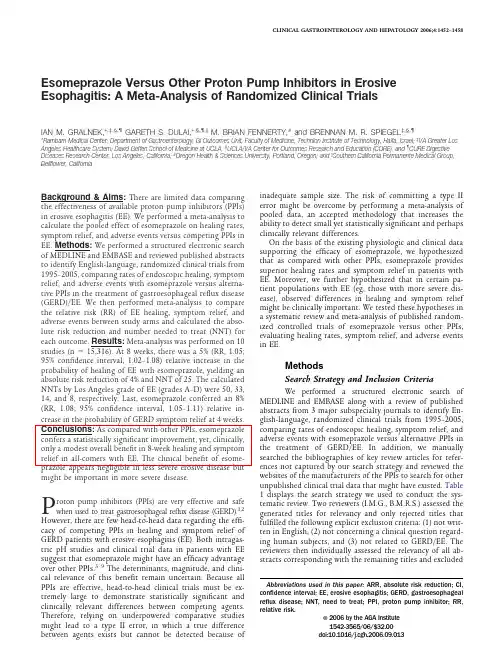
Esomeprazole Versus Other Proton Pump Inhibitors in Erosive Esophagitis:A Meta-Analysis of Randomized Clinical TrialsIAN M.GRALNEK,*,‡,§,¶GARETH S.DULAI,*,§,¶,ʈM.BRIAN FENNERTY,#and BRENNAN M.R.SPIEGEL‡,§,¶*Rambam Medical Center;Department of Gastroenterology,GI Outcomes Unit,Faculty of Medicine,Technion Institute of Technology,Haifa,Israel;‡VA Greater Los Angeles Healthcare System;David Geffen School of Medicine at UCLA,§UCLA/VA Center for Outcomes Research and Education(CORE),and¶CURE Digestive Diseases Research Center,Los Angeles,California;#Oregon Health&Sciences University,Portland,Oregon;andʈSouthern California Permanente Medical Group, Bellflower,CaliforniaBackground&Aims:There are limited data comparing the effectiveness of available proton pump inhibitors(PPIs)in erosive esophagitis(EE).We performed a meta-analysis tocalculate the pooled effect of esomeprazole on healing rates,symptom relief,and adverse events versus competing PPIs in EE.Methods:We performed a structured electronic search of MEDLINE and EMBASE and reviewed published abstractsto identify English-language,randomized clinical trials from1995–2005,comparing rates of endoscopic healing,symptomrelief,and adverse events with esomeprazole versus alterna-tive PPIs in the treatment of gastroesophageal reflux disease(GERD)/EE.We then performed meta-analysis to comparethe relative risk(RR)of EE healing,symptom relief,andadverse events between study arms and calculated the abso-lute risk reduction and number needed to treat(NNT)for each outcome.Results:Meta-analysis was performed on10 studies(nϭ15,316).At8weeks,there was a5%(RR,1.05; 95%confidence interval,1.02–1.08)relative increase in the probability of healing of EE with esomeprazole,yielding an absolute risk reduction of4%and NNT of25.The calculated NNTs by Los Angeles grade of EE(grades A–D)were50,33, 14,and8,st,esomeprazole conferred an8% (RR,1.08;95%confidence interval,1.05–1.11)relative in-crease in the probability of GERD symptom relief at4weeks. Conclusions:As compared with other PPIs,esomeprazole confers a statistically significant improvement,yet,clinically, only a modest overall benefit in8-week healing and symptom relief in all-comers with EE.The clinical benefit of esome-prazole appears negligible in less severe erosive disease but might be important in more severe disease.P roton pump inhibitors(PPIs)are very effective and safe when used to treat gastroesophageal reflux disease(GERD).1,2 However,there are few head-to-head data regarding the effi-cacy of competing PPIs in healing and symptom relief of GERD patients with erosive esophagitis(EE).Both intragas-tric pH studies and clinical trial data in patients with EE suggest that esomeprazole might have an efficacy advantage over other PPIs.3–9The determinants,magnitude,and clini-cal relevance of this benefit remain uncertain.Because all PPIs are effective,head-to-head clinical trials must be ex-tremely large to demonstrate statistically significant and clinically relevant differences between competing agents. Therefore,relying on underpowered comparative studies might lead to a type II error,in which a true difference between agents exists but cannot be detected because of inadequate sample size.The risk of committing a type II error might be overcome by performing a meta-analysis of pooled data,an accepted methodology that increases the ability to detect small yet statistically significant and perhaps clinically relevant differences.On the basis of the existing physiologic and clinical data supporting the efficacy of esomeprazole,we hypothesized that as compared with other PPIs,esomeprazole provides superior healing rates and symptom relief in patients with EE.Moreover,we further hypothesized that in certain pa-tient populations with EE(eg,those with more severe dis-ease),observed differences in healing and symptom relief might be clinically important.We tested these hypotheses in a systematic review and meta-analysis of published random-ized controlled trials of esomeprazole versus other PPIs, evaluating healing rates,symptom relief,and adverse events in EE.MethodsSearch Strategy and Inclusion CriteriaWe performed a structured electronic search of MEDLINE and EMBASE along with a review of published abstracts from3major subspecialty journals to identify En-glish-language,randomized clinical trials from1995–2005, comparing rates of endoscopic healing,symptom relief,and adverse events with esomeprazole versus alternative PPIs in the treatment of GERD/EE.In addition,we manually searched the bibliographies of key review articles for refer-ences not captured by our search strategy and reviewed the websites of the manufacturers of the PPIs to search for other unpublished clinical trial data that might have existed.Table 1displays the search strategy we used to conduct the sys-tematic review.Two reviewers(I.M.G.,B.M.R.S.)assessed the generated titles for relevancy and only rejected titles that fulfilled the following explicit exclusion criteria:(1)not writ-ten in English,(2)not concerning a clinical question regard-ing human subjects,and(3)not related to GERD/EE.The reviewers then individually assessed the relevancy of all ab-stracts corresponding with the remaining titles and excluded Abbreviations used in this paper:ARR,absolute risk reduction;CI, confidence interval;EE,erosive esophagitis;GERD,gastroesophageal reflux disease;NNT,need to treat;PPI,proton pump inhibitor;RR, relative risk.©2006by the AGA Institute1542-3565/06/$32.00doi:10.1016/j.cgh.2006.09.013CLINICAL GASTROENTEROLOGY AND HEPATOLOGY2006;4:1452–1458abstracts for the following reasons:(1)fulfilled one or more of the title exclusion criteria,(2)was not a randomized clinical trial,and(3)did not compare esomeprazole with one or more alternative PPIs.The reviewers then independently assessed the relevancy of all articles corresponding with the remaining abstracts and included articles only if they ful-filled all the previous criteria and included data regarding prespecified symptoms of gastroesophageal reflux,including “acid reflux,”“heartburn,”and“pyrosis.”Each study was then independently abstracted for data by these same2 investigators,and the results were entered onto a standard-ized electronic data abstraction form.In addition,the ab-stractors assigned a score for methodologic quality by apply-ing the Jadad scale,which is a standardized instrument focusing on features related to internal validity10(Table2). In addition,we measured inter-rater agreement for each aforementioned step with astatistic and adopted a thresh-old ofϾ0.7as the definition for acceptable agreement.11 Disagreements were settled by discussion and consensus between the2primary reviewers and a third arbiter(M.B.F.).Statistical AnalysisBefore conducting statistical analysis,wefirst con-structed evidence tables and performed a qualitative assess-ment for homogeneity by comparing key study features in-cluding patient demographic characteristics(age,gender), indication for treatment,concurrent use of antacids or his-tamine2-receptor antagonists,and Helicobacter pylori status.If the studies were qualitatively homogeneous,we then per-formed meta-analysis with Stata(Stata Corporation,College Station,Texas)statistical software v8.0to compare the rela-tive risk(RR)of EE healing,symptom relief,and adverse events between study arms.12,13We then calculated the ab-solute risk reduction(ARR)and number needed to treat (NNT)with esomeprazole versus alternative PPI for each outcome.14We performed a statistical test for heterogeneity and adopted a P value of greater than.05as evidence for homogeneity.12,13If the data were homogeneous,we then selected afixed effects model.12,13If the data were heteroge-neous,we performed both afixed and random effects mod-el.12,13We performed a qualitative appraisal of publication bias by constructing a funnel plot and observing for evidence of asym-metry.15In a funnel plot,larger studies that provide a more precise estimate of an intervention’s effect form the spout of the funnel,whereas smaller studies with less precision form the cone end of the funnel.Asymmetry in the funnel plot indicates potential publication bias.In addition,we performed a quan-titative appraisal for publication bias by conducting an Egger’s test.16We assumed there was evidence for publication bias if there was a qualitative lack of small“negative”studies on the funnel plot,or if the P value for the Egger’s test was less than .05.15,16ResultsStudy Selection and Data CollectionWe identified84titles,of which11were selected for final review(Ͼ0.8for agreement)(Figure1).Meta-analysis was performed on10studies that included nϭ15,316total subjects.These10studies included8peer-reviewed,full-text manuscripts,1published abstract,and1manufacturer package insert7–9,17–23(Table3).In our methodologic assessment of theTable1.Search StrategyGroup Search terms Significance of grouping 1MEDLINE or EMBASE Targeted bibliographic database2(Randomized-controlled-trial or Controlled-clinical-trial or Randomized-controlled-trials or Random-allocation or Double-blind-method or Single-blind-method or Clinical-trial orClinical-trials or(Clin*Near Trial*)or((Singl*or Doubl*or Trebl*or Tripl*)Near(Blind*or Mask*)))Filter to identify randomized controlled trials3Esomeprazole[tw]Targeted proton pump inhibitor 4(Lansoprazole or Omeprazole or Rabeprazole or Pantoprazole or Proton PumpInhibitor*or PPI)Comparator proton pump inhibitors 5(Gastroesophageal Reflux[MeSH]or Esophageal Reflux or Gastro-Esophageal Reflux orGastro Esophageal Reflux or Reflux,Gastro-Esophageal or Gastro-oesophagealReflux or Gastro oesophageal Reflux or Reflux,Gastro-oesophageal orGastroesophageal Reflux Disease or GERD or Reflux,Gastroesophageal orRegurgitation,Gastric or Gastric Regurgitation or Heartburn[MeSH]or Pyros*orEsophagitis,Peptic[MeSH]or Esophagitis[MeSH])Targeted disease content6(TGϭAnimal or Letter[pt]or Editorial[pt]or Review[pt]or News[pt])Excluded study types and content NOTE.Searchϭ1and2and3and4and5not6.Table2.Jadad Scale for Quality Assessment of ControlledClinical Trials10Quality indicator Points assessedWas the study described as“randomized”?If yes,scoreϩ1If no,score0If randomization was performed,was there concealed allocation?If yes,scoreϩ1 If no,scoreϪ1Was the study described as“double blind”?If yes,scoreϩ1If no,score0If blinding was performed,was it appropriate?If yes,scoreϩ1If not,scoreϪ1Was there a description of withdrawals and dropouts?If yes,scoreϩ1 If no,score0NOTE.Poor-quality studies are defined as those with a cumulativescoreϽ3,and high-quality studies are defined as those with a cumu-lative scoreՆ3.December2006ESOMEPRAZOLE VS OTHER PPIs IN EROSIVE ESOPHAGITIS1453quality of selected clinical trials for meta-analysis,7of 8pub-lished trials were “high quality”(Jadad score ϭ3–5),and 1trial was of “low quality”(Jadad score ϭ1–2).10We were unable to assess methodologic quality on either the published abstract or unpublished clinical trial data reported in the manufacturer’s package insert.22,23Healing of Erosive EsophagitisIn comparing rates of healing of EE at both 4and 8weeks,we found a 10%(RR,1.10;95%confidence interval (CI),1.05–1.15)and 5%(RR,1.05;95%CI,1.02–1.08)relative increase in the probability of healing,respectively,with es-omeprazole versus alternative PPIs (Figures 2and 3).At 8weeks,there was an ARR of 4%and NNT of 25(Figure 4).In other words,25patients with EE would need to be treated with esomeprazole in lieu of an alternative PPI to achieve 1additional case of healed EE.We also found that the effec-tiveness of esomeprazole was inversely proportional to base-line EE severity.The calculated NNTs by Los Angeles grade of EE (grades A–D)were 50,33,14,and 8,respectively (Figure 5).Gastroesophageal Reflux Disease Symptom ReliefWe found that esomeprazole conferred an 8%(RR,1.08;95%CI,1.05–1.11)relative increase in the probability of GERD symptom relief at 4weeks.This translates into an ARR of 4%and NNT of 25.Here again,25patients with EE would need to be treated with esomeprazole instead of an alternative PPI to provide GERD symptom relief in 1addi-tional patient with EE after 4weeks of treatment (Figure 6).Adverse EventsThere was a 22%relative increase in the reportedincidence of headache with esomeprazole compared withFigure 1.Results of literature search.Table 3.Evidence TableStudy 1st author,reference no.,y Publication type N Age (mean,y)Gender (%male)%Helicobacter pylori positive Treatment groups Los Angeles grade of EE,%(A–D)GERD symptom relief measured?Study duration,wk Jadad score (1–5)Kahrilas,72000Full-textmanuscript 13044660NA ESO,40mg,n ϭ654;OME,20mg,n ϭ65034,39,20,7Yes 85Richter,82001Full-textmanuscript 242547618ESO,40mg,n ϭ1216;OME,20mg,n ϭ120933,41,21,5Yes 85Castell,92002Full-textmanuscript 5241475715ESO,40mg,n ϭ2624;LAN,30mg,n ϭ261736,40,18,6Yes 85Howden,172002Full-textmanuscript 284475628ESO,40mg,n ϭ141;LAN,30mg,n ϭ1430,61,30,9Yes 83Scholten,182003Full-textmanuscript 217545822ESO,40mg,n ϭ105;PAN,40mg,n ϭ1120,73,27,0Yes 43Gillessen,192004Full-textmanuscript 227536127ESO,40mg,n ϭ114;PAN,40mg,n ϭ1130,83,17,0Yes 103Fennerty,202005Full-textmanuscript 99947669ESO,40mg,n ϭ498;LAN,30mg,n ϭ5010,0,79,21Yes 85Labenz,212005Full-textmanuscript 3151516327ESO,40mg,n ϭ1562;PAN,40mg,n ϭ158932,44,19,5Yes 81Package insert (AstraZeneca),22Package insert1148NA NA NA ESO,40mg,n ϭ576;OME,20mg,n ϭ572Not reported Yes 8NA Sierra,232005Abstract320NANANAESO,40mg,n ϭNA;OME,40mg,n ϭNALimited to LA grades C &D but exact breakdown not reported in abstractNA8NAESO,esomeprazole;OME,omeprazole;LAN,lansoprazole;PAN,pantoprazole;NA,not able to determine from information provided by investigator.1454GRALNEK ET AL CLINICAL GASTROENTEROLOGY AND HEPATOLOGY Vol.4,No.12other PPIs (RR,1.22;95%CI,1.03–1.44),but there was no observed difference in the reported rates of diarrhea,abdom-inal pain,nausea,or total adverse events between the various PPIs.Publication BiasThere was no observed publication bias (Figure 7).Aqualitative inspection of the Begg’s funnel plot showed the distribution of included studies to be relatively symmetric,thus no apparent publication bias.Further evaluation for publication bias in a quantitative manner by using the Egg-er’s test was also statistically nonsignificant,P ϭ.21.DiscussionThis meta-analysis of randomized clinical trials com-paring esomeprazole versus alternative PPIs in the treatment of EE found that in the healing of EE,there was a modest overall benefit of esomeprazole.Specifically,at 8weeks of healing,we found an ARR of 4%,yielding an NNT of 25.However,when analyzing by specific LA grade of EE,we found that as the severity of EE grade increased,the NNT decreased.These data suggest that as compared with otheravailable PPIs,esomeprazole provides greater effectiveness in EE healing in patients with more severe erosive disease (eg,LA grade C,NNT ϭ14and LA grade D,NNT ϭ8).This finding might help clinically validate the 24-hour intragas-tric pH data that have demonstrated physiologic superiority of esomeprazole.4–6We found similar results in evaluating GERD symptom relief.As compared with alternative PPIs,esomeprazole again provides a modest improvement in GERD symptom relief at 4weeks.Unfortunately,these stud-ies did not stratify the outcome of GERD symptom relief by baseline grade of EE;thus we were unable to evaluate whether there was a similar benefit in GERD symptom relief with esomeprazole by baseline EE grade as was observed in EE healing.We also evaluated adverse events and found that there was a significantly higher (22%relative increase)re-ported incidence of headaches with esomeprazole use.How-ever,there were no differences in reported rates of diarrhea,abdominal pain,nausea,or total adverse st,we performed additional pooled analyses of the data with only high-quality studies as defined by Jadad et al.10We found no difference in the study findings (data not presented).There are limited published data comparing the effective-ness of the individual available PPIs for the treatmentofFigure 2.Relative risk reduction forest plot(random effects model)demonstrating healing of erosive esophagitis at 4weeks (n ϭ14,779).Figure 3.Relative risk reduction forest plot(random effects model)demonstrating healing of erosive esophagitis at 8weeks (n ϭ15,099).December 2006ESOMEPRAZOLE VS OTHER PPIs IN EROSIVE ESOPHAGITIS 1455GERD and EE.24In an earlier report,Bell et al 3demonstrated improved healing of EE caused by GERD as directly related to the percentage of time during a 24-hour period that the intragastric pH is maintained above 4.0.More recent pub-lished data have demonstrated superiority of esomeprazole as compared with other PPIs in controlling intragastric pH.4–6In a randomized study of 38patients with GERD,Lind et al 4found that both esomeprazole 40mg and 20mg once daily in oral dosing provided significantly better 24-hour intragastric pH control (pH Ͼ4at steady-state on day 5)as compared with omeprazole 20mg daily.They con-cluded that esomeprazole demonstrated more effective acid control than omeprazole and thus offered the potential for improved efficacy in acid-related diseases.In a study of 130patients with GERD,Rohss et al 5similarly reported that esomeprazole 40mg once daily demonstrated a significantly greater mean percentage of the 24-hour period with an in-tragastric pH Ͼ4as compared with omeprazole 40mg once daily.In a United States population,Miner et al 6conducted a randomized,open-label comparative 5-way crossover study evaluating the 24-hour intragastric pH profile of esomepra-zole 40mg,lansoprazole 30mg,omeprazole 20mg,panto-prazole 40mg,and rabeprazole 20mg once daily in 34H pylori –negative GERD patients.They found that at steady state,the intragastric pH was maintained at greater than 4.0for a mean of 14.0hours with esomeprazole,statistically significantly higher than as compared with the other PPIs (P Յ.001).All these studies,however,are limited by relatively small numbers of subjects and the evaluation of an interme-diate study end point (eg,24-hour intragastric pH)that might not correlate with more clinically relevant patient outcomes in GERD symptom relief and healing of EE.Prior pooled analyses comparing the relative benefits of PPIs for the treatment of GERD and EE have yielded similar results.25,26Raghunath et al 25reviewed pooled data limited to clinical trials comparing esomeprazole with lansoprazole in the acute healing of EE.Similar to our findings in this present meta-analysis,there was a modest incremental ben-efit in healing rates with esomeprazole of 5%and 4%at the 4-week and 8-week healing end points,respectively.However,there were no reported data evaluating EE healing by severityof erosive disease.Vakil and Fennerty 26also examined this topic in a systematic review and found that as compared with standard dose omeprazole,lansoprazole,and pantoprazole,esomeprazole provided earlier relief of GERD symptoms and superior healing of EE.This present analysis has several strengths.First,we used a standardized and systematic search strategy (electronic and manual search),including both MEDLINE and EMBASE,to identify relevant studies (full text and published abstracts).Second,we performed all steps of the analysis in parallel by 2abstractors blinded to each other’s status.Third,the stud-ies in our pooled analyses included a large number of sub-jects (n ϭ15,316)and did not show evidence of publication st,all but one study included for meta-analysis was of high methodologic quality.The one low quality study was to the right of the meta-analytic point estimate,suggesting that if it were removed,then the effect of esomeprazole would be even more modest.21Of course,there are also limitations to this study.We limited our literature search to English-lan-guage studies only and thus might not have capturedallFigure 4.Absolute risk reduction forestplot in healing of erosive esophagitis at 8weeks (n ϭ15,099).ARR ϭ4%yielding an NNT ϭ25.Figure 5.NNTs for Los Angeles grades A-D.NNTs decrease as LAGrade severity of EE increases.1456GRALNEK ET AL CLINICAL GASTROENTEROLOGY AND HEPATOLOGY Vol.4,No.12relevant foreign language published studies.There might also have been additional unpublished data per the PPI manufacturers that we were unable to st,because there are no reported clinical trials directly comparing es-omeprazole and rabeprazole for the treatment of EE,this analysis is limited to comparisons of esomeprazole with the other 3available PPIs (omeprazole,lansoprazole,and panto-prazole).However,on the basis of published physiologic data,we do not believe that rabeprazole would behave sig-nificantly different in clinical efficacy than the other com-parator PPIs,and that these meta-analytic findings therefore might be extrapolated to all available PPIs.6In summary,we found that as compared with alternative PPIs,esomeprazole provides a statistically significant but only modest degree of improved effectiveness in the healing of EE,and this appears to be largely limited to those indi-viduals with more severe erosive disease (LA grades C and D).In addition,we found no evidence of what we believe would be considered a clinically meaningful improvement in symp-tom relief with esomeprazole compared with alternative PPIs,although clinical meaningfulness is subjective,is determined by each individual practitioner,and might vary widely.We believe that appropriately designed outcome studies in this patient population,including an a priori definition of what is a “clinically meaningful improvement,”are needed to eval-uate whether any potential clinical advantage is provided by esomeprazole.Moreover,although there was a higher relative rate of reported headaches with esomeprazole,no significant differences in overall adverse events compared with other PPIs was detected.These data indicate that although esome-prazole is a more effective agent in healing and symptom relief in patients with EE,any advantage is largely found in those with more severe disease.As such,the choice of PPI used to manage a patient with GERD is likely best made on the basis of a number of factors including the patient’s disease presentation but also other factors such as drug cost,formulary availability,and patient tolerability of thedrug.Figure 6.GERD symptom relief at 4weeks:esomeprazole vs comparator PPIs rel-ative risk forest plot with fixed effects model,n ϭ14,996.Figure 7.Begg’s funnel plot of studies re-porting EE healing at 8weeks selected for meta-analysis.No evidence of publication bias,P ϭ.21by Egger’s test,n ϭ15,099.December 2006ESOMEPRAZOLE VS OTHER PPIs IN EROSIVE ESOPHAGITIS 1457References1.Chiba N,DeGara CJ,Wilkinson JM,et al.Speed of healing andsymptom relief in grade II to IV gastroesophageal reflux disease:a meta-analysis.Gastroenterology1997;112:1798–1810.2.Klinkenberg-Knol EC,Nelis F,Dent J,et al.Long-term omeprazoletreatment in resistant gastroesophageal reflux disease:efficacy, safety and influence on gastric mucosa.Gastroenterology2000;118:661–669.3.Bell NJV,Burget D,Howden CW,et al.Appropriate acid suppres-sion for the management of gastroesophageal reflux disease.Digestion1992;51(Suppl1):59–67.4.Lind T,Rydberg L,Kyleback A,et al.Esomeprazole providesimproved acid control vs omeprazole in patients with symptoms of gastro-oesophageal reflux disease.Aliment Pharmacol Ther 2000;14:861–867.5.Rohss K,Hasselgren G,Hedenstrom H.Effect of esomeprazole40mg vs omeprazole40mg on24-hour intragastric pH in pa-tients with symptoms of gastroesophageal reflux disease.Dig Dis Sci2002;47:954–958.6.Miner P,Katz PO,Chen Y,et al.Gastric acid control with esome-prazole,lansoprazole,omeprazole,pantoprazole,and rabepra-zole:afive-way crossover study.Am J Gastroenterol2003;98: 2616–2620.7.Kahrilas PJ,Falk GW,Johnson DA,et al.Esomeprazole improveshealing and symptom resolution as compared with omeprazole in reflux oesophagitis patients:a randomized controlled trial—the esomeprazole study investigators.Aliment Pharmacol Ther2000;14:1249–1258.8.Richter JE,Kahrilas PJ,Johanson J,et al.Efficacy and safety ofesomeprazole compared with omeprazole in GERD patients with erosive esophagitis:a randomized controlled trial.Am J Gastro-enterol2001;96:656–665.9.Castell DO,Kahrilas PJ,Richter JE,et al.Esomeprazole(40mg)compared with lansoprazole(30mg)in the treatment of erosive esophagitis.Am J Gastroenterol2002;97:575–583.10.Jadad AR,Moore RA,Carroll D,et al.Assessing the quality ofreports of randomized clinical trials:is blinding necessary?Con-trol Clin Trials1996;17:1–12.11.Kraemer HC.Measurement of reliability for categorical data inmedical research.Stat Methods Med Res1992;1:183–199. 12.DerSimonian R,Laird N.Meta-analysis in clinical trials.ControlClin Trials1986;7:177–188.13.Hedges LV,Olkin I.Statistical methods for meta-analysis.SanDiego,CA:Academic Press,Inc,1985.14.Cook RJ,Sackett DL.The number needed to treat:a clinicallyuseful measure of treatment effect.BMJ1995;310:452–454.15.Begg CB,Mazumdar M.Operating characteristics of a rankcorrelation test for publication bias.Biometrics1994;50:1088–1101.16.Egger M,Davey Smith G,Schneider M,et al.Bias in meta-analysis detected by simple,graphical test.BMJ1997;315: 629–634.17.Howden CW,Ballard ED II,Robieson W.Evidence for therapeuticequivalence of lansoprazole30mg and esomeprazole40mg in the treatment of erosive oesophagitis.Clin Drug Invest 2002;22:99–109.18.Scholten T,Gatz G,Hole U.Once-daily pantoprazole40mg andesomeprazole40mg have equivalent overall efficacy in relieving GERD-related symptoms.Aliment Pharmacol Ther2003;18:587–594.19.Gillessen A,Beil W,Modlin IM,et al.40mg pantoprazole and40mg esomeprazole are equivalent in the healing of esophageal lesions and relief from gastroesophageal reflux disease-related symptoms.J Clin Gastroenterol2004;38:332–340.20.Fennerty MB,Johanson JF,Hwang C,et al.Efficacy of esomepra-zole40mg vs lansoprazoole30mg for healing moderate to severe oesophagits.Aliment Pharmacol Ther2005;21:455–463.benz J,Armstrong D,Lauritsen K,et al.A randomized compar-ative study of esomeprazole40mg versus pantoprazole40mg for healing erosive oesophagitis:the EXPO study.Aliment Phar-macol Ther2005;21:739–746.22.Available at:/pi/nexium.AstraZenecaPharmaceuticals.Nexium(esomeprazole magnesium)product information.23.Sierra F,Torres D,Martinez O,et al.Esomeprazole40mgs vsomeprazole40mgs in healing erosive esophagitis(LA grades C or D):double blind randomized clinical trial of superiority and efficacy.Gastroenterology2005;A417.24.Katz e of intragastric pH monitoring in gastroesophagealreflux disease.Gastrointest Endosc Clin N Am2005;15:277–287.25.Raghunath AS,Green JRB,Edwards SJ.A review of the clinicaland economic impact of using esomeprazole or lansoprazole for the treatment of erosive esophagitis.Clin Ther2003;25:2088–2101.26.Vakil N,Fennerty MB.Systematic review:direct comparativetrials of the efficacy of proton pump inhibitors in the management of gastro-oesophageal reflux disease and peptic ulcer disease.Aliment Pharmacol Ther2003;18:599–68.Address requests for reprints to:Ian M.Gralnek,MD,MSHS, FASGE,Rappaport Faculty of Medicine,Technion Israel Institute of Technology,GI Outcomes Unit Department of Gastroenterology, Rambam Medical Center,Haifa,Israel.e-mail:i_gralnek@ .il.;fax:؉970-4-854-3058.M.B.F.is a consultant for TAP Pharmaceuticals,Santarus,AstraZen-eca,Atlanta,and Axcan.Supported by VA HSR&D Advanced Research Career Develop-ment Award and VA HSR&D IIR01-191-1(I.M.G.);supported by VA HSR&D Research Career Development Award RCD03-179-2and by the CURE Digestive Diseases Research Center(NIH2P30DK041301-17)(B.M.R.S.);and by a grant from EBMed with funding for the grant obtained from AstraZeneca.1458GRALNEK ET AL CLINICAL GASTROENTEROLOGY AND HEPATOLOGY Vol.4,No.12。
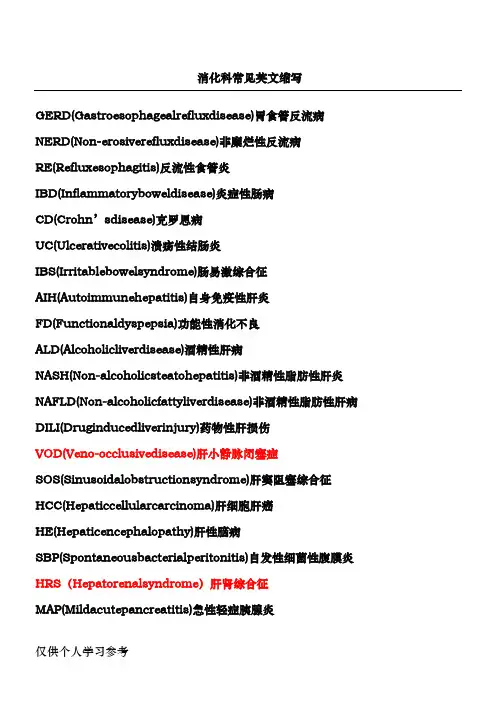
消化科常见英文缩写GERD(Gastroesophagealrefluxdisease)胃食管反流病NERD(Non-erosiverefluxdisease)非糜烂性反流病RE(Refluxesophagitis)反流性食管炎IBD(Inflammatoryboweldisease)炎症性肠病CDHCC(Hepaticcellularcarcinoma)肝细胞肝癌HE(Hepaticencephalopathy)肝性脑病SBP(Spontaneousbacterialperitonitis)自发性细菌性腹膜炎HRS(Hepatorenalsyndrome)肝肾综合征MAP(Mildacutepancreatitis)急性轻症胰腺炎SAP(Severeacutepancreatitis)急性重症胰腺炎CP(Chronicpancreatitis)慢性胰腺炎AIP(Auto-immunepancreatitis)自身免疫性胰腺炎PC(Pancreaticadenocarcinoma)胰腺癌MALT(Mucosa-associatedlymphoidTissue)粘膜相关组织淋巴瘤SIRS(Systematicinflammatoryresponsesyndrome)全身炎症反应综合征影术ERBD(Endoscopicretrogradebiliarydrainage)内镜下胆管支架引流术SOD(SphincterofOddidysfunction)Oddi括约肌功能障碍PTCD(Percutaneoustranshepaticcholangialdrainage)经皮肝穿刺胆道引流TACE(Transcatheterarterialchemoembolization)肝动脉化疗栓塞术消化科常见英文缩写TAE(Transcatheterarterialembolization)肝动脉栓塞术TAI(Transcatheterarterialinfusion)?肝动脉插管灌注化疗PSE(Partialsplenicembolization)部分脾栓塞术TIPS(Transjugularintrahepaticportosystemicshunt)经颈静脉肝内门体分流术SMT(Submucosaltumor)粘膜下肿瘤EMR(Endoscopicmucosalresection)内镜下粘膜切除术FNH(PSC(Primarysclerosingcholangitis)原发性硬化性胆管炎ICP(Intrahepaticcholestasisofpregnancy)妊娠期肝内胆汁淤积症BCS(Budd-Chiarisyndrome)布-加综合征。

・1964・现代医药卫生2020年7月第36卷第13期JMod Med Health,July2020,Vol.36,No.13.论著.氟哌嘍吨美利曲辛辅助治疗难治性胃食管反流病疗效及安全性meta分析孔凯#,杨正武[1.山东第一医科大学(山东省医学科学院),山东泰安2710002.山东第一医科大学第二附属医院消化内科,山东泰安271000([摘要]目的评价氟哌廛吨美利曲辛(黛力新)联合常规药物辅助治疗难治性胃食管反流病(RGERD)}者的临床疗效及安全性&方法检索中国知网数据库(CNKI)、维普数据库(VIP)、万方数据库、中国生物医学文献服务系统(CBM)、Pubmed、谷歌学术、EMBASE等数据库关于比较使用氟哌廛吨美利曲辛联合常规药物与单独使用常规药物治疗RGERD O随机对照研究(RCTs),筛选文献、提取数据后依据Cochrane Handbook5.10进行偏倚风险评价,数据处理采用RevMan5.3软件进行meta分析&结果共13项随机对照试验纳入研究,共计1483例患者,异质性检验厂=0%,P=0.90,固定效应模型分析其合并风险比(--)=131(95%C+ 1.24—1.38),统计检验Z=9.57(P<0.01) &在不良反应发生率方面,两组比较,差异无统计学意义(P= 0.11)&结论氟哌囉吨美利曲辛联合常规药物治疗RGERD的治疗效果优于单用常规药物,且安全性较好,无严重不良反应生&[关键词]氟哌囉吨美利曲辛;难治性胃食管反流病;疗效;安全性;Meta分析DOI:10.3969/j.issn.1009-5519..020.13.004中图法分类号:R573.9文章编号:1009-5519(2020)13-1964-06文献标识码:AFlupentixol-melitracenas adjunctive therapy on patients with refractory gastroesophageal reflux disease:a meta analysisKONG K%JANG Zheugou2[1.ShaTtdoTig First Medical('riiversity(.ShaTtdoTtg Academy of Medical Sciertces),Taicm,ShaTtdoTig271000,Chirta;2.The Sccorid Affiliated Hospital of ShaTtdoTtg FirstMedical(niversity,Taicm,shaTtdoTtg271000,Chirta([Abstract]Objective To evaluate the clinical effect and safety of flupentixol-melitracen combined with routine drugs for patients with refractory gastroesophageal reflux disease(RGERD).Methods China Knowledge Network Database(CNKI),VIP, Wanfang,CBM,Pubmed,Google,EMBASE were retrieved to identify randomized clinical trials about flupentixol-melitracen combined with routine drugs and routine drugs alone in the treatment oPRGERD.Risk oPbias oPincluded studies were appraised in terms of Cochrane Handbook for Systematic Reviews of Intervetions of Version5.1.0.Meta-analysis was performed with RevMan 5.3software.Results A total of13randomized controlled trials were included involving1483patients.The result of heterogeneity test showed that+2=0%,P=0.90.For the fixed-effect model the risk ratio was1.31(95%CI1.24—138)Statistical test Z=9. 57(P<0.01).There was no significant difference in untoward effect rate between the two groups(P=0.11).Conclusion Thera-peuticefectofflupentixol-melitracencombinedwithroutinedrugsinthetreatmentofRGERDisbeterthanuseofroutinedrugsa-loneandnoseriousadverseeventshappenedinbothtwogroups[Key words]Flupentixol-melitracen;Refractory gastroesophageal reflux disease;Therapeutic effect;Security;Meta analysis胃食管反流病(GERD)是指胃内容物逆行进入食管引起的直接相关症状或并发症%1。

哮喘GINA方【篇一:哮喘gina方】全球哮喘防治倡议(gina)最新发布了 2016 版 gina 指南:gina 全球哮喘处理和预防策略。
与 2015 版 gina 指南相比,2016 版 gina指南在哮喘治疗方面依然分为四部分,主要更新内容集中在第二部分「可使哮喘症状控制和风险降低的药物和治疗策略」:在「第 1 级治疗:按需急救药物吸入」以及「第 2 级治疗:低剂量控制药物 + 按需急救药物」部分,新版 gina 指南未做修改。
第 3 级治疗:增加「低剂量糠酸氟替卡松 / 维兰特罗」作为新的ics/laba 治疗选择。
2015 版内容「目前获批用于第 3 级治疗的联合 ics/laba 吸入器包括:丙酸氟替卡松 / 福莫特罗、丙酸氟替卡松 / 沙美特罗、倍氯米松/ 福莫特罗、布地奈德 / 福莫特罗和莫米松 / 福莫特罗。
」更新为:「目前获批用于第 3 级治疗的联合 ics/laba 吸入器包括:低剂量丙酸氟替卡松 / 福莫特罗、糠酸氟替卡松 / 维兰特罗、丙酸氟替卡松 / 沙美特罗、倍氯米松/ 福莫特罗、布地奈德 / 福莫特罗和莫米松 / 福莫特罗。
」2016 版增加了一种新的治疗选择「糠酸氟替卡松 / 维兰特罗」。
第 4 级治疗:增加「噻托溴铵作为有急性发作史的 12 岁以上青少年和成人哮喘患者的附加疗法」,即将 2015 版内容「软雾吸入器给药的噻托溴铵可作为有哮喘急性发作病史患者的附加疗法(b 级证据)。
这一疗法不建议使用在年龄 ?? 18 岁的儿童中。
」更新为:「软雾吸入器给药的噻托溴铵(lama)可作为有哮喘急性发作病史的成人或青少年患者的附加疗法(a 级证据)。
这一疗法不建议使用在年龄 12 岁的儿童中。
」该修改内容同步更新在所有相关表格中。
更新的主要依据是 2015 年发表在 chest 的一篇综述/荟萃分析(chest. 2015 ;147(2):388-96.)。
该综述认为,噻托溴铵联用 ics可显著提高患者肺功能,降低急性发作以及改善哮喘控制状况;对于 ics 或 ics/沙美特罗控制症状不佳的中重度哮喘患者,噻托溴铵联用 ics/沙美特罗相较于 ics/沙美特罗也可显著提高肺功能,降低急性发作,改善哮喘控制状况 1。