
英语必修5 Unit1 Great Scientists Warming up
- 格式:ppt
- 大小:3.19 MB
- 文档页数:39

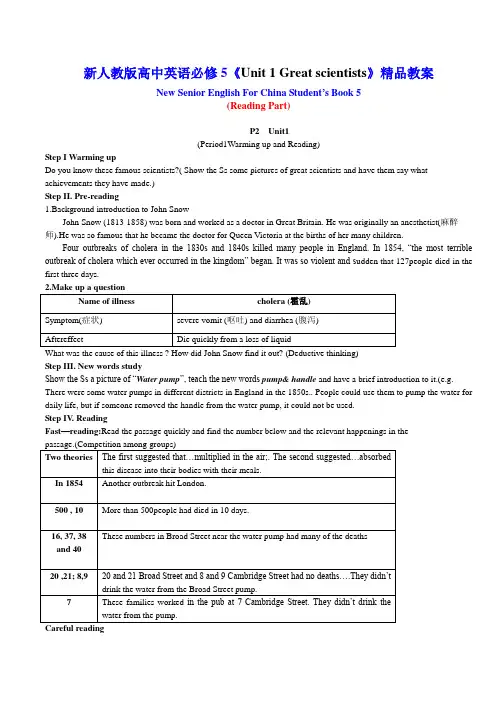
新人教版高中英语必修5《Unit 1 Great scientists》精品教案New Senior English For China Student’s Book 5(Reading Part)P2 Unit1(Period1Warming up and Reading)Step I Warming upDo you know these famous scientists?( Show the Ss some pictures of great scientists and have them say what achievements they have made.)Step II. Pre-reading1.Background introduction to John SnowJohn Snow (1813-1858) was born and worked as a doctor in Great Britain. He was originally an anesthetist(麻醉师).He was so famous that he became the doctor for Queen Victoria at the births of her many children.Four outbreaks of cholera in the 1830s and 1840s killed many people in England. In 1854, “the most terrible outbreak of cholera which ever occurred in the kingdom” began. It was so violent and s udden that 127people died in the first three days.What was the cause of this illness ? How did John Snow find it out? (Deductive thinking)Step III. New words studyShow the Ss a picture of “Water pump”, teach the new words pump& handle and have a brief introduction to it.(e.g. There were some water pumps in different districts in England in the 1850s.. People could use them to pump the water for daily life, but if someone removed the handle from the water pump, it could not be used.Step IV. ReadingFast—reading:Read the passage quickly and find the number below and the relevant happenings in theparagraph and findout what evidenceor approach is JohnSnow used in thestage of experiment,then fill in the chartbelow.Step V. Discussion1.What’s the significance of Snow’s famous cholera map ?2.If you were John Snow, how would you investigate the cholera?Step VI. SummaryStep VII. Homework assignment1.Finish Ex.1 on P42.2. Retell the story.3. Prepare for tomorrow’s dictation.P9 Unit2 The United Kingdom(Period 1 Warming up and Reading)Step 1 Warming up& lead-in1. Game playingT: Morning everybody! You see, nowadays, travelling abroad are becoming more and more popular. So if you have a chance to go aboard, which country do you want to go most? How much do you know about that country?T: Very good! Just now some of you shared your ideas, and now let’s play a short game: Guess which country it is! Altogether there are 8 groups, you are asked to choose one item and guess which country it isaccording to the related information offered to you.1. People----America2. Music----Argentina3. Video----Australia4. Food-----Italy5. Shooping----France6. Architecture-----China7. Poetry-----the UKStep2 Pre-Reading1. Brainstorming :T: Now you have a chance to go to the UK. , before you go there you’d better go to the library to search for some information about the country. What kind of information about it you want to find out?S: geography, literature, politics, sports, sightseeings,cultures, ethnic groups, famouscities, food, history, language, fashion, life styles …….T: How much do you know about these?Step 3 Reading1. Fast-reading.1)Task 1:Question: What kinds of information are mentioned in the text?(sports, geography, history, flag, London, The biggest country England, flag,invasions).2) Task 2:How many parts can this passage be divided into and what the main idea of each part is?.Part1(para1-4): How the UK came into beingPart2 (para5): England is divided into 3 zones.Part3 (para6): The reason why London became the cultural capital of England.2. Careful readingPart 11) T: Very good! So could you tell me how many countries the UK consists of and what they are?S: The UK consists of four countries, that is England, Wales, Scotland and Northern Ireland.2) T: Exactly! Then does these four countries united in one day?S: No.T: Then how can the UK come into being?S: First there was only England, then in the 13th century AD, Wales was linked to the England, and in 1603, the two were joined to Scotland to make the Great Britain come into being. Later, Northern Ireland was united to theGreat Britain to form the UK.T: Wonderful job! Actually the history can be shown in the national flag called the Union Jack.3) T: By the way, you see, the flag Union Jack only unites England, Scotland and Northern Ireland, with Wales left out. So do you know why?S: Becauseit is usually assumed to be part of England.T: Yes! And according to the passage, although the four countries belong to the UK, they are still quite different in some aspects, so in what ways are the four countries different?S: They are different in international relations. They have different educational and legal systems as well as football teams.Part 2T: Among the four countries, England is the largest, and for connivance it is divided into 3 zones. What are they?S: The South of England, the Midlands and the North.T: Good! And now could you tell me what the feature of each zone?Most population settled inThe South of England.Most of the large industrial cities are in the North and the Midlands.Many cities have famousfootball teams.Part 31) T: So we all know the UK has a long history and of course rich culture,and the cultural center is,obviously, the capital city London. So why can London become the cultural center ?S: Because there are a lot of historical treasure in London.T: Why there are so many historical treasure in London?S: London has been influencedby some invaders.2) T: Actually, in the England history, altogether there are four invasions, do you know what they are? S: The Romans; The Anglo-Saxons; the Vikings; the Normans.T: What did they left in England?S: the Romans left towns and roads, theAnglo-Saxons language and government, the Vikingsinfluence the vocabulary and place-names of the North and the Normans castles and words for food.Step 4. Post-Reading1. Task 1 Role-playTwo students act as tourist guides, and two students act as the tourists who want to go to the UK. Before they start, they ask the guides some background information of the UK.2. Task 2 Discussion of ideasThis is an opportunity to allow students to draw connections in the history and the geography of England. Ask students work in groups of 4, and every group choose 1 topic. At last the group leader should give a representation of their ideas.1) What similarity is there between the invasions of the Romans and the Normans?2) What similarity is there between the invasions of the Anglo-Saxons and the Vikings?3) Why does London only have evidence from three of the four invaders?4) What geographical factors make it difficult to invade England successfully?3. Task 3 DebateIn the history of the UK. , there are some important inventions. Those invaders ruled the country for sometime. They brought pains to the local people, but at the same time, they also brought something new to the country, which is important for the making up of its history.“Is the inventions good or bad to the country Britain?”Step5 Homework1. Read the text and try to find out some important or difficult words and expressions.2. Write a short summary of the passage.3. Preview “Learning about Language—Discovering useful words and expressions”.P17 Unit3 Life in the Future(Periods 1-2 Warming up and reading)Step 1 warming upTalk about how many changes there have been in the last one thousand years. And what changes we might expect to find in the next one thousand yearsStep 2: pre-reading1.Can you tell what problems people are facing today?2.what problems do you think people in the future will have overcome?Which ones will still be there or even worse in AD3005?(Key: 1The problem of population will be solved,have begun to Control the birth rate. //2The problems will be still there,and will even worse.// 3I don’t think so.Now scientists are trying their best to develop new resources that human beings can make use of ,such as solar energy.In my opinion……)Step 3:fast reading1. Read the text for the first time and tell what the text is about?It’s an e-mail written by a man Who has taken up a trip to the future.2. Look at the following sentence, there are in wrongorder, tell me the correct order for these sentenceA. We were transported into the future by acomfortable time capsule.B. I arrived a t Wang Ping’s home andeverything in his house made mesurprised.C.I won a travel to the year AD3005D. I have my first try to master a hoveringcarriage.Step 4 careful reading1.Answer the following questions:1.Why did I have the chance to travel to the year AD3005?2. What is a “ time lag”?3. How did I feel when I was in the capsule?4. Who guides my trip?5.Why did my guide give me some tables?6.Who transported us to the future?Key:1. I took up the prize I won the year before.2. “Time lag”means a person get s flashbacks from his previous time period.3. The seats in the capsule are very comfortable.4. My friend Wang Ping is my guide to the future.5. The tablets could help me feel less nervous and uncertain6. Wang Ping’s parents’ company transported us to the future.2. ComprehendingPractice by doing the comprehending exercise Exercise 1-2 on Page 19I think the writer has an optimistic view of the future. He was very excited when he traveled to the year AD 3005 an d couldn’t believe if was true. From this, we can see he is eager to go to the future. Thoughhe was hit by the lack of fresh air,---P25 Unit 4 Making the news(Period 1 Warming up and Reading)(整合warming up, Pre-reading, Reading 与Comprehending四部分)StepI. Elaboration (warming up):Help the students to relate their known knowledge to the topic that will be learnedabout in the text?Step II. Prediction (pre-reading):Task : Predict the main idea of the text by discussing the following questions:1. What are the qualities a good news reporter needs to have?(Have group discussion first and then finish Part 1 individually)2. What your first day at school was like? How would you feel on your first day at work? (Group discussion)Step III. Skimming, scanning, analyzing (Reading & Comprehending)Task 1: Read the text quickly to get a general idea of the text.Task 2: Divide the passage into three sections and match the following main ideas to the three sections:1)How to get an accurate story3)Work in a teamTask 3 Read quickly to find out the information to fill in the form belowTask 4: Tell what is required for a reporter and a photographerpatient; imaginative ; well-organized; technically good; polite; concise; thorough; creative; curious; careful; gifted; professionalStep IV. SummarizingTask 8: Write a summary of the textStep V. AssignmentRead an English newspaper and retell the main idea of one article in it.P33 Unit 5 First aid(Period 1 Warming up and Reading)Step 1 Revision1.Greet the whole class as usual2.The teacher checks the students’ homework: show some pictures about some common injuries andreview some words, some useful expressions and the information about first aid.Step 2 Pre-readingFirst let the students talk about the picture (page 33)What kind of first aid would you perform in the situation of burning?Step 3 While-reading1) Skim for general idea. How many parts are the text and what are they?Five parts1.The purpose of skin2.Cause of burns3.Types of burns4.Symptoms of burns5.First aid treatment2)Scanning : read the text quickly and do the multiple choices (page 36)3)Detail reading: Filling in the blanksWhat can skin do for our body ?•Protect you against diseases, poisons and the sun’s harmful rays.•Keep you warm or cool•Prevent you from losing water•Gives you sense of touchCauses of burnsYou can get burnt by :•hot liquids•steam,•fire, •radiation,•the sun, •electricity and chemicalsWhat are the three types of burns?••F i r s t d e g r e e:Not serious; affect only the top layer of the skin; feel better a day or two•S e c o n d d e g r e eAffect both the top and the second layer of the skin; serious; take a few weeks to heal•T h i r d d e g r e eAffect all three layers of the skin and any tissue and organs under the skin; very severe injuries; victim must get to a hospital at once.•3. Why do you think clothes and jewellery near burns should be removed?B e c a u s e t h i s m a y b r e a k a n y b l i s t e r s a n d t h e w o u n d m a y g e t i n f e c t e d.Step 4 Home work•1. Finish the Exes in p36.2.Read the text.。

Book 5 Unit 1 Great ScientistsA general review of Unit 1Period 1 Word study, Warming up, pre-readingPeriod 2 Reading (P2)Period 3 Language points, learning about languagePeriod 4 Using language( listening), GrammarPeriod 5 Listening & Reading (p44-45)Period 6 Reading & writing (p6)Period 7 Exercises & SummaryPeriod 1Pre-class task:1. Preview new vocabulary of Unit 1, and especially pay attention to the pronunciation of the new word2. Finish the quiz in Warming up( p1) in groups of four by referring to books or surfing the net.Step 1 Learning GoalsGet Ss to go through the summing up form on p 8 in order to have a general idea of the learning goals of Unit 1Step 2 Word Study1. (Pair work) Get Ss to learn the new words and phrases on p91 within 3 mins, by reading them aloud to each other to make sure that they can pronounce the words correctly----4 words then go to next pair2. PracticeUse the correct form of the words to fill in the blanks.infectionexamination=examscience /scientistconcludeanalysisdefeatvalueinstructor/instructioncontribution /contributor contributivecreatecalculatemovecompletionenthusiasm3. Fill in the blanks using the new words in this unit1) Mrs. White bought a pan with a long ________. (handle)2) The pollution is so ________ that we have to take some measures to stop it. (severe)3) He has a big nose that is a ________ of his family. (characteristic)4) Water and salt are ________ into our blood stream every day. (absorbed)5) If a doctor or a medical tr eatment ________ someone’s illness, they make the person well again. (cure)Step 3. Warming up(Group competition) Check the answers to the quiz to find out which group knowthe most . Show pictures to introduce some scientists while Ss giving the correct answers--Step 4 Pre-reading1. (Pair work) What five most important qualities do you think a scientist should have? Give reasons.clever/talented strict patient creative determined/strong-willed positive honest energetic intelligent/hard-working ambitious careful co-operative confident brave2. (Group work) Ex2, p1Do you know how to prove a new idea in scientific research? Discuss in groups the stages in examining a new scientific idea. What order would you put them in?Draw a conclusion Think of a method Collect results Make up a question Find a problem Analyse the resultsStep 5. Summary1. Seeing much, suffering much, and studying much are three pillars (支柱,要素)of learning.2. learning without thought is a labour lost; thought without learning is perilous(危险的)3. To know the disease is half the cure. 找出病根等于医治了一半。
