
牛津小学英语4A Unit4 I like (A)公开课
- 格式:ppt
- 大小:6.75 MB
- 文档页数:40

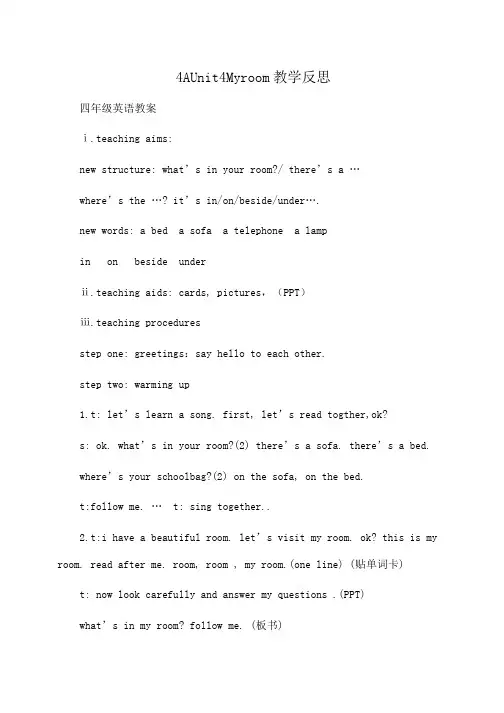
4AUnit4Myroom教学反思四年级英语教案ⅰ.teaching aims:new structure: what’s in your room?/ there’s a …where’s the …? it’s in/on/beside/under….new words: a bed a sofa a telephone a lampin on beside underⅱ.teaching aids: cards, pictures,(PPT)ⅲ.teaching proceduresstep one: greetings:say hello to each other.step two: warming up1.t: let’s learn a song. first, let’s read togther,ok?s: ok. what’s in your room?(2) there’s a sofa. there’s a bed.where’s your schoolbag?(2) on the sofa, on the bed.t:follow m e. … t: sing together..2.t:i have a beautiful room. let’s visit my room. ok? this is my room. read after me. room, room , my room.(one line) (贴单词卡) t: now look carefully and answer my questions .(PPT)what’s in my room? follow me. (板书)t: what’s in my ro om?step three: learning new words1.(让学生随便说,说哪个出现哪个) s:a bed. (操作幻灯片,出现图片)t:clever. you should say “there’s a bed”. s: …t: follow her. s:…t:one by one.2.a sofa.t: anything else?s: there’s a sofa. t: follow her.(one group by one group)3.a telephone t:what’s in my room? s: there’s a telephone.(快慢读)4.a lamp t:anything else?(抽读)5. t: let’s read together. t: what’s in my room? s: there’s…6. t: take out your paper and then decorate your room.7. t: oh,so beautiful room. what’s in your room?s: there’s…in my room.(板书)read after me.(2 students)t: practice in pairs.(拍手做)t:let’s read together.step four:learning new structure.1. t:you did a very good job. congratulations.look, this is a box. guess,what’s in the box?(露出兔子耳朵)s:rabbit.t: there’s a …in the box. follow her.t: look , where’s the rabbit? (板书)s: on the box. (小组读)2.t: where’s the rabbit?s1.it’s under the box. t: super. follow her.t: where’s the rabbit?ss: it’s under the box.3.t:who can ask? s: where’s the rabbit?t:who can answ er? s: it’s in the box.boys ask girls answer. girls ask boys answer.4.t:ask together. ss:where’s the rabbit?t: who can answer? s: it’s beside the box. t:i ask you answer.(一块读)5. t:in,in里面; on on 上面;under,under下面;beside,beside 旁边。

四年级英语Unit2复习卷姓名:________ 班级:_______ 学号:____-一.英汉互译.1.我的钢笔_____2.你的狗_____3.他的狮子_____4.她的老虎_____5.那只猫_____6.在书桌上_____7.in a toy shop_____ 8.How lovely! _____9.I see. _____ 10.看一看_____11.I’d like _____ 12.a nice monkey_____13.In which box? _____ 14.这是一只铅笔。
_____15.I like_____ 16.两只圆珠笔_____二.选择。
( ) 1.---Which is for me ?---This one _____ that one?A. andB. forC. or( ) 2.---This bookcase is for Li Ping. --- _______.A. Sure. Here you areB. All rightC. Thank you ( ) 3.---What’s that? --- ________ .A.That’s a rabbitB. This is a rabbitC. A rabbit ( ) 4.---Can I have a look at your toy panda ?---________.A. Yes , I canB. SureC. No, I can’t ( ) 5.---_______this ? --- It’s a cat.A. WhatB. What’sC. What are( ) 6.---That’s ________ monkey ,I think.---Yes, it’s ______ monkey.A. your; myB. your; hisC. his ;her( ) 7.This is a lion ,I think .--- _______. It’s a dog.A. Yes ,it isB. No, it isn’tC. Yes , it isn’t ( )8._______like that lion ,Miss Li .A. I’dB.I likeC. Let’s( )9.Can you see the cats on the desk ?A.Sorry ,I don’t know .B. Yes ,I can .C. No , I don’t.( )10.A:I like my toy cat .B:I like ______ toy cat ,too.A. yourB. Helen’sC. you三.情景交际。

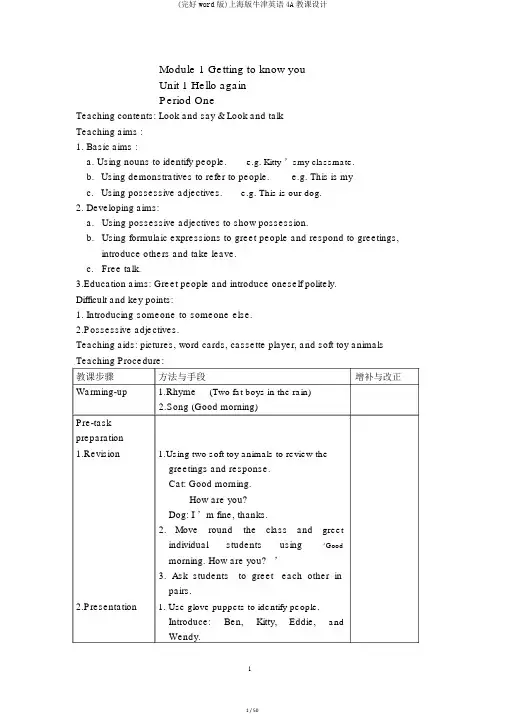
Module 1 Getting to know youUnit 1 Hello againPeriod OneTeaching contents: Look and say & Look and talkTeaching aims :1. Basic aims :a. Using nouns to identify people. e.g. Kitty ’smy classmate.b. Using demonstratives to refer to people. e.g. This is myc. Using possessive adjectives. e.g. This is our dog.2.Developing aims:ing possessive adjectives to show possession.ing formulaic expressions to greet people and respond to greetings,introduce others and take leave.c.Free talk.cation aims: Greet people and introduce oneself politely.Difficult and key points:1.Introducing someone to someone else.2.Possessive adjectives.Teaching aids: pictures, word cards, cassette player, and soft toy animals Teaching Procedure:教课步骤方法与手段增补与改正Warming-up 1.Rhyme(Two fat boys in the rain)2.Song (Good morning)Pre-taskpreparation1.Revision ing two soft toy animals to review thegreetings and response.Cat: Good morning.How are you?Dog: I ’m fine, thanks.2. Move round the class and greetindividual students using‘Goodmorning. How are you?’3. Ask students to greet each other inpairs.2.Presentation 1. Use glove puppets to identify people.Introduce: Ben, Kitty, Eddie,andWendy.2. Guess: Who is Wendy?to elicit: She ’sEddie ’ssister.While-taskprocedure1.Introduce: 1. Invite one student to stand up. Say:classmate He/She is your classmate. You ’reclassmates.2. Imitation(Show the word card) Ask students toread the word several times.3. Invite a different student to stand up.Ask: What ’shis/her name? Prompt thestudents to say: This is my classmate.His/Her name ’s ___.4. Substitution:In groups of four, have studentsintroduce their classmates.2.Introduce:our 1. Show the toy dog. Ask: Whose dog isthis? to elicit: It ’sKitty and Ben ’sdog.2. Play the cassette: This is our dog. Hisname ’sSam.3. Imitation:a. Show the word card. Ask students toread the word.b. Play the cassette again. Thestudents listen and repeat.4. Sentence making: e.g. This is ourfriend/classmate/teacher. His/Hername ’s___.3. Listen and 1. Play the cassette: Look and say. The answer students listen carefully.2.Answer the questions:Who ’sEddie ’sclassmate?Who ’sWendy?Whose cat is this?What ’sthe cat ’sname?3.Play the cassette again.The students listen and repeat.Post-taskactivities1. Production1. In groups of four, have the studentspractice the dialogue.2. Play a game (Look and talk)a. Write the numbers on the back ofthe word card.b. Students choose the differentnumbers.c. Then ask students to complete thedialogue according to their cards.3. Free talkEncourage students to introduce theirpets, their classmates using their ownname and their toy animals.2. Assignment 1. Introduce your parents using ‘This isHis/Her name ’s2.Write about one of your classmates.成功经验课板后书随设思虑与对策笔计Period TwoTeaching contents: Read a story & Learn the soundTeaching Aims:1.Basic aims:ing verbs to describe actions. e.g. run, swim, jumping modals to talk about ability. e.g. She can run.c. Using connectives to link contrasting ideas e.g. But she can’tcook.d.Saying the sound ‘ch- ‘2.Developing aims:a.Read and act the storyb.Talking about ability.c. Write a simple story.Teaching aids: pictures, word cards, cassette player, and mask Teaching Procedure:教课步骤方法与手段增补与改正Warming-up Song (I can sing)Pre-taskpreparation1. Revision 1. Say and act: sing, draw, write2. Sentence making:e.g. I can draw a dog.I can sing a song.2. Presentation 1. Put on the mask. Ask: Do youknow him? to elicit: He is aSuperman.2. Encourage students to describeSuperman.e.g. He’s strong. He’sbrave/super.While-taskprocedure1.Introduce: 1. Ask students to guess whatrun, jump, Superman can do.swim, dive, 2. Put the word and picture cards onfly the board in random order. Usingmine, introduce: run, swim, jump,dive, and fly.3. Read the words with actions.4. Invite individual students to comeout and match the words andpictures.5. Invite students to say whatSuperman can do.e.g. He can run. He can dive.2.Introduce: 1. Ask students what they thinkcook, Superman can ’tdo.2. Using mime, introduce: cook3. Introduce: Superman can fly. Buthe can ’tcook.4.Sentence making:e.g. I can sing. But I can’tfly.3.Read the 1.Ask: Do you like Superman?story to elicit: Alice likes Supergirl.She ’s reading a story aboutSupergirl.2.Ask students what they thinkSupergirl can or cannot do.3.Play the cassette. The studentslisten and check their guesses.4.Play the cassette again. Thestudents listen and repeat.Post-taskactivities1. Production 1.True or FalseAsk students to read thestatements in Read and answer.Do number 1 and number 2 withthe students to help themunderstand the words ‘True’and‘False’.Then ask them to finishthe rest of the exercise.2. Invite students to retell the story.3. Draw and writeDivide students into groups offour. Have them draw a picture oftheir favourite cartoon characterand write the caption underneath.Then talk about each drawing.2. Learn the 1. Have students repeat the soundsound and words after you.2. Play the cassette. Students listenand repeat.3.Invite individual students to readaloud the sentences.3. Assignment 1. Retell the story.2. Write a story about your favouritecartoon character.课成功与经验板后书随思虑与对策设笔计Period ThreeTeaching contents: Look and say & Ask and answerTeaching aims:1.Basic aims:a. Using verbs to describe actions. e.g. paint, readb. Using interrogatives to ask‘yes/no’-questions to obtain simple responses.e.g. Can you swim?c. Using modals to talk about ability.e.g. Yes, I can. / No, I can ’t.2 .Developing aims:a. Asking about ability.b. Do a survey in class.cation aims: Talking about ability to establish friendly relations withyour classmates.Teaching aids: pictures, word cards, cassette player,Teaching Procedure:教课步骤方法与手段增补与改正Warming-up 1. Song2. Responding to simpleinstructionse.g. Sing a song. Draw a circle.Pre-taskpreparation1. Revision Invite individual students to cometo the board and choose a PictureCard and mime whether they cando or can ’tdo a particular action.The rest of the class say: He/Shecan/can ’t2.Presentation Invite individual students to stand up.Point to the pictures and ask: Canyou ? And prompt them to use: Yes, Ican. /No, I can ’t. to answer yourquestions.While-taskprocedure1. Introduce: 1. Introduce: paint by miming apaint painting action, and then stickthe Word and Picture Cards onthe board.2. Read the word with action.3. Ask individual students: Canyou paint? to elicit: Yes, Ican./No, I can ’t,4. Ask and answer in pairs.2.Introduce: 1. Draw a picture on the board.read Ask: What can she do? to elicit:She can read.2.Read the word in different voices.3.Ask individual students: Can youread? What can you read? toelicit: I can read English/a story.3.Listen and 1. Play the cassette: Look andsay say. Students listen.2. Play the cassette again.Thestudents follow in their booksand, in groups of four,practicethe dialogue.3.Invite individuals to read thedialogue to the class.Post-taskactivities1.Production 1. Show a photo album.Tellstudents that it is your album.Encourage them to ask aboutyour photograph using‘Canyou ?’2.Students work in pairs using thepictures in Ask and answer to findout what their partner can andcannot do.3.Do a survey:Ask students to walk around theclass and interview three to fiveclassmates. Students are to findtheir classmates who can orcannot do a certain thing.Invite individual students toreport back to the class.2.Assignment plete Workbook page two.2. Write about your ability using ‘Ican ’课成功与经验板后书随思虑与对策设笔计Module 1 Getting to know youUnit 2How old are you?Period OneTeaching contents:Look and say.Ask and answerTeaching aims:1. Basic aim:能听懂,会说,会读本课对话. E.g. How old Happy?birthday. Thank you.2. Education aim:会互相咨询对方年纪,庆祝对方诞辰,增进感情。