
循环冗余校验码的原理及应用
- 格式:ppt
- 大小:1.10 MB
- 文档页数:23
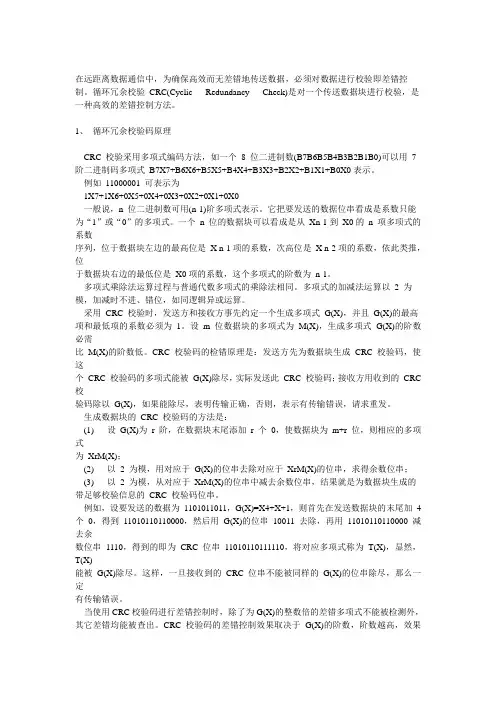
crc循环冗余校验码校验规则英文回答:Introduction to CRC (Cyclic Redundancy Check)。
Cyclic Redundancy Check (CRC) is an error-detecting code commonly used in digital networks and storage devices. It is a type of polynomial code that generates a fixed-length checksum based on the input data. The checksum is appended to the data and used to verify the integrity of the data during transmission or storage.How CRC Works.CRC works by dividing the input data by a predetermined polynomial. The remainder of this division is known as the CRC value. The CRC value is then appended to the input data and transmitted or stored.When the data is received or retrieved, the CRC valueis recalculated using the same polynomial. If the recalculated CRC value matches the original CRC value, it indicates that the data has not been corrupted during transmission or storage.Types of CRC Polynomials.There are various types of CRC polynomials, each with its own characteristics. Some common CRC polynomials include:CRC-16: Used in various applications, including data communication protocols and storage devices.CRC-32: Widely used in file transfer protocols, such as ZMODEM and Kermit.CRC-64: Used in high-performance computing and storage systems.Applications of CRC.CRC is used in a wide range of applications, including:Data communication: CRC is used to detect errors in data transmitted over networks and communication channels.Storage devices: CRC is used to protect data stored on hard drives, RAID systems, and other storage media.Error correction: Some CRC algorithms can correct errors in addition to detecting them.CRC Calculation Methods.There are two main methods for calculating CRC values:Hardware implementation: CRC values can be calculated using dedicated hardware circuits.Software implementation: CRC values can be calculated using software algorithms.Benefits of Using CRC.Error detection: CRC is effective in detecting errors that occur during data transmission or storage.Data integrity verification: CRC ensures that the received data is identical to the data that was sent.Efficient error detection: CRC can detect errors quickly and efficiently.Error correction (in some cases): Certain CRC algorithms can also correct errors.Limitations of CRC.False positives: CRC can sometimes detect errors that do not actually exist.Limited error detection: CRC can only detect errors that occur within the scope of the CRC calculation.Polynomial selection: The choice of CRC polynomial canaffect the effectiveness of error detection.Conclusion.Cyclic Redundancy Check (CRC) is a powerful error-detecting code that plays a vital role in ensuring data integrity in various applications. By generating a checksum based on the input data and verifying it after transmission or storage, CRC helps detect errors and maintain the reliability of data.中文回答:什么是CRC循环冗余校验码?CRC(循环冗余校验码)是一种常用于数字网络和存储设备中的错误检测码。
计算机网络原理循环冗余码循环冗余校验码(CRC:Cyclic Redundancy Code)借助于循环码来实现校验。
循环码不同于奇偶校验码,它有两个显著特点:一是循环码适合于用代数方法分析码的结构,并可以用代数方法设计各种实用的、有较强纠错能力的码,并且无需很长的码长;二是由于码的循环特性,所需的编、译码设备比较简单,易于实现。
因此循环码在实际中得到广泛应用。
1.CRC的工作方法在发送端产生一个循环冗余码,附加在信息位后面一起发送到接收端,接收端收到的信息按发送端形成循环冗余码同样的算法进行校验,若有错,需重发。
2.循环冗余码的产生与码字正确性检验例子。
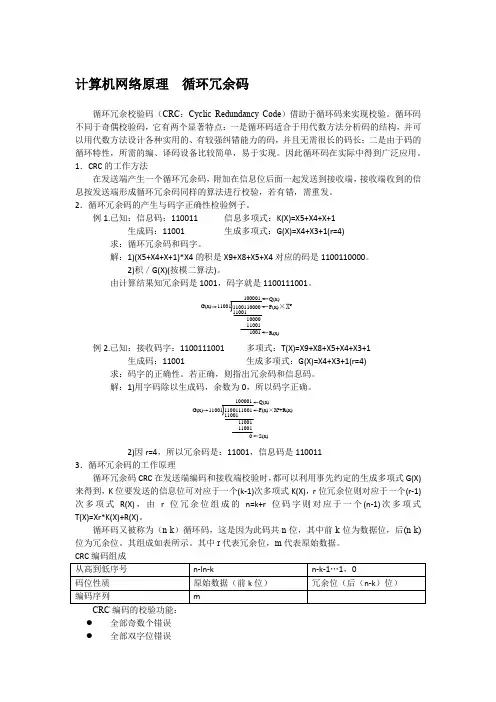
例1.已知:信息码:110011 信息多项式:K(X)=X5+X4+X+1生成码:11001 生成多项式:G(X)=X4+X3+1(r=4)求:循环冗余码和码字。
解:1)(X5+X4+X+1)*X4的积是X9+X8+X5+X4对应的码是1100110000。
2)积/G(X)(按模二算法)。
由计算结果知冗余码是1001,码字就是1100111001。
G(x)11001100001001×X r例2.已知:接收码字:1100111001 多项式:T(X)=X9+X8+X5+X4+X3+1生成码:11001 生成多项式:G(X)=X4+X3+1(r=4)求:码字的正确性。
若正确,则指出冗余码和信息码。
解:1)用字码除以生成码,余数为0,所以码字正确。
G(x)110011100111001×X r+R(x) S(x)2)因r=4,所以冗余码是:11001,信息码是1100113.循环冗余码的工作原理循环冗余码CRC在发送端编码和接收端校验时,都可以利用事先约定的生成多项式G(X)来得到,K位要发送的信息位可对应于一个(k-1)次多项式K(X),r位冗余位则对应于一个(r-1)次多项式R(X),由r位冗余位组成的n=k+r位码字则对应于一个(n-1)次多项式T(X)=Xr*K(X)+R(X)。

crc循环冗余码的例题
CRC(循环冗余校验)是一种用于检测数据传输或存储中的错误的常见方法。
CRC利用一个多项式对数据进行操作,产生一个校验码,然后接收方可以使用同样的多项式对接收到的数据进行相同的操作,如果结果匹配,则数据被认为是正确的。
下面是一个简单的CRC计算例子:
假设我们有一个4位的二进制数据:1011。
我们选择一个生成多项式:x^4 + x^3 + x + 1,也可以表示为10011。
首先,我们把数据和生成多项式进行异或运算:
1011 异或10011 = 0110
然后我们把结果左移4位(相当于乘以2^4),变为:0110 左移4位= 0000111000
接下来我们把原始数据和刚才的结果进行异或运算:
1011 异或0000111000 = 1010
这个结果就是我们的CRC校验码。
接收方可以通过同样的方式对接收到的数据进行CRC 校验,如果结果和发送方的CRC校验码相同,那么数据就是正确的。
这只是一个非常基础的CRC计算例子,实际的CRC算法可能会更复杂,可能需要处理更长的数据和更复杂的生成多项式。