
Chapter 8 Position of the states in int...
- 格式:ppt
- 大小:259.50 KB
- 文档页数:56


英美文化课后答案2Lecture 2 HistoryTell wheher each of the following statements is true or false1-10: FTTFT/TFTFF 11-20: FTTTF/FTTFFFill in the blanks with the correct information.1. Celt2. Romans3.5th4. Viking; 10665. Hundred Years’ War6. York7. divorce8.11 9. Elizabeth I; Queen Victoria 10. America 11. 1492 12. Virginia; 1607 13. Thanksgiving Day 14. 13 15. Declaration of Independence 16. 4th of July 17. Uncle Tom’s Cabin 18. 1865 19. World War I 20. World War II 21. Puritans, religious, Mayflower 22. Thomas Jefferson, Declaration of Independence, National Day 23. Monroe Doctrine, colonize, interfere 24. agrarian, industrial, Andrew Jackson 25. Harriet Beecher Stowe, Uncle Tom’s Cabin, slavery 26. 1932, recovery, New DealChoose the correct answer on the basis of what is stated in text.1-10: ABDCD/CBDAB 11-20: CBDCB/DCADD 21-30: BDABA/DCBCBExplain the following terms.1. The Anglo-SaxonsIn the 5th century, the tribes called the Angles and Saxons invaded Britain, coming from northern Europe. By the end of the 5th century, the Anglo-Saxons ruled most of Britain. Their language was called Old English. From them comes the name of “England” and “English”; England came from “Angle-land” meaning the land of the Anglo-Saxons.2. Norman ConquestAfter King Edward died, Duke William of Normandy, from northern France, declared that Edward had promised to let him become the king. On October 14, 1066, William and his army invaded England and defeated the English army. He was made king and crowned in Westminster Abby on Christmas Day, 1066. William is often referred to as William the Conqueror in English history.3. Robin HoodEngland's best-loved legend of Robin Hood is an outlawed Saxon nobleman oppressed by the Normans. He hid i n the forest near Sherwood with his band of followers, called “merry men”. From this secret wood, they went out to rob from the rich to give to the poor with their longbows. Robin Hood has been a popular subject of numerous films, television series, books, comics and plays.4. The Hundred Years’ WarAt the beginning of the 14th century, England developed into a stronger state in Europe. Consequently, the rich wanted to control more markets and the nobles wanted to regain their lost land. When King Edward III of England declared that he should become the French king, the French rejected his claim so he declared war on France in 1337. The war lasted intermittently for116 years, hence being known as the Hundred Years’ War.5. The Civil WarIn January 1642 the Civil War broke out between the Roundheads (supporters of Parliament) and the Cavaliers (supporters of the King). The Civil War ended with the Parliamentary victory and it led to the execution of Charles I, and his son Charles II was driven out of the country in 1649. In addition to that, Oliver Cromwell, the leader of the Roundheads,formed republican England, known as the Commonwealth of England and the English monarchy was abolished.6. American IndiansThe American Indians were the descendants of t he Mongoloid. The name “Indians” was given by Columbus when he mistook them for the people of India. It is believed that about 25,000 years ago the Indians crossed the Bering Strait land bridge to Alaska. The American Indians developed the brilliant civilizations of the Aztecs, the Incas and the Mayas.7. Columbus’ “discovery ” of AmericaIn 1492, Columbus persuaded the king and queen of Spain to finance his voyage. He believed that by sailing west from Europe, he could reach India. Columbus failed to reach India but landed at one of the Caribbean islands instead. He mistook these islands for part of India and called the local people Indians.8. The MayflowerThe Mayflower has a famous position in American history as a symbol of early European colonization. With their religion oppressed by the Church of England, in the autumn of 1620, 102 people sailed to the New World in a ship named the “Mayflower”. Late in December, the Mayflower finally landed in what is now Plymouth, Massachusetts.9. Declaration of IndependenceOn July 2, 1776, the Congress finally determined that these United Colonies ought to be free and independent states. Thomas Jefferson, assisted by Benjamin Franklin, drafted the Declaration of Independence, which the Congress adopted on July 4, 1776. It announced the independence of 13 North American colonies and the birth of a new nation.10. Abraham LincolnIn March 1861 Abraham Lincoln took the office of president. He realized that by making the war a battle against slavery, he could win support for the Union at home and abroad. On January 1, 1863, he issued the Emancipation Proclamation, which granted freedom to all slaves.11. William ShakespeareWilliam Shakespeare (1564-1616): English playwright and poet, whose body of works is considered as the greatest in English literature. His plays, many of which were performed at the Globe Theater in London, include historical works, comedies and tragedies. He also composed 154 sonnets and 36 plays.12. Sir Francis BaconSir Francis Bacon (1561-1626): English philosopher, essayist, courtier, jurist, and statesman. His writings include The Advancement of Learning (1605) and The Novum Organum (1620), in which he proposed a theory of scientific knowledge based on observation and experimentation that came to be known as the inductive method.13. Gunpowder PlotGunpowder Plot: Conspiracy of a group of English Catholics to blow up the Houses of parliament where King James I was present on 5 November, 1605. The plan was discovered and Guy Fawkes was caught and burnt alive. In England, 5 November is celebrated with bonfires, fireworks and the burning of the effigies.14. Great Fire of LondonGreat Fire of London (2-5 September, 1666): Worst fire in London’s history. It destroyed a large part of the city, including most of the civic buildings, St. Paul’s Cathedral, 87 parish churches, and about 13,000 houses. It began accidentally at the house of the king’s baker in Pudding Lane near London Bridge.15. Suez Canal CrisisSuez Canal Crisis: A major international incident that arose in 1956 from the decision by Gamal A. Nasser, President of Egypt, to nationalize the Suez Canal, which long had been controlled by Great Britain. After Nasser took over the canal, Britain and France induced Israel to provoke a conflict with Egypt that would serve as a pretext for an Anglo-French invasion of Egypt. The United States, which had been excluded from the planned invasion, denounced it. The incident severely damaged Anglo-American relations.16. John MajorJohn Major (1943- ): British banker and conservative politician, who served as Prime Minister from 1990 to 1997. during this administration, he advocated privatization, anti-inflationary budget discipline, and negotiations for peace in Northern Ireland.17. the First Continental CongressIn September 1774, 55 representatives from all the colonies except Georgia held a meeting in Philadelphia to talk about their troubles with their mother country. The meeting was called the First Continental Congress. At the meeting the majority of representatives still thought they could settle their quarrel with the British by peaceful means. They agreed to refuse to buy British goods, hoping in this way to force the British Government to give in to their demands. They also agreed to raise a volunteer army to protect the colonies if Britain used force to break the boycott.18. Louisiana PurchaseThe most glorious achievement of Jefferson as President was the Louisiana Purchase. The Louisiana Purchase, in 1803, gave Western farmer use of the important Mississippi River waterway, removed the French presence from the western border of US, provided US farmers with vast expanses of land, and furthered American leaders’ vision of creating a “Great Nation”.19. US-Spanish WarThe US-Spanish War broke out in April, 1898, lasted for only 70 days and ended with US as the victor. A peace treaty was signed in December 1898 in Paris. As a result of the war, Spain was forced to cede her former colonies Cuba, Puerto Rico, Guam and the Philippines to US; US agreed to pay 20 million dollars for them in an attempt to put a good face on its foreign expansion. Cuba remained a US “protectorate”for some years, while the Philippines were not granted its independence until after the end of WW I. US seized Hawaii from Spain after the US-Spanish War. The US-Spanish War was the first imperialist war for re-dividing the world. It marked a new stage in which US transformed into an imperialist power. From that time the US began its modern history.20. roaring twentiesThe expression of “roaring twenties” is often used to describe the period of American life. The roaring twenties ushered in an exciting time of social change and economic prosperity, as the recession at the end of WW II was quickly replaced by an unprecedented period of financial growth. The stock market soared to unimaginable heights because of the so-called Second Industrial Revolution at the turn of the 20th century, which saw the development of new inventions and machines that changed American society drastically.21. Wathergate ScandalIn the presidential election year 1972, five men of the Committee for the Reelection of the President broke into the Democratic national headquarters at the Water Hotel, Washington, D.C., where they planted bugs in order to get information for the Committee. But unfortunately they were arrested. Although it was never approved that Nixon planned the Watergate break-in or that he ever knew about it beforehand, he was eventually forced out of office because he was found guilty for his effort to avoid the investigation and disclosures.。
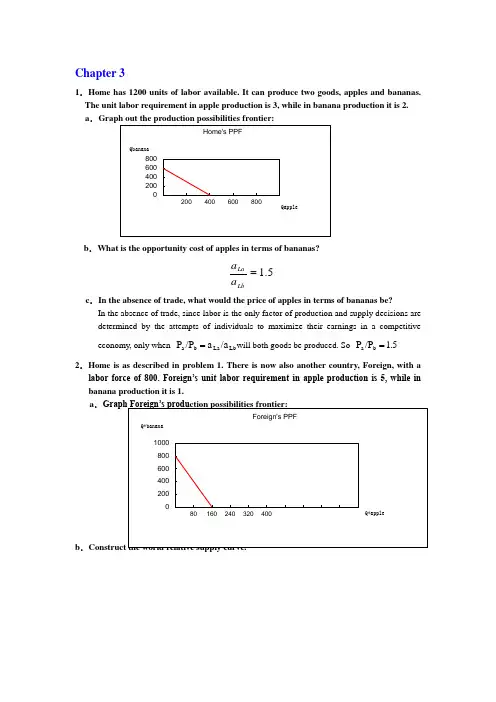
Chapter 31.Home has 1200 units of labor available. It can produce two goods, apples and bananas. The unit labor requirement in apple production is 3, while in banana production it is 2. a .b .What is the opportunity cost of apples in terms of bananas?5.1=LbLa a a c .In the absence of trade, what would the price of apples in terms of bananas be?In the absence of trade, since labor is the only factor of production and supply decisions aredetermined by the attempts of individuals to maximize their earnings in a competitive economy, only when Lb La b a /a a /P P =will both goods be produced. So 1.5 /P P b a =2.Home is as described in problem 1. There is now also another country, Foreign, with alabor force of 800. Foreign’s unit labor requirement in apple production is 5, while in banana production it is 1.a .b .3.Now suppose world relative demand takes the following form: Demand for apples/demand for bananas = price of bananas/price of apples.a .Graph the relative demand curve along with the relative supply curve:a b b a /P P /D D =∵When the market achieves its equilibrium, we have 1b a )(D D -**=++=ba b b a a P P Q Q Q Q ∴RD is a hyperbola xy 1=b .What is the equilibrium relative price of apples?The equilibrium relative price of apples is determined by the intersection of the RD and RScurves.RD: yx 1= RS: 5]5,5.1[5.1],5.0(5.0)5.0,0[=∈=⎪⎩⎪⎨⎧+∞∈=∈y y y x x x ∴25.0==y x∴2/=b P a P e ec .Describe the pattern of trade.∵b a b e a e b a P P P P P P ///>>**∴In this two-country world, Home will specialize in the apple production, export apples and import bananas. Foreign will specialize in the banana production, export bananas and import apples.d .Show that both Home and Foreign gain from trade.International trade allows Home and Foreign to consume anywhere within the coloredlines, which lie outside the countries’ production possibility frontiers. And the indirect method, specializing in producing only one production then trade with other country, is a more efficient method than direct production. In the absence of trade, Home could gain three bananas by foregoing two apples, and Foreign could gain by one foregoing five bananas. Trade allows each country to trade two bananas for one apple. Home could then gain four bananas by foregoing two apples while Foreign could gain one apple by foregoing only two bananas. So both Home and Foreign gain from trade.4.Suppose that instead of 1200 workers, Home had 2400. Find the equilibrium relative price. What can you say about the efficiency of world production and the division of the gains from trade between Home and Foreign in this case? RD: yx 1=RS: 5]5,5.1[5.1],1(1)1,0[=∈=⎪⎩⎪⎨⎧+∞∈=∈y y y x x x ∴5.132==y x∴5.1/=b P a P e eIn this case, Foreign will specialize in the banana production, export bananas and importapples. But Home will produce bananas and apples at the same time. And the opportunity cost of bananas in terms of apples for Home remains the same. So Home neither gains nor loses but Foreign gains from trade.5.Suppose that Home has 2400 workers, but they are only half as production in both industries as we have been assuming, Construct the world relative supply curve and determine the equilibrium relative price. How do the gains from trade compare with those in the case described in problem 4?In this case, the labor is doubled while the productivity of labor is halved, so the "effective labor "remains the same. So the answer is similar to that in 3. And both Home and Foreign can gain from trade. But Foreign gains lesser compare with that in the case4.6.”Korean workers earn only $2.50 an hour; if we allow Korea to export as much as it likes to the United State s, our workers will be forced down to the same level. You can’t import a $5 shirt without importing the $2.50 wage that goes with it.” Discuss.In fact, relative wage rate is determined by comparative productivity and the relative demand for goods. Kore a’s low wage reflects the fact that Korea is less productive than the United States in most industries. Actually, trade with a less productive, low wage country can raise the welfare and standard of living of countries with high productivity, such as United States. So this pauper labor argument is wrong.7.Japanese labor productivity is roughly the same as that of the United States in the manufacturing sector (higher in some industries, lower in others), while the United States, is still considerably more productive in the service sector. But most services are non-traded. Some analysts have argued that this poses a problem for the United States, because our comparative advantage lies in things we cannot sell on world markets. What is wrong with this argument?The competitive advantage of any industry depends on both the relative productivities of the industries and the relative wages across industries. So there are four aspects should be taken into account before we reach conclusion: both the industries and service sectors of Japan and U.S., not just the two service sectors. So this statement does not bade on the reasonable logic. 8.Anyone who has visited Japan knows it is an incredibly expensive place; although Japanese workers earn about the same as their U.S. counterparts, the purchasing power of their incomes is about one-third less. Extend your discussing from question 7 to explain this observation. (Hint: Think about wages and the implied prices of non-trade goods.) The relative higher purchasing power of U.S. is sustained and maintained by its considerably higher productivity in services. Because most of those services are non-traded, Japanese could not benefit from those lower service costs. And U.S. does not have to face a lower international price of services. So the purchasing power of Japanese is just one-third of their U.S. counterparts.9.How does the fact that many goods are non-traded affect the extent of possible gains from trade?Actually the gains from trade depended on the proportion of non-traded goods. The gains will increase as the proportion of non-traded goods decrease.10.We have focused on the case of trade involving only two countries. Suppose that there are many countries capable of producing two goods, and that each country has only one factor of production, labor. What could we say about the pattern of production and in this case? (Hint: Try constructing the world relative supply curve.)Any countries to the left of the intersection of the relative demand and relative supply curves export the good in which they have a comparative advantage relative to any country to the right of the intersection. If the intersection occurs in a horizontal portion then the country with that price ratio produces both goods.。

S TATUTE OF THE C OURTThe Statute of the International Court of Justice is annexed to the Charter of the United Nations, of which it forms an integral part. The main object of the Statute is to organize the composition and the functioning of the Court.The Statute can be amended only in the same way as the Charter, i.e., by a two-thirds majority vote in the General Assembly and ratification by two-thirds of the States (Art 69).Should the ICJ consider it desirable for its Statute to be amended, it must submit a proposal to this effect to the General Assembly by means of a written communication addressed to the Secretary-General of the United Nations (Art 70). However, there has hitherto been no amendment of the Statute of the Court.STATUTEOF THEINTERNATIONAL COURT OF JUSTICETABLE OF CONTENTS:Chapter I: Organization of the Court (Articles 2 - 33)Chapter II: Competence of the Court (Articles 34 - 38)Chapter III: Procedure (Articles 39 - 64)Chapter IV: Advisory Opinions (Articles 65 - 68)Chapter V: Amendment (Articles 69 & 70)Article 1The International Court of Justice established by the Charter of the United Nations as the principal judicial organ of the United Nations shall be constituted and shall function in accordance with the provisions of the present Statute.CHAPTER I - ORGANIZATION OF THE COURTArticle 2The Court shall be composed of a body of independent judges, elected regardless of their nationality from among persons of high moral character, who possess the qualifications required in their respective countries for appointment to the highest judicial offices, or are jurisconsults of recognized competence in international law.Article 31. The Court shall consist of fifteen members, no two of whom may be nationals of the same state.2. A person who for the purposes of membership in the Court could be regarded as a national of more than one state shall be deemed to be a national of the one in which he ordinarily exercises civil and political rights.Article 41. The members of the Court shall be elected by the General Assembly and by the Security Council from a list of persons nominated by the national groups in the Permanent Court of Arbitration, in accordance with the following provisions.2. In the case of Members of the United Nations not represented in the Permanent Court of Arbitration, candidates shall be nominated by national groups appointed for this purpose by their governments under the same conditions as those prescribed for members of the Permanent Court of Arbitration by Article 44 of the Convention of The Hague of 1907 for the pacific settlement of international disputes.3. The conditions under which a state which is a party to the present Statute but is not a Member of the United Nations may participate in electing the members of the Court shall, in the absence of a special agreement, be laid down by the General Assembly upon recommendation of the Security Council.Article 51. At least three months before the date of the election, the Secretary-General of the United Nations shall address a written request to the members of the Permanent Court of Arbitration belonging to the states which are parties to the present Statute, and to the members of the national groups appointed under Article 4, paragraph 2, inviting them to undertake, within a given time, by national groups, the nomination of persons in a position to accept the duties of a member of the Court.2. No group may nominate more than four persons, not more than two of whom shall be of their own nationality. In no case may the number of candidates nominated by a group be more than double the number of seats to be filled.Article 6Before making these nominations, each national group is recommended to consult its highest court of justice, its legal faculties and schools of law, and its national academies and national sections of international academies devoted to the study of law.Article 71. The Secretary-General shall prepare a list in alphabetical order of all the persons thus nominated. Save as provided in Article 12, paragraph 2, these shall be the only persons eligible.2. The Secretary-General shall submit this list to the General Assembly and to the Security Council.Article 8The General Assembly and the Security Council shall proceed independently of one another to elect the members of the Court.Article 9At every election, the electors shall bear in mind not only that the persons to be elected should individually possess the qualifications required, but also that in the body as a whole the representation of the main forms of civilization and of the principal legal systems of the world should be assured.Article 101. Those candidates who obtain an absolute majority of votes in the General Assembly and in the Security Council shall be considered as elected.2. Any vote of the Security Council, whether for the election of judges or for the appointment of members of the conference envisaged in Article 12, shall be taken without any distinction between permanent and non-permanent members of the Security Council.3. In the event of more than one national of the same state obtaining an absolute majority of the votes both of the General Assembly and of the Security Council, the eldest of these only shall be considered as elected.Article 11If, after the first meeting held for the purpose of the election, one or more seats remain to be filled, a second and, if necessary, a third meeting shall take place.Article 121. If, after the third meeting, one or more seats still remain unfilled, a joint conference consisting of six members, three appointed by the General Assembly and three by the Security Council, may be formed at any time at the request of either the General Assembly or the Security Council, for the purpose of choosing by the vote of an absolute majority one name for each seat still vacant, to submit to the General Assembly and the Security Council for their respective acceptance.2. If the joint conference is unanimously agreed upon any person who fulfills the required conditions, he may be included in its list, even though he was not included in the list of nominations referred to in Article 7.3. If the joint conference is satisfied that it will not be successful in procuring an election, those members of the Court who have already been elected shall, within a period to be fixed by the Security Council, proceed to fill the vacant seats by selection from among those candidates who have obtained votes either in the General Assembly or in the Security Council.4. In the event of an equality of votes among the judges, the eldest judge shall have a casting vote.Article 131. The members of the Court shall be elected for nine years and may be re-elected; provided, however, that of the judges elected at the first election, the terms of five judges shall expire at the end of three years and the terms of five more judges shall expire at the end of six years.2. The judges whose terms are to expire at the end of the above-mentioned initial periods of three and six years shall be chosen by lot to be drawn by the Secretary-General immediately after the first election has been completed.3. The members of the Court shall continue to discharge their duties until their places have been filled. Though replaced, they shall finish any cases which they may have begun.4. In the case of the resignation of a member of the Court, the resignation shall be addressed to the President of the Court for transmission to the Secretary-General. This last notification makes the place vacant.Article 14Vacancies shall be filled by the same method as that laid down for the first election, subject to the following provision: the Secretary-General shall, within one month of the occurrence of the vacancy, proceed to issue the invitations provided for in Article 5, and the date of the election shall be fixed by the Security Council.Article 15A member of the Court elected to replace a member whose term of office has not expired shall hold office for the remainder of his predecessor's term.Article 161. No member of the Court may exercise any political or administrative function, or engage in any other occupation of a professional nature.2. Any doubt on this point shall be settled by the decision of the Court.Article 171. No member of the Court may act as agent, counsel, or advocate in any case.2. No member may participate in the decision of any case in which he has previously taken part as agent, counsel, or advocate for one of the parties, or as a member of a national or international court, or of a commission of enquiry, or in any other capacity.3. Any doubt on this point shall be settled by the decision of the Court.Article 181. No member of the Court can be dismissed unless, in the unanimous opinion of the other members, he has ceased to fulfill the required conditions.2. Formal notification thereof shall be made to the Secretary-General by the Registrar.3. This notification makes the place vacant.Article 19The members of the Court, when engaged on the business of the Court, shall enjoy diplomatic privileges and immunities.Article 20Every member of the Court shall, before taking up his duties, make a solemn declaration in open court that he will exercise his powers impartially and conscientiously.Article 211. The Court shall elect its President and Vice-President for three years; they may bere-elected.2. The Court shall appoint its Registrar and may provide for the appointment of such other officers as may be necessary.Article 221. The seat of the Court shall be established at The Hague. This, however, shall not prevent the Court from sitting and exercising its functions elsewhere whenever the Court considers it desirable.2. The President and the Registrar shall reside at the seat of the Court.Article 231. The Court shall remain permanently in session, except during the judicial vacations, the dates and duration of which shall be fixed by the Court.2. Members of the Court are entitled to periodic leave, the dates and duration of which shall be fixed by the Court, having in mind the distance between The Hague and the home of each judge.3. Members of the Court shall be bound, unless they are on leave or prevented from attending by illness or other serious reasons duly explained to the President, to hold themselves permanently at the disposal of the Court.Article 241. If, for some special reason, a member of the Court considers that he should not take part in the decision of a particular case, he shall so inform the President.2. If the President considers that for some special reason one of the members of the Court should not sit in a particular case, he shall give him notice accordingly.3. If in any such case the member Court and the President disagree, the matter shall be settled by the decision of the Court.Article 251. The full Court shall sit except when it is expressly provided otherwise in the present Statute.2. Subject to the condition that the number of judges available to constitute the Court is not thereby reduced below eleven, the Rules of the Court may provide for allowing one or more judges, according to circumstances and in rotation, to be dispensed from sitting.3. A quorum of nine judges shall suffice to constitute the Court.Article 261. The Court may from time to time form one or more chambers, composed of three or more judges as the Court may determine, for dealing with particular categories of cases; for example, labour cases and cases relating to transit and communications.2. The Court may at any time form a chamber for dealing with a particular case. The number of judges to constitute such a chamber shall be determined by the Court with the approval of the parties.3. Cases shall be heard and determined by the chambers provided for in this article if the parties so request.Article 27A judgment given by any of the chambers provided for in Articles 26 and 29 shall be considered as rendered by the Court.Article 28The chambers provided for in Articles 26 and 29 may, with the consent of the parties, sit and exercise their functions elsewhere than at The Hague.Article 29With a view to the speedy dispatch of business, the Court shall form annually a chamber composed of five judges which, at the request of the parties, may hear and determine cases by summary procedure. In addition, two judges shall be selected for the purpose of replacing judges who find it impossible to sit.Article 301. The Court shall frame rules for carrying out its functions. In particular, it shall lay down rules of procedure.2. The Rules of the Court may provide for assessors to sit with the Court or with any of its chambers, without the right to vote.Article 311. Judges of the nationality of each of the parties shall retain their right to sit in the case before the Court.2. If the Court includes upon the Bench a judge of the nationality of one of the parties, any other party may choose a person to sit as judge. Such person shall be chosen preferably from among those persons who have been nominated as candidates as provided in Articles 4 and 5.3. If the Court includes upon the Bench no judge of the nationality of the parties, each of these parties may proceed to choose a judge as provided in paragraph 2 of this Article.4. The provisions of this Article shall apply to the case of Articles 26 and 29. In such cases, the President shall request one or, if necessary, two of the members of the Court forming the chamber to give place to the members of the Court of the nationality of the parties concerned, and, failing such, or if they are unable to be present, to the judges specially chosen by the parties.5. Should there be several parties in the same interest, they shall, for the purpose of the preceding provisions, be reckoned as one party only. Any doubt upon this point shall be settled by the decision of the Court.6. Judges chosen as laid down in paragraphs 2, 3, and 4 of this Article shall fulfill the conditions required by Articles 2, 17 (paragraph 2), 20, and 24 of the present Statute. They shall take part in the decision on terms of complete equality with their colleagues.Article 321. Each member of the Court shall receive an annual salary.2. The President shall receive a special annual allowance.3. The Vice-President shall receive a special allowance for every day on which he acts as President.4. The judges chosen under Article 31, other than members of the Court, shall receive compensation for each day on which they exercise their functions.5. These salaries, allowances, and compensation shall be fixed by the General Assembly. They may not be decreased during the term of office.6. The salary of the Registrar shall be fixed by the General Assembly on the proposal of the Court.7. Regulations made by the General Assembly shall fix the conditions under which retirement pensions may be given to members of the Court and to the Registrar, and the conditions under which members of the Court and the Registrar shall have their travelling expenses refunded.8. The above salaries, allowances, and compensation shall be free of all taxation.Article 33The expenses of the Court shall be borne by the United Nations in such a manner as shall be decided by the General Assembly.CHAPTER II - COMPETENCE OF THE COURTArticle 341. Only states may be parties in cases before the Court.2. The Court, subject to and in conformity with its Rules, may request of public international organizations information relevant to cases before it, and shall receive such information presented by such organizations on their own initiative.3. Whenever the construction of the constituent instrument of a public international organization or of an international convention adopted thereunder is in question in a case before the Court, the Registrar shall so notify the public international organization concerned and shall communicate to it copies of all the written proceedings.Article 351. The Court shall be open to the states parties to the present Statute.2. The conditions under which the Court shall be open to other states shall, subject to the special provisions contained in treaties in force, be laid down by the Security Council, but in no case shall such conditions place the parties in a position of inequality before the Court.3. When a state which is not a Member of the United Nations is a party to a case, the Court shall fix the amount which that party is to contribute towards the expenses of the Court. This provision shall not apply if such state is bearing a share of the expenses of the CourtArticle 361. The jurisdiction of the Court comprises all cases which the parties refer to it and all matters specially provided for in the Charter of the United Nations or in treaties and conventions in force.2. The states parties to the present Statute may at any time declare that they recognize as compulsory ipso facto and without special agreement, in relation to any other state accepting the same obligation, the jurisdiction of the Court in all legal disputes concerning:a. the interpretation of a treaty;b. any question of international law;c. the existence of any fact which, if established, would constitute a breach of an international obligation;d. the nature or extent of the reparation to be made for the breach of an international obligation.3. The declarations referred to above may be made unconditionally or on condition of reciprocity on the part of several or certain states, or for a certain time.4. Such declarations shall be deposited with the Secretary-General of the United Nations, who shall transmit copies thereof to the parties to the Statute and to the Registrar of the Court.5. Declarations made under Article 36 of the Statute of the Permanent Court of International Justice and which are still in force shall be deemed, as between the partiesto the present Statute, to be acceptances of the compulsory jurisdiction of the International Court of Justice for the period which they still have to run and in accordance with their terms.6. In the event of a dispute as to whether the Court has jurisdiction, the matter shall be settled by the decision of the Court.Article 37Whenever a treaty or convention in force provides for reference of a matter to a tribunal to have been instituted by the League of Nations, or to the Permanent Court of International Justice, the matter shall, as between the parties to the present Statute, be referred to the International Court of Justice.Article 381. The Court, whose function is to decide in accordance with international law such disputes as are submitted to it, shall apply:a. international conventions, whether general or particular, establishing rules expressly recognized by the contesting states;b. international custom, as evidence of a general practice accepted as law;c. the general principles of law recognized by civilized nations;d. subject to the provisions of Article 59, judicial decisions and the teachings of the most highly qualified publicists of the various nations, as subsidiary means for the determination of rules of law.2. This provision shall not prejudice the power of the Court to decide a case ex aequo et bono, if the parties agree thereto.CHAPTER III - PROCEDUREArticle 391. The official languages of the Court shall be French and English. If the parties agree that the case shall be conducted in French, the judgment shall be delivered in French. If the parties agree that the case shall be conducted in English, the judgment shall be delivered in English.2. In the absence of an agreement as to which language shall be employed, each party may, in the pleadings, use the language which it prefers; the decision of the Court shall be given in French and English. In this case the Court shall at the same time determine which of the two texts shall be considered as authoritative.3. The Court shall, at the request of any party, authorize a language other than French or English to be used by that party.Article 401. Cases are brought before the Court, as the case may be, either by the notification of the special agreement or by a written application addressed to the Registrar. In either case the subject of the dispute and the parties shall be indicated.2. The Registrar shall forthwith communicate the application to all concerned.3. He shall also notify the Members of the United Nations through the Secretary-General, and also any other states entitled to appear before the Court.Article 411. The Court shall have the power to indicate, if it considers that circumstances so require, any provisional measures which ought to be taken to preserve the respective rights of either party.2. Pending the final decision, notice of the measures suggested shall forthwith be given to the parties and to the Security Council.Article 421. The parties shall be represented by agents.2. They may have the assistance of counsel or advocates before the Court.3. The agents, counsel, and advocates of parties before the Court shall enjoy the privileges and immunities necessary to the independent exercise of their duties.Article 431. The procedure shall consist of two parts: written and oral.2. The written proceedings shall consist of the communication to the Court and to the parties of memorials, counter-memorials and, if necessary, replies; also all papers and documents in support.3. These communications shall be made through the Registrar, in the order and within the time fixed by the Court.4. A certified copy of every document produced by one party shall be communicated to the other party.5. The oral proceedings shall consist of the hearing by the Court of witnesses, experts, agents, counsel, and advocates.Article 441. For the service of all notices upon persons other than the agents, counsel, and advocates, the Court shall apply direct to the government of the state upon whose territory the notice has to be served.2. The same provision shall apply whenever steps are to be taken to procure evidence on the spot.Article 45The hearing shall be under the control of the President or, if he is unable to preside, of the Vice-President; if neither is able to preside, the senior judge present shall preside.Article 46The hearing in Court shall be public, unless the Court shall decide otherwise, or unless the parties demand that the public be not admitted .Article 471. Minutes shall be made at each hearing and signed by the Registrar and the President.2. These minutes alone shall be authentic.Article 48The Court shall make orders for the conduct of the case, shall decide the form and time in which each party must conclude its arguments, and make all arrangements connected with the taking of evidence.Article 49The Court may, even before the hearing begins, call upon the agents to produce any document or to supply any explanations. Formal note shall be taken of any refusal.Article 50The Court may, at any time, entrust any individual, body, bureau, commission, or other organization that it may select, with the task of carrying out an enquiry or giving an expert opinion.Article 51During the hearing any relevant questions are to be put to the witnesses and experts under the conditions laid down by the Court in the rules of procedure referred to in Article 30.Article 52After the Court has received the proofs and evidence within the time specified for the purpose, it may refuse to accept any further oral or written evidence that one party may desire to present unless the other side consents.Article 531. Whenever one of the parties does not appear before the Court, or fails to defend its case, the other party may call upon the Court to decide in favour of its claim.2. The Court must, before doing so, satisfy itself, not only that it has jurisdiction in accordance with Articles 36 and 37, but also that the claim is well founded in fact and law.Article 541. When, subject to the control of the Court, the agents, counsel, and advocates have completed their presentation of the case, the President shall declare the hearing closed.2. The Court shall withdraw to consider the judgment.3. The deliberations of the Court shall take place in private and remain secret.Article 551. All questions shall be decided by a majority of the judges present.2. In the event of an equality of votes, the President or the judge who acts in his place shall have a casting vote.Article 561. The judgment shall state the reasons on which it is based.2. It shall contain the names of the judges who have taken part in the decision.Article 57If the judgment does not represent in whole or in part the unanimous opinion of the judges, any judge shall be entitled to deliver a separate opinion.Article 58The judgment shall be signed by the President and by the Registrar. It shall be read in open court, due notice having been given to the agents.Article 59The decision of the Court has no binding force except between the parties and in respect of that particular case.Article 60The judgment is final and without appeal. In the event of dispute as to the meaning or scope of the judgment, the Court shall construe it upon the request of any party.Article 611. An application for revision of a judgment may be made only when it is based upon the discovery of some fact of such a nature as to be a decisive factor, which fact was, when the judgment was given, unknown to the Court and also to the party claiming revision, always provided that such ignorance was not due to negligence.2. The proceedings for revision shall be opened by a judgment of the Court expressly recording the existence of the new fact, recognizing that it has such a character as to lay the case open to revision, and declaring the application admissible on this ground.3. The Court may require previous compliance with the terms of the judgment before it admits proceedings in revision.4. The application for revision must be made at latest within six months of the discovery of the new fact.5. No application for revision may be made after the lapse of ten years from the date of the judgment.Article 62l. Should a state consider that it has an interest of a legal nature which may be affected by the decision in the case, it may submit a request to the Court to be permitted to intervene.2 It shall be for the Court to decide upon this request.Article 631. Whenever the construction of a convention to which states other than those concerned in the case are parties is in question, the Registrar shall notify all such states forthwith.2. Every state so notified has the right to intervene in the proceedings; but if it uses this right, the construction given by the judgment will be equally binding upon it.Article 64Unless otherwise decided by the Court, each party shall bear its own costs.CHAPTER IV - ADVISORY OPINIONSArticle 651. The Court may give an advisory opinion on any legal question at the request of whatever body may be authorized by or in accordance with the Charter of the United Nations to make such a request.2. Questions upon which the advisory opinion of the Court is asked shall be laid before the Court by means of a written request containing an exact statement of the question upon which an opinion is required, and accompanied by all documents likely to throw light upon the question.Article 661. The Registrar shall forthwith give notice of the request for an advisory opinion to all states entitled to appear before the Court.2. The Registrar shall also, by means of a special and direct communication, notify any state entitled to appear before the Court or international organization considered by the Court, or, should it not be sitting, by the President, as likely to be able to furnish information on the question, that the Court will be prepared to receive, within a time-limit to be fixed by the President, written statements, or to hear, at a public sitting to be held for the purpose, oral statements relating to the question.3. Should any such state entitled to appear before the Court have failed to receive the special communication referred to in paragraph 2 of this Article, such state may express a desire to submit a written statement or to be heard; and the Court will decide.。