
烟气脱硝工艺
- 格式:ppt
- 大小:3.22 MB
- 文档页数:55
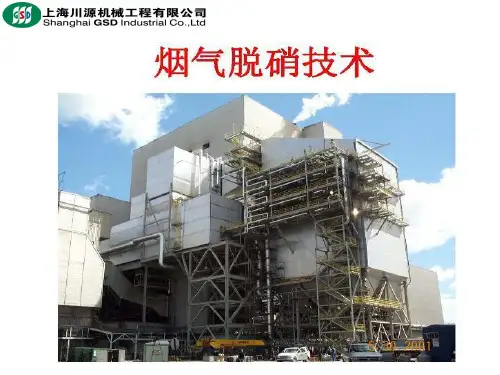

脱硝的工艺流程脱硝是一种减少燃煤电厂和工业锅炉排放的二氧化氮(NOx)的工艺。
脱硝的目的是减少空气污染,保护环境和人类健康。
下面是一个典型的脱硝工艺流程的描述。
首先,在燃煤电厂或工业锅炉中,燃烧产生的高温烟气中含有大量的NOx,这些有害气体需要被去除。
脱硝工艺的第一步是将烟气通过一种称为喷淋层的装置,喷淋层将尿素溶液释放到烟气中。
尿素溶液在高温环境下分解,产生一种称为尿素气体的物质。
尿素气体与烟气中的NOx发生化学反应,生成氨气和二氧化碳。
第二步是将烟气中的氨气和NOx一起进一步处理。
烟气通过一系列的减速装置,使烟气在其中停留一段时间,以便氨气和NOx之间进行更充分的反应。
这个过程被称为选择性催化还原(SCR),通过使用特殊的催化剂,NOx会与氨气进行反应,生成氮气和水汽。
第三步是净化烟气,去除其中的固体颗粒物和其他污染物。
这个过程通常通过电除尘器或布袋过滤器来完成,这些设备通过电荷吸引和过滤的原理,将固体颗粒物从烟气中分离出来,同时保持烟气的正常流动。
最后一步是排放处理后的烟气,保证其满足环境排放标准。
通常,处理后的烟气通过排气管道排放到大气中。
在某些情况下,为了满足更严格的排放标准,烟气可能需要进一步处理,例如进行干燥或冷却。
整个脱硝工艺需要一个完善的监控系统,以确保各个步骤的运行正常。
例如,监控系统可以监测烟气中的NOx浓度,以便自动调节尿素溶液的喷淋量。
此外,还需要定期对催化剂进行维护和更换,以保持其催化性能。
脱硝工艺是一项复杂的工程,需要综合考虑工艺效率、能耗、运维成本等各个方面。
目前,有许多不同的脱硝技术可供选择,如SCR、SNCR(选择性非催化还原)等,每种技术都有其适用的场景和优势。
总之,脱硝是一种重要的空气污染控制工艺,可以有效减少燃煤电厂和工业锅炉排放的NOx。
通过合理的工艺流程设计和运行管理,可以实现高效的脱硝效果,保护环境和人类健康。
烟气脱硝工艺流程设计下载温馨提示:该文档是我店铺精心编制而成,希望大家下载以后,能够帮助大家解决实际的问题。
文档下载后可定制随意修改,请根据实际需要进行相应的调整和使用,谢谢!本店铺为大家提供各种各样类型的实用资料,如教育随笔、日记赏析、句子摘抄、古诗大全、经典美文、话题作文、工作总结、词语解析、文案摘录、其他资料等等,如想了解不同资料格式和写法,敬请关注!Download tips: This document is carefully compiled by the editor. I hope that after you download them, they can help you solve practical problems. The document can be customized and modified after downloading, please adjust and use it according to actual needs, thank you!In addition, our shop provides you with various types of practical materials, such as educational essays, diary appreciation, sentence excerpts, ancient poems, classic articles, topic composition, work summary, word parsing, copy excerpts, other materials and so on, want to know different data formats and writing methods, please pay attention!烟气脱硝工艺在工业环保领域扮演着至关重要的角色。
工业烟气脱硝工艺流程英文回答:Industrial flue gas denitrification is a crucial process in reducing nitrogen oxide (NOx) emissions from industrial plants. There are several common techniques used in this process, including selective catalytic reduction (SCR), selective non-catalytic reduction (SNCR), and wet scrubbing.Selective catalytic reduction (SCR) is a widely adopted method for flue gas denitrification. In this process, a catalyst, typically made of metal oxides such as vanadium or titanium, is used to facilitate the reaction between NOx and ammonia (NH3) or urea (CO(NH2)2). The flue gas is passed through a catalyst bed, where the NOx reacts with the ammonia or urea to form nitrogen (N2) and water (H2O). SCR technology is known for its high efficiency in reducing NOx emissions, with removal rates of up to 90%.Selective non-catalytic reduction (SNCR) is another technique used in flue gas denitrification. Unlike SCR, SNCR does not require a catalyst and instead relies on the injection of a reducing agent directly into the flue gas stream. Common reducing agents used in SNCR include ammonia (NH3) and urea (CO(NH2)2). When the reducing agent is injected into the flue gas at high temperatures, it reacts with the NOx to form nitrogen (N2) and water (H2O). SNCR is less efficient than SCR, typically achieving NOx removal rates of 40-70%.Wet scrubbing, also known as flue gas desulfurization (FGD), can also be used for flue gas denitrification. In this process, a scrubbing solution, usually a mixture of water and a reagent such as lime or limestone, is sprayed into the flue gas stream. The reagent reacts with the NOx to form nitrogen (N2) and other compounds, which are then captured in the scrubbing solution. Wet scrubbing is effective in removing both sulfur dioxide (SO2) and nitrogen oxide (NOx) emissions.In summary, the industrial flue gas denitrificationprocess involves techniques such as selective catalytic reduction (SCR), selective non-catalytic reduction (SNCR), and wet scrubbing. Each technique has its own advantagesand limitations in terms of efficiency and cost. The choice of the denitrification method depends on factors such asthe specific emission requirements, the type of fuel being burned, and the available resources.中文回答:工业烟气脱硝是减少工业厂房氮氧化物(NOx)排放的关键过程。

废气脱硝处理工艺
废气脱硝是针对含有氮氧化物(NOx)的工业废气进行的一种气体净化技术。
目前主流的废气脱硝处理工艺有三种:选择性催化还原法、非选择性催化还原法和氨水法。
选择性催化还原法是通过将氨气和废气在催化剂的作用下进行反应,降低废气中NOx的含量。
催化剂通常采用具有高比表面积和活性的金属氧化物,如钨、钒、钛等。
这种方法具有反应速率快、处理效率高、废气中氨气浓度低等优点,在烟气排放标准较高的国家得到了广泛应用。
非选择性催化还原法则是在还原剂的存在下,利用催化剂将NOx与还原剂进行反应,产生氮气和水。
这种方法适用于高浓度NOx的废气处理,但是在还原剂的使用上对环境有一定影响。
氨水法是将氨水喷入废气中,与NOx进行反应,生成氮气和水。
该方法适用于低浓度NOx的废气处理,但是由于氨气具有毒性,需要注意对环境与工人的保护。
综上所述,选择性催化还原法、非选择性催化还原法和氨水法是当前主流的废气脱硝处理工艺,各自具有优缺点,在实际应用中需要选取合适的工艺来进行废气处理。