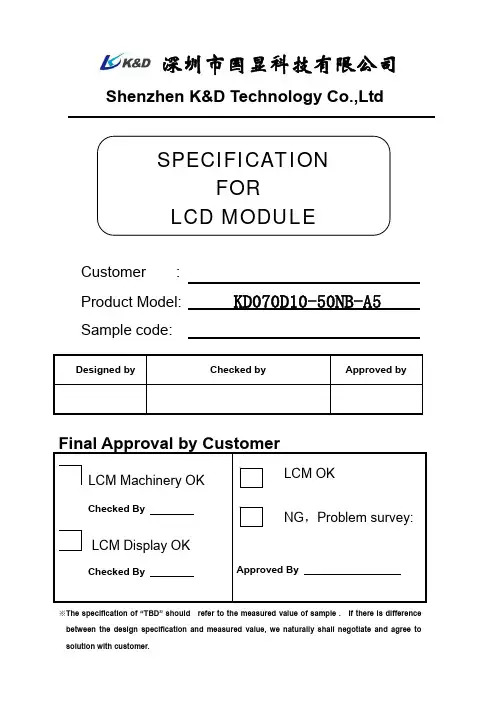
深圳市国显科技有限公司Shenzhen K&D Technology Co.,LtdSPECIFICATIONFORLCD MODULECustomer:Product Model: KD070D10-50NB-A5Sample code:Approved byDesigned by Checked by Array※The specification of “TBD” should refer to the measured value of sample . If there is difference between the design specification and measured value, we naturally shall negotiate and agree toRevision HistoryVersion Contents Date NoteA Original 2012-5-5B Add the specification of backlight 2012-10-9ContentsNo. Item Page1. Numbering System 4/262 Scope 5/263 Normative Reference 5/264 Definitions5/265 Technology Specifications7/266 Circuit block diagram 14/267 Reliability Test Condition and Methods 16/268 Inspection standard17/269 Handling Precautions23/2610 Precaution for use24/2611 Dimensional Outline25/2612 Packaging Drawing 26/261 Numbering System— (1) (2) (3) (4) (5) (6) (7) (8)2 ScopeThis specification applies to the TFT LCD module which is designed and manufactured by LCM Factory of Shenzhen K&D Technology Co.,Ltd.3 Normative ReferenceGB/T4619-1996 《Liquid Crystal Display Test Method》GB/T2424 《Basic environmental Testing Procedures for Electric and Electronic Products.》GB/T2423 《Basic Testing Procedures for Electric and Electronic Products》IEC61747-1 《SIXTH PARTGB2828`2829-87《National Standard of PRC》4 Definitions4.1 Definitions of VopThe definitions of threshold voltage Vth1, Vth2 the following typical waveforms are applied on liquid crystal by the method of equalized voltage for each duty and bias.【 selected waveform 】【 non-selected waveform 】① Vth1: The voltage which the brightness of segment indicates 50% of saturated value on the conditions of selected waveform(f f=80Hz, Φ=10°θ=270° at 25℃)② Vth2: The voltage which the brightness of segment indicates 50% of saturated value on the conditions of non-selected waveform(f f=80Hz, Φ=10°θ=270° at 25℃)③ Vop: (Vth1(50%)+Vth2(50%))/2 (f f=80Hz, Φ=10°θ=270° at 25℃)4.2 Definition of Response Time Tr, TdTr: The time required which the brightness of segment①becomes 10% from 100% when waveform is switched toselected one from non-selected one. (f f=80Hz, Φ=10°θ=270° at 25℃)②ss of segmentTd: The time required which the brightneselected one from selected one. (f f=80Hz, Φ=10°θ=270° at25℃)4.3 Definition of Contrast Ratio CrCr=A/B① A: Segments brightness in case of non-selected waveform② B: Segments brightness in case of selected waveform4.4 Definition of Angle and Viewing RangeAngular Graph: Constrast RatioSuch as:Viewing Angle Range:80(Cr>2) Horizontal70(Cr>2) Vertical5 Technology Specifications5.1 FeatureThis single-display module is suitable for use in Multidedia Player products. The LCD adopts one backlight with High brightness 18-lamps white LED.1) Construction: 7〞а-Si color TFT-LCD ,White LED backlight and FPC. 2) LCD:2.1 Amorphous-TFT 7-inch display, transmissive, normally white type. 2.2 800(RGB)×480 dots Matrix. 2.3 Narrow-contact ledge technique. 3) RGB interface.4) Video signal interface: Parallel RGB.5.2 Mechanical SpecificationsItem Specifications UnitDimensional outline 164.9(W) ×100.0(H) ×3.4(D) mmActive area 154.08(W) × 85.92(H) mm Pixel size 63.2(W) ×RGB×179(H) um Resolution 800(RGB) ×480 pixelLuminance250(TYP ) cd/m25.3 Absolute Max. RatingItem Symbol ValuesUnit RemarkMin. MaxPower voltageDV DD -0.5 5.0 V AV DD -0.5 15 VV GH -0.3 40 V V GL -20 0.3 V Operation temperature T OP -10 60 ℃ Storage temperatureT ST -20 70 ℃Note: The absolute maximum rating values of this product not allowed to be exceeded at any times. Should be module be used with any of absolute maximum ratings exceeded. The characteristics of the module may not be recovered, or in an extreme case, the module may be permanently destroyed.5.4 Electrical Characteristics Note 1Item SymbolValuesUnit Remark Min. Typ MaxPower voltage DV DD 3.0 3.3 3.6 V Note2 AV DD 10.1 10.3 10.5 VV GH 17.5 18 18.5 VV GL -8.5 -8 -7.5 VInput signal voltage V COM 3.1 3.3 3.4 VInput logic high voltage V IH 0.7DV DD- DV DD VNote 3 Input logic low voltage V IL 0 -0.3DV DD VNote 1:Be sure to apply DV DD and V GL to the LCD first, and then apply V GH . Note 2: DV DD setting should match the signals output voltage(refer to Note 3) of Customer’s system board.Note 3: DCLK,HS.VS,RESET,U/D,L/R,DE,R0-R7,G0-G7, G0-G7,MODE,DITHB.5.5 Optical specificationsItem Symbol ConditionValuesUnit Remark Min. Typ. Max.Viewing angle (CR≥ 10) θLΦ=180°(9o’clock)70 80 -degreeNote 1 θRΦ=0°(3 o’clock)70 80 -θTΦ=90°(12o’clock)60 70 -θBΦ=270°(6o’clock)65 75 -ResponsetimeT ONNormalθ=Φ=0° - 10 20msecNote3T OFF -1530msecNote3Contrast ratio CR 350500--Note4Color chromaticity W X 0.249 0.2990.349- Note 2Note 5Note 6 W Y 0.281 0.3310.381-Luminance L 200250 -cd/m2Note6Luminance uniformity Y U 70 80 - % Note6,7Test Conditions:1. DVDD=3.3V, I LED=120mA, the ambient temperature is 25.℃2. The test systems refer to Note 2.Note 1: Definition of viewing angle rangeNote 2: Definition of optical measurement system.The optical characteristics should be measured in dark room. After 30minutes operation, the optical properties are measured at the center point of the LCD screen. (Viewing angle is measured by ELDIM-EZ contrast/Height :1.2mm ,Response time is measured by Photo detector TOPCON BM-7, other items are measured by BM-5A/ Field of view: 1° /Height: 500mm.)Normal line Φ=270°6 o’clock direction Φ=0°Φ=180°Φ=270° 6 o’clock direction Φ=0°ΦNormal line θ=Φ=0°Note 3: Definition of Response timeThe response time is defined as the LCD optical switching time intervalbetween “White” state and “Black” state. Rise time (T ON ) is the time between photo detector output intensity changed from 90% to 10%. And fall time (T OFF ) is the time between photo detector output intensity changed from 10% to 90%.Note 4: Definition of contrast ratiostate Black"" the on LCD when measured Luminance state White"" the on LCD when measured Luminance (CR) ratio Contrast =Note 5: Definition of color chromaticity (CIE1931)Color coordinates measured at center point of LCD.Note 6: All input terminals LCD panel must be ground while measuring the centerarea of the panel. The LED driving condition is I LED =180mA.Note 7: Definition of Luminance UniformityActive area is divided into 9 measuring areas. Every measuring point is placed at the center of each measuring area.max minB B(Yu)Uniformity Luminance = L-------Active area length W----- Active area widthB max : The measured maximum luminance of all measurement position. B min : The measured minimum luminance of all measurement position.90%10% 0%P h o t o d e t e c t o r o u t p u t (R e l a t i v e v a l u e )ONWhite (TFT OFF)Black (TFT ON)White (TFT OFF)5.6 LED back light specification (18 White Chips)UnitMaxTypItem Symbol Condition Min=120mA9 9.6 9.9 V Forward Voltage Vf lf=120mA80 - - % Uniformity (with L/G) ΔB p lf5.7 Interface Pin ConnectionsPinSymbol I/O Function Remark No.1 VLED+ P Power for LED Backlight(Anode)2 VLED+ P Power for LED Backlight(Anode)3 VLED- P Power for LED Backlight(Cathode)4 VLED- P Power for LED Backlight(Cathode)ground5 GND PPowervoltageCommon6 V COM I7 DV DD P Power for Digital Circuit8 MODE I DE/SYNC mode select Note 1EnableInput9 DE IData10 VS I Vertical Sync Input11 HS IInputSyncHorizontalBluedata(MSB)12 B7 IBluedata13 B6 IdataBlue14 B5 IdataBlue15 B4 IBluedata16 B3 Idata17 B2 IBlue18 B1 I Blue data Note 219 B0 I Blue data(LSB) Note 2Greendata(MSB)20 G7 Idata21 G6 IGreen22 G5 IdataGreendata23 G4 IGreenGreendata24 G3 Idata25 G2 IGreen26 G1 I Green data Note 227 G0 I Green data(LSB) Note 2data(MSB)Red28 R7 Idata29 R6 IRedReddata30 R5 IdataRed31 R4 Idata32 R3 IRedReddata33 R2 I34 R1 I Red data Note 235 R0 I Red data(LSB) Note 2PowerGround36 GND P37 DCLK I Sample clock Note 3PowerGround38 GND P39 L/R I Left / right selection Note 4,540 U/D I Up/down selection Note 4,541 V GH P Gate ON VoltageVoltage42 V GL P GateOFF43 AV DD P Power for Analog Circuit44 RESET I Global reset pin. Note 6connection45 NC -NoCommonVoltage46 V COM I47 DITHB I Dithering function Note 7PowerGround48 GND PconnectionNo49 NC -connectionNo50 NC -I: input, O: output, P: PowerNote 1: DE/SYNC mode select. Normally pull high.When select DE mode, MODE=”1”, VS and HS must pull high.When select SYNC mode,MODE=”0”, DE must be grounded.Note 2: When input 18 bits RGB data, the two low bits of R,G and B data must be grounded.Note 3: Data shall be latched at the falling edge of DCLK.Note 4: Selection of scanning modeSetting of scan control inputScanning directionU/D L/R GND DV DD Up to down, left to right DV DD GND Down to up, right to left GNDGNDUp to down, right to left DV DD DV DDDown to up, left to rightNote 5: Definition of scanning direction.Refer to the figure as below:an RC reset circuit for stability. Normally pull high.Note 7: Dithering function enable control, normally pull high. When DITHB=”1”,Disable internal dithering function, When DITHB=”0”,Enable internal dithering function,6 Signal timing diagram6.2 Signal Timing Diagram6.2.1 Power ON/OFF Sequencea Power onb Power off6.2.2 Data input format6.2.3 Timing DiagramItemSymbol Values Unit RemarkMin Typ Max Horizontal Display Areathd - 800 - DCLK DCLK frequency fck - 30 50 MHz One horizontal line th 889928 1143DCLK HS pulse width thpw 1 48 255 DCLK HS Blanking thb 88 88 88 DCLK HS Front Porch thfp140255DCLK7 Reliability Test Conditions And MethodsNO Item Condition Method1 High / LowTemperatureStorage70℃/-20℃ 120hrsCheck and recordevery 48Hrs2 High / LowTemperature Life60℃/-10℃ 120hrs (operatingmode)Check and recordevery 48Hrs3 HighTemperature、High HumidityOperating60℃,90% RH, 96HrsCheck and recordevery 48hrs4 ThermalShock -20℃(30Min ) 25℃(5Min)70℃(30Min)(conversion time, : 5 sec ) 20cyclesEach 10 cycles end ,check5 StaticElectricity Gap mood: ±1KV~±8KV (10times air discharge withpositive/negative voltagevoltage gap : 1kv)Touch mood: ±1KV~±4KVEach discharge end,Check the ElectricalCharacteristics8 Inspection standardxxIntensity OfAdhesionIf lower than specification, reject Gold Fold Twist Reject07 IC/FPCBondingSiliconAccording to outline, no gold outside,seal can not be higher than LCDFPC Gold SeverReject08 SMTLack ofComponent、Polarity InverseIf exist, rejectLeak Solder、Virtual SolderIf exist, rejectShort Circuit InSolder PointIf exist, rejectTin Ball If exist, rejectTin Acumination If visual, rejectHeightSolder Point If higher 0.5mm than component. rejectHeight ofcomponentEither side higher 0.5mm thancomponent, reject9 Handling Precautions9.1 Mounting methodThe LCD panel of Daxian LCD module consists of two thin glass plates with polarizes which easily be damaged. And since the module in so constructed as to be fixed by utilizing fitting holes in the printed circuit board.Extreme care should be needed when handling the LCD modules.9.2 Caution of LCD handling and cleaningWhen cleaning the display surface, Use soft cloth with solvent[recommended below] and wipe lightlyz Isopropyl alcoholz Ethyl alcoholDo not wipe the display surface with dry or hard materials that will damage the polarizer surface.Do not use the following solvent:z Waterz AromaticsDo not wipe ITO pad area with the dry or hard materials that will damage the ITO patternsDo not use the following solvent on the pad or prevent it from being contaminated:z Soldering fluxz Chlorine (Cl) , Salfur (S)If goods were sent without being sili8con coated on the pad, ITO patterns could be damaged due to the corrosion as time goes on.If ITO corrosion happen by miss-handling or using some materials such as Chlorine (CI), Salfur (S) from customer, Responsibility is on customer.9.3 Caution against static chargeThe LCD module use C-MOS LSI drivers, so we recommended that you: Connect any unused input terminal to Vdd or Vss, do not input any signals before power is turned on, and ground your body, work/assembly areas, assembly equipment to protect against static electricity.9.4 packingz Module employ LCD elements and must be treated as such.z Avoid intense shock and falls from a height.z To prevent modules from degradation, do not operate or store them exposed direct to sunshine or high temperature/humidity9.5 Caution for operationz It is an indispensable condition to drive LCD’s within the specified voltage limit since the higher voltage then the limit cause the shorter LCD life.z An electrochemical reaction due to direct current causes LCD’s undesirable deterioration, so that the use of direct current drive should be avoided.z Response time will be extremely delayed at lower temperature then the operating temperature range and on the other hand at higher temperature LCD’s how dark color in them. However those phenomena do not meanoperation temperature.z If the display area is pushed hard during operation, some font will be abnormally displayed but it resumes normal condition after turning off once.z A slight dew depositing on terminals is a cause for electro-chemical reaction resulting in terminal open circuit.Usage under the maximum operating temperature, 50%Rh or less is required.9.6 storageIn the case of storing for a long period of time for instance, for years for the purpose or replacement use, the following ways are recommended.z Storage in a polyethylene bag with the opening sealed so as not to enter fresh air outside in it . And with no desiccant.z Placing in a dark place where neither exposure to direct sunlight nor light’s keeping the storage temperature range.z Storing with no touch on polarizer surface by the anything else.[It is recommended to store them as they have been contained in the inner container at the time of delivery from us9.7 Safetyz It is recommendable to crash damaged or unnecessary LCD’s into pieces and wash off liquid crystal by either of solvents such as acetone and ethanol, which should be burned up later.z When any liquid leaked out of a damaged glass cell comes in contact with your hands, please wash it off well with soap and water10 Precaution for use10.1A limit sample should be provided by the both parties on an occasion when the both parties agreed its necessity. Judgment by a limit sample shall take effect after the limit sample has been established and confirmed by the both parties.10.2On the following occasions, the handing of problem should be decided through discussion and agreement between responsible of the both parties.z When a question is arisen in this specificationz When a new problem is arisen which is not specified in this specificationsz When an inspection specifications change or operating condition change in customer is reported , and some problem is arisen in this specification due to the change.z When a new problem is arisen at the customer’s operating set for sample evaluation in the customer site.11 D imensional Outline12. Package DrawingTBD。