
肝胆疾病的营养治疗_图文
- 格式:pptx
- 大小:492.99 KB
- 文档页数:83

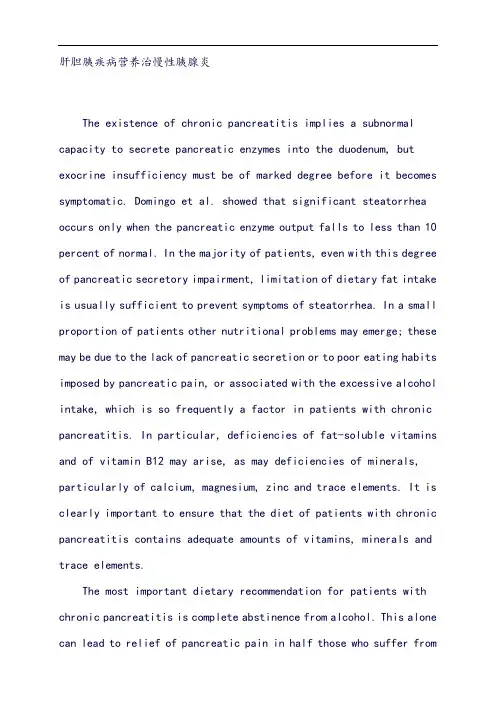
肝胆胰疾病营养治慢性胰腺炎The existence of chronic pancreatitis implies a subnormal capacity to secrete pancreatic enzymes into the duodenum, but exocrine insufficiency must be of marked degree before it becomes symptomatic. Domingo et al. showed that significant steatorrhea occurs only when the pancreatic enzyme output falls to less than 10 percent of normal. In the majority of patients, even with this degree of pancreatic secretory impairment, limitation of dietary fat intake is usually sufficient to prevent symptoms of steatorrhea. In a small proportion of patients other nutritional problems may emerge; these may be due to the lack of pancreatic secretion or to poor eating habits imposed by pancreatic pain, or associated with the excessive alcohol intake, which is so frequently a factor in patients with chronic pancreatitis. In particular, deficiencies of fat-soluble vitamins and of vitamin B12 may arise, as may deficiencies of minerals, particularly of calcium, magnesium, zinc and trace elements. It is clearly important to ensure that the diet of patients with chronic pancreatitis contains adequate amounts of vitamins, minerals and trace elements.The most important dietary recommendation for patients with chronic pancreatitis is complete abstinence from alcohol. This alone can lead to relief of pancreatic pain in half those who suffer fromit. Dietary fat should be reduced to less than 25 percent of total calories in order to avert steatorrhea and avoid undue stimulation of the gland. In patients with severe exocrine insufficiency, it may be necessary to increase dietary protein intake. Diabetes complicates chronic pancreatitis in a small proportion of patients, and appropriate dietary measures should be undertaken. Even if steatorrhea is controlled, there may be deficiency of fat-soluble vitamins, and supplementation is advised.一、概述慢性胰腺炎(chronic pancreatitis)是由于各种不同原因,其中以胆道疾病和嗜酒为主要病因引起的慢性进行性炎症反应,是胰腺分泌的多种消化酶对胰腺及其周围组织“自身消化”的过程。



肝胆疾病护理必备技能,守护你的生命肝胆疾病是指影响肝脏和胆囊功能的一系列疾病,包括肝炎、脂肪肝、胆结石等。
这些疾病对健康产生重要影响,因此了解肝胆疾病的护理技能至关重要。
以下是对肝胆疾病护理的详细科普:1. 饮食管理:饮食管理在肝胆疾病的护理中起着重要的作用。
以下是一些饮食管理的注意事项:首先,低脂饮食是关键。
限制高脂肪食物的摄入,尤其是饱和脂肪和反式脂肪。
选择低脂肪的蛋白质来源,如鸡胸肉、鱼类、豆类和脱脂奶制品。
其次,要控制糖分摄入。
过度摄入糖分会增加肝脏的负担,特别是对于患有脂肪肝的人。
减少食用高糖食物,如糖果、糕点和饮料。
此外,高纤维饮食对于肝胆疾病的管理也很重要。
增加膳食纤维的摄入,有助于促进消化系统的健康和维持正常的胆囊功能。
膳食纤维丰富的食物包括水果、蔬菜、全谷类食品和豆类。
控制盐的摄入也是必要的。
过量摄入盐可能导致水肿和高血压,对肝脏健康不利。
减少食用加工食品和咸味食物,尽量使用少量的盐调味。
保持适量的饮水也是重要的。
水对于维持正常的代谢和肝脏功能起着关键的作用。
每天建议饮用充足的水和无糖饮料。
此外,避免酗酒也是至关重要的。
酒精对肝脏有直接的损害作用,会加重肝脏疾病的风险和恶化病情。
如果已经被诊断出肝疾病,应避免饮酒或遵循医生建议的限制饮酒量。
最后,个体化饮食也是关键。
根据个体的具体情况,例如疾病类型、病情严重程度和身体状况,制定适合自己的个体化饮食计划。
最好在专业医生或营养师的指导下进行饮食调整。
需要注意的是,以上是一般性的饮食管理原则,对于每个人来说,根据具体情况可能会有一些差异。
因此,建议在制定饮食计划之前,咨询专业医生或营养师的建议,并根据个体情况进行个性化的饮食管理。
通过科学的饮食管理,可以帮助保护肝脏健康,减轻症状,并提高生活质量。
2. 健康生活方式:在肝胆疾病的护理中,健康生活方式扮演着重要的角色。
首先,饮食管理是至关重要的。
建议采用均衡饮食,包括新鲜的水果、蔬菜、全谷类食品、低脂蛋白质和健康油脂,避免过度摄入高脂肪、高糖和高盐食物。