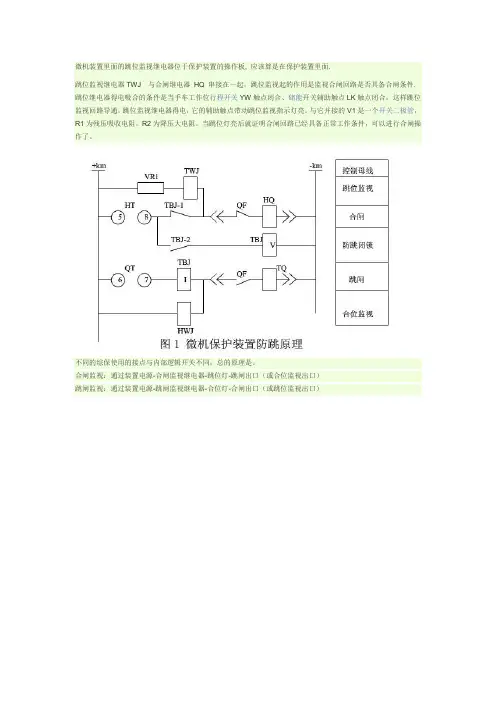
ABB REF跳闸监视回路原理
- 格式:pdf
- 大小:478.66 KB
- 文档页数:10
Section 6 Supervision functions6.1 Trip circuit supervision TCSSCBR6.1.1 Identification6.1.2 Function blockFigure 237:Function block6.1.3 FunctionalityThe trip circuit supervision function TCSSCBR is designed to supervise the controlcircuit of the circuit breaker. The invalidity of a control circuit is detected by usinga dedicated output contact that contains the supervision functionality. The failure ofa circuit is reported to the corresponding function block in the IED configuration.The function starts and operates when TCSSCBR detects a trip circuit failure. Theoperate time characteristic for the function is of definite time (DT) type. Thefunction operates after a predefined operating time and resets when the faultdisappears.The function contains a blocking functionality. Blocking deactivates the ALARMoutput and resets the timer.6.1.4 Operation principleThe function can be enabled and disabled with the Operation setting. Thecorresponding parameter values are "On" and "Off".The operation of trip circuit supervision can be described by using a modulediagram. All the modules in the diagram are explained in the next sections.Figure 238:Functional module diagramTCS statusThis module receives the trip circuit status from the hardware. A detected failure inthe trip circuit activates the timer.TimerOnce activated, the timer runs until the set value of Operate delay time has elapsed.The time characteristic is according to DT. When the operation timer has reachedthe maximum time value, the ALARM output is activated. If a drop-off situationoccurs during the operate time up counting, the fixed 0.5 s reset timer is activated.After that time, the operation timer is reset.The BLOCK input can be controlled with a binary input, a horizontalcommunication input or an internal signal of the relay program. The activation ofthe BLOCK input prevents the ALARM output to be activated.6.1.5 ApplicationTCSSCBR detects faults in the electrical control circuit of the circuit breaker. Thefunction can supervise both open and closed coil circuits. This kind of supervisionis necessary to find out the vitality of the control circuits continuously.Figure 239 shows an application of the trip-circuit supervision function use. Thebest solution is to connect an external R ext shunt resistor in parallel with the circuitbreaker internal contact. Although the circuit breaker internal contact is open, TCScan see the trip circuit through R ext. The R ext resistor should have such a resistancethat the current through the resistance remains small, that is, it does not harm oroverload the circuit breaker's trip coil.460615 seriesFigure 239:Operating principle of the trip-circuit supervision with an external resistor. The TCSSCBR blocking switch is not required since theexternal resistor is used.If TCS is required only in a closed position, the external shunt resistance can be omitted. When the circuit breaker is in the open position, TCS sees the situation as a faulty circuit. One way to avoid TCS operation in this situation would be to blockthe supervision function whenever the circuit breaker is open.Figure 240:Operating principle of the trip-circuit supervision without anexternal resistor. The circuit breaker open indication is set to blockTCSSCBR when the circuit breaker is open.Trip-circuit supervision and other trip contactsIt is typical that the trip circuit contains more than one trip contact in parallel, forexample in transformer feeders where the trip of a Buchholz relay is connected inparallel with the feeder terminal and other relays involved. The supervising currentcannot detect if one or all the other contacts connected in parallel are not connectedproperly.Figure 241:Constant test current flow in parallel trip contacts and trip-circuitsupervisionIn case of parallel trip contacts, the recommended way to do the wiring is that theTCS test current flows through all wires and joints as shown in the following figure. 462615 seriesFigure 242:Improved connection for parallel trip contactsSeveral trip-circuit supervision functions parallel in circuitNot only the trip circuit often have parallel trip contacts, it is also possible that the circuit has multiple TCS circuits in parallel. Each TCS circuit causes its own supervising current to flow through the monitored coil and the actual coil current is a sum of all TCS currents. This must be taken into consideration when determiningthe resistance of R ext.typically affect the supervising current injection.Trip-circuit supervision with auxiliary relaysMany retrofit projects are carried out partially, that is, the old electromechanicalrelays are replaced with new ones but the circuit breaker is not replaced. Thiscreates a problem that the coil current of an old type circuit breaker can be too highfor the protection IED trip contact to break.The circuit breaker coil current is normally cut by an internal contact of the circuitbreaker. In case of a circuit breaker failure, there is a risk that the protection IEDtrip contact is destroyed since the contact is obliged to disconnect high level ofelectromagnetic energy accumulated in the trip coil.An auxiliary relay can be used between the protection IED trip contact and thecircuit breaker coil. This way the breaking capacity question is solved, but the TCScircuit in the protection IED monitors the healthy auxiliary relay coil, not the circuit breaker coil. The separate trip circuit supervision relay is applicable for this to supervise the trip coil of the circuit breaker.Dimensioning of the external resistor Under normal operating conditions, the applied external voltage is divided between the relay’s internal circuit and the external trip circuit so that at the minimum 10 V (3...10 V) remains over the relay’s internal circuit. Should the external circuit’s resistance be too high or the internal circuit’s too low, for example due to welded relay contacts, the fault is detected.Mathematically, the operation condition can be expressed as:U R R I V AC DC C ext int s c −++×≥(R )/20(Equation 59)U R R I V DC c ext s c −+×≥()10(Equation 60)U c Operating voltage over the supervised trip circuit I c Measuring current through the trip circuit, appr. 1.0 mA (0.85...1.20 mA)R ext external shunt resistance R s trip coil resistance If the external shunt resistance is used, it has to be calculated not to interfere with the functionality of the supervision or the trip coil. Too high a resistance causes too high a voltage drop, jeopardizing the requirement of at least 20 V over the internal circuit, while a resistance too low can enable false operations of the trip coil.Table 398:Values recommended for the external resistor R extDue to the requirement that the voltage over the TCS contact must be 20V or higher, the correct operation is not guaranteed with auxiliary operating voltages lower than 48V DC because of the voltage drop in the R ext and operating coil or even voltage drop of the feeding auxiliary voltage system which can cause too low voltage values over the TCS contact. In this case, erroneous alarming can occur.At lower (<48V DC) auxiliary circuit operating voltages, it is recommended to use the circuit breaker position to block unintentional operation of TCS. The use of the position indication is described earlier in this chapter.464615 seriesUsing power output contacts without trip-circuit supervisionIf TCS is not used but the contact information of corresponding power outputs are required, the internal resistor can be by-passed. The output can then be utilized as a normal power output. When bypassing the internal resistor, the wiring between the terminals of the corresponding output X100:16-15(PO3) or X100:21-20(PO4) can be disconnected. The internal resistor is required if the complete TCS circuit is used.Figure 243:Connection of a power output in a case when TCS is not used and the internal resistor is disconnectedIncorrect connections and usage of trip-circuit supervisionAlthough the TCS circuit consists of two separate contacts, it must be noted that those are designed to be used as series connected to guarantee the breaking capacity given in the technical manual of the IED. In addition to the weak breaking capacity, the internal resistor is not dimensioned to withstand current without a TCS circuit. As a result, this kind of incorrect connection causes immediate burning of the internal resistor when the circuit breaker is in the close position and the voltage is applied to the trip circuit. The following picture shows incorrect usage of a TCS circuit when only one of the contacts is used.Figure 244:Incorrect connection of trip-circuit supervisionA connection of three protection IEDs with a double pole trip circuit is shown inthe following figure. Only the IED R3 has an internal TCS circuit. In order to testthe operation of the IED R2, but not to trip the circuit breaker, the upper tripcontact of the IED R2 is disconnected, as shown in the figure, while the lowercontact is still connected. When the IED R2 operates, the coil current starts to flowthrough the internal resistor of the IED R3 and the resistor burns immediately. Asproven with the previous examples, both trip contacts must operate together.Attention should also be paid for correct usage of the trip-circuit supervision while,for example, testing the IED.466615 seriesFigure 245:Incorrect testing of IEDs 6.1.6 SignalsTable 399:TCSSCBR Input signalsTable 400:TCSSCBR Output signalsTable 401:TCSSCBR Non group settings6.1.8Monitored data Table 402:TCSSCBR Monitored data6.2Current circuit supervision CCRDIF 6.2.1Identification 6.2.2Function block Figure 246:Function block 6.2.3Functionality The current circuit supervision function CCRDIF is used for monitoring current transformer secondary RDIF calculates internally the sum of phase currents (I_A, I_B and I_C) and compares the sum against the measured single reference current (I_REF). The reference current must originate from other three-phase CT cores than the phase currents (I_A, I_B and I_C) and it is to be externally summated, that is, outside the RDIF detects a fault in the measurement circuit and issues an alarm or blocks the protection functions to avoid unwanted tripping.It must be remembered that the blocking of protection functions at an occurring open CT circuit means that the situation remains unchanged and extremely high voltages stress the secondary circuit.468615 series。