北京大学2004年博士研究生入学考试英语试题
- 格式:doc
- 大小:61.00 KB
- 文档页数:9
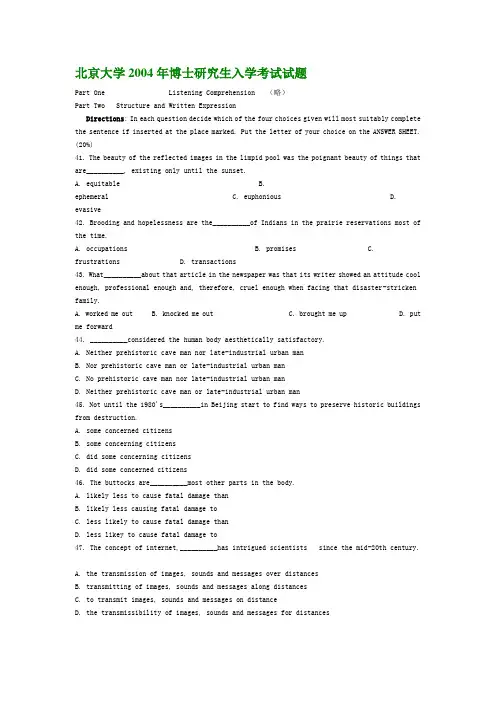
北京大学2004年博士研究生入学考试英语试题Part One Listening Comprehension (20 points)(略)Part Two Structure and Written Expression (20 points) Directions:In each question decide which of the four choices given will most suitably complete the sentence if inserted at the place marked. Put the letter of your choice on the ANSWER SHEET(1). (20 points)41.The beauty of the reflected images in the limpid pool was the poignant beauty of things that are ______, existing only until the sunset.A.equitable B.ephemeral C.euphonious D.evasive42.Brooding and hopelessness are the ______ of Indians in the prairie reservations most of the time.A.occupations B.promises C.frustrations D.transactions 43.What ______ about that article in the newspaper was that its writer showed an attitude cool enough, professional enough and, therefore, cruel enough when facing that disaster-stricken family.A.worked me out B.knocked me outC.brought me up D.put me forward44.______ considered the human body aesthetically satisfactory.A.Neither prehistoric cave man nor late-industrial urban manB.Nor prehistoric cave man or late-industrial urban manC.No prehistoric cave man nor late-industrial urban manD.Neither prehistoric cave man or late-industrial urban man45.Not until the 1980s ______ in Beijing start to find ways to preserve historic buildings from destruction.A.some concerned citizens B.some concerning citizensC.did some concerning citizens D.did some concerned citizens46.The buttocks are ______ most other parts in the body.A.likely less to cause fatal damage thanB.likely less causing fatal damage toC.less likely to cause fatal damage thanD.less likely to cause fatal damage to47.The concept of internet, ______ has intrigued scientists since the mid-20th century.A.the transmission of images, sounds and messages over distancesB.transmitting of images, sounds and messages along distancesC.to transmit images, sounds and messages on distanceD.the transmissibility of images, sounds and messages for distances48.Because of difficulties in getting a visa, the students had to ______ the idea of applying for study in the United States.A.reduce B.yield C.relinquish D.waver49.His request for a day off ______ by the manager of the company.A.was turned off B.was turned downC.was put down D.was put away50.The index of industrial production ______ last year.A.raised up by 4 percent B.rose up with 4 percentC.arose up with 4 percent D.went up by 4 percent51.Please ______ if you ever come to Sydney.A.look at me B.look me up C.look me out D.look to me 52.British hopes of a gold medal in the Olympic Games suffered ______ yesterday, when Hunter failed to qualify during the preliminary heats.A.a sharp set-back B.severe set-backC.a severe blown-up D.sharp blown-up53.By the end of the year 2004, he ______ in the army for 40 years.A.will have served B.will serveC.will be serving D.will be served54.______ there was an epidemic approaching, Mr. Smith ______ the invitation to visit that area.A.If he knew, would have declined B.If he had known, would declineC.Had he known, would decline D.Had he known, would have declined55.In the dark they could not see anything clear, but could ______.A.hear somebody mourn B.hear somebody mourningC.hear somebody mourned D.hear somebody had been mourning56.The team leader of mountain climbers marked out ______.A.that seemed to be the best route B.what seemed to be the best routeC.which seemed to be the best route D.something that to be the best route57.The scheme was so impracticable that I refused even ______.A.to consider supporting it B.considering to support itC.to considering to support it D.considering supporting it58.Among the first to come and live in North America ______, who later prospered mainly in New England.A.had been Dutch settlers B.Dutch settlers were thereC.were Dutch settlers D.Dutch settlers had been there59.The cargo box has a label ______ on it. Please handle it with care.A."flexible" B."break" C."fragile" D."stiff"60.______ we wish him prosperous, we have objections to his ways of obtaining wealth.A.Much as B.As much C.More as D.As well asPart Three Reading Comprehension (25 points)ⅠDirections:Each of the passages is followed by some questions. For each question four answers are given. Read the passages carefully and choose the best answer to each question. Put your answer on the ANSWER SHEET(1). (10 points)Passage OneWhat Makes a "Millennial Mind"?Since 1000 A.D., around 30 billion people have been born on our planet. The vast majority have come and gone unknown to all but their friends and family. A few have left some trace on history: a discovery made, perhaps, or a record broken. Of those, fewer still are remembered long after their death. Yet of all the people who have lived their lives during the last 1,000 years, just 38 have achieved the status of "Millennial Minds"—that's barely one in a billion. Those whose lives Focus has chronicled have thus become members of possibly the mostexclusive list of all time. And choosing who should be included was not easy.From the beginning, the single most important criterion was that the "Millennial Minds" are those who did more than merely achieve greatness in their own time, or in one field. Thus mere winners of Nobel Prizes had no automatic right to inclusion, nor artists who gained fame in their own era, but whose reputation has faded with changing fashion. The achievements of the genuine "Millennial Mind" affect our lives even now, often in ways so fundamental that it is hard to imagine what the world was like before.Not even transcendent genius was enough to guarantee a place in the Focus list. To rate as a "Millennial Mind", the life and achievements also had to cast light on the complex nature of creativity: its origins, nature, and its personal cost.61.The first paragraph tells us that ______.A.Focus had a list of "Millennial Minds" worked out in secretB.Focus had compiled a biographical book of the lives of "Millennial Minds”C.Focus's list of the "Millennial Minds" consists of a strictly selected fewD.Focus tried hard to exclude most of the famous lives from the list of the "Millennial Minds"62.According to the second paragraph, which of the following statements is TRUE?A.Nobel Prize winners are not qualified for the "Millennial Minds".B.A "Millennial Mind" needs only to have a great influence on the lives of the people of his time.C.Only those whose achievements still greatly affect our lives today can be included in the list of the "Millennial Minds".D.The "Millennial Minds" are those who have changed human lives so much that people of later generations can not remember what things were like in the past.63.In the first sentence of the third paragraph, "transcendent genius" means ______.A.people who are exceptionally superior and great in talentB.people whose achievements are not forgotten by later generationsC.people whose genius has been passed down to the present timeD.people who have guaranteed themselves a place in the Focus list64.In the third paragraph, the phrase "cast light on" can be replaced by ______.A.shine over B.light up C.shed light on D.brighten upPassage TwoTribute to Dr. Carlo Urbani, Identifier of SARSOn the 29th of March, 2003, the World Health Organization doctor Carlo Urbani died of Severe Acute Respiratory Syndrome, the fast-spreading pneumonia that had killed 54 people worldwide.The 46-year-old Italian doctor was the first WHO officer to identify the outbreak of this new disease in an American businessman. Dr. Urbani first saw the US businessman on Feb. 28, two days after the patient had been admitted to a hospital in Hanoi. Although Urbani had worn a mask, he lacked goggles and other protective clothing. He began demanding that Hanoi hospitals stock up on protective gear and tighten up infection control procedures. But he was frustrated at how long it was taking to teach infection-control procedures to people in hospitals. There were shortages of supplies, like disposable masks, gowns, gloves.After three weeks of round-the-clock effort, Urbani's superior urged him to take a few days off to attend a medical meeting in Bangkok, where he was to talk on childhood parasites. The day after he arrived, he began feeling ill—with symptoms of the new disease. He called his wife, now living in Hanoi with their three children. He said: "Go back to Italy and take the children, because this will be the end for me." Dr. Urbani developed a fever and was put into isolation where he remained until his death. The WHO representative in Hanoi said: "He was very much a doctor, his first goal was to help people. "He was buried on April 2, 2003 in Castelplanio, central Italy, leaving behind his wife and children. The measures he helped put in place before his death appear to have doused the SARS wildfire in Vietnam.65.Which of the following statements is NOT TRUE?A.Dr. Urbani caught SARS from an American businessman who was hospitalized in Hanoi.B.There were not enough disposable masks, gowns, gloves and protective equipments.C.He knew he had little hope to survive after he was found infected.D.Dr. Urbani had helped combating the new disease by putting in place a series of infection-control measures.66.In the third paragraph, "three weeks of round-clock effort" means ______.A.for three weeks the hospital was taking in SARS patients without stoppingB.Dr. Urbani worked day and night for three weeks, trying to get SARS under controlC.for three weeks Dr. Urbani did not have any time to sleep, trying hard to fight the new diseaseD.after three weeks hard work to control SARS, the hospital superior thought it was time to stop the clock67.According to the context, the word "doused" in the last sentence of this passage could be best replaced with ______.A.extinguished B.eliminated C.solved D.delugedPassage ThreeGlassSince the Bronze Age, about 3000 B. C., glass has been used for making various kinds of objects. It was first made from a mixture of silica, lime, and an alkali such as soda or potash, and these remained the basic ingredients of glass until the development of lead glass in the seventeenth century.When heated the mixture becomes soft and moldable and can be formed by various techniques into a vast array of shapes and sizes. The homogeneous mass thus formed by melting then cools to create glass, but in contrast to most materials formed in this way (metals, for instance), glass lacks the crystalline structure normally associated with solids, and instead retains the random molecular structure of a liquid. In effect, as molten glass cools, it progressively stiffens until rigid, but does so without setting up a network of interlocking crystals customarily associated with that process. This is why glass shatters so easily when dealt a blow.Another unusual feature of glass is the manner in which its viscosity changes as it turns from a cold substance into a hot, ductile liquid. Unlike metals that flow or "freeze" at specific temperatures, glass progressively softens as the temperature rises, going through varying moldable stages until it flows like a thick syrup. Each of these stages allows the glass to be manipulated into various forms, by different techniques, and if suddenly cooled the object retains the shape achieved at that point. Glass is thus open to a greater number of heat-forming techniques than most other materials.68.According to the passage glass cools and becomes rigid differently from metals because______.A.it has an unusually low melting temperatureB.it does not set up a network of interlocking crystalsC.it has a random molecular structure of a liquidD.it is made from a mixture of silica, lime, and soda69.In the phrase "without setting up a network of interlocking crystals customarily associated with that process" in the second paragraph, a substitute for the word "customarily" may be ______.A.continuously B.certainly C.eventually D.usually70.Glass can be easily molded into all kinds of forms because ______.A.it melts like liquid when heatedB.it softens gradually through varying stages when heatedC.it retains the shape at the point when it is suddenly cooledD.various heating techniques can be used in making glassⅡDirections: Read the following passage carefully and then explain in your own English the exact meaning of the numbered and underlined parts. Put your answers on the ANSWER SHEET(2). (15 points)No one gets out of this world alive, and few people come through life without at least one serious illness. (71) If we are given a serious diagnosis, it is useful to try to remain free of panic and depression. Panic can constrict blood vessels and impose an additional burden on the heart.(72) Depression, as medical researchers way back to Galen, an ancient Greek doctor, have observed, can set the stage for other illnesses or intensify existing ones. It is no surprise that so many patients who learn that they have cancer or heart disease—or any other catastrophic disease—become worse at the time of diagnosis. (73)The moment they have a label to attach to their symptoms, the illness deepens. All the terrible things they have heard about disease produce the kind of despair that in turn complicates the underlying condition. (74) It is not unnatural to be severely apprehensive about a serious diagnosis, but a reasonable confidence is justified. Cancer today, for example, is largely a treatable disease. A heavily damaged heart can be reconditioned. (75) Even a positive HIV diagnosis does not necessarily mean that the illness willmove into the active stage.Part Four Cloze Test (10 points)Directions: Fill in each numbered blank in the following passage with ONE suitable word to complete the passage. Put your answers on the ANSWER SHEET(2). (10 points) Flowers for the DeadSince flowers symbolize new life, it may seem inappropriate to have them at funerals. Yet people in many cultures top coffins or caskets with wreaths and garlands and put blossoms on the graves of the (76) ______. This custom is part of a widespread, longlived pattern. Edwin Daniel Wolff speculated that floral tributes to the dead are an outgrowth of the grave goods of ancient (77) ______. In cultures that firmly believed in an (78) ______, and believed further that the departed could enter that afterlife only (79)______ they took with them indications of their worldly status, it was a necessity to bury the dead with material goods: hence the wives and animals that were killed to accompany (80) ______ rulers, the riches (81) ______ with Egyptian pharaohs, and the coins that Europeans used to place on the departed person's eyes as payment for the Stygian ferryman. In time, as economy modified tradition, the actual (82) ______ goods were replaced (83) ______ symbolic representations. In China, for example, gold and silver paper became a stand-in (84) ______ real money. Eventually even the symbolic significance became obscured. Thus, Wolff said, flowers may be the (85) ______ step in "three well-marked stages of offerings to the dead: the actual object, its substitute in various forms, and—finally—mere tributes of respect."Part Five Proofreading (10 point)Directions:This part consists of a short passage. In this passage, there are altogether 10mistakes ,one in each underlined sentence or part of a sentence. You may have to change a word,add a word or just delete a word. If you change a word, cross it out with a slash (/) and write the correct word near it. If you add a word, write the missing word between the words (in brackets) immediately before and after it. If you delete a word, cross it out with a slash (/).Put your answers on the ANSWER SHEET(2). (10 points)Examples:e. g. 1 (86) The meeting begun 2 hours ago.Correction in the ANSWER SHEET (2): (86) begun begane. g. 2 (87) Scarcely they settled themselves in their seats in the theatre when the curtainswent up.Correction in the ANSWER SHEET (2): (87) (Scarcely) had (they)e. g. 3 (88) Never will I not do it again.Correction in the ANSWER SHEET (2): (88) not(86) Homes could start been connected to the Internet through electrical outlets.(87) In this way, consumers and business may find easier to make cheaper telephone calls under new rules that the Federal Communications Commission began preparing on Thursday. (88) Taking together, the new rules could profoundly affect the architecture of the Internet and the services it provides.(89) They also have enormous implications for consumers, the telephone and energy industries, equipment manufacturers. Michael K. Powell, the F.C.C. chairman, and his two Republican colleagues on the five-member commission said that (90) a 4-to-1 vote on Thursday to allow a small company providing computer-to-computer phone connections to operate in different rules from ordinary phone companies, would ultimately transform the telecommunications industry and the Internet.(91) "This is a reflecting of the commission's commitment to bring tomorrow's technology to consumers today," said Mr. Powell. He added that (92) the rules governing the new phone services sought to make them as wide available as e-mail, (93) and possibly much less expensive than traditional phones, and given their lower regulatory costs. At the same time, (94) once while the rules allowing delivery of the Internet through power lines are completed, (95) companies could provide consumers with the ability to plug their modems directly into wall sockets, just like they do with a toaster, or a desk lamp.Part Six Writing (15 points)Directions: Write a short composition of about 250 to 300 words on the topic given below. And write the composition on the ANSWER SHEET(2). (15 points)Topic: Epidemic Diseases and public Health Crises。