
Lecture 3 Market Segmentation, Targeting and Positioning
- 格式:ppt
- 大小:729.00 KB
- 文档页数:18

Principles of MarketingMarketing is a broad field that involves various activities aimed at promoting products or services to consumers. To achieve success in marketing, it is essential to understand and apply the key principles that guide effective marketing strategies. In this document, we will discuss the fundamental principles of marketing and how they can be applied to drive business growth.1. Customer OrientationOne of the primary principles of marketing is customer orientation. This principle emphasizes the importance of understanding and meeting customer needs and wants. Successful marketers strive to create products or services that provide value to customers and address their specific preferences and desires. By focusing on the customer, businesses can build strong relationships, increase customer loyalty, and ultimately drive sales.2. Segmentation, Targeting, and PositioningAnother crucial principle in marketing is segmentation, targeting, and positioning (STP). The market is diverse, and targeting all consumers with a single marketing strategy may not be effective. Therefore, marketers use segmentation to divide the market into distinct groups based on demographics, psychographics, or behavior.After segmenting the market, marketers select specific target segments that align with their business goals andcapabilities. Once the target audience is identified, positioning comes into play. Positioning involves creating a unique and compelling brand image in the minds of consumers, differentiating the product or service from competitors. By leveraging STP, marketers can develop tailored marketing campaigns that resonate with the target audience, leading to higher engagement and conversion rates.3. Marketing MixThe marketing mix is a set of core elements that marketers manipulate to achieve their objectives. It consists of the four Ps: Product, Price, Place, and Promotion. These elements work together to create a comprehensive marketing strategy.•Product: This element focuses on developing and offering products or services that meet customer needs. It includes product design, features, packaging, quality, andbranding.•Price: The price element involves determining the optimal pricing strategy for a product or service. It takesinto consideration factors such as production costs,competitor pricing, and perceived value by customers.•Place: This element refers to the distribution and availability of the product or service. It involves selectingappropriate distribution channels and ensuring that theproduct is accessible to the target audience.•Promotion: Promotion encompasses all activities that communicate and promote the product or service tothe target audience. It includes advertising, public relations, sales promotions, and direct marketing.By carefully managing the marketing mix, businesses can create a compelling offering that attracts customers and drives sales.4. Integrated Marketing CommunicationIntegrated Marketing Communication (IMC) is the concept of coordinating all marketing communication efforts to deliver a consistent and unified message. This principle recognizes that customers receive information through various channels, and consistency across these channels is crucial for effective marketing.IMC involves integrating different communication tools, such as advertising, public relations, sales promotions, and direct marketing, to create a seamless and synchronized message. By coordinating these efforts, businesses can reinforce their message, enhance brand awareness, and establish a strong brand identity in the minds of consumers.5. Continuous Monitoring and AdaptationMarketing is not a one-time effort but an ongoing process that requires continuous monitoring and adaptation. Successful marketers regularly track key performance indicators, market trends, and customer feedback to evaluate the effectiveness of their strategies. They are also prepared to make necessary adjustments to their marketing plans to stay relevant and meet changing consumer demands.Continuous monitoring enables businesses to identify opportunities, identify potential pitfalls, and optimize their marketing efforts in real-time. By staying agile and responsive, marketers can maintain a competitive edge, improve customer satisfaction, and drive long-term business growth.In conclusion, these principles of marketing provide a foundation for creating effective marketing strategies. By putting the customer at the center, segmenting the market, leveraging the marketing mix, implementing integrated marketing communication, and continuously monitoring and adapting, businesses can effectively promote their products or services, engage their target audience, and achieve their marketing objectives.。
•中文參考內容部份的版權屬K. L. Chan所有,歡迎轉載。
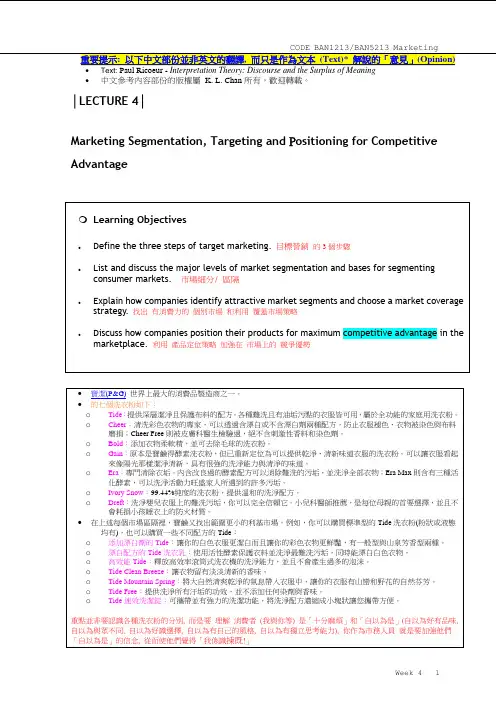
│LECTURE 4│Marketing Segmentation, Targeting and P ositioning for Competitive Advantage•中文參考內容部份的版權屬 K. L. Chan 所有,歡迎轉載。
1. Target Marketing目標營銷A marketer classifies a market as the set of all actual and potential buyers of a product or service. Facing numerous buyers with varied needs and buying practices, marketers must design strategies to build the right relationships with the right customers. Thus, each company must identify the parts of the market that it can serve best and most profitably.市場上有一大堆現實和有潛力的購買者, 他們的要求不盡相同, 所以市務人員要首先界定 甚麼種類的客人是公司的目標客戶, 然後再利用策略 與他們建立良好關係, (SEIKO, Role x, Patek Philippe, TAG Heuer 的目標市場有甚麼不同?凡勃倫效應 (Veblen Effect) - 挥霍性消费, 即是說,「一件美麗的東西若價格不昂貴,便會被視為不美麗」(A beautiful article which is not expensive is accounted not beautiful )款式、皮質差不多的一雙皮鞋,在普通的鞋店賣180元,進入大商場的櫃檯,就要賣到幾百元,卻總有人願意買。

segmentationtargetingpositioning -回复什么是[分割目标定位(STP)]?分割目标定位(STP)是市场营销中一个关键的策略过程,用于识别和满足特定市场细分中的消费者需求和欲望。
STP策略的核心思想是,不同的消费者在他们对产品或服务的需求和偏好方面存在差异,因此市场细分可以帮助企业更好地理解并满足特定消费者群体的需求。
一、分割(Segmentation)分割是STP过程的第一个步骤,它涉及将整个市场细分成不同的消费者群体,也被称为“市场细分”。
这里的目标是将消费者划分为具有相似需求和行为模式的小型群体。
市场细分可以根据各种因素进行,包括地理位置、年龄、性别、收入、兴趣爱好、购买行为等等。
这些因素可以帮助企业更好地了解不同细分市场中消费者的需求和习惯。
二、目标(Targeting)目标是STP过程的第二个步骤,它涉及从分割的市场细分中选择一个或多个细分市场作为目标市场。
目标市场是企业认为最有利可图的市场细分,企业将集中精力满足这一特定群体的需求和欲望。
选择目标市场时,企业需要考虑多个因素,包括市场规模、增长潜力、竞争情况、资源可用性等等。
通过选择合适的目标市场,企业可以更好地调整其市场营销和资源分配策略。
三、定位(Positioning)定位是STP过程的第三个步骤,它涉及确定并传达企业在目标市场中的差异化和独特性。
定位帮助企业在目标市场中树立自己与竞争对手的差异化形象。
企业可以通过多种方式定位,例如基于产品特点、价格、服务、品牌形象等等。
定位策略需要考虑目标市场中消费者的需求和价值观,以便与他们建立联系并满足他们的需求。
为了成功实施STP策略,企业需要进行市场研究、分析和定量数据收集。
消费者调研和分析数据可以帮助企业更好地了解不同的市场细分和消费者群体,并确定最具潜力的目标市场。
此外,企业需要开发相应的市场营销策略,以满足特定目标市场的需求。
这些策略可能包括产品开发、定价、推广、分销和服务等。
