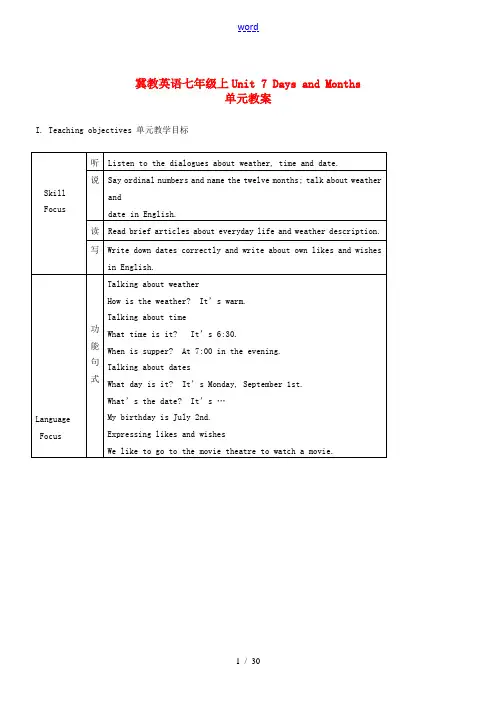
冀教英语七年级上Unit 7 Days and Months单元教案I. Teaching objectives 单元教学目标II. Teaching materials analyzing 教材分析1.教材分析本单元的主要内容是表达“天气”、“日期”和“时间”。
旨在通过听力、对话练习、调查、讨论、游戏、竞赛等活动帮助学生掌握如何表达有关“天气”、“日期”和“时间”的内容;同时,学习序数词和代词“it”的用法,这也是本单元的语法重点;本单元的写作任务是能用英语写出自己的喜好和意愿。
Lesson 49 1根据图片内容和某些实物,引出有关的词汇(季节、月份等);2通过对四幅图片的描写,对四个季节进行简单描述。
Lesson 50 1让学生学习1至12序数词的表达;2让学生学习如何询问和表达日期。
Lesson 51 1通过2个人的对话,让学生学会询问对方的生日日期。
Lesson 52 1通过对春、夏、秋、冬四幅图片的描述,把四季的典型特征表述出来。
2继续对天气情况的讨论。
Lesson 53 1让学生知道一些重要节日的说法。
2具体讨论中国的传统节日春节。
Lesson 54 学会表达日常生活中经常做的事情与喜欢做的事情。
Lesson 55 通过对李明一天生活的了解,让学生可以讲述自己的一天。
2. 课堂设计与课时分配Period 1 Speaking and listeningPeriod 2 GrammarPeriod 3 Speaking and listeningPeriod 4 Speaking and readingPeriod 5 Speaking and listeningPeriod 6 SpeakingPeriod 7 Speaking and listeningPeriod 8 Integrating skillsIII. Teaching plans for each period 分课时教案Period 1 Speaking and listeningTarget language 目标语言1. Words and phrases 生词和短语March, April, May, June, July, August, autumn, September, October, November, December, January, February, weather, windy, sunny, cloudy, snowy, rainy, season, month, spring, summer, winter 2. Key sentences 重点句子There are four seasons in a year.How is the weather? It’s …What weather do you like?Ability goals 能力目标Enable students to say the twelve months, the four seasons and talk about different weather. Learning ability goals 学能目标Help students learn about different seasons and weather.Teaching important and difficult points 教学重难点Learn to express different seasons and different weather.Teaching methods 教学方法Speaking, listening and game.Teaching aids 教具准备Pictures, cards and tape recorder.Teaching procedures & ways 教学过程与方式Step I Lead-inUse a beautiful wall calendar to teach the twelve months one by one: January, February, March, April, May, … (Show Ss cards for months.) Have Ss repeat them.Then ask: How many months are there in a year?Help Ss try to answer: There are twelve months in a year.Step II GameWhat’s missing?Put up the twelve months in the front of the classroom. Tell Ss to look at the twelve months for one minute and then close their eyes. Remove a picture.Ask Ss to open their eyes and try to figure out which month you have removed. Call on individual Ss to answer with the removed month until one answer correctly.Then the student who answered correctly hides a picture and leads the guessing.StepIII PresentationShow Ss many beautiful pictures on the screen.First show pictures of green trees, green grass, flowers that e out, melting snow, ...T: Every year we can see these things. We call this period “spring”. (Write it on the Bb and let Ss read it.)Then show pictures of girls who wear skirts, boys who wear shorts, old men with fans, swimming children in the pool, ...T: You must be familiar with these pictures. We call this period “summer”. (Write it on the Bb and let Ss read it.)Teach “autumn” and “winter” with the same way.At last, ask Ss: How many seasons are there in a year?Ss: There are four seasons in a year.Step IVAn activityWhat season?Use this game to remember seasons. Put clothing in the front of the classroom that is appropriate for different seasons. When you call out a season, volunteers race for the appropriate clothing to pick out. For example:Winter—winter scarf, gloves, winter hatSpring—umbrella, rain boots, rain jacketSummer—shorts, T-shirt, sun glassesAutumn—sweater, jacket, pantsIf you can’t get clothes for this game, you can play it with pictures of clothes. Divide the class into small groups. When you call out a season, the students race to take the cards for the appropriate clothing.Step V Discussion(1) When is spring / summer / autumn / winter?(2) How is the weather in spring / summer / autumn / winter? (Write the sentence on the Bb and explain it to the class. Tell them you can say it in another way: What’s the weather like?)Discuss the Qs with Ss or Ss discuss them in groups according to their experience and feelings to get the final result:(1) spring (March, April and May); summer (June, July and August ); autumn (September, October and November); winter (December, January and February).(2) It is warm and windy in spring. (If Ss can’t say the weather in English, Chinese is OK.)It is hot and sunny / rainy in summer.It is cool and cloudy in autumn.It is cold and snowy in winter.Write the words about weather that Ss talk of on the Bb. Have Ss repeat and try to remember them.Step VI ListeningLet Ss listen to a short passage about weather twice. Then answer some Qs in oral:How is the weather in spring / summer / autumn / winter? (It is warm and windy / hot and sunny / cool and cloudy / cold and snowy.)What weather does Danny like? (He likes rainy days.)Step VII PresentationAsk and answer with Ss, then Ss can do it in pairs.T: What weather / season do you like? / Which month do you like?S: I like rainy days / summer / August.T: Why?S: Because ……Step VIII HomeworkExercises:I. plete the following sentences.1. It’s raining now. Today is _____.2. It’s snowing now. Today is _____.3. The first month of the year is ______.4. ______ is the fifth month.5. A: How is the weather in January?B: It’s _____ and _____.6. A: How is the weather in April?B: It’s _____ and _____.II. Change the following sentences.7. I feel very cold. (对划线部分提问)______ ______ you ______ ?8. It’s very cold today. (对划线部分提问)______ is the ______ today?9. February is the second month. (同义句)The ______ ______ of the year is ______.10. How is the weather? (同义句)______the weather ______ ?Suggested answers:1. rainy;2. snowy;3. January;4. May;5. cold, snowy;6. warm, rainy;7. How do, feel;8. How, weather;9. second month, February; 10. What’s, like.Period 2 GrammarTarget language 目标语言1. Words and phrases 生词和短语date, fourth, fifth, sixth, seventh, eighth, ninth, tenth, eleventh, twelfth, yesterday, tomorrow, race, first, second, third, was2. Key sentences 重点句子What’s the date?It’s October 19th.The boy in red shorts is third.Ability goals 能力目标Enable students to say and write dates correctly.Learning ability goals 学能目标Help students learn ordinal numbers.Teaching important and difficult points 教学重难点The use of ordinal numbers.Teaching methods 教学方法Speaking and game.Teaching aids 教具准备Cards about dates, calendar and pictures of stars.Teaching procedures & ways 教学过程与方式Step I Revision(1)Ss talk about the pictures which were used in the last period in pairs:S1: What can you see in the picture?S2: I can see …S1: What season is it?S2: It’s …S1: How is the weather in …?S2: It’s …(2)An activity.This game works for as many as twenty to twenty-five Ss. Repeat the game so everyone has a turn. Preparea set of vocabulary cards you want to review (the twelve months, the four seasons and different weather).Give each student a card. Do not let Ss stand beside each other. Spread them out in the classroom.Whenyou say Go! the Ss all begin saying the word on their vocabulary card over and over again.a. They must move to find the other Ss in the classroom who are sayingthe same type of word overand over.b. Or they may form groups like this: spring — March, April, May — warm, windy.Step II Lead-inPoint to the twelve Ss with the month cards at the front of the classroom:T:How many months are there in a year?Ss: There’re twelve months in a year.T: Let’s say them together.Ss: January, February, March, April, …T: Good. January is the first month of the year. The second month is February. The third month is March. …(Show the cards with ordinal numbers. Have Ss repeat them a few times.)Step III Grammar FocusT: One, two, three, … we call them cardinal numbers. First, second, third, … we call them ordinal numbers. They often end with “th”. They are used as not only ordinal numbers, but also adjectives or adverbs. They are usually used together with “the”, but sometimes with “a” or without an article.Pay attention to the following words:One—first; two—second; three—third; five—fifth; nine—ninth; twelve—twelfth.Step IV PresentationUse a Chinese calendar to practise:T: Look here! What’s the date today? (Have Ss repeat it and tell them to answer with “it is…”.)Ss: It’s November 18th.T: What’s the date tomorrow?Ss: It is November 19th.T: What was the date yesterday? (“Yesterday”shows we should use “The Simple Past Tense”. “Was”is the p.t. of “is”. )Ss: It was November 17th. Tell Ss that: They can write the first three letters of each month for short. For example: November18th—Nov. 18th, July 20th—Jul. 20th.Then ask some Ss to be teachers and show the others cards with dates. Let Ss say the dates correctly: S1: What’s the date?S2: It’s …Step V petitionDivide the class into four groups. Ask one student to say ten dates quickly. The others write them down. Who writes down the most is the winner.Step VI PresentationShow a picture on the screen (Part 1, on Page 63):T: How many Ss can you see in the picture?Ss: Three.T: What are they doing?Ss: They’re running.T: Yes, they’re running. We call it “race”. (Have Ss repeat it.) Who is first / second / third? Ss: … (Chinese is OK.)T: The boy in a blue T-shirt is first.The girl is second.The boy in red shorts is third.“In” here means “wearing”. We often use “in” like this:The woman in black (= in black clothes) is his mother.The girl is in red (= in red clothes.).Ss make up sentences like the examples above. Then practise like this, using the picture on the screen or other pictures of stars:S1: Look! Who is the girl?S2: Which girl?S1: The girl in blue.S2: She is Li Yuchun.Step VII HomeworkFinishExI. Part B on Page 69.Exercises:I. plete the following sentences.1. July is the ______ month of the year.2. How is the w______? It’s hot.3. Today is hot and s______.4. In J______ the weather in China is cold and s______.5. It’s N______ 25th.II. Form the sentences.1. today, is, date, what, the___________________2. the, in, yellow, girl, the, a, second, is, shirt__________________________________3. talk, phone, I, the, my, on, with, friend_______________________________4. windy, cloudy, is, and, weather, the____________________________5. race, first, the, is, in, the, he______________________Suggested answers:I. 1. seventh; 2. weather; 3. sunny; 4. January, snowy; 5. November. II. 1. What’s the date today?2. The girl in a yellow shirt is the second.3. I talk on the phone with my friend.4. The weather is windy and cloudy.5. He is the first in the race.Period 3 Speaking and listening Target language 目标语言1. Words and phrases 生词和短语when, flower, bloom2. Key sentences 重点句子When is your / Danny’s birthday?My birthday is July 25th.Ability goals 能力目标Enable students to ask others’ birthdays.Learning ability goals 学能目标Help students learn how to know about others’ birthdays.Teaching important and difficult points 教学重难点Fill in the chart by asking some Qs.Teaching methods 教学方法Speaking and listening.Teaching aids 教具准备Pictures and tape recorder.Teaching procedures & ways 教学过程与方式Step I Lead-inT: This class we’ll talk about birthdays. Look at the picture! This is my lovely daughter. She is three years old. When is her birthday? (Write it on the Bb and explain it to the class.) Try to guess. Ss: … (Maybe different months.)T: Her birthday is November 30th. Now let me learn about yours. How old are you?S1: I’m thirteen years old.T: When is your birthday?S1: My birthday is July 16th.T: What about you, S2?S2: …Ask more Ss about it.Step II SurveyCall attention to the survey chart. Divide the class into groups of ten Ss. Let them fill in the chart by asking several Ss for each question“How old are you?” and “When is your birthday?”At last, they report the result of the survey: Find out in which month most of them were born. For example: Most students’birthdays are September (30%) or most students (30%) were born in September.Step III PresentationPair workLet Ss make up conversations orally, using the information in the chart above.A sample conversation:S1: How old are you?S2: I’m twelve years old.S1: When is your birthday?S2: My birthday is February.S1: How old is S5?S2: He is thirteen years old.S1: When is his birthday?S2: His birthday is June 3rd.Step IV ListeningT: Now you will hear a short dialogue with the target language. You’ll listen to it twice. Please listen carefully and then answer my Qs:1. How old is Danny?2. When is Danny’s birthday?3. How old is Bob?4. When is Bob’s birthday?Play the audiotape. After listening, check Ss’ answers.Suggested answers:1. He is thirteen years old.2. His birthday is July 25th.3. He is sixteen years old.4. His birthday is December 17th.Step V SongSs sing a song. (P64).Divide the class into six groups.Each group thinks about actions for each part of the song.Step VI HomeworkExercise:plete the dialogue.A: Hello! What’s your ______?B: Hello! My name is Bob.A: My name is Ann. ______ ______ are you, Bob?B: I’m thirteen ______ ______.A: ______ is your birthday?B: My birthday is October thirteenth.A: ______ you ______ a birthday party?B: Yes, I will. My father and mother ______ give me many ______ and a birthday _____ that day. Suggested answers:Name; How old; years old; When; Will; have; will; presents; cake.Period 4 Speaking and readingTarget language 目标语言1. Words and phrases 生词和短语sun, wind, cloud, rain, snow, day, blow, leaf2. Key sentences 重点句子What day is it today / tomorrow?It’s Tuesday, October 27th.How is the weather today?Is it snowy / windy / sunny?Ability goals 能力目标Enable students to talk about weather and what day it is.Learning ability goals 学能目标Help students learn how to describe the weather and how to answer “What day is it?” correctly. Teaching important and difficult points 教学重难点How to describe the weather.Teaching methods 教学方法Speaking and petition.Teaching aids 教具准备Pictures, cards, a Chinese calendar and tape recorder.Teaching procedures & ways 教学过程与方式Step ILead-inAsk several Ss who are good at drawing to draw “the sun, rain, cloud, wind, leaves, snow” on the Bb. (If Ss can’t understand you, maybe you can say them in Chinese.) Then:T: (Point to the picture of the sun.) This is the sun. (Write it in the middle of the Bb. Ss read it.) The sun is hot. How is the weather?Ss: It’s sunny.T: Is it hot?Ss: Yes, it is.T: (Point to the picture of the wind.) This is wind. (Write it in the middle of the Bb.)The wind is blowing the tree’s leaves. (Have Ss repeat them.) How is the weather?Ss: It’s windy.T: Is it cool?Ss: Yes, it is.Learn the words “rain, cloud, snow” with the same way.Pay attention to: (n.—adj.)Sun — sunny; wind — windy; rain — rainy; snow — snowy; cloud — cloudy.The last five words all end with “y”.Step II PresentationShow some pictures on the screen one by one. Ss make up dialogues in pairs.S1: Look at the snow! How is the weather?S2: It’s snowy / cold.S1: Is it cold / snowy?S2: Yes, it is.S3: Look at the cloud! How is the weather?S4: It’s cloudy. (Maybe Ss can say it’s going to rain.)S3: Is it windy?S4: No, but it’s cool.Step III Vocabulary practiceT: Look at Ex. 1 (c) on Page 69. Here are five sentences with blanks. Fill in the blanks with the words given.Students work alone to fill in the blanks. When they’ve finished, ask some students to read these sentences. Correct any mistakes they may have. Then let students make their own sentences with these words.Step IV PresentationAt first, Ss review days of the week together.Then show Ss a Chinese calendar.T: Look here! What is the date today?Ss: It’s December 15th.T: What day is it today? (Write it on the Bb and explain it to the class. Help Ss to answer it with “It is……”)Ss: It’s Thursday.T: Good. What day is it today? It’s Thursday, December 15th. Is it windy today?Ss: No, it isn’t.T: Is it cloudy?Ss: No, it isn’t.T: How is the weather today?Ss: It’s fine /sunny today.T: What day was it yesterday?Ss: It was Wednesday, December 14th. (Remind them to pay attention to “was”.)T: How was the weather yesterday?Ss: It was rainy.Pay attention to the answer with the correct day of the week, then the month and the ordinal number. Ss practise it with the calendar. They present it to the whole class:S1: What day is it?S2: It is Monday, May 18th.S3: What day is it?S4: It is Friday, August 26th.Step V petitionWhat day is it?It’s a game to review days of the week, months and ordinal numbers.Put your cards for numbers (not ordinals) from one to thirty-one, months of the years and days of the week in the front of the class. Divide the class into two teams. Ask for a volunteer from each team. The volunteer from Team 1 indicates, in any order, a month, a day of the week and a number. This volunteer then asks “What day is it?” The volunteer from Team 2 tries to answer with the correct day of the week, then the month and the ordinal number. Two more volunteers e forward.Keep score. Give a point for each part of the answer that is correct and another point for putting all parts of the answer in the correct order (for a maximum of four points).Step VI ReadingPlay the audiotape. Let Ss read after it.Language points:1. The wind is blowing the tree’s leaves.leaves 是leaf 的复数形式。