
新核心大学英语B版听说教程1Unit
- 格式:ppt
- 大小:8.32 MB
- 文档页数:96


Unit 13 The MediaPart ACommunicative Function Describing ThingsIn daily life we often describe things to others. In our descriptions, we talk about size, shape, color and so on.Listen to the Conversation and supply the missing information in the blanks.Color: orangeShape: rectangularMaterial: woolUsage: to keep warmThe present: a woolen scarfScriptRose: Hi, James. I hear that your birthday is coming soon.James: Yes. It's next Tuesday.Rose: I've bought a present for you.James: What is it? Can you tell me?Rose: No, it's a surprise. You'll see it next Tuesday.James: Let me guess. What color is it?Rose: Um…it's orange.James: And what about the shape?Rose: Rectangular.James: How big is it?Rose: Oh, about 30 centimeters wide and 2 meters long.James: Really? Is it heavy?Rose: Not really.James: What's it made of?Rose: It's made of wool.James: What's it used for?Rose: To keep warm.James: Oh, I know! It's a woolen scarf.Rose: That's it. See you next Tuesday, James. Bye.NotesThere are a variety of shapes. The common ones are round, square (正方形), oval (橢圆形), long, angular (尖角形), rectangular (长方形) and so on.Useful Expressions for Describing ThingsAsking for Descriptions●How big is (the living room)?●How heavy is (this down jacket)?●How does (the computer) work?●What's (the shopping bag) made of?●What's (this tool) used for?●What color are (the walls)?●What size are (the shoes)?●What does (your new apartment) look like?●Can you describe (the house/flat you have just moved in)?●Tell me about (the kitchen).Describing Things●It's (dark blue).●It's (round).●It's made of (wood/plastic/leather).●It's (quite long and rather wide).●It's (a multi-storey building).●It's (in the center of the town).●It’s (quite modern).●It looks like (a TV set).Listening Strategy Filling in FormsIn everyday life we often have to fill in different kinds of forms. Knowing how to fill in a form is a skill we must learn. Before filling in a form it is important to find out what kind of information is required and where to write the relevant details.Now listen to the tape and then complete the student information card and the hotel reservation form below.ScriptBetty Li graduated from No.3 Girls High School in Shanghai in the summer of 2008. She enrolled in the Department of Chinese at Northwest University on August 31st, 2008. Betty lives on campus. She lives in Room 420 of No.1 Residence Hall for students. Her phone number is 52167739.Betty was born on August 19th, 1990. She is interested in writing, painting and music. She hopes to become a writer when she finishes college.Part BPre-listening TaskQuestions for DiscussionYou are going to talk about the media. Read the following questions and discuss them with your partner.1.Do you often listen to the radio?2.What kind of radio programs do you listen to? What do you think of them?3.Do you often watch TV?4.What TV programs do you like watching?5.Which do you like better, radio or television? Why?6.What role do radio and TV play in your life?7.Can you imagine a life without TV or radio?Demo4. What TV programs do you like watching?I like watching travel programs and Discovering Channel. For example, travel programs introduce to the audience the unknown land with peculiar culture or customs of the native people. So the audience, without going out of doors, can experience the beautiful scenery and the fantastic customs. I have to admit that I'm a big fan of Discovery Channel which shows the recent development or findings in science and technology. I can still remember one issue of the program about the Mood Landing. It's really fascinating. I think Discovery Channel does produce some of the best documentaries in the world.6. What role do radio and TV play in your life?TV and radio are an integral part of my life. I don't read newspapers and I rely heavily on radio or TV to keep me informed. I watch the news on TV every evening or listen to the news while having a dinner. What's more, the radio and television present various kinds of programs. They present programs of sports and entertainment. We can enjoy listening to different forms of music and songs on the radio and watch the live broadcast of sports events and the reports of adventures in the mountains and unknown lands. Educational programs of different kinds are presented on the radio and television as well. These programs are very informative. There are lectures and discussions on the latest science and arts subjects.Language FocusHere are some sentences and structures that you might find handy in discussing the above questions:●Radio and TV connect us to the outside world / tell us what is happening near and far /shortens the distance between us and the outside world.●I listen to news / English news / music / story-telling / sports / talk of the day / economicnews on the radio while I'm getting up / having breakfast / on my way to class / before I go to bed ….●I like to leave my radio on while I'm reading / working on my homework / waiting for a bus /riding on a train …●I enjoy listening to / watching …program most. I think it's terrific / fascinating / moving /funny / informative / instructive / amus ing / relaxing / entertaining / romantic …●I like small portable radios. You can carry one with you wherever you go.●Many people catch the latest news on their car radio.●I often watch sports / discovery channel programs / travel programs / talk shows / quiz shows/ soap operas / variety shows on TV.●I prefer TV to radio. TV is visual / not only tells you what is happening but also lets you seeit with your own eyes / brings the outside world right into your room.●One picture is worth a thousand words.●Compared with radio, everything on television is more lifelike, vivid and real.●Television takes up too much of our time. We no longer have enough time to develop otherinterests.●Life without TV or radio is possible today ’cause we’ve got the Internet, wh ich presents us amore colorful world.●I think turning off TV one night or two a week is a good thing/ will give us more time to bewith our family or friends.Listening TasksA PassageRadio and TVWord Bankadapt v. to adjust 适应imaginative a. using or having imagination富有想象力的visual a. gained by seeing, visible视觉的,看得见的flexible a. adaptable 灵活的,适应性强的portable a. movable; quite small and light便携的,手提式的jog v. to run slowly and steadily 慢跑access n. means of obtaining 取得……的途径interval n. a period of time between events, activities, etc. 间隔interactive a. influencing or having an effect on each other交互的,互动的ScriptRadio and TVThe most obvious difference between radio and television is that you listen and look at the television, but just listen to the radio. In this way, radio is more imaginative because it forces you to form pictures in your own mind rather than providing you with visual information, which is what television does.In addition, radio is more flexible than television, since you don't have to be in the same room as the radio set in order to listen to the programs, but you do have to be in the same room as a television in order to watch it.A radio is also far more portable than a television. You can listen to the radio while driving in the car, jogging or even just walking around. Although portable televisions do exist, you can't really watch one while you are jogging, for example.One of the main advantages of radio, however, is that it offers the listener more immediate access to information. Most radio stations broadcast news reports at regular half-hour or hourly intervals, but television news is only broadcast a few times each day. Also, the variety of topics you get on the radio is much greater than that on television.Radio is more personal than television. Many radio programs are interactive in a way that television can never be. Listeners can call the radio station they are listening to and express their thoughts and opinions live on air. You can't ring up a television station and express your opinions, can you?Language and Culture Notes1.Background information From its appearance at the beginning of the 20th century, radio had been a major provider of news and entertainment until television came into being. The early models of the modern television appeared in the 1920s but its popularity did not begin until after World War II, especially until after color TV became available in the 1960s. Today TV sets are much more sophisticated. Not only are they attached with remote control, but they can be hooked to VCR, VCD, DVD and even to the Internet. So it is not surprising that more and more people now watch TV to get news, sports, and a great variety of entertainment. Yet television cannot completely replace radio. Many people still like radio because of its compactness in size. Radio also survives as a major part of a tape recorder, a hi-fi and a necessary component of a car. To adapt to the invention of TV, radio has also made great changes in its system, and in the way it presents programs. The stereo system, for example, is successful in winning music lovers to radio programs.2. portable television A television set about 3" in size and can easily be carried or moved3. at regular half-hour or hourly intervals(the program is broadcast on the radio) every half hour or every hour4. Many radio programs are interactive …Program hosts or hostesses can get immediate feedback from their listeners and they can discuss a topic on the air. With TV, however, audience interaction is more difficult. The usual way is to send out a TV crew to bring in live coverage of people's response to some event.5.live on air Listeners' thoughts or opinions can be heard on the radio at the moment they are spoken rather than later on a recording.Exercise 1: Listening for general understandingListen to the recording once and choose the right answers to the questions you hear.1. What is the passage mainly about?a. The advantages of radio over television.b. The difference between radio and television.c. The changes made to radio programs.d. The reasons for the unpopularity of TV programs.2. Which of the following reflects the speaker's attitude?a. The invention of television is a failure.b. The invention of television has had a great impact on radio.c. Radio definitely has a larger audience than television does.d. Radio will not easily be replaced by television.Exercise 2: Listening for detailsListen to the recording once again and fill in the chart with the missing information.Speaking TasksPair WorkListen to the conversations and repeat after the recording. Practise the conversations with your partner, playing the role of A or B. Then work with your partner to create your own conversations by replacing the underlined parts with your own words.Part CAdditional ListeningA Passage The Benson Family’s DecisionA. Listen to the passage and answer the following question.What’s the main idea of the passage?Without watching TV, people may find many interesting things to do.B. Listen to the passage again and choose the best answers.What has each member of the Benson Family found time doing in the past year?1. Mr. Benson a. playing the pianob. playing tennisc. working in the cinemad. writing a novel2. Mrs. Benson a. taking up judob. seeing films and playsc. writing a dramad. joining a film society3. Daughter Emily a. taking up actingb. reading ten novelsc. learning to play the pianod. solving math problems4. Son Mark a. reading novels and other booksb. playing tennisc. joining a societyd. going to tennis classesScriptThe Benson Family’s DecisionHave you ever spent a year without television? A year ago the Benson family decided that they were spending too much time in front of the box. So they got rid of it. And they have been living without a television for almost a year now. How have they been spending their free time then?“We found it very hard for the first few weeks,” says Mrs. Benson. “We didn’t k now what to do with our free time. But since then it’s been fine. We’ve done so many things that we hadn’t done for such a long time. Last year, for example, we didn’t go out to the cinema or the theatre once, but this year we’ve seen at least a dozen films and plays. And I’ve even joined the local drama society.Mr. Benson has taken up tennis. Daughter Emily has been learning to play the piano and son Mark has been going to judo (柔道) classes. And they’ve all read more books. Mark said, “This year I’ve read about ten novels and five or six other books, too.”So haven’t they missed the box at all? Emily says she has had a few problems: “I don’t like it when I go to school and all the kids are talking about a program that they’ve seen. Actually, I’ve just bee n watching a program at my friend’s house.”Nevertheless, according to Mr. Benson, “We’ve all started doing so many interesting thingsthat we wouldn’t have time to watch TV now.”Part DTest Your ListeningA Compound DictationListen to the passage three times and supply the missing information.There are different 1) types of media today. News and 2) entertainmentare communicated to us in a number of different ways, using different media. It may be 3) print media such as newspapers and magazines, or 4) electronic media such as radio and television. The word media is most often used to refer to the communication of news, and in this 5) context means the same as news media.Programs on radio and television may be referred to formally as 6) broadcasts or informally as shows, especially in American English. The person who 7) presents a program or a show on radio or TV is a host or hostess but the one who hosts a popular music program is called a disk jockey or DJ. 8) News programs may be hosted by an anchor, either a man or a woman, who is sometimes more famous than the people in the news. In more traditional news programs, the news is read by a newsreader.There are many broadcasting organizations in a country and competition among them is serious. 9) Most TV and radio networks want to increase the size of their audience, or their ratings. Good ratings are especially important during prime-time, the time of day when most people watch TV. This is not surprising as high audience figures attract more advertising or commercials to be shown in commercial breaks between programs. And 10) the broadcasting organization that can attract most advertising makes most money.。

全新版⼤学英语听说教程1答案LSB1Unit01StudyingEnglishUnit 1 Studying EnglishPart ACommunicative FunctionGreetings and IntroductionsPeople greet each other when they meet. And in meeting new people it is common to introduce oneself and be introduced by others. This exercise focuses on different ways to greet people and to make introductions.Listen to the recording and complete the following conversations.1. Bill: Hi, Mary.Mary: Hi, Bill. How are you doing ?Bill: Good, thanks. And you?Mary: Just fine, Bill. I’d like you to meet my classmate, Bob Smith. Bob, this is my friend, Bill Jones.Bill: Hello, nice to meet you.Bob: Nice to meet you, too.2. Linda: Excuse me, are you Paul Johnson from London? I'm Linda Blake from Smith andWells.Paul: Yes, I am Paul Johnson. How do you do, Miss Blake?Linda: How do you do, Mr. Johnson? May I introduce Charles Green to you ? He's our sales manager.Paul: Pleased to meet you , Mr. Green.Mr. Green: It's a pleasure to meet you .3. Jack: Mum, I've brought one of my friends.Mother: Ask him in, Jack.Jack: Come and meet my family, Tom. Mum, this is Tom, my roommate.Mother: Hello, Tom. It's good to know you.Tom: How do you do, Mrs. Brown?Jack: And this is my sister, Jane.Notes1. Conversation 1 is more informal as it is between young friends. Conversation 2 is more formal as it is between strangers and, possibly, business partners. Conversation 3 is informal when Jack is talking to his mother but formal when Tom is addressing Jack's mother.2. In introducing someone to others, it is customary to add a few words about that person'sbackground. In Conversation 2, for example, Linda introduces Charles Green to Paul and adds that the former is the sales manager.3.Smith and Wells: the name of a companyUseful ExpressionsUseful Expressions for Greetings and IntroductionsGreetings●Hello.●How are you doing?●How’s everything?●What’s new?●How’s it going?●Good morning, Jack. How are you?●Hello, Paul. I’ve heard so mu ch about you.●You look great today. How are things?●Hi. How have you been?●Hey, great to see you.●Fancy meeting you here.●Hi, I’ve been looking forward to meeting you.●How nice to see you.●It’s good to see you.Making Introductions●May I introduce (Mr. Wang) to you?●I'd like to introduce (Mr. Wang) to you.●Come and meet (Mr. Wang), our software engineer.●This is (Mr. Wang), my cousin.●Hello. I’m (Wang Ling) from (Beijing).●My name is (Wang Ling).●I’d like you to meet the president of our company, Mr Wang Ling.●Good afternoon, I’m (Wang Ling). Very pleased to meet you.Listening StrategyDetecting Incomplete PlosionIn connected speech when a plosive consonant like /k/, /g/, /t/, /d/, /p/, /b/ is followed by another consonant, it is not fully pronounced. This is called incomplete plosion.Listen and read after the recording, paying attention to the letters in italics.1. Laura is one of the to p students in Gra d e One.2. Te d li k es to sing English po p songs3. Listening is not a bi g problem for me.4.Fran k can spea k si x languages fluen t ly.5.I’d li k e to rea d novels an d shor t stories in English.6.Bo b’s strong local a c cen t ma k es i t difficul t for us to understan d him.Part BPre-listening TaskPair WorkQuestions for DiscussionYou are going to talk about your experience of studying English. Read the following questions and discuss them with your partner.1.When did you start learning English? How long have you studied it?2.Do you like English? Why or why not?3.What do you think of studying English? Is it interesting or boring? Difficult or easy? Givereasons.4.Which accent do you prefer, American or British?5.What is your purpose of studying English?Demo:1. When did you start learning English? How long have you studied it?I started learning English when I was 9 years old. At that time, learning English was a fun. We didn't have any modern equipment like MP3 or radios and we didn't have a good English teacher either. In class we just repeated after the teacher who spoke English with a heavy accent. As she didn't know the International Phonetic Alphabet, she even asked us to use Chinese characters to mark the English sounds. Ten years has passed since I learned to speak the first English word.4. Which accent do you prefer, American or British?Well, I don't have any preference. When I speak English, I don't have to sound like an American or British. All I have to do is speak clearly, so that people can understand me. Actually, young people in Britain find the American accent attractive while young people in the US like British accent. In this aspect, movies play an important role. Many young Americans like to imitate the accent through movies. They think the most appealing aspect of an English man is his accent. For example, many American girls watch Harry Potter movies over and over again just to listen to the actors speak.Language FocusHere are some useful sentences and structures that you might find handy in discussing the above questions:I've studied English for about / more than nine years.I started learning English five / several years ago / in primary / high school.I find English rather difficult / interesting / useful / quite different from Chinese.I find English grammar rather confusing / difficult to understand / beyond me.I prefer an American accent to a British accent / I like the British accent better.English is an international language / one of the most widely used languages in theworld.A good command of English will help me greatly in my study and work.Good English means more chances and opportunities in the job market.With English I can get access to a huge amount of useful information.Listening TasksA Passage Talking about Studying EnglishWord Bankl. freshman n. a student in his first year at a university or college ⼤学⼀年级学⽣2. major v. to specialize (in) 主修n. a student specializing in a certain subject 主修某科⽬的学⽣3. nervous a. worried or slightly frightened 紧张的4. overcome v. to get over 克服5. shyness n. the state of being timid or uncomfortable 害羞6. official n. authorized 官⽅的7. fluent a. able to speak a language easily and without many pauses 流利的8. article n. a piece of writing on a particular subject ⽂章Language and Cultural Notes.1. Background information Listening, speaking, reading and writing are known as the four skills in learning English. Among those listening and reading are regarded as receptive skills while speaking and writing are productive skills. However, it does not follow that listening and reading are passive activities. Take listening for example, To understand a listening text, we need to rely on our knowledge of the sound system, vocabulary, syntax and our ability to infer, to predict, to summarize, etc. The four skills are closely related to each other. So if we want to improve our listening we must improve the other skills as well, especially skills in reading because it is through reading that we get the most language input.2. Freshman A first-year university student. Sophomores, juniors, and seniors are respectivelysecond, third, and fourth year university students.3. Singapore A country in Southeast Asia with a population of about 3.4 million. It has four official languages: Malay, Chinese, Tamil and English. The National University of Singapore is one of the two universities in the country, the other being Nanyan Science and Technology University.4. A library science major A university student whose main field of study is library science.The word "major" can be used both as a noun and as a verb. For example, we can say: "What's your major?" and "I major in English."ScriptTalking About Studying EnglishAt a gathering of students from China and some other countries, Yang Weipingand Virginia Wang, both first-year college students, are talking about their learningof English.Hello, my name is Yang Weiping. I’m a freshman at Beijing University and I’m majoring in Chemistry.At college we have to study a foreign language. I chose English because I like listening to English programs on the radio and TV. I also like British and American pop songs. Some day I hope to visit Britain and the United States.I started learning English several years ago and I’m getting better at it. My favorite activity is listening, especially listening to songs and stories. My big problem is, however, speaking. I feel nervous whenever I speak. And I never seem to know what to say when people talk to me. But I’ve decided to overcome my shyness and learn to speak English by speaking as much as I can.Hi, my name is Virginia Wang. I'm a library science major at the National University of Singapore. In our country, English is important. It is one of the official languages and you have to be fluent in English to get a good job.I've been studying English since high school. I'm good at reading because I like learning about new things and new ideas. There are so many books and articles written in English. Our textbooks at the university are in English, too. I know writing is also very important, but I find it really difficult.When I graduate from the university, I would like a job in the city library where I can read all kinds of new books. Exercise 1:Listen to the recording once and choose the right answer to each question you hear.1. Which of the following would be the best title for the two talks?a. School Lifeb. Studying Englishc. Why Learn a Foreign Language?d. Difficulties in Learning English2. Who are the speakers?a. English majors.b. Senior students at college.c. Beginners in English study.d. Non-English majors at college.Exercise 2Speaking TasksPair WorkListen to the conversations and repeat after the recording. Practise the conversations with your partner, playing the role of A or B. Then work with your partner to create your own conversations by replacing the underlined parts with your own words. Substitution Exercises:Part CAdditional ListeningA Passage How to Improve Listening ComprehensionListen and answer the questions by filling in.1.What’s the speaker’s problem in learning English?He finds listening most difficult, because he worries about the words he doesn’t know.2.How is he trying to overcome the difficulty now?Now he’s trying to focus on the general idea first. Then he’ll listen again carefully and play the difficult parts again if he has any problems.3.Why is he happy with the method?Because in this way he can understand better both the main idea and the details of the listening text.ScriptHow to Improve Listening ComprehensionAmong the four skills of listening, speaking, reading and writing, I find listening most difficult, because I worry about the words I don’t know. Now I’m trying to focus on the general idea, not worrying about the new words. This makes me feel good, because I know I’ve understood something. Then, I listen again carefully and if I have any problems I play the difficult parts again. In this way I come to understand better both the main idea and the details of the listening context.Part DTest Your Listening Short ConversationsYou’re going to hear five short conversations. Listen caref ully and choose the right answers to the questions you hear.1.a.Watching TV.b.Studying Chinese.c.Doing a Chinese test.d.Reviewing his Chinese lessons.2.a.Write a history paper for the woman.b.Help the woman with her history lesson.c.Help the woman finish her history paper.d.Tell the woman how to write a history paper quickly.3.a.The English Department.b.The French Department.c.The German Department.d.The school library.4.a.After his class is over.b.After four o’clock today.c.In a few minutes.d.Sometime after four tomorrow afternoon.5.a.His mother forgot to wake him up.b.He doesn’t have a clock to wake him up.c.He sleeps too late.d.He sleeps too much.Script:1. W: John, why don’t you watch NBA games on TV?M: Oh, I’m studying for a Chinese test tomorrow.Q : What’s the man doing?2. W: Tom, if you can give me a hand, I will be able to get this history paper done quickly. M: Of course I can.Q : What’s Tom going to do?3. M: Excuse me, is this the French Department?W: No, it’s the English Department. The French Department is in the new building opposite the school library, right beside the German Department.Q: What’s the man looking for?4. W: Good morning, Professor Wang. Could I talk to you about my paper now?M: I have a class in a few minutes. How about coming to my office after four tomorrow afternoon?Q : When will the woman see the professor?5. W: Tim, why are you late for class again? You were late yesterday and the day beforeyesterday.M: I’m sorry, Miss. My mother goes to work early. And I overslept because I don’t have an alarm clock.Q: What does Tim say about his being late for class?。
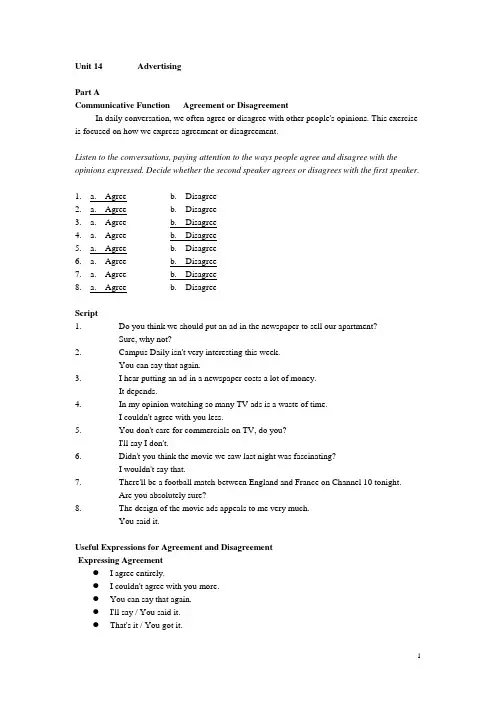
Unit 14 AdvertisingPart ACommunicative Function Agreement or DisagreementIn daily conversation, we often agree or disagree with other people's opinions. This exercise is focused on how we express agreement or disagreement.Listen to the conversations, paying attention to the ways people agree and disagree with the opinions expressed. Decide whether the second speaker agrees or disagrees with the first speaker.1. a. Agree b. Disagree2. a. Agree b. Disagree3. a. Agree b. Disagree4. a. Agree b. Disagree5. a. Agree b. Disagree6. a. Agree b. Disagree7. a. Agree b. Disagree8. a. Agree b. DisagreeScript1. --Do you think we should put an ad in the newspaper to sell our apartment?--Sure, why not?2. --Campus Daily isn't very interesting this week.--You can say that again.3. --I hear putting an ad in a newspaper costs a lot of money.--It depends.4. --In my opinion watching so many TV ads is a waste of time.--I couldn't agree with you less.5. --You don't care for commercials on TV, do you?--I'll say I don't.6. --Didn't you think the movie we saw last night was fascinating?--I wouldn't say that.7. --There'll be a football match between England and France on Channel 10 tonight.--Are you absolutely sure?8. --The design of the movie ads appeals to me very much.--You said it.Useful Expressions for Agreement and DisagreementExpressing Agreement●I agree entirely.●I couldn't agree with you more.●You can say that again.●I'll say / You said it.●That's it / You got it.●Why not?●That’s for sure/ Sure / Absolutely / Definitely / By all means / You bet.●That's just what I think / I feel the same way.●Me. too.●I think (guess / suppose ) so.●Exactly.Expressing Disagreement●I wouldn't say so.●I couldn't agree with you less.●No way.●It's out of the question.●I'm not sure I can agree.●I couldn't disagree more.●I disagree.●I don’t think so.●7. Are you absolutely sure?●I wonder if there's a mistake.●Are you kidding?NotesWe can express disagreement either directly or indirectly. You disagree directly when you are sure of the fact or when you think your opinion is more reasonable. Otherwise indirect disagreement often sounds more polite. "Are you absolutely sure?" and "I wonder if there's a mistake" are examples of showing disagreement indirectly.Listening StrategyDistinguishing Signal WordsWords like "but", "although" and "however" give a signal that the speaker (or writer) is going to say something different from what has been said. On the other hand, words like "and", "besides" and "also" only add something similar to what has been said. The ability to recognize these signal words while listening is a great help in understanding a text correctly.Listen to the short conversations and choose the right answers to the questions you hear. Example: --You like to go shopping in the supermarket, don't you?--Yes, it's so convenient. Besides, things are cheaper.Q: Does the woman enjoy shopping in the supermarket?a. Yesb. No1. a. Yes b. No2. a. Yes b. No3. a. Yes b. No4. a. Yes b. No5. a. Yes b. No6. a. Yes b. No7. a. Yes b. No8. a. Yes b. NoScript1. --How do you like our campus, John?--Well, it's very large but it's not clean enough.Q: Does John have a favorable opinion of the campus?2. --How do you like your English teacher, Li Ming?--She's very strict and her classes are always well-organized. Besides, she often givesup her free time for her students.Q: Does Li Ming like her English teacher?3. --How did you enjoy your vacation, Jack?--Although it was short, I visited many museums and art galleries.Q: Did Jack enjoy his vacation?4. --Michael, everybody says Professor Fall is a boring teacher. What do you think?--Everyone falls asleep in his class. And he's hard to talk to.Q: Is Professor Fall popular among his students?5. --What's your impression of New York, Barbara?--I really like the stores and the museums appeal to me, too.Q: Does Barbara like New York very much?6. --Do you like living on campus?--I think so. But sometimes the dorm is so noisy that I can't get anything done.Q: Does the woman have a completely favorable opinion of living on campus?7. --Do you think you will major in medicine, Mary?--I think being a doctor means a lot of study and then working all sorts of hours.Q: Does Mary want to major in medicine?8. --How do you like living with your roommates?--Well, sometimes it's hard to share a room with others but you get along with yourroommates by compromising.Q: Does the woman get along with her roommates?Part BPre-listening TaskQuestions for DiscussionYou are going to talk about advertising. Read the following questions and discuss them with your partner.1.Do you think ads are necessary or a nuisance?2.Do you like watching or reading advertisements? Why or why not?3.Why do manufacturers spend so much money on advertising?4.Do ads influence you (or people in general) in buying things? How?5.Has any particular ad had an effect on you in your decision to buy something?6.Do you have anything to advertise?7.Suppose you've got some second-hand course books to sell, where would you place your adand how?Demo2. Do you like watching or reading advertisements? Why or why not?I’d like to watch advertisements on TV. The reasons are as follows: Firs t, I can see the actual product as it is shown on TV. Second, I can see the demonstration of the product and how it is used. Lastly, the person who shows the product to the audience is usually a celebrity. So I can see the celebrity often by watching advertisements.3. Why do manufacturers spend so much money on advertising?Manufacturers are no fools. They spend so much money on ads because advertising is an effective way of their marketing products. When you want to sell something in the market, you have to tell as many people as you can so that they will become interested in what you offer. If somebody else has the same thing to sell in the market, then you will have to tell people that your goods are better than others so that people will choose yours. All manufacturers know this very well and that is why they spend large amounts of money on advertising.Language FocusHere are some sentences and structures that you might find handy in discussing the above questions:●I like / dislike watching / reading ads. They are amusing / interesting / vivid / fascinating /funny / persuasive / misleading / exaggerated…●I come across ads every time I turn on TV / radio / open a newspaper / magazine.●Ads are part of our life / something unavoidable no matter whether you like them or not.●To sell a product, the first thing to do is make it known to potential customers. That’s whymanufacturers are ready to spend a lot of money on advertising their products.●The cost of making ads is actually included in the prices of goods.●Ads provide us with useful information on commodities / services / jobs …●Ads influence us in the kind of goods we buy. When we do shopping, we automaticallychoose to buy advertised goods without hesitation.●With ads, we save a lot of time in shopping / choosing the kind of product we want / lookingfor jobs / getting better services …●Without ads, manufacturers may find it difficult to sell their products /make their productsknown to consumers.●Without commercial ads, newspapers, radio and television companies cannot survive.●TV commercials are a nuisance / waste of time / interrupt programs too frequently.●Ads take advantage of our longing for wealth / good looks / good health / comfort …●Ads exploit our fear of danger / growing old / fa lling ill …●I once put an ad in a local newspaper to look for a roommate/ to sell some used textbooks/ tosell some electronic appliances and it really worked.I don’t want to spend money on ads. I always sell the books that I no longer use to asecond-hand bookstore.Listening TasksA ConversationPlacing an AdWord Bankclassification n. category 类别read v. to be worded 措辞utilities ( pl ) n. a service such as gas, water or electricity that is provided to the public公用事业matching a. agreeing in color or pattern with another thing和……相配的offer n. an amount of money that sb. is willing to pay for sth.出价run v. to publish in a newspaper, magazine 刊登take up v. to fill or use space or time, to occupy 占用ScriptPlacing an Ad(Ring …Ring … Sound of phone being picked up)John: Hello, Campus Daily, advertising department. This is John speaking.Maggie: Hi. I'm calling to place a couple of ads.J ohn: Sure. Under what classification?Maggie: Well, I'd like one in the "Roommates Wanted" section.J ohn: All right. And how would you like your ad to read?Maggie: It should read "Female roommate wanted for pleasant, sunny two-bedroom apartment on Fifth Avenue, three blocks from campus. Share rent and utilities. AvailableSeptember first. Call between 5 and 9 p.m. and ask for Maggie."John: Fine. And what about your other ad?Maggie: That one I'd like under "Merchandise for Sale", and I'd like it to read "Matching blue sofa and easy chair for sale, excellent condition, $350 or best offer. Call between 5 and9 p.m. and ask for Maggie." Did you get all that?J ohn: Uh, huh. You'll want your phone number on these, right?Maggie: Oh sure. Thanks for reminding me. It's 555-6792.John: And how long do you want these ads to run?Maggie: For a week, I guess. How much would that be?John: Let's see—it's $8 a week per line. Your two ads will both take up three lines, so that's $24 per ad.Maggie: All right.Language and Culture Notes1.Background information University and college students often run their own newspapers to keep the university community informed of what happens on campus. They cover major school events, notices issued by the school authorities, sports and entertainment news, and articles writtenby students to air different viewpoints. A special column called "classifieds", or "classified ads", is devoted to advertisements for jobs, accommodation news, sale of used things -- books, furniture, cars, etc.—under such headings as "Help Wanted", "Services", "Furniture for Sale", "Roommates Wanted", "Miscellaneous". To place an ad, one can call the advertising department of the paper to arrange it and pay a small fee. For example, a student-run paper at an American university in New York charges the following advertising rates: 8 dollars for the first 20 words, 25 cents for each individual word and 50 cents for a box.2. Campus Daily Name of a school newspaper3. How would you like your ad to read?What words would you like to put in your advertisement?4. Roommates Wanted A type of classified advertisement. You place your ad in this column in order to find others to share your apartment.5. utilities Supplies of water, gas, electricity and sometimes, telephone.6. Available September first. The earliest date for the roommate to move in will be September 1st.7. Matching blue sofa and easy chair The sofa and easy chair are of the same design and color8. ... or best offer Or highest price offered by a potential buyer9.it's $8 a week per line It costs $8 for one line to run /appear a week in the paper.Exercise 1: Listening for general understandingListen to the recording once and choose the right answers to the questions you hear.1. Who are the two speakers in the telephone conversation?a. A newspaperman and a reader.b. An advertising agent and a client.c. A real estate agent and a tenant.d. A shop assistant and a customer.2. What is Maggie doing in the conversation?a. She is applying to work for a newspaper.b. She is trying to sell her apartment through a local newspaper.c. She is running the ads column of a campus newspaper.d. She is having two ads run in a school newspaper.3. What can you infer about Maggie?a. She will graduate soon.b. She feels lonely living in an apartment all by herself.c. She will move out of a two-bedroom apartment.d. She might be unable to afford a two-bedroom apartment alone.Exercise 2: Listening for detailsListen to the recording once again and fill in the blanks with the missing information.Speaking TasksPair WorkListen to the conversations and repeat after the recording. Practise the conversations with your partner, playing the role of A or B. Then work with your partner to create your own conversations by replacing the underlined parts with your own words.Part CAdditional ListeningA Passage Different Kinds of AdvertisingListen to the passage and fill in the blanks with the missing information.ScriptDifferent Kinds of AdvertisingAdvertising is an important part of marketing. Very few companies are able to sell a product without advertising. It is possible, but very unlikely. There are many different kinds of advertising. The simplest is called promotion. Promotion is using brochures or pamphlets to advertise. Theses can be handed to people on the street or they can be mailed. If they are mailed, it is called direct mail advertising. After direct mail advertising, there are: newspaper advertising, radio advertising, magazine advertising and television advertising. Newspaper advertising is the cheapest kind, while television is the most expensive.Television ads are generally used by large companies selling a product to a large market segment. Television advertising can be very successful because it reaches such a large audience. Small companies may find television advertising too expensive, so they often use newspapers to advertise. However, large companies also like newspapers because of their wide circulation.Part DTest Your ListeningA Compound DictationListen to the passage three times and supply the missing information.Advertising is an important part of the free enterprise 1) system. This is because different businesses are 2) competing for the same market. For this reason, they buy advertising 3) space in newspapers or magazines and advertising time on radio or TV. They each hope that advertisements will increase 4) demand for their products.In order to do well in the market, advertisers need to decide on a target; in other words, who are possible 5) buyers for their product? For example, what is the age and sex of their target group? How much education do they have? What are their political 6) beliefs and values? How much money do they make? Some companies such as McDonald’s target various groups, so they have many different ads—one for 7) teenagers, one for families and several in different languages.8) After advertisers decide on who, they need to determine where. What is a good place for their advertisement? Sellers of toys often advertise during children’s TV programs on Saturday morning. Sellers of expensive clothing advertise in V ogue and other fashion magazines.9) Advertisers also need to think about people’s motivation—their reasons for buying something. What makes people buy one product but not another? There are many possible reasons: health, profit, love, entertainment, etc. A study of advertising can also be a study of psychology. 10) When we think about the products that people buy, we learn about their needs, wants, fears, and values.。

Unit 1Part 1Sectio n1第二页FTFTF第三页four-year schoolshigher learni ngreligi o us leaderoutsid e the united statesformer coherewent into effecteightmember1779annive rsary dateattendSectio n11第二页CBBDA第三页It offers advanc ed teaching progra ms facili t iesStuden ts with specia l skills or talent sIt provid es a good chance to get expose d to the societ yThey pay a health servic e feePart 11Sectio m 11第三页March14,1879April18,1955April14,18651636March28,1986August 2008第四页March30,196819901997Part111Sectio n 1第一页ACCCABCCSectio n 11第一页ADA第二页BCDBSectio n 111第一页BAA第二页ADBSectio n 1Vdating back tocoasteaster nestabl i shdonate dsurrou ndedbyatmosp hereStuden ts attend ing Harvar d To name a fewPartic ipate inPart 1VTask 1第一页How are you doingNothin g muchStillaliveCall you later第二页Just finethings couldn not be bettervery nice meetin g yousame herePart V1---10awarddegreeinstit utionestabl i shproper tycompos edivisiontalentofficiallyrecogn ize11----20materiallocatecomple x charit y presen tdistin g uish ed routin e specia lizeinstru c tion access21----30 detailed expens e boastfacili t ytuitio n expose chartlocation breakt hroug h financ ialUnit 2 Part 11Sectio n11第三页$200$50$2.25$2.8$30第四页$2.79$4.11$4.96$3.82$9.63$9.27$8Part 111Sectio n1BBCA DCACSectio n11第一页CAD第二页BACDSectio n111第一页ACB第二页DCA第三页CBBASectio n1vbillio nsIn a single wordWashin g awaynativepovert yuniversalemotio nsAmeric a is pushin g itthe worldis pullin g itEnglis h representshopepart 1vTask 1第一页I'd like you to meetthis is my friendIt's a pleasu re to meet youGlad to meet youthankyouvery nice meetin g you第二页Didn't you meet her at the partylet me introd uce you to herthis is my classm ateI'm glad to meet younice to meet youPart V1----10emergeresour cefinanc ecolonialnativegovern commer ce essent ial requir e staff11_____20 toughfacility fund technical invest mentgraspambitious incrediblesignif icanc e dominant 21___30 repres ent emotio n consta nt brilliant mediumreward ingdesiredepositbenefitsteadyunit3Part 11sectio n 11第四页Becaus e Mr Willia ms made a lot of moneyin this busine ssLate one evenin gSeveno'clockin the evenin g第五页untilhalf-past nineWhat are the timesof mealsthen?from sevento half-past elevenfrom twelve to threefrom four to fivefrom six to half past ninePart 111sectio n 11到4DDBA5到8BCAAsectio n 11第一页BCD第二页因为第7题系统问题无法选择故无法给出答案sectio n 111第一页BCA第二页CAC第三页DACBsectio n 1vcreateexchan geupdatebriefimagescontai nvariou sbuildyour Englis h readin g skillsdepend ing on your list of freien dsa signif icant select ion of writin gPart 1VTask 1第一页got a messag ethe tutori al sessio nthanks a lotno proble mwhat's wrongcouldyou give it to her for me no troubl ethankyou very muchnot at all第二页I'm really sorrythat's all rightforget aboutitPart V1到5suppos edrecogn izecommit teeaccentbottom6到10phonic ssuppor terimpuls enonnat iveinstin ctive ly11到15debatecombin eincred iblyauthor itysight16到20politi cianurgepronun ciati onguaran teedisapp ointe d21到25connec tpresen tincrea serequir ecombin e26到30effect ivelyslightfamili aradvant ageapproa chUnit 4 Part 1sectio n 1第二页TFFTF第三页onactive tiestheirchoicea blankstarechalle ngingtime manage mentissueswastetimeset a goalmake otheropport uniti esin the proces sin the direct ionsectio n 11第二页BAACB第三页The body and the mindThe benefi ts of One Day Univer sityThey have made the course s lectur es availa ble online -for free52Part111sectio n 1BCA CABDDSectio n 11第一页BCA第二页ACBDsectio n 111第一页DCBA第二页BAD第三页CBDsectio n 1Vyoungs tersrapidl ycontin uoushandleconclu dedmerelyimplie sbuilds on and affect sinvolv ed in learin g activi tiestheirlivesand career sPart 1Vtask 1第一页speech contes tmany proble ms with Englis h learni ngcheerupyou'll do fine if you try your bestBe confid ent ,and nevergive upkeep your chin uNothin g is imposs ibleto a willin g heart第二页Why are you so nervou sWhen'S it dueTake your time .Rslaxuntilit's finish edPart V1到10strugg letechni callyalignencour agerazorindivi dualpassio natecasepartic ipantblade11到20stareenhanc ebreath ecompos eshavin gchalle ngingavaila bleeliefregist ercream21到30realiz eopport unitypartic ularmarvel ousorgina lclientevalua teselectdiscov ermentalUnit 5 part1sectio n 1第二页TFTFT第三页caused a debateraisedstreng th and powerinsultparent ing method spressu relow expect ation srather thanthis intens e debaterepeat the way Part 11sectio n 1第二页BACDASectio n 11第二页2112211211第三页BDDAC第四页ACBBCPart111Sectio n1DBC BCD AB sectio n 11第一页DBAB第二页DBCSectio n111第一页BDC第二页ACDA第三页CDDsectio n1Vscienc e testsprepar ingcreati vityand critic alcombin eslibera l artsinquir yconsta ntlyinnova tionopposi te direct ionstrong intere st in standa rdiza tionPart 1VTask第一页I wouldsugges tlet's nothow aboutWhy don't we第二页Couldyou maybeMy sugges tionoughttowhy don't youwhy don't weWe'd betterLet'SPart V1到10debateraiseimmigr antrepres entexcell encethreat enstuffe dinsultexpect ationcritic ize11到20abuseextrem erebelretrea tassumegraveenormo usstrideinnova tionvictim21到30unmoti vatedessent ialimitat ordriftdisapp earcreati vitymaturefolkintens eblosso mUnit 6 part1sectio n 1第二页TFTFF第三页succee dgradua tea top gradea core curric ulumdistri butio n requir ement swhat they teachcontin ue to risegenera l educat ionthe more likelyglobal market placesectio n 11第二页CADBApart 11sectio n11ACCDD第四页ABBCDPart 111sectio n 1CDCAABBDSectio n 11第一页DABB第二页BDCsectio n 111第一页CBAC第二页ACC第三页CADSectio n 1Veffect iveexperi encedreplac edlectur ingprepar edscoredAttend ancedesign ed to encour agecritic izedthe wayeviden ce abouthow the brainlearnsPart 1Vtask第一页Can I help youreserv e a roomJanuar y 10th to 14thhold the lineWhichdo you prefercouldyou tell me the name of the guestIs that correc tThanks for callin g第二页What can I do for youI'm callin gA double oneWhen will you arriveHow long will you stayhave roomsavaila bleMay I know your namesif you have any speial reques tsa quietroom with balcon yconfir m the bookin gpart V1到10econom icsnonpro fitlibera lsurveycurric ulumdistri butio ncounci lhumani tydranaindivi dual11到12guaran teegradua teglobaleffici entreleva ntpass overadaptopport unityawaretake up21到30extendfparti cularin termsofconsis tbroade nreligi ouscorefor one's sakeextens ionspecif icpart1sectio n 1第二页FTTFT第三页recogn izelinkrespon ds tonarrat ed what she was doingpick up the melodi esin everywordFrench from Spanis hhigher IQ scoresParent s and caregi versintera ctive back-and-forthdefini telyreacts toSectio n 11第二页由于系统问题3题无法选择Part 11sectio n 1me a ata in the and a in amay with your by the of thebut with them thean is half theTo in a and atoand a than forby theA is by hisis'stoand beat thesectio n 11Dentis tWaiterProfes sorBank teller第三页career experi enceB.A.in accoun tingaccoun tingassist antaccoun t Manage rCPA(Certif led Public Accoun tant)Englis h tutor第四页a touris t guidea touris t guideI love my jobin a hospit ala nursea brainsurgeo na dozenoperat ionsNot badsectio n 1CBCB BCBDsectio n11第一页DBA第二页BCADsectio n 111第一页DCCA第二页BDA第三页CACsectio n 1Vwalksmedica l caredescri besexiste ncecompet ingdog-tiredworsehas its dayhave to learnnew skillsan old dog new tricksPart 1VTask第一页make an appoin tment witha meetin g to attendsuitat that time第二页my propos almeet with youconven ientforfullHow aboutsounds goodPart v1到10monito rnarrat ewombmelodyrecipr ocityactiva teprefixlitiga torassoci ationdevice11到20caregi versynony mbooste rintera ctivecorpor ationzoonracketumpireoffisi dederail21到30respon dconclu deexpres sionlitera turetentjourna lprotec tionreligi onmidter mawakeUnit 8Part 11Sectio n1第二页TFTFT第三页tradeand worldgrowtheconom ic recove rygreatreward simbala ncesdraw indevelo pingdevelo pedinclud e wealth y countr ieshas brough t attent iontraderelati onsby the year 2020sectio n 11第二页ACDBDpart11sectio n 11第二页wantstowill surelyvery happyshould focuson her school work第三页ACDCpart 111sectio n 1BDCB DACAsectio n 11第一页ABD第二页DCDDSectio n 111第一页CABD第二页ACB第三页AABsectio n 1Vpoliti calaffair sfreedo mblendi ngunderd evelo pedaffordinflue ncestar to transf orm thema proces s of intera ctionphysic al well-beingin societ iesPart 1VTask 1第一页deposi tedchecki ng accoun twithdr awchecki ng accoun tdeposi tsaving s accoun t 第二页credit cardaccept checkswriteyou a checkATM isPart V1到10foruminclus ivesecret ariatsideli neimbala nceaddres spartic ipati onjustic einequa lity11到20thawactivi stcanoei ngelimin ateprecau tioncasual tyrehear salcollid etamescatte r21到30isolat edcapsul eivoryflamma blecomple xycoinci denta llyprogre ssdeclar ecollap se。