
全新版大学英语听说教程2
- 格式:ppt
- 大小:3.21 MB
- 文档页数:60

全新版大学英语(第二版)听说教程2(1-14单元)答案-CAL-FENGHAI.-(YICAI)-Company One1全新版大学英语(第二版)听说教程2Unit OnePart A1. 172. 19633. 1.984. 2165. 19846. 19867. 30418. third9. 198710. 1988 11. four 12. ten 13. 1998 14. six 15. 1990s 16. 45 17. sixth18. 1998 19. 1999 20. five 21. 1999 22. 2001Part BExercise 11. d2. bExercise 21. Because she wants to enjoy good health. She also wants to stay in shape and look good2. Both Peter and Laura like cycling and swimming. Laura also plays tennis regularly Part C.1. d2. c3. d4. c5. bUnit TwoPart A.1. Yes2. No3. Yes4. No5. Yes6. No7. No8. NoPart BExercise 1.1. for a while2. plans, this Saturday3. have dinner, weekend4. Italian, too much food5. Chinese, JapaneseExercise 21. It uses natural flavors, not much oil or cream or heavy sauces1. They will have dinner on Saturday at either a Chinese or a Japanese restaurant Part C1. b2. c3. dUnit ThreePart A1. a. Fine and pleasant b. 18℃(64℉) c. cloudy with heavy showers moving in from the west2. a. It started around 8 p.m and lasted for about three hoursb. It caused foru deaths and serious damage including a widespread power failurePart BExercise 11. b2. a3. dExercise 21. They went to the department picnic but their fun was spoiled by the hot weather1. Because he thinks it'll only be a short shower that cools things off a littlePart C1. a2.b3. c4. d5. bUnit FourPart A.1. However; a2. Because; d3. Firstly; then, finally; c4. In short; bPart B.Exercise 12 4 5 10 12 13 16 17Exercise 21. b2. d3. c4. aPart C1. encouraged2. talent3. composed4. conquest5. steady6. enthusiastic7. investing8. her real breakthrough in America came when she was selected by Disney to sing the theme song of Beauty and the Beast9. In 1996 she performed at the opening ceremony of the 1996 Atlanta Olympic Games10. She sings the depth and the power of love in a great many of her hits such as “Love Can Move Mountains”, “Because You Loved Me”, “The Power of Love”Unit 5Part A1. c2. dPart BExercise 11. d2. d3. c4. dExercise 21. She has suffered from insomnia for several months and lately has had a lot ofindigestion1. He gave the patient some medicine for insomnia and indigestion. He alsoadvised the patient to have a proper diet and begin a regular exercise program Part C1. d2. b3. b4. a5. dUnit 6Part A1. They are probably business partners1. One is showing the other the building where her company has offices1. 2nd 8th 9th 1stintroduction history business marketsPart BExercise 11. They are discussing which candidate is more suitable for a vacant position inthe company1. Leader of a group1. Being dynamic1. Because he has no experience in leadership1. Because he has always been a follower, not a leaderExercise 2Loyal, twenty No experience Peterpersonnel management experience Joan Peter and CliveExperienced, solid reliable cautious, dynamic Peter and ClivePart C1. c2. c3. a4. d5. cUnit 7Part Aa medium-sized white T-shirt, a slogan on the front, a shop assistant in getting what he wantsPart BExercise 11. b2. c3. dExercise 21. interesting, handsome, successful, sporty, fashionable, fun1. great, terrible1. the high status group, taste and style, image1. brightens, good, face another day, energy1. high fashion, practical, the image, the realityPart C1. significant 2 relatively 3. concentrate 4. iberal 5. editor 6. ready-to-wear 7. expand8. Vera Wang herself is a very good skater and she had Olympic dreams too9. However, her love for the sport never ceased10. I don't know if designing costumes for Nancy has been good in terms of actual sales, but it has been tremendous for name recognitionUnit 8Part A1. Learn to like yourself1. Self-esteem grows out of achieving realistic goals1. Take occasional days of rest1. Exercise1. Get enoug sleep to feel rested1. Build close relationshipsPart BExercise 11. b2. d3. d4. b5. c6.dExercise 2millions, dream of swimming, one million, receive, $25000 to $40000, twenty, taxes, differentpursue their own interests, home, travel, their children's college education Mosta small number stay on their jobs security opportunities happinessPart C1. c2. b3. d4. dUnit 9Part A1. b2. c3. dPart BExercise 11. c2. b3. aExercise 21. His belief that one day he would become a movie star1. Parking cars for one of Hollywood's big restaurant1. No, his pay was only basic. But he got generous tips from guests driving intothe restaurant1. Larry parked the car of a famous film director and was able to introduce himselfto the man1. a. Many big film companies are interested in meb. Many big companies are pressing me to pay their billsPart C1. b2. d3. b4.aUnit 10Part A1. 1. earthquake2. three days ago3. Turkey4. 100005. 340002. 1. explosion 2. early this morning3. 1084. 385. 11Part BExercise 11. Three months ago2. In the middle of a jungle3. A terrible storm4. All on board the plane except the narrator5. One (the narrator)Exercise 21. It rolled and shook in the wind1. No. It arrived nine days later because it was raining heavily and the helicopterscouldn't fly in the heavy rain. To make the matter worse, the plane crashed in a swamp in the middle of a jungle.1. Yes. She was in terrible pain and couldn't move1. By drinking dirty floodwaterPart C1.c2. d3. a4. bUnit 11Part A1. Neutral2. Positive3. Positive, respectfulPart BExercise 11. a2. b3. d4. c5. aExercise 21. stockbroker2. retailing3. March 6, 19264. New York5. music school6. economics7. Commerce8. master's degree9. PhD10. Industrial 11. economic consulting 12. Federal GovernmentPart C1. Microsoft2. farewell3. software4. toughest5. legal6. long-term7. impactful 8. which is that the day-to-day work is fun and enjoyable9. So it's a special group of people who put so much into it10. There won't be a day of my life that I'm not thinking about Microsoft, and the great things that it's doing, and wanting to help.Unit 12Part A1. computer labs for the schools, poor rural1. cooperating, India, software professionals1. computer virus, attackPart BExercise 11. b2. b3. d4. b5. c6. aExercise 21. an ambulance crew1. had trouble breathing and moving1. the rescuers came to her help1 surfing the Net for fun3 the international, put a call through to the student's countryPart C1. c2. b3. b4. aUnit 13Part A1 f2 e 3. dPart BExercise 11. a2. c3. d4. a5. bExercise 258, unemployed, tire, suitcase, dropped, scene, picked up Next, TV, winner, return, keep prize conscience, return the money to its owner radio hundreds trickInto cash, 60 handed over expectation tearsPart C1. b2. d3. b4. dUnit 14Part A1893 kindergarten teachers studentsTitle Good children to greet their teacher1924 book of music added writer unknown1930s appeared movies radio shows permissionWon the copy right Happy Birthday to You different lyricsPublicly gets paidPart BExercise 11. parking space, grocery cart, in line1. Phone-In Drive-through Market1. drive-through convenience, banks, fast food, catalog shopping1. save time1. goods, ordered, good quality $1.5 each otherExercise 2in the item numbers of the goods you ordermakes a print-out of your listthe goods on your list in a warehousedrive up to the market, and punch your code into a terminalwrite a checkPart C1. b2. c3. c4. dTest OnePart A1. b2. c3. b4. c.5. b6. c7. a.8. bPart B9. d 10. b 11. d 12. c 13. c 14. b 15. dPart C16. stocks 17. exhibition 18. techniques 19. activities 20. research21. modem 22 software23. Delivery time for e-mail from Europe to the USA is about 10 seconds24. What's reallyextraordinary about the Internet is the aount and variety of information available25. Services are also available that allow you to do your banking, reserve airline tickets, and even shop for a Mother's Day giftPart D26. c 27. d 28. c 29. c 30. c 31. a 32. d 33. b 34. c 35. aTest TwoPart A.1. d2. c3. d4. c5. d6. b7. c8. aPart B9. d 10. d 11. a 12. b 13. c 14. b 15. cPart C16. forecast 17. unusual 18. Fortunately 19. extreme 20. rarely 21. global22. rush 23. People enjoy discussing the snow, complaining about the cold24. Contrary to popular opinion, it does not rain all the time25. Thanks to the rain, Britain has a rich countryside, which is famous for its deep green colorPart D26. a 27. d 28. b 29. b 30 a 31. c 32. c 33. a 34. d 35. b。

全新版大学英语听说教程2完整答案文库Unit 1Part A1. 108:962. 110:1113. 135:1304. 69:75Part BTextExercise 1: 1. D 2. BExercise 2:Peter likes cycling and swimming. Laura likes these two sports too. Besides, she plays tennis regularly.Because she wants to enjoy good health; she wants to stay in shape and look good.Part CExercise: 1. B 2.DPart D(Refer to Text Book)Unit 2Part A1.a. Fine and pleasantb. 18'C (64'F)c. Cloudy with outbreaks of heavy showers2. a. It started around 8 pm and lasted for about three minutes.b. It caused four deaths and serious damage including a power failure.Part BTextExercise 1: 1. B 2. A 3.AExercise 2:They went to the department picnic but their fun was spoiled by the hot weather. Because he thinks it will only be short shower that cools things off a little.Part CExercise: 1. F 2.F 3.F 4.T 5.FPart D(Refer to TextBook)Unit 3Part A1. Yes2.No3.Yes4.No5.Yes6.No7.No8.NoPart BTextExercise 1:1. ...for a while2. ...plans for this Saturday3. ...dinner...weekend4. ...Italian...too much food5. ...Chinese...JapaneseExercise 2:It uses natural flavors, not much oil or cream or heavy sauces.They will have dinner on Saturday either at a Chinese or a Japanese restaurant. Part CExercise: 1. B 2.C 3.DPart D (Refer to TextBook)Unit 4Part A1. C2. DPart BTextExercise 1: 1. d 2.d 3. c 4. dExercise 2:He has suffered from insomnia for several months and lately has had a lot of indigestion.She gave the patient some medicine for insomnia and indigestion. she advised the patient to have a proper diet and begin a regular exercise program.Part CExercise: 1. T 2.T 3. F 4.T 5.FPart D (Refer to TextBook)Unit 5Part A1. However2. Because3.Firstly,then,finally4.In shortPart BTextExercise 1:tick: 2,4,5,10,12,13,16,17Exercise 2: 1. b 2.d 3. c 4.aPart CExercise:1. working-class2. Canada3. 134. song5. Dream6. fond7. own home8. great success9. Canadian10. gold11. France12. English language13. award14. opening ceremonies15. Titanic16. Heart7. LovePart D (Refer to TextBook)Unit 6Part AQ1: They are probably business partners.Q2: One is showing the other the building where her company has offices.Q3: Accounting Office: 2nd floorPersonnel Department: 8th floorManager's Office: 9th floorSales Office: 1st floorPart BTextExercise 1:They are discussing which candidate is more suitable for a vacant position in the company.Leader of a small group.being dynamicbecause he is always a followerbecause he has no experience in leadership.Exercise 2:John: Loyal; with the company for 20 years/ No experience in being a leader/ Peter/ Joan and CliveRita: Has personnel management skill/ lacks experienc/ Joan/ Peter and CliveSusan: Experiences, solid and reliable/ a bit too cautious, not dynamic enough/ Peter and Clive; Joan (agrees with reservation)/ Joan (at first)Part CExercise: 1.c 2.c 3.a 4.d 5.cPart D (Refer to TextBook)Unit 7Part AA man is at a store. He wants to buy a medium-sized T-shirt with a slogan on the front. He is helped by a shop assistant in getting what he wants.Part BTextExercise 1: 1.b; 2.c; 3.dExercise 2:interesting/handsome/successful/sporty, fashionable/funthe high status group/taste and style/imagebrightens/good/face another day/energygreat/terrible/average buyershigh fashion or not/image and realityPart CExercise: 1.T 2.F 3.T 4.F 5.FPart D (Refer to TextBook)Unit 8Part AHeart/14/weight changes/3130/adults/heart disease/sure/high-fat foods/developing heart disease/lose/stomachPart BTextExercise 1: 1.b; 2.d; 3.d; 4.b; 5.c; 6.dExercise 2:(ommited)Part CExercise: 1.c 2.b 3.d 4.dPart D (Refer to TextBook)Unit 9Part AHe was walking his dog, Jack.The dog can not digest paper.He was happy because he got his money back and the money could be used again after being cleaned.Part BTextExercise 1: 1.d; 2.c; 3.c ; 4.d; 5.aExercise 2:about 63 years agoabout three years oldin 197092 years oldPart CExercise:1-4-2-5-6-3Part D (Refer to TextBook)Unit 10Part A11) earthquake2) 3 days ago3) Turkey4) 100005) 3400021) explosion2) early this morning3) 1084) 385) 11Part BTextExercise 1:3 months agoin the middle of a jungle in Burmaa terrible stormall aboard the plane except the narrator1 (narrator)Exercise 2:It rolled and shook in the wind.No. It arrived nine days later because it was raining heavily and the helicopters couldn't fly in the heavy rain. To make the matter worse, the plane crashed in a swamp in the middle of a jungle.Yes. She was in terrible pain and couldn't move. By drinking dirty flood water.Part CExercise: 1.b 2.a 3.a 4.d 5.cPart D (Refer to TextBook)Unit 11Part A1. Neutral2. Positive3. Positive, respectfulPart BTextExercise 1: 1.a 2.b 3.d 4.c 5.a Exercise 2:1) stockbroker2) retailing3) March 6, 19264) New York5) music school6) economics7) Commerce8) Master's degree9) PhD10) Industrial11) economic consulting12) Federal GovernmentPart CExercise: 1.F 2.T 3.F 4.F 5.F 6.T Part D (Refer to TextBook)Unit 12Part A 1. B 2. B 3. APart BTextExercise 1: 1.a 2.d 3.b 4.b 5.d Exercise 2:(ommited)Part CExercise:microwave ovenNew York, July 12, 1854replace the heavy old machinefilms for the camerayou push the button, we do the rest clinics/ museums/ performing1932/77/remembered/the good of mankind Part D (Refer to TextBook)Unit 13Part A 1. f 2. e 3. dPart BTextExercise 1: 1.a 2.c 3.d 4.a 5.bExercise 2:(ommited)Part CExercise:operation, JewishJewPalestinian/ Sundayfather/ Radio/ noble act/ donor'sdeep inside people are exactly the same/ conflicts/ unnecessary Part D (Refer to TextBook)Unit 14Part A 1. c 2. b 3. aPart BTextExercise 1: 1.T 2.F 3.T 4.F 5.FExercise 2:a wonderful worldloss/ change/ balancedirect benefits/ plants/ air/ breatheeconomic/ health/ raw material / things / medicineunless/ later/ valuable/ threatPart CExercise:1.c 2.a 3.c..4.a 5.bPart D (Refer to TextBook)Unit 15Part A 1. c 2. d 3. bPart BTextExercise 1: 1.c 2.a 3.dExercise 2: 1.F 2.T 3.F 4.T 5.F 6.TPart CExercise:It is Western Europe's most important waterway.It was seriously polluted. Fish disappeared and it was dangerous to swim in.A fire broke out at chemical plant in Basel, France, which caused tons of pesticides to leak into the Rhine.The countries along the Rhine realized that they should clean it up and keep it clean.Every six minutes, twenty-four hours a day.France, Germany, Switzerland and Holland.Part D (Refer to TextBook)Unit 16Part Acomputer labs for the school/ poor ruralcooperating/ India/ software professionalsattackPart BTextExercise 1: 1.b 2.a 3.b 4.b 5.bExercise 2:65%30%33%47%Part CExercise:1.F 2.T 3.F 4.TPart D (Refer to TextBook)Test 1Part A1. d2. b3. b4. a5. b6. d7. c8. aPart B1. exaggeration2. controlled3. extent4. remote control5. manufactured6. automation7. scheduling8. computerized9. confirmed 10. calculations11. storing much more information 12. would take years of work by mathematiciansPart CPassage IMr. Johnson: better climate; less pollutionMrs. Johnson: a more modern house; a bigger gardenDavid: a better place for surfingCarol and Betty: live in a new house; learn to play the pianoPassage II1. a2. d3. bTest 2Part A1.What is the main idea of the passage? A. The Life of Mozart.2.What does the speaker think of dictation? C. He thinks it is a comprehensive skill training exercise.Part B1. 5 billion2. sensible3. 30%4. cleaning the filters5. 256. 10%7. leaks are fixed immediately8. 5009. 310. 5% to the amount of energy consumedPart CPassage I1.take of her three dogs2.agreed3.really mad4.did not like dogs5.did not like him either6.they would take care of the dogs until Mrs. Young got back in two weeksPassage IIFunctions of computer:1.Internet2.word processing3.designing and store4.play gamesDisadvantages of spending too much time on the computer:1.eyesight2.backaches3.their social skills4.socially awkwardConclusion… they are not without disadvantagesPassage III1. F2. T3. T4. F5. F。

全新版大学英语听说教程答案II-1-16testboo k two全新版大学英语听说教程答案K ey to Boo k Tw o U nit 1Par t A1. 108:962.110:111 3. 135:130 4. 69:75Pa rt BTextE xerci se 1:1. D2. B Ex ercis e 2:1.Peter like s cyc lingand s wimmi ng. L auralikes thes e two spor ts to o. Be sides, she play s ten nis r egula rly.2.Becau se sh e wan ts to enjo y goo d hea lth;she w antsto st ay in shap e and look good. P art CE xerci se: 1. B 2.DPartD (R eferto Te xt Bo ok)Un it 2Par t A1.a. Fine andpleas antb. 18'C (64'F) c.Cloud y wit h out break s ofheavy show ers2. a. It s tarte d aro und 8 pm a nd la stedfor a boutthree minu tes.b. Itcause d fou r dea ths a nd se rious dama ge in cludi ng apower fai lure.Par t BTextEx ercis e 1:1. B2. A 3.A Ex ercis e 2:1.Theywentto th e dep artme nt pi cnicbut t heirfun w as sp oiled by t he ho t wea ther. 2. Beca use h e thi nks i t wil l onl y beshort show er th at co ols t hings offa lit tle.Par t CExe rcise: 1.F 2.F 3.F 4.T 5.FPa rt D (Ref er to Text Book)Unit3 P art A1.Yes 2.No 3.Ye s 4.No 5.Y es 6.No 7.No 8.NoPar t BTextEx ercis e 1:1. ...for a whil e 2....pl ans f or th is Sa turda y3. ...dinn er...weeke nd 4. ...I talia n...t oo mu ch fo od 5. ...Chi nese...Jap aneseE xerci se 2:1. It u ses n atura l fla vors, notmuchoil o r cre am or heav y sau ces.2.Theywillhavedinne r onSatur day e ither at a Chin ese o r a J apane se re staur ant.Par t CExe rcise: 1.B 2.C 3.D Part D (R eferto Te xtBoo k)--------------------------------------------------------------------------------Uni t 4 Part A1. C 2. DP art BTex tExerc ise 1: 1. d2.d 3. c 4.dExerc ise 2:1. Hehas s uffer ed fr om in somni a for seve ral m onths andlatel y has hada lotof i ndige stion.2. She gave thepatie nt so me me dicin e for inso mniaand i ndige stion. she advi sed t he pa tient to h ave a prop er di et an d beg in aregul ar ex ercis e pro gram.Pa rt CEx ercis e: 1. T 2.T3. F 4.T 5.FPart D (R eferto Te xt Bo ok)-------------------------------------------------------------------------------- Unit 5 PartA1. Howe ver 2. Beca use 3.Fir stly,then,final ly 4.In s hortPart BT extExe rcise 1: tick: 2,4,5,10,12,13,16,17 Exer cise2: 1. b2.d 3.c 4.aPartCExerc ise:1.worki ng-cl ass 2.Canad a 3. 134. son g 5. Dr eam6. fo nd 7. o wn ho me 8. g reatsucce ss 9. C anadi an10. go ld 11.Franc e 12. E nglis h lan guage13. aw ard14. o penin g cer emoni es 15.Titan ic 16.Heart 7. LovePar t D (Refer to T ext B ook)--------------------------------------------------------------------------------U nit 6Pa rt AQ1:Theyare p robab ly bu sines s par tners.Q2: On e isshowi ng th e oth er th e bui lding wher e her comp any h as of fices.Q3: Ac count ing O ffice: 2nd floo r Pe rsonn el De partm ent:8th f loor Mana ger's Offi ce: 9th fl oor Sales Offi ce: 1st fl oor Part BT extExe rcise 1: 1. They arediscu ssing whic h can didat e ismoresuita ble f or avacan t pos ition in t heco mpany.2. Lea der o f a s mallgroup.3. bei ng dy namic4. beca use h e isalway s a f ollow er5. be cause he h as no expe rienc e inleade rship. Exer cise2: 1. John: Loy al; w ith t he co mpany for20 ye ars/No ex perie nce i n bei ng aleade r/ Pe ter/Joanand C live2.Rita: Hasperso nnelmanag ement skil l/ la cks e xperi enc/Joan/ Pete r and Cliv e3. Sus an: E xperi ences, sol id an d rel iable/ a b it to o cau tious, not dyna mic e nough/Pet er an d Cli ve; J oan (agree s wit h res ervat ion)/ Joan (atfirst)P art CE xerci se: 1.c 2.c 3.a 4.d 5.cP art D (Ref er to Text Book)--------------------------------------------------------------------------------Unit 7 PartAAman i s ata sto re. H e wan ts to buya med ium-s izedT-shi rt wi th asloga n onthe f ront. He i s hel ped b y a s hop a ssist ant i n get tingwhathe wa nts.Part BT extExe rcise 1: 1.b; 2.c; 3.dEx ercis e 2:1. in teres ting/hands ome/s ucces sful/sport y, fa shion able/fun 2. t he hi gh st atusgroup/tast e and styl e/ima ge3. br ighte ns/go od/fa ce an other day/energ y4. gre at/te rribl e/ave ragebuyer s5. hig h fas hionor no t/ima ge an d rea lityPar t CExe rcise: 1.T 2.F 3.T 4.F 5.FPar t D (Refer to T ext B ook)--------------------------------------------------------------------------------Uni t 8 Part AH eart/14/we ightchang es/3130/ad ults/heart dise ase/s ure/h igh-f at fo ods/d evelo pingheart dise ase/l ose/s tomac hP art BTex tExerc ise 1: 1.b;2.d;3.d ; 4.b; 5.c; 6.d Exer cise2: ( om itted )P art CE xerci se: 1.c 2.b 3.d 4.d Part D (R eferto Te xt B ook)--------------------------------------------------------------------------------Uni t 9 Part A1. Hewas w alkin g his dog, Jack.2. The dogcan n ot di gestpaper.3. Hewas h appybecau se he gothis m oneybackand t he mo ney c ouldbe us edag ain a fterbeing clea ned.Part BT extExe rcise 1: 1.d; 2.c; 3.c ; 4.d; 5.aExerc ise 2: 1.about 63 y earsago 2. a boutthree year s old3. in 1970 4. 92 yea rs ol dP art CE xerci se: 1-4-2-5-6-3P art D (Ref er to Text Book)--------------------------------------------------------------------------------U nit 10 P art A1 1) e arthq uake2) 3 days ago3) T urkey4)100005)3400021) ex plosi on2) ear ly th is mo rning3)1084) 385)11P art BTex tExerc ise 1: 1.3 mon ths a go2. in themiddl e ofa jun gle i n Bur ma3. aterri ble s torm4.all a board theplane exce pt th e nar rator5. 1 (n arrat or) Ex ercis e 2:1. It roll ed an d sho ok in thewind.2. No.It ar rived nine days late r bec auseit wa s rai ningheavi ly an d the heli copte rsco uldn't fly in t he he avy r ain.To ma ke th e mat ter w orse, theplane cras hed i n a s wampin th e mid dle o f a j ungle.3. Yes. She wasin te rribl e pai n and coul dn'tmove.4. By d rinki ng di rty f loodwater.P art CE xerci se: 1.b 2.a 3.a 4.d 5.cP art D (Ref er to Text Book)--------------------------------------------------------------------------------U nit 11 P art A1.Neutr al2. Pos itive3.Posit ive,respe ctfulPar t BTextEx ercis e 1: 1.a 2.b 3.d 4.c 5.aExerc ise 2:1) st ockbr oker2) r etail ing3) Ma rch 6, 19264) NewYork5) m usicschoo l6) econ omics7)Comme rce8) Ma ster's deg ree9) Ph D10) Ind ustri al11) ec onomi c con sulti ng12) Fe deral Gove rnmen tPa rt CEx ercis e: 1.F 2.T 3.F 4.F 5.F 6.TPa rt D(Refe r toTextBook)-------------------------------------------------------------------------------- Un it 12Pa rt A 1.B 2. B 3. APar t BTextEx ercis e 1: 1.a 2.d 3.b 4.b 5.dExerc ise 2: (omitt ed)PartCExerc ise:1.micro waveoven2.New Y ork,July12, 1854 3. r eplac e the heav y old mach ine 4. f ilmsfor t he ca mera5.you p ush t he bu tton, we d o the rest6. clin ics/museu ms/ p erfor ming7.1932/77/re membe red/t he go od of mank ind Part D (R eferto Te xt Bo ok)-------------------------------------------------------------------------------- Unit 13 Part A 1. f 2.e 3. dPartBTe xt Exer cise1: 1.a 2.c 3.d 4.a 5.bEx ercis e 2: ( o mitte d)P art CE xerci se: 1. o perat ion,Jewis h2. Jew3. Pale stini an/ S unday4. fath er/ R adio/ nobl e act/ don or's5.deepinsid e peo ple a re ex actly thesame/ conf licts/ unn ecess ary Par t D (Refer to T ext B ook)-------------------------------------------------------------------------------- Uni t 14Par t A 1. c 2. b 3. aPart BT extExe rcise 1: 1.T 2.F 3.T 4.F 5.FE xerci se 2:1. awonde rfulworld2. loss/ cha nge/balan ce3. di rectbenef its/plant s/ ai r/ br eathe4. econ omic/ heal th/ r aw ma teria l / t hings / me dicin e5. unl ess/later/ val uable/ thr eat Part C Exer cise: 1.c 2.a 3.c..4.a 5.bPart D (R eferto Te xt Bo ok)-------------------------------------------------------------------------------- Unit 15 Part A 1. c 2.d 3. b Par t BTextEx ercis e 1: 1.c 2.a 3.dExe rcise 2: 1.F 2.T 3.F 4.T 5.F 6.TPart C Exer cise:1. It i s Wes ternEurop e's m ost i mport ant w aterw ay. 2. I t was seri ously poll uted. Fish disa ppear ed an d itwas d anger ous t o swi m in.3. A fi re br oke o ut at chem icalplant in B asel, Fran ce, w hichcause d ton s ofpesti cidesto l eak i nto t he Rh ine.4.The c ountr ies a longthe R hinereali zed t hat t hey s hould clea n itup an d kee p itclean. 5. Eve ry si x min utes, twen ty-fo ur ho urs a day.6. Fran ce, G erman y, Sw itzer landand H ollan d.PartD (Re fer t o Tex t Boo k)--------------------------------------------------------------------------------Uni t 16Par t A 1. comp uterlabsfor t he sc hool/ poor rura l2. coo perat ing/India/ sof tware prof essio nals3.attac kP art BTex tExerc ise 1: 1.b 2.a 3.b 4.b 5.b E xerci se 2:1. 65%2. 30%3. 33%4.47% Part C Exer cise: 1.F 2.T 3.F 4.TPart D (R eferto Te xt Bo ok)-------------------------------------------------------------------------------- Te st 1P art A1. d 2. b 3. b4. a 5.b6. d 7. c8. aPa rt B1. exa ggera tion2. con troll ed 3. exte nt4. rem ote c ontro l 5. man ufact ured 6.autom ation7.sched uling8. co mpute rized 9. conf irmed10. calc ulati ons 11. stor ing m uch m ore i nform ation12. woul d tak e yea rs of work by m athem atici ansPa rt CP assag e IMr. J ohnso n: be tterclima te; l ess p ollut ionMrs.Johns on: a more mode rn ho use;a big ger g ardenDav id: a bett er pl ace f or su rfingCar ol an d Bet ty: l ive i n a n ew ho use;learn to p lay t he pi anoPa ssage II1. a 2. d 3. bTe st 2P art A1. What is t he ma in id ea of thepassa ge? A. The Life of M ozart.2. Wha t doe s the spea ker t hinkof di ctati on? C. Hethink s itis acompr ehens ive s killtrain ing e xerci se.Pa rt B1. 5 bill ion 2. sen sible 3. 30%4. c leani ng th e fil ters5. 256. 10%7. lea ks ar e fix ed im media tely8. 5009.3 10.5% to theamoun t ofenerg y con sumedPartCPass age I1. take of h er th ree d ogs2. a greed3. real ly ma d4. did notlikedogs5. did n ot li ke hi m eit her6. t hey w ouldtakecareof th e dog s unt il Mr s. Yo ung g ot ba ck in twoweeks Passa ge IIFun ction s ofcompu ter:1. Inter net2. w ord p roces sing3. desig ningand s tore4. playgamesDisad vanta ges o f spe nding toomuchtimeon th e com puter:1. eye sight2. back aches3. thei r soc ial s kills4. soci allyawkwa rdCon clusi on… they arenot w ithou t dis advan tages Passa ge II I1. F 2. T 3.T 4. F 5. F 。
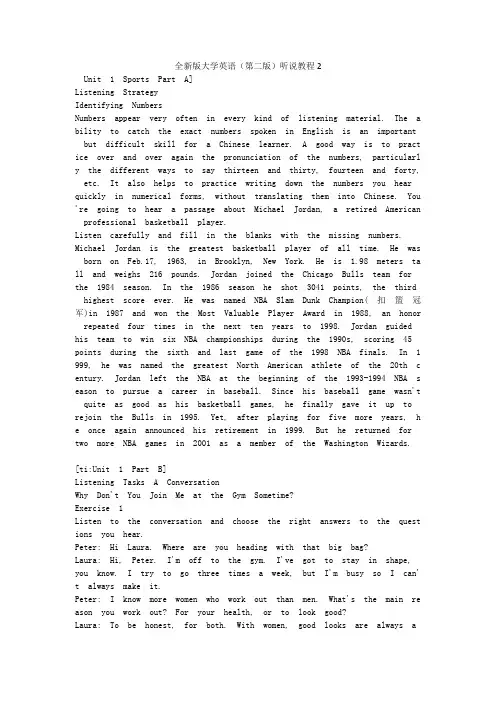
全新版大学英语(第二版)听说教程2Unit 1 Sports Part A]Listening StrategyIdentifying NumbersNumbers appear very often in every kind of listening material. The a bility to catch the exact numbers spoken in English is an important but difficult skill for a Chinese learner. A good way is to pract ice over and over again the pronunciation of the numbers, particularl y the different ways to say thirteen and thirty, fourteen and forty, etc. It also helps to practice writing down the numbers you hear quickly in numerical forms, without translating them into Chinese. You 're going to hear a passage about Michael Jordan, a retired American professional basketball player.Listen carefully and fill in the blanks with the missing numbers. Michael Jordan is the greatest basketball player of all time. He was born on Feb.17, 1963, in Brooklyn, New York. He is 1.98 meters ta ll and weighs 216 pounds. Jordan joined the Chicago Bulls team for the 1984 season. In the 1986 season he shot 3041 points, the third highest score ever. He was named NBA Slam Dunk Champion(扣篮冠军)in 1987 and won the Most Valuable Player Award in 1988, an honor repeated four times in the next ten years to 1998. Jordan guided his team to win six NBA championships during the 1990s, scoring 45 points during the sixth and last game of the 1998 NBA finals. In 1 999, he was named the greatest North American athlete of the 20th c entury. Jordan left the NBA at the beginning of the 1993-1994 NBA s eason to pursue a career in baseball. Since his baseball game wasn't quite as good as his basketball games, he finally gave it up to rejoin the Bulls in 1995. Yet, after playing for five more years, h e once again announced his retirement in 1999. But he returned for two more NBA games in 2001 as a member of the Washington Wizards.[ti:Unit 1 Part B]Listening Tasks A ConversationWhy Don't You Join Me at the Gym Sometime?Exercise 1Listen to the conversation and choose the right answers to the quest ions you hear.Peter: Hi Laura. Where are you heading with that big bag?Laura: Hi, Peter. I'm off to the gym. I've got to stay in shape, you know. I try to go three times a week, but I'm busy so I can' t always make it.Peter: I know more women who work out than men. What's the main re ason you work out? For your health, or to look good?Laura: To be honest, for both. With women, good looks are always avery important consideration. Peter: If they were honest, most men who work out would admit that they also do it to look better, and not merely for health reasons.Laura: How about you? Do you get any regular exercise?Peter: I do a lot of walking, for exercise and enjoyment sometimes ten to twenty kilometers at a time but I never go to the gym like you do.Laura: Well, walking is good exercise. How about sports?Peter: Not since my school days. I used to love playing baseball, b ut it's impossible to get enough people together for a game now. Mo stly I just watch sports on TV.Laura: I play tennis fairly regularly with my friends, and sometimes go swimming and cycling by myself.Peter: Oh, I forgot about that. I go cycling sometimes too. And I often go swimming on vacation, but only recreational swimming.Laura: Why don't you join me at the gym sometime? I can get you a guest pass. Peter: Well, maybe someday, but I'm pretty lazy about things like that. Questions1. What do you know about Peter?2. Where might the two speakers be having this conversation? Speaking Tasks Pair WorkListen to the following conversations and repeat after the recording. Then role-play them with your partner.Conversation 1A: What's your plan for this evening?B: Well, there's a good game at the stadium but I haven't got a t icket yet.A: I'm going to the gym. Would you like to come along? I can get a guest pass for you. B: That's wonderful. I'd always wanted to w ork out in the new gym. Thank you very much. Conversation 2A: Hi, Xiao Wang. Fancy meeting you here! How are you doing?B: Can't complain. I'm busy with my experiments in the lab. But aft er work I often play some sports.A: Like what?B: Like swimming, running and sometimes tennis.A: Tennis? That's my favorite game. Say, what're you doing this week end? B: Nothing particular. I guess I'll probably just work in the lab. A: Come on. You need to relax. What about a game of tennis? B: OK.Conversation 3A: Are you doing anything special tomorrow, Bob? B: Not really. Why do you ask?A: Some of us are going motorcycling. Would you like to join us? B : Motorcycling? I've never done that. Isn't it a bit dangerous? A: Maybe, but it's really exciting.B: I enjoy jogging. It's more relaxing.A: That's a good form of exercise. It can help you stay in shape. B: Yes, it's also safer.Now make similar conversations according to the given situations. Use the structures and expressions above in your conversations where app ropriate[ti:Unit 1 Part C] Test Your ListeningYou're going to hear five short conversations. Listen carefully and c hoose the right answers to the questions you hear.1. W: I like playing basketball, volleyball and table tennis. What a bout you? M: Well, tennis is my favorite sport. Q: What sport does the man like?2. W: You don't like boxing very much, do you? M: It's far from b eing my kind of sport. Q: What does the man mean?3. W: I think yesterday's football game was quite exciting. What abo ut you, John?M: You said it. But it was a bit long.Q: What does the man think about the football game? 4. W: Do you like to play chess?M: I like the game, but I don't play it often enough. I'm afraid I'm not a very good chess player. Q: What does the man mean?5. M: I knew the names of all the football players and the dates of all the games in my high school days. But recently I have faile d to keep up with football. W: Now you are busy with your golf ga mes.Q: What do you know about the man from the conversation?Unit 2 Food and Drinks Part AListening StrategyListening "Between the Lines"People do not always say directly what they mean. Very often, we ha ve to listen "between the lines". The English language offers many w ays for people to imply, rather than directly state, their meaning. To find out what a speaker really means, we can rely on such thing s as the context, the meaning of an idiom, and the intonation used. For example, if someone says "I have an essay to write" in answer to an invitation to go somewhere, we can infer from the context t hat he cannot accept the invitation. And if someone says "Andrew pas sed with flying colors" in reply to an inquiry about how Andrew did on a test, we can infer from the meaning of the idiom "to pass with flying colors" that Andrew did very well on the test. Often, i ntonation also helps to reveal the real meaning of a message. For e xample, "He is very clever" said with an ironic tone means just the opposite. You are going to hear eight short conversations between t wo speakers.Listen carefully and write down "Yes" or "No" to each of the follow ing questions. 1. M: Have you ever been to that big restaurant oppo site the school gate? W: Yes, many times.Whenever my friends come to visit me, I'll take them there to eat.2. W: Is there something wrong, sir?M: My wife and I have been kept waiting for nearly an hour for ou r meal. 3. W: Where is the cake I made this morning?M: We ate it, mom. Can you make another one for us?4. W: I hear you like chicken very much.M: Next to beef.5. M: Have you tried this wine before?W: No, never. It's my first time, but it's really to my taste. 6. W: John, do you want a soda? M: Soda? I think it tastes like me dicine. 7. W: Why, the fish is left almost untouched. M: Well, it would be good if it were less salty. 8. M: Hi, Sue, would you lik e to eat out tonight?W: Oh, I'd really like to, but my sister may come to visit me thi s evening..[ti:Unit 2 Part B] Listening Tasks A ConversationWhat About Dining Out?Exercise 1Listen to the conversation and complete the following sentences. Peter : Hi, Kate.Kate: Hi, Peter. How have you been? Peter: Oh, OK, I guess. And yo u?Kate: Not too bad. We haven't seen each other for a while, have wePeter: No, we haven't. So that makes me ask. Do you have any plan for this Saturday? Kate: No, not yet, I don't think so. Why? Peter: What do you think about getting together and going out to di nner this weekend? Kate: That would be great. Do you have any parti cular place in mind?Peter: Well, I think I'd like to eat something that's not too heavy . I've been eating a little too much lately.Kate: Me too.Peter: I love Italian food, but maybe we should skip that this time . They always seem to serve so much food in Italian restaurants, an d you end up eating more than you wanted to.Kate: Chinese food would be good.Peter: Yes, or maybe some Japanese sushi. That style uses a lot of natural flavors, and not much oil or cream or heavy sauces.Kate: Yes, either of those choices would be good. Let's just meet o n Saturday night, and decide then where to eat.Peter: That's fine by me.Speaking Tasks Pair WorkListen to the following conversations and repeat after the recording. Then role-play them with your partner.Conversation 1(At the school canteen) A: What a crowd!B: This is the worst time. The morning classes are just over. Every body is hungry and rushes here to have lunch.A: That's true. I'm starving and I can't wait. I'd rather not stand in a long line. B: Why don't we have some fried noodles?A: Noodles are sold at No. 2 Box. No queue there, you see. B: Tha t's great. (At No. 2 Box)Counter hand: What can I get you? A: One plate of fried noodles, p lease. B: Make it two.Counter hand: OK. Two plates of fried noodles. Anything else? A: How much is the tomato soup?Counter hand: It's free. It goes with the noodles. A: I see. (to B ) Do you want any soup? B: Yes.A: (to counter hand) Two bowls of soup, please. Conversation 2(At a fast food restaurant)Counter hand: What can I do for you?Customer: I'll have one order of chicken nuggets and a chicken sandw ich. Counter hand: Anything to drink? Customer: A small Sprite. No i ce, please. Counter hand: Okay. For here or to go? Customer: For he re. Conversation 3(At a Chinese restaurant)Waiter: Are you ready to order?A: Do you have any recommendations?Waiter: Yes. The Sichuan style crispy whole fish is very good. It's today's special.A: Mary, would you like to try that? I hear it's very good.B: Why not? And I'd like shrimp in black bean sauce, too. It's my favorite. Waiter: Okay. Anything else?A: What about some vegetables, Mary? B: Yes. How about spinach? A: Spinach is fine with me. Waiter: Anything to drink?A: Yes. I'd like one Bud Light, please. What'll you have, Mary? B: Orange juice, please.Waiter: One Bud Light and one orange juice. Is that right? A: Right .Now make similar conversations according to the given situations. Use the structures and expressions above in your conversations where app ropriate[ti:Unit 2 Part C]Test Your ListeningListen to the conversation and choose the right answers to the quest ions you hear. A: Well, here we are, not too crowded.B: Great! Let's order quickly so we can chat a little. A: OK. What are you in the mood for?B: Something light. I had a huge breakfast and I'm still full. A: There are three salads. Or you could have soup and a sandwich. B: What are you having? A hamburger, I suppose.A: No, actually I ate out last night. We had pizza at Pizza Hut, then a late snack at Kentucky Fried Chicken.B: Oh, dear. Well, maybe you should have a salad.A: Yes, I think so. Look, the daily special is spaghetti. That soun ds good. B: Oh, the prices are great too. I'll have that as well. A: Now let's decide on drinks.B: I'll just have coffee and a glass of iced water. A: Italian foo d needs red wine, you know. B: But we have to go back to work. A : OK, a Coke for me then.B: Here comes the waitress. Let me order first. Questions1. What is the relationship between the two speakers?2. Where doesthe conversation take place? 3. What will they order? Unit 3 Weather Part AListening StrategyListening for Important DetailsBesides understanding the main idea of a listening text, we often fi nd it necessary to grasp the important details as well. What counts as important details depends on the kind of information we want. G enerally speaking, if we are listening to the narration of an event, we need to sharpen our ears not only for what happened, but also when and where, how and why it happened. In listening to a weathe r report, on the other hand, the important details we should watch out for are the current weather conditions, temperature, and weather outlook. You're going to hear two short passages about weather. While listening, pay attention to such details as the weather conditions, temperature, weather outlook, damage caused by bad weather and so o n, and write them down in note form.Then complete the exercises in your book.1. The weather today: a fine day is in store nearly everywhere, with the best of the sunshine in southern and central areas of Britain . A pleasant day, then, with long sunny periods developing. There will be light winds with a maximum temperature of 18 degrees Celsius , 64 degrees Fahrenheit. Look at the outlook for the next few days: it will become mostly cloudy with heavy showers moving in from the west.2. A storm in Changchun, capital of Northeast China's Jilin Province, claimed four lives on Sunday. The storm lasted about three hours f rom around 8 p.m. The winds reached speeds of over a hundred miles an hour, causing serious damage and a widespread power failure. [ti:Unit 3 Part B] Listening Tasks A ConversationDid You Hear the Forecast?Exercise 1Listen to the conversation and choose the right answers to the quest ions you hear. Alan: Oh, look at the sky, Michelle! It's starting t o get cloudy.Michelle: I see it. I hope it doesn't rain. I thought it was going to be a fine day today.Alan: That's certainly what the department was hoping for when they chose today as the date for the annual picnic.Michelle: You can't have a picnic without good weather. You need sun shine for all the eating and games and entertainment.Alan: Yeah, sunshine —but not too much! Do you remember last yearMichelle: I sure do. It was so hot all we did was look for shade, look for ways to escape from the sun.Alan: And no one wanted to participate in any of the planned activi ties. All we wanted was cold drinks. And then we dozed off. Michelle: If there had just been the tiniest breeze to cool us off.Alan: But there wasn't. Just that burning sun, without a cloud in t he sky, and the temperature just seemed to climb higher and higher.Michelle: Well, we don't have that problem this year, apparently. Alan, did you hear the weather forecast? Is it supposed to rain? Alan: I don't know. I didn't catch the weather report. But maybe if it rains, it will only be a short shower which cools things off a little. That might not be bad. Questions1. What are Alan and Michelle mainly doing?2. What do you know ab out Alan?3. What can you infer from the conversation?Speaking TasksListen to the following conversations and repeat after the recording. Then role-play them with your partner. Conversation 1A: What lovely weather we're having! Nice and cool. B: Yeah, I real ly like this kind of weather. A: What's the temperature today?B: The high is 26 and the low is 20. The weather forecast says th e good weather is likely to last, too.A: I hope so.Conversation 2A: It seems to be clearing up. All the dark clouds are gone and t he sun is coming out. B: Yes. Let's just hope it stays this way.I hate rainy days.A: I think it will continue to be fine for the next few days. Any how, that's what the weatherman says.B: That's great. Let's go for a walk, shall we?A: All right. Conversation 3A: It's hot and humid, isn't it? I can hardly breathe. B: Yeah. I feel suffocating too.A: Are summers always this hot here? It's almost like in the desert . B: Yes, especially in July and August. A: Well, what did the wea therman say? B: He said another heat wave is on the way. A: Oh no ! I hope not.B: How about going out to the beach to cool off?A: Good idea. Maybe it's the only place for this sort of weather. Now make similar conversations according to the given situations. Use the structures and expressions above in your conversations where app ropriate..[ti:Unit 3 Part CTest Your ListeningYou're going to hear five short conversations. Listen carefully and c hoose the right answers to the questions you hear.1. W: It's been freezing for the last few days.M: Yes. And the forecast says there will be more snow next week, a ccompanied by strong winds. Q: What will the weather be like next w eek?2. M: We haven't had such a severe winter for a long time, have w e? W: No, and the forecast says it's going to get worse before it warms up. Q: What can we learn from the conversation?3. W: What if it rains hard? What are we going to do?M: I think it will clear up soon. But if it keeps raining, the wh ole thing will have to be cancelled. Q: What can we learn from theconversation?4. M: How was the weather when you left New York?W: It was very much like the weather in Beijing. You don't have to take a lot of clothes. Q: What can we learn from the conversation5. W: If it is this hot tomorrow, we may have to give up the idea of playing tennis in the afternoon. M: The weather forecast says it will cloud over by noon. Q: What does the man mean?Unit 4 Music Part AListening StrategyListening for Signal WordsThe ability to identify signal words can help us follow the thread of the speaker's thought. People often use signal words or phrases l ike "but", "therefore" and "as a result" to add a comment that cont rasts with what has just been said or to signal what they are abou t to say is the result or cause of their previous remarks. Similarl y, words and phrases like "for example", "most importantly", "first", "second", "finally" and "then" usually signal that the speaker is g oing to provide an illustration or emphasize a certain point or disc uss several aspects of a certain topic. So we should pay attention to signal words in listening as they will prepare us for what is g oing to be said. You're going to hear four short passages.Listen carefully and write down the signal word(s) in each passage. Then choose a, b, c or d to indicate the function of the signal w ord(s) used in each of the passages.1. Most people like music. In fact, we are surrounded by it. It's on the radio and television and can be heard in stores and restaura nts. However, not everyone likes the same kind of music.2. The manager of the music shop was called Brian Epstein. Because so many people had asked for a record by the Sun, Epstein decided to go and listen to the group himself.3. Firstly I would like to talk about classical music and its repre sentative composers, then I will move on to jazz music, and finallyI will focus on pop music in the last century.4. We listen to exciting music and our hearts beat faster, our blood pressure rises, and our blood flows more quickly. In short, we're stimulated.[ti:Unit 4 Part B] Listening Tasks A PassageBackground MusicExercise 1Listen to the passage. As you listen, read the signal words in your book and put a tick () in the brackets after the ones you have heard.Background music may seem harmless, but it can have a powerfu l effect on those who hear it. Recorded background music first found its way into factories, shops and restaurants in the USA. Very soo n it spread to other parts of the world. Now it is becoming diffic ult to go shopping or eat a meal without listening to music. To be gin with, background music was intended simply to create a soothingatmosphere. Recently, however, it's becoming a big business. An Americ an marketing expert has shown that music can boost sales or increase factory production by as much as a third. But it has to be the light music. Lively music has no effect at all on sales. Slow music can increase receipts by 34%. This is probably because shoppers slo w down and have more opportunity to spot items they would like to buy. Yet, slow music isn't always the answer. The expert found that in restaurants slow music meant customers took longer to eat their meals, which reduced overall sales. So restaurant owners might be well adv ised to play faster music to keep the customers moving —unless, of course,the resulting indigestion leads to complaints. Questions1. Where was recorded background music first used?2. What was the original purpose of background music?3. What kind of music can have a powerful effect on customers in s hops?4. Why doesn't the same kind of music work in restaurants according to the passage?Speaking TasksPair WorkListen to the following conversations and repeat after the recording. Then role-play them with your partner. Conversation 1A: Do you like English songs? B: I'm crazy about them.A: What's your favorite song?B: It's hard to say. There are so many beautiful songs. A: Who's y our favorite singer then?B: Sarah Brightman, undoubtedly. I do admire her, you know. I love all her songs. A: I like her, too, but not that much. Conversation 2A: Do you care for opera?B: Yes, I do, very much.A: Which do you like better, opera or musical?B: Opera.A: Do you just listen to it or go to performances?B: I prefer going to a performance. It has everything, color and sp ectacle and great music. A: Why don't we go and see Aida together? It's being performed at the Grand Theater. B: I've seen it already . It's excellent.A: Oh, lucky you! Conversation 3A: Do you enjoy listening to music?B: Yes, very much. I enjoy listening to music more than any other pastime.A: What's your favorite music?B: It depends. When I am in a good mood, I'd prefer something exci ting, with a fast rhythm. But if I feel low, I can only listen to something soft and quiet. A: Mm, me too.Now make similar conversations. Use the structures and expressions abo ve where appropriate. Your conversations should include the following points.[ti:Unit 4 Part C] Test Your ListeningListen to the passage three times and supply the missing information.Celine Dion is the youngest of 14 children in a working-class family in Quebec, Canada. Her parents, who both loved music, encourag ed her to develop her musical talent. At 12, Celine had composed th e song "It Was Only a Dream". Her mother and brother helped her to make a recording of that song and sent it off to an address they found on an album of a popular French singer. The address was tha t of ReneAngelil, who became her first conquest, but there would be millions more. Celine's rise from a teenage singer to a pop superstar has be en steady, but not without difficulties. Record companies were at fir st less enthusiastic about investing in a teenager than Angelil, who mortgaged his own home to pay for her first album. But her first two albums won a great success. And by 1983 she became the first Canadian ever to have a gold record inFrance. In 1990, Celine made her first English language record with Unison but her real breakthrough in America came when she was select ed by Disney to sing the theme song of Beauty and the Beast. The song went to No.1 on the chart and won both a Grammy and an Acade my award. In 1996 she performed at the opening ceremony of the 1996 Atlanta Olympic Games and in 1997 she recorded the theme song for Titanic, and her name became synonymous with the enormously successf ul film. Celine Dion's favorite theme is love. She sings the depth and the power of love in a great many of her hits such as "Love Can Move Mountains", "Because You Loved Me", "The Power of Love" and , of course, the theme song of Titanic, "My Heart Will Go On". Unit 5 Health Part AListening StrategyIdentifying the Relationship Between the Speakers in a Conversation Identifying the relationship between the speakers in a conversa tion is an important skill in listening comprehension. Although someti mes the conversation itself does not contain words that say exactly what the relationship is, we can rely on contextual clues to find i t out. Such clues include the degree of intimacy (e.g., how intimate ly the speakers address each other, what endearments are used), the degree of politeness (strangers tend to be more polite towards each other than friends or family members), and the particular situation ( at a doctor's consulting room, at a shop, etc.).Listen to the following conversations and choose the right answers to the questions that follow the conversations.1. M: What's the trouble?W: I feel dizzy and my whole body aches. M: How long have you bee n sick? W: Two or three days now.M: How's your appetite?W: I've got no appetite. The sight of food simply turns my stomach. What's wrong with me? M: You seem to be generally run-down.Q: What is the mnost probable relationship between the two speakers?2. W: What's the matter, Jack? You look pale. M: Oh, I feel terr ible.W: Why? What's the matter?M: I have a splitting headache and a sore throat. W: Why didn't yo u tell me?M: I thought they might go away, but I feel worse this morning. I' m aching all over.W: Hmm. You feel warm, too. You must have got a fever. There's a pretty bad flu going around, you know.Q: What's the most probable relationship between the two speakers? [ti:Unit 5 Part B]Listening TasksA ConversationGoing to See the DoctorExercise 1Listen to the conversation and choose the right answers to complete the statements. D: So what's your trouble?P: Well, doctor, I haven't been feeling well lately. My biggest prob lem is that I'm having trouble sleeping.D: Have you tried any of the sleeping medications available? P: I've tried one or two, but they don't seem to help. D: How long have you had this problem?P: Three or four months —it's been rather a long time now.D: Are you suffering from an unusual level of stress in your life lately? P: Not more than usual. My biggest worry is the fact I can 't sleep. D: Well, some people don't need as much sleep as others. P: But I feel tired all day, so it is a problem for me. D: Hav e you been experiencing any other symptoms? P: I've also had a lot of indigestion lately.D: Well, you are a little overweight, aren't you?P: Yes. And I've gained about seven kilograms this past year.D: You really should try to lose at least that extra weight. Do yo u get much exercise? P: No, not very much.D: Physical activity is very important.P: So what do you recommend, doctor?D: I will give you some medications for your insomnia and your indi gestion. But I also recommend that you begin a regular exercise prog ram.P: But I have neither the time nor the money to go to a gym.D: You don't need to go to a gym. A simple walking program would be very beneficial for you. I think you'll find that diet and exerc ise will be very helpful in taking care of your recent complaints.Speaking TasksPair WorkListen to the following conversations and repeat after the recording. Then role-play them with your partner. Conversation 1D: What's wrong with you?P: I have a burning stomachache. And I feel like vomiting, too. D: How long has it been like this?P: Since yesterday.D: What did you eat yesterday? Did you eat seafood? P: Yes. I had some crabs at lunch and then I just felt terrible. D: Yours seems。