
定语从句-2010年专升本-英语复习
- 格式:ppt
- 大小:256.00 KB
- 文档页数:25

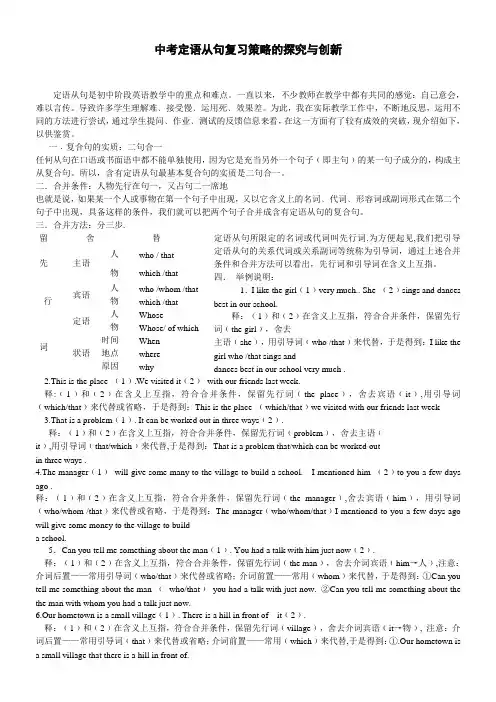
中考定语从句复习策略的探究与创新定语从句是初中阶段英语教学中的重点和难点。
一直以来,不少教师在教学中都有共同的感觉:自己意会,难以言传。
导致许多学生理解难﹑接受慢﹑运用死﹑效果差。
为此,我在实际教学工作中,不断地反思,运用不同的方法进行尝试,通过学生提问﹑作业﹑测试的反馈信息来看,在这一方面有了较有成效的突破,现介绍如下,以供鉴赏。
一﹒复合句的实质:二句合一任何从句在口语或书面语中都不能单独使用,因为它是充当另外一个句子﹙即主句﹚的某一句子成分的,构成主从复合句。
所以,含有定语从句最基本复合句的实质是二句合一。
二.合并条件:人物先行在句一,又占句二一席地也就是说,如果某一个人或事物在第一个句子中出现,又以它含义上的名词﹑代词﹑形容词或副词形式在第二个句子中出现,具备这样的条件,我们就可以把两个句子合并成含有定语从句的复合句。
三.合并方法:分三步.定语从句所限定的名词或代词叫先行词.为方便起见,我们把引导定语从句的关系代词或关系副词等统称为引导词,通过上述合并条件和合并方法可以看出,先行词和引导词在含义上互指。
四. 举例说明:1.I like the girl ﹙1﹚very much.. She ﹙2﹚sings and dances best in our school.释:﹙1﹚和﹙2﹚在含义上互指,符合合并条件,保留先行词﹙the girl ﹚,舍去主语﹙she ﹚,用引导词﹙who /that ﹚来代替,于是得到:I like the girl who /that sings anddances best in our school very much .2.This is the place ﹙1﹚.We visited it ﹙2﹚ with our friends last week.释:﹙1﹚和﹙2﹚在含义上互指,符合合并条件,保留先行词﹙the place ﹚,舍去宾语﹙it ﹚,用引导词﹙which/that ﹚来代替或省略,于是得到:This is the place ﹙which/that ﹚we visited with our friends last week3.That is a problem ﹙1﹚. It can be worked out in three ways ﹙2﹚.释:﹙1﹚和﹙2﹚在含义上互指,符合合并条件,保留先行词﹙problem ﹚,舍去主语﹙it ﹚,用引导词﹙that/which ﹚来代替,于是得到:That is a problem that/which can be worked outin three ways .4.The manager ﹙1﹚ will give some many to the village to build a school. I mentioned him ﹙2﹚to you a few days ago .释:﹙1﹚和﹙2﹚在含义上互指,符合合并条件,保留先行词﹙the manager ﹚,舍去宾语﹙him ﹚,用引导词﹙who/whom /that ﹚来代替或省略,于是得到:The manager ﹙who/whom/that ﹚I mentioned to you a few days ago will give some money to the village to builda school.5.Can you tell me something about the man ﹙1﹚. You had a talk with him just now ﹙2﹚.释:﹙1﹚和﹙2﹚在含义上互指,符合合并条件,保留先行词﹙the man ﹚,舍去介词宾语﹙him →人﹚,注意:介词后置——常用引导词﹙who/that ﹚来代替或省略;介词前置——常用﹙whom ﹚来代替,于是得到:①Can you tell me something about the man ﹙ who/that ﹚ you had a talk with just now. ②Can you tell me something about the the man with whom you had a talk just now.6.Our hometown is a small village ﹙1﹚. There is a hill in front of it ﹙2﹚.释:﹙1﹚和﹙2﹚在含义上互指,符合合并条件,保留先行词﹙village ﹚,舍去介词宾语﹙it →物﹚, 注意:介词后置——常用引导词﹙that ﹚来代替或省略;介词前置——常用﹙which ﹚来代替,于是得到:①.Our hometown is a small village that there is a hill in front of.留 舍 替 先 主语 人 who / that 物 which /that 行 宾语 人 who /whom /that 物 which /that 定语 人 Whose 词 物 Whose/ of which 状语 时间 When 地点 where 原因 why②Our hometown is a small villag in front of which there is a hill.7.I will never forget the days ﹙1﹚.I lived and studied with my classmates at college in the days﹙2﹚.释:﹙1﹚和﹙2﹚在含义上互指,符合合并条件,保留先行词﹙the days﹚,舍去介词宾语﹙the days﹚, 注意:介词后置——常用引导词﹙that﹚来代替或省略;介词前置——常用﹙which﹚来代替; 舍去时间壮语﹙in the days﹚, 用引导词﹙when﹚来代替, 于是得到:①. I will never forget the days that I lived and studied with my classmates at college in.②.I will never forget the days in which I lived and studied with my classmates at college .③. I will never forget the days when I lived and studied with my classmates at college .五:原理运用:要求逆向思维汉译英:分三步﹙先分——后译——再合﹚例:我们昨天参观的那个工厂是去年建的⑴. 分:那个工厂是去年建的。
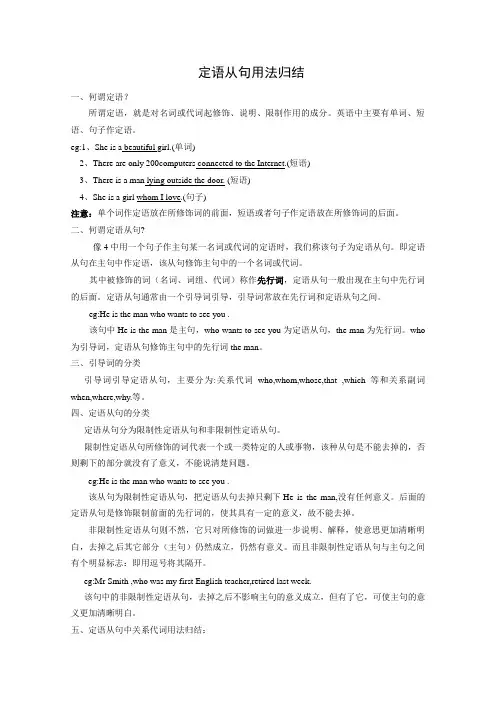
定语从句用法归结一、何谓定语?所谓定语,就是对名词或代词起修饰、说明、限制作用的成分。
英语中主要有单词、短语、句子作定语。
eg:1、She is a beautiful girl.(单词)2、There are only 200computers connected to the Internet.(短语)3、There is a man lying outside the door. (短语)4、She is a girl whom I love.(句子)注意:单个词作定语放在所修饰词的前面,短语或者句子作定语放在所修饰词的后面。
二、何谓定语从句?像4中用一个句子作主句某一名词或代词的定语时,我们称该句子为定语从句。
即定语从句在主句中作定语,该从句修饰主句中的一个名词或代词。
其中被修饰的词(名词、词组、代词)称作先行词,定语从句一般出现在主句中先行词的后面。
定语从句通常由一个引导词引导,引导词常放在先行词和定语从句之间。
eg:He is the man who wants to see you .该句中He is the man是主句,who wants to see you为定语从句,the man为先行词。
who 为引导词,定语从句修饰主句中的先行词the man。
三、引导词的分类引导词引导定语从句,主要分为:关系代词who,whom,whose,that ,which等和关系副词when,where,why.等。
四、定语从句的分类定语从句分为限制性定语从句和非限制性定语从句。
限制性定语从句所修饰的词代表一个或一类特定的人或事物,该种从句是不能去掉的,否则剩下的部分就没有了意义,不能说清楚问题。
eg:He is the man who wants to see you .该从句为限制性定语从句,把定语从句去掉只剩下He is the man,没有任何意义。
后面的定语从句是修饰限制前面的先行词的,使其具有一定的意义,故不能去掉。

2010高考二轮复习英语考案专题十定语从句【专题考案】1. The man ____ visited our school yesterday is from London.A. whoB. whichC. whomD. when2. The woman ____ is talking to my mother is a friend of hers.A. whoseB. whoC. whomD. which3. Because of my poor memory, all ____ you told me has been forgotten.A. thatB. whichC. whatD. as4. Do you remember those days ____ we spent along the seashore very happily?A. whenB. whereC. whichD. who5. Tom did not take away the camera because it was just the same camera ____ he lost last week.A. whichB. thatC. whomD. as6. Those ____ want to go please sign their names here.A. whomB. whichC. whoD. when7. Where is the man ____ I met this morning?A. whenB. whereC. whichD. who8. Who is the woman ____ is sweeping the floor over there?A. whoB. /C. thatD. when9. The man ____ you talked just now is a worker.A. whoB. whomC. to whomD. to who10. The man ____ you are going to ma ke friends is my father’s neighbour.A. with whomB. whenC. to whomD. which11. The doctor ____ is leaving for Africa next month.A. the nurse is talking to himB. whom the nurse is talkingC. the nurse is talking toD. who the nurse is talking12. The man ____ around our school is from America.A. which you showedB. you showed himC. you showedD. where you showed13. He talked about a hero ____ no one had ever heard.A. of whomB. from whomC. about thatD. who14. In fact the Swede did not understand the three questions ____ were asked in French.A. whereB. whoC. in whichD. which15. Have you read the book ____ I lent to you?A. thatB. whomC. whenD. whose16. Finally, the thief handed over everything ____ he had stolen to the police.A. thatB. whichC. whateverD. all17. The foreign guests, ____ were government officials, were warmly welcomed at the airport.A. most of themB. most of thatC. most of whomD. most of those18. This is the very letter ____came last night.A. whoB. whichC. thatD. as19. I know only a little about this matter; you may ask ____ knows better than I.A. whoeverB. whomeverC. anyoneD. the one20. This is the school ____ we visited three days ago.A. whereB. /C. whenD. what21. This is the factory ____ we worked a year ago.A. whereB. thatC. whichD. on which22. Nearby were two canoes ____ they had come to the island.A. whichB. in whichC. thatD. /23. Jack is pleased with ____ you have given him and all ____ you have told him.A. that, whatB. what, thatC. which, whatD. that, which24. Do you work near the building ____ colour is yellow?A. thatB. whichC. itsD. whose25. In the dark street, there wasn’t a single person ____ she could turn for help.A. whomB. whoC. to whomD. form whom26. Is this school ____ we visited three years ago?A. the oneB. whichC. thatD. where27. Is this the school ____ we visited three years ago?A. the oneB. whereC. in whichD. /28, How many students are there in your class ____ homes are in the country?A. whoseB. whoC. whomD. which29. Alice received an invitation from her boss, ____ came as a surprise.A. itB. whichC. thatD. he30. The train was crowded and I had to get into a carriage ____ already seven other people.A. when there wereB. which there wereC. that there wereD. where there were31. I live in the house ____ windows face south.A. whichB. whoseC. whereD. in that32. ---- What game is popular with them?---- The ____ most is tennis.A. game they like itB. game they likeC. best game they likeD. best game they like it33. They stayed with me three weeks, ____ they drank all the wine I had.A. whichB. which timeC. during which timeD. during which34. The room ____ Mr White lives is not very large.A. thatB. whichC. whereD. when35. Don’t forget the day ____ you were received into the Y outh League.A. whenB. thatC. at whichD. where36. I’ve finished writing the novel, ____ is to be published next month.A. thatB. whatC. whichD. when37. He returned home safe and sound after a fierce battle, ____ was unexpected.A. whichB. asC. thatD. it38. ____ we is known to all, English is not very difficult to learn.A. WhatB. AsC. ThatD. Which39. The old man had three sons, all of ____ died during World War Ⅱ.A. whoseB. thatC. whomD. who40. I have bought two pens, ____ write well.A. none of whichB. neither of whichC. both of whichD. all of which41. Do you know the reason ____ she has changed her mind?A. whyB. whichC. for thatD. of which42. He failed in the exam, ____ proves that he wasn’t working hard enough.A. whichB. whatC. itD. that43. During the week ____ he tried to collect materials for his article.A. followingB. followedC. to followD. that followed44. ____ was expected, he succeeded in the exam.A. ItB. WhichC. AsD. That45. He studied hard and later became a well-known writer, ____ his father expected.A. that was whatB. what was thatC. and which wasD. which was what46. We should read such books ____ will make us better and wiser.A. whenB. asC. whoseD. what47. Y ou must show my wife the same respect ____ you show me.A. whenB. asC. whoseD. what48. He is absent ____ is often the case.A. whatB. whichC. whoD. as49. It is the first time ____ I have come to your city.A. thatB. whichC. whatD. when50. Who ____ has the same idea as it will do it in this way.A. whoB. thatC. whomD. which51. I shall never forget those years ____ I lived in the country with the farmers, ____ has a great effect on my life.A. that, whichB. when, whichC. which, thatD. when, who52. This is the only book ____ I can find.A. thatB. whichC. itD. with which53. I don’t like ____ you speak to her.A. the wayB. the way in thatC. the way whichD. the way of which54. That is one of those books that ____ worth reading.A. isB. areC. hasD. have55. This is the only one of the students whose handwriting ____ the best.A. isB. areC. hasD. have56. There was ____ to prevent the accident.A. something could doB. anything we could doC. nothing we couldn’t doD. nothing we could do57 Y esterday Mr. Li finally bought his own house, _______ is a hospital.A. in whereB. to the east of whichC. to the east of itD. in the east of that58. My brother's purse, _______ he put ¥1,000, was missing on the bus.A. thereB. whichC. in whichD. that59. The football match _______ the students competed yesterday was very wonderful.A. in whichB. whichC. in thatD. that60. The reason _______ he was late again was that he was caught in a traffic jam in the rush hour.A. whichB. in whichC. for whichD. of which61. His glasses, _______ he could see nothing, was taken away by a naughty boy.A. whichB. without whichC. with whichD. without those62. The computer, _______ he paid ¥3,000, was once owned by his uncle.A. whichB. for whichC. thatD. to that63. In the past we lost many chances, _______ we paid little attention.A. whichB. thatC. in whichD. to which64. The pen, _______ I had been writing for ten years, was broken.A. with whichB. with thatC. asD. with it65. Mary has two brothers, ________ are doctors.A. both of theyB. both of whomC. both of themD. whom of both66. The problem _______ you argued about yesterday has been solved.A. thatB. whatC. whyD. for which67. My aunt bought me a book, the name _______ I have forgotten.A. of itB. whichC. whoseD. of w hich68. On the way home I met my friend John, from _______ home the thief had stolen a computer.A. whomB. whichC. thatD. whose69. I hate the way _______ you talk to your mother.A. by whichB. on whichC. in whichD. which70. At last we found the hole in the wall _______ the mouse got into the house last night.A. in whichB. whichC. through whichD. by which71. There are three girls in the room, ________ is Tom's sister.A. the tallest of whichB. the tallest of whomC. tallest of thatD. tallest of which72. I'll never forget the day _______ I bought my own guitar with my own money.A. whereB. on whichC. on whenD. that73. She is just the girl, with _______ my brother came to visit me last month.A. whomB. herC. thatD. who74. Last night we saw two movies, _______ was interesting.A. both of whichB. neither of whichC. both of themD. neither of them75. This is the house in _______ I was born thirty years ago.A. itB. thereC. whichD. that76. The reason for _______ he failed in the exam was that he was too careless.A. whichB. whyC. thatD. it77.I saw a woman running towards me in the dark. Before I could recognize who she was, she had run back in the direction _______ she had comeA. of which B by which C. in which D. from which78. Women _______ drink more than two cups of coffee a day have a greater chance of having heart disease than those ______ don’t.A. who, /B. / , whoC. who, whoD./, /79. We are just trying to reach a point ______ both sides will sit down together and talk.A. whereB. thatC. whenD. which80.—Do you have anything to say for yourselves?---Y es , there’s one point ____ we must insist on.A. whyB. whereC. howD./81. She was educated at Beijing University, _____ she went on to have her advanced study abroad.A. after thatB. from thatC. from whichD. after which82. We saw several natives advancing towards our party, and one of them came up to us, ______ wegave some bells and glasses.A. to which B to whom C. with whom D. with which83.Look out! Don’t get too close to the house _____ roof is under repair.A. whoseB. whichC. of whichD. that84. The owner of the cinema needed to make a lot of improvements and employ more people to keep it running, ______ meant spending tents of thousands of pounds.A. whoB. that C as D. which85. I was given three books on cooking, the first _____ I really enjoyed.A. of thatB. of whichC. thatD. which86. Do you still remember the chicken farm______ we visited three months ago?A. whereB. whenC. thatD. what87. I have many friends, ________ some are businessmen.A of themB from whichC who ofD of whom88. ---Why does she always ask you for help?---There is no one else _______, is there?A who to turn toB she can turn toC for whom to turnD for her to turn89. Last month, part of Southeast Asia was struck by floods, from _____ effects the people are still suffering.A thatB whoseC thoseD what90. If a shop has chairs _______ women can park their men, women will spend more time in the shop.A thatB whichC whenD where91. Mark was a student at this university from 1999 to 2003, _____ he studied very hard and was made Chairman of the Students’ Union.A during which timeB for which timeC during whose timeD by that time92. Anyway, that evening, ____ I’ll tell you more about later, ended up staying at Rachel’s place.A whenB whereC whatD which93.Luckily, we’d brought a road map without _______ we would have lost our way.A itB thatC thisD which94.--- Is that the small town you often refer to?----Right, just the one _______ you know I used to work for years.A thatB whichC whereD what95. Jim passed the driving test, _____ surprised everybody in the office.A whichB thatC thisD it96. American women usually identify their best friend as someone _____ they can talk frequently.A whoB asC about whichD with whom97. His parents wouldn’t let him marry anyone ____ family was po or.A. of whomB. whomC. of whoseD. whose98. She heard a terrible noise, _______ brought her heart into her mouth.A. itB. whichC. thisD. that99. In the dark street, there wasn’t a single person _____ she could turn for help.A. thatB. whoC. from whomD. to whom100. The weather turned out to be very good, ____ was more than we could expect.A. whatB. whichC. thatD. it101. After living in Pairs for fifty years he returned to the small town ____ he grew up as a child. A. which B. where C. that D. when102.Carol said the work would be done by October, _____personally I doubt very much. A. it B. that C. when D. which103.He was hiding behind the door _________ he could see what was happening.A. whichB. from where C from which D. where104. Recently I bought an ancient Chinese vase, _____ was very reasonable.A. which priceB. the price of whichC. its priceD. the price of whose105._____ has already been pointed out, grammar is not a set of dead rules.A. AsB. ItC. ThatD. Which106. He lived in London for 3 months, during ____ time he learned some English.A. thisB. whichC. thatD. same107. Helen was much kinder to her youngest son than to the others , ____ , of course , made the others envy him .A. whoB. thatC. whatD. which108. A story goes ______ Elizabeth I of England liked nothing more that being surrounded by clever and qualified noblemen at court.A. whenB. whereC. whatD. that109. The visitor asked the guide to take his picture _____ stands the famous tower.A. thatB. whereC. whichD. there110.The boss ____ department Ms King worked ten years ago look down upon women.A. in whichB. in thatC. in whoseD. whose111. I don’t like _____ you speak to her.A. the wayB. the way in thatC. the way whichD. the way of which112. There are two buildings ,____stands nearly a hundred feet high .A.the larger B.the larger of them C.the larger one that D.the larger of which113. He made another wonderful discovery, ____ of great importance to science.A. which I think isB. which I think it isC. which I think itD.I think which is114. American women usually identify their best friend as someone _____ they can talk frequently.A. whoB. asC. about whichD. with whom115. George Orwell, _______ was Eric Arthur, wrote many political novels and essays.A. the real nameB. what his real nameC. his real nameD. whose real name参考答案:1-5 ABACD 6-10 CDCCA 11-15 CCADA 16-20 ACCAB 21-25 ABBDC 26-30 ADABD 31-35 BBDCA36-40 CABCC 41-45 AADCD 46-50 BBDAB 51-55. BAABA56-60.CBCAC 61-65.BBDAB 66-70 A DDCC 71-75 BBABC 76-80 ADCAD 81-85 DBADB 86-90 CDBBD 91-95 ADDCA 96- 100 DDBDB101-105 BDBBA 106-110BDDBC 111-115ADADD。

专升本定语从句英语语法点Alright, here are a few paragraphs on English grammar points focusing on attributive clauses in the context of upgrading from a vocational school to a university.Let's start with a basic example. When you're writing about the courses you took in vocational school, you might want to mention the ones that were particularly challenging. You can say: "The courses I took in vocational school, especially the ones that required a lot of practical skills, really pushed me out of my comfort zone."Now, let's talk about how you can use attributive clauses to describe the people you met in your academic journey. For instance, you could say: "I'm grateful for all the professors I had, particularly the ones who believed in my potential and encouraged me to pursue higher education."Moving on to a more conversational tone, let's imagine you're talking to a friend about why you decided to upgradeyour education. You might say: "You know, there's a whole world of opportunities out there for people with a university degree. I'm excited to be a part of it, especially the opportunities that align with my interests and skills."Lastly, let's discuss how you can use attributive clauses to talk about your goals and aspirations after graduating from university. You could say: "I have big dreams for my future, and I'm determined to pursue them. That includes working in a field that challenges me, one where I can make a difference and contribute to.。