中考英语二轮复习《第2讲动词分类与谓语动词》讲义
- 格式:doc
- 大小:71.50 KB
- 文档页数:11
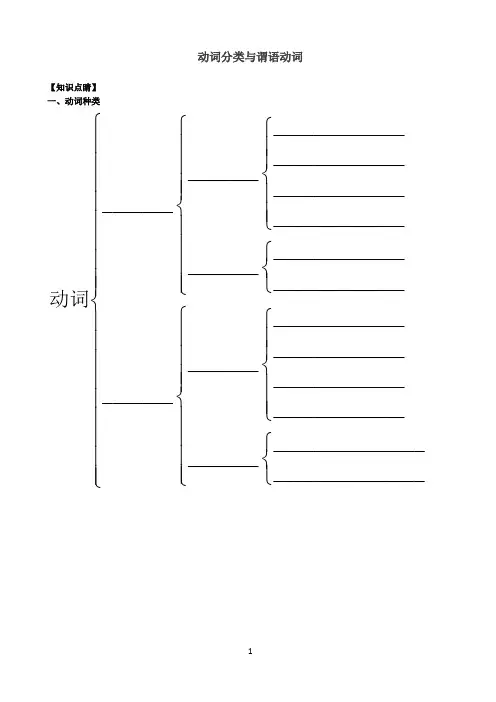
动词分类与谓语动词【知识点睛】 一、动词种类__________________________________________________________________________________________________________________________________________________________________________⎧⎧⎪⎪⎪⎪⎨⎪⎪⎪⎨⎪⎩⎪⎪⎧⎪⎨⎪⎩⎩⎧⎪⎪⎨⎪⎪⎩动词________________________________⎧⎪⎪⎪⎪⎪⎪⎪⎪⎪⎨⎧⎪⎪⎪⎪⎪⎪⎪⎪⎨⎪⎪⎪⎪⎪⎧⎪⎪⎨⎪⎪⎩⎩⎩情态动词用法:没有人称和数的变化;不能单独作谓语,后面必须接动词原形构成谓语部分;变否定,情态动词后直接加not;变疑问,情态动词直接提前。
can & could表_________ He can speak English.He could ride a bike when he was 7.He is so young that he can’t look after hims elf.He couldn’t write when he was only 2.I will be able to speak German fluently someday.表_________ Can you pass me some paper?Could you please tell me where the bookstore is?You can go now.表_________ —Who is singing in the next room? Is it Lucy?—It can’t be her. She has gone to New York.may & might表_________ —May I know your name?—Might I know your name?—Yes, you __________.—No, you __________.You may go now.表__________ She may know the answer, but I’m not sure.—Have you decided where to go for your weekend?—Not yet. We may go to Qingdao.must & have to___________ The movie is boring. I must go now.Drivers must wear the safety belt when driving. This is the traffic rule.My mother called me. I have to go now.—Dad, must I practice the piano today?—Yes, you _______.—No, you ______./ No, you don’t have to. You may do it tomorrow.___________ You mustn’t nip off the flowers.You don’t have to be in a hurry.(没必要)表_________ —Whose notebook is this?—It must belong to Tom. I saw he used it just now.He must have known the truth.need___________ You need not get here early.—Need I repeat it?—Yes, you ______./ No, you _______.___________ She needs a dictionary to help her study.I need to make a phone call.The room needs cleaning.情态动词表推测——一肯,一否,三个不一定—Whose notebook is this?—It must belong to Tom. I saw he used it just now.—Who is singing in the next room? Is it Lucy?—It can’t be her. She ha s gone to New York.She may/might/could know the answer, but I’m not sure.情态动词+现在完成时1、表对过去的猜测、可能性①must have done“一定做了…”用于肯定句,语气最强。
The light is off. He must have slept.②may/ might have done可能做了…,语气弱,可能性小。
其否定式意为“可能不…”,如:He might nothave been in. 他可能不在家。
might比may可能性更小。
③can (could) not have done“不可能做了…”,语气强,can, could也可用于疑问句,表可能性,如:Could he have left?2、表示虚拟语气,与过去事实相反,“本来应该”而“没有…”。
①should (ought to) have done. 本来应该做,而没做到如:You should have asked him for help. (事实上没求他帮忙)②could have done 本来能够…,如:He could have passed the exam. (结果没通过)③might have done 本来可以…④needn’t have done 本来没必要…You needn’t have taken a taxi. It is not far. (事实上坐出租车了)⑤had better have done sth. 用于事后的建议,含轻微的责备的口吻,意为“当时最好做了某事”。
⑥表示would rather have done sth.“当时宁愿做了某事”,表示“后悔”的意思。
should, ought to, could, might, had better, would rather也可用于否定句式,意思与上述在肯定句中的意思正好相反。
二、时态 (一)时态分类________________________________________________________________________________________________________________________________________________________________________________________⇒⎧⎪⇒⎪⎨⇒⎪⎪⇒⎩⇒⇒⇒按分________________________________⎧⎪⎪⎪⎪⎪⎪⎧⎨⎪⎪⎨⎪⎪⎪⎩⎪⎪⎪→⇒⎩(二)各个时态的用法(详细用法请参考附录1)一般现在时:反复性 规律性 经常性、客观事实真理、主将从现 一般过去时:过去的动作或状态、过去经常或习惯 一般将来时:将来的动作或状态、计划打算、现进表将来 过去将来时:从过去某一时刻看将来、主过从过(would + v.) 现在进行时:此时此刻、现阶段过去进行时:过去某一时刻(段)正在进行、过去频繁发生 现在完成时:过去发生影响现在、过去发生持续现在将来 过去完成时:过去的过去 —____the film before?—Yes. I ___it the day before yesterday. A. Have you seen; saw B. Did you see; have seen C. Have you seen; have seen D. Have you seen; was seeing(三)易混时态区分:一般过去时VS现在完成时—Yes, I _____________(see) it already. It is really interesting.(四)完成时态中瞬间动词变延续性动词汇总瞬间动词_______(有/无)现在完成时用法;当瞬间动词用于现在完成时中,并与__________连用时,需要将瞬间动词转换成相应的延续性动词—Your sister looks very happy!—Yeah, she has finally bought the dress she wants most.—Wow, your watch looks nice. Is it new?—No, I _________ (buy) it since 3 years ago.将下列瞬间动词转换为相应的延续性动词:close → __________ come → __________ go → __________finish→ __________ die → __________ put on→ _________lose → __________ join → __________ get up → _________buy → __________ borrow → _________ o pen → __________leave → __________ fall asleep → __________wake up → __________ arrive/reach → __________start/begin → __________ catch a cold → __________三、语态(一)主动语态和被动语态主动语态:动作的 _________ 作主语。
I bought a book.被动语态:动作的 _________ 作主语。
A book was bought by me.(二)被动语态用法1.不知道或没有必要指出动作的执行者是谁2.需要强调或突出动作的承受者3.动作的发出者不是人(三)被动语态基本结构:_________________(四)各种时态下主动语态、被动语态构成【小试牛刀】1.The building can___________ (see) from every part of the city. It _________ (build) many yearsago.2.Yesterday Tom _________ (tell) me that his bike ________ (break) last week.3.The students ___________ often ___________ (tell) to take care of their desks and chairs.4.Now he __________ (be) asked if the meeting ___________ (hold) next Friday.5.My teacher gave me a new book yesterday._________________________________________________________________________6.She is looking for her keys at the moment._________________________________________________________________________7.I saw some girls playing tennis on the playground when I passed._________________________________________________________________________8.In the old days, the employer made their employees work in the factory from morning to evening. _________________________________________________________________________(五)主动表被动1.That book is really _____________________(值得一读).2.Harry Potter _______________________(卖得很好).3.My bike __________________________(需要修理了).4.Great changes _____________(发生了) in the countryside in recent years.【精讲精练】一、找出下列句子中的动词,并指出其属于什么动词1.He often drew pictures on the floor with chalk and when his mother saw what he had done, she wouldquickly clean them with a mop.2.Li Jun, a 17-year-old girl from Shenzhen Foreign Language School, still can’t believe her 10-dayfree training camp in the Alps in Switzerland last month was true.3.The American official, the French, Japanese who had spoken earlier all lowered their heads inshame, and did not dare to answer.4.It’s OK if it takes you a while to feel yourself again when you go to a new place or meet newpeople.5.The drunken man asked the police if they knew where Mabel was as he was put into the back seatof the police car.二、单项选择( )1.Choosing the right circle of friends will _______ us a lot of troubles, heartaches and possibly a life of deep regret.A. saveB. shareC. keepD. bring( )2.It is helpful to ______ a good habit of reading in language learning.A. takeB. showC. developD. match( )3.The cloth ______ very soft and comfortable.A. smellsB. tastesC. feelsD. sounds( )4.The plane will ______ from Beijing Capital Airport and land in London.A. take upB. take outC. take awayD. take off( )5.—How does the animal get food?—It doesn’t need to do anything. The zookeeper will _____ it with food and drink.A. offerB. provideC. divideD. give( )6.—Where are you going?—I’m going to the airport to ______ my friend, Mary. She is going to London on holiday.A. see offB. put offC. take offD. send off( )7.—My grandma is ill in bed.—Sorry to hear that. Why not ______ a doctor?A. send forB. send upC. send awayD. send out( )8.—Do you miss your son who is at university, Mrs. Zhang?—No. I often ______ him, and make telephone calls to him.A. think aboutB. hear fromC. look afterD. learn from( )9.—We must act now because time is ______.—Yes. Let’s start.A. coming outB. giving outC. putting outD. running out( )10.—Do you still have a headache, Bill?—No, it’s ______. I’m all right now, Mum.A. droppedB. ranC. leftD. gone( )11.You _______ smoke in the hospital.A. needn’tB. oughtn’t toC. ought to notD. may not( )12.—Another cup of coffee?—No, thanks. I _____ be off. Mary is waiting for me.A. canB. mayC. mustD. might( )13.—May I watch TV for a while?—No, you _______. You have to finish your homework first.A. shouldn’tB. needn’tC. mustn’tD. won’t( )14.—I can’t give up smoking, doctor.—For your health, I’m afraid you ________.A. mayB. canC. have toD. must( )15.Mr. White _____ at 8:30 for the meeting, but he didn’t show up.A. should have arrivedB. should arriveC. should have had arrivedD. should be arriving( )11.When winter comes, ______ spring be far behind?A. shouldB. needC. mustD. can( )12.—Will you answer the telephone? It ______ be your mother.—Sorry. I ______. I’m very busy.A. can; mustn’tB. will; can’tC. may; can’tD. need; will ( )13.You ______ drive your car so fast. It’s very dangerous.A. wouldn’tB. shouldn’tC. couldn’tD. mightn’t ( )14.—Shall we meet at the station at 8 a.m.?—In fact we ______. The train ______ until 10 a.m.A. mustn’t; doesn’t leaveB. mustn’t; leavesC. needn’t; won’t leaveD. needn’t; will leave( )15.—Are you going anywhere?—I ______ about visiting my sister, but I have changed my mind.A. thinkB. have thoughtC. will thinkD. thought( )16.—Does this bus go to the beach?—No. You ______ the wrong way. You want the Number 11.A. goB. were goingC. are goingD. would go( )17.—Is Tom at home?—No, he ______ to town.A. has beenB. has goneC. goesD. will go( )18.The official said they ______ a new law to protect the tourists the next year.A. makesB. would makeC. madeD. have made( )19.It ______ usually ______ at this time of year, but today it is raining heavily.A. is; rainingB. won’t; rainC. has; rainedD. doesn’t; rain ( )20.I ______ my hometown for a long time. I really miss it!A. leftB. went away fromC. have leftD. have been away from( )21.When we hurried to the cinema, the film ______ for ten minutes.A. had been onB. had begunC. has begunD. begun( )22.—What language ______ in that country?—German and English.A. are speakingB. are spokenC. speakD. is spoken( )23.The mobile phone has influenced people’s life a lot since it ______.A. inventsB. was inventedC. is inventedD. invented( )24.Bamboos can ______ paper.A. used to makeB. be used makeC. be used to makeD. be used to making( )25.—Would you mind my sitting here?—Sorry, it ______ already.A. has takenB. is takingC. has been takenD. took【参考答案】【知识点睛】动词种类:主动词,分为系动词(状态系动词、保持系动词、变化系动词、感官系动词)和实义动词(及物动词、不及物动词)助动词分为助动词(do/does/did/doing/done, is/are/am/was/were/being/been, have/has/had/having/had, will/would/shall/should)和情态动词(will/would/shall/should, can/could/may/might, need/must/have to/had better/ought to…)表能力表请求许可表猜测表请求许可can/may; can’t/may not/mustn’t表猜测(可能性)必须(主客观)must; needn’t禁止(否定)表肯定猜测(一定)需要情态动词must; needn’t需要实义动词时态分类:按时间分:过去、现在、将来过去:一般过去(v-ed)、过去进行(was/were doing)、过去将来(would+v.)、过去完成(had+done)现在:一般现在(v.)、现在进行(am/is/are+doing)、现在完成(have/has+done)将来:一般将来(will+v. / be going to+v.)ADid you seehave seen有时间段have hadbe closed be here be there be over be dead wear be lost be in/be a member of be up have keep be open be away (from) be asleep be awake be (in/at) be on have a cold发出者承受者be done(四)各种时态下的主动语态和被动语态构成v.(v.-s) am/is/are +doneam/is/are +doing am/is/are being donehave/has +done have/has been donev-ed was/were donewas/were doing was/were being donehad +done had been donewould +v. would be donewill +v. will be done【小试牛刀】be seen,was built;told,broke;are,told;is,will be held;I was given a new book by my teacher yesterday. / A new book was given to me by my teacher yesterday. Her keys are being looked for by her at the moment.Some girls were seen playing tennis on the playground by me when I passed.In the old days, the employees were made to work by the employer in the factory from morning to evening.(五)主动表被动worth reading;sells well;needs repairing / to be repaired;have taken place【精讲精练】二、单项选择1-5:ACCDB 6-10:AABDD 11-15:BCCCA16-20:DCBCD 21-25:CBBDD 26-30:ADBCC。
![[配套k12学习]通用版2019中考英语二轮复习动词讲义](https://imgs-1438308264.cos.ap-hongkong.myqcloud.com/a443801487c24028915fc3f0.webp)