
SPC concept
- 格式:ppt
- 大小:120.50 KB
- 文档页数:12
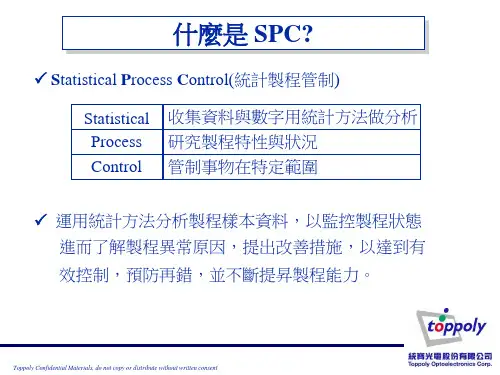

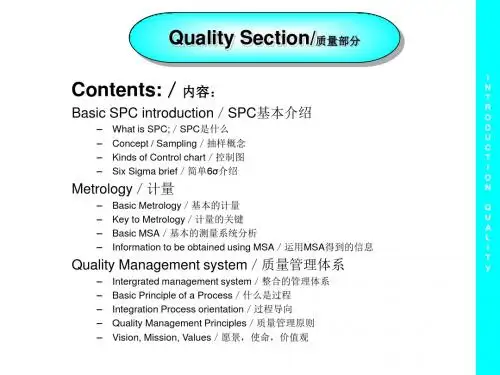

SPC Basic Training ManualIntroductionWelcome to the SPC (Statistical Process Control) Basic Training Manual. This manual is designed to provide you with a fundamental understanding of SPC and how it can be applied to improve process and product quality.Chapter 1: What is SPC?SPC is a methodology for controlling and improving the quality of processes and products. It involves the collection and analysis of data to identify and reduce variation in a process. By understanding and controlling variation, organizations can increase efficiency, reduce defects, and ultimately improve customer satisfaction.Chapter 2: Key SPC ConceptsIn this chapter, we will introduce you to the key concepts of SPC. These concepts include: - Variation: Understanding the different types of variation in a process. - Control charts: Learning how to create and interpret control charts to monitor process performance. - Process capability: Assessing the capability of a process to meet customer requirements. - Sampling: Understanding the importance of sampling techniques in data collection.Chapter 3: Tools and TechniquesIn this chapter, we will explore the various tools and techniques used in SPC. These include: - Pareto analysis: Identifying and prioritizing the most significant contributors to process variation. - Cause and effect diagrams: Investigating and understanding the root causes of process problems. - Histograms and scatter plots: Analyzingdata distributions and relationships. - Six Sigma: Applying the principles and methods of Six Sigma to improve process performance.Chapter 4: Implementing SPCIn this chapter, we will discuss the steps involved in implementing SPC in an organization. These steps include: 1. Define the process: Clearly define the process to be monitored and improved. 2. Collect data: Identify the appropriate data points and collect data over a period of time. 3. Analyze the data: Use statistical analysis techniques to identify patterns and trends in the data. 4. Implement control charts: Create control charts to monitor the process and identify out-of-control conditions. 5. Take corrective actions: When an out-of-control condition is detected, take appropriate corrective actions to bring the process back into control. 6. Continuously improve: Use the information gathered from SPC to make continuous improvements to the process.Chapter 5: SPC Case StudiesIn this final chapter, we will present real-life case studies that demonstrate the successful implementation of SPC in various industries. These case studies will highlight the benefits and the practical applications of SPC.ConclusionIn conclusion, SPC is a powerful methodology for improving process and product quality. By implementing SPC techniques, organizations can reduce defects, increase efficiency, and enhance customer satisfaction. This training manual serves as a foundation for your understanding of SPC and its applications. We encourage you to apply the knowledge gained from this manual to your own processes and make continuous improvements. Good luck on your SPC journey!。