
课程设计指导书
- 格式:ppt
- 大小:105.50 KB
- 文档页数:21
课程设计指导书课程设计名称沈阳建筑大学XXXX学院20XX 年X 月编写说明1、鼓励指导教师结合课程教学内容和学生所属专业特点,自行编写具有专业特色的《课程设计指导书》。
《课程设计指导书》的具体格式见附表。
2、允许指导教师选用校外公开出版的优秀《课程设计指导书》,但必须是所选用的《课程设计指导书》恰好能够符合我校教学大纲要求。
3、如果选用的《课程设计指导书》中有部分引用,建议摘录后编入新的《课程设计指导书》。
能力的作用;课程设计对后续课的影响等)二、课程设计题目(只写大题目或母题目,可不写“每人一题”的具体子题目)三、课程设计内容(课程设计所应完成的主要环节或项目)四、课程设计涉及知识范围(主要的先修课程及有关的实践环节)五、课程设计方法、步骤和要点(结合设计题目撰写)六、课程设计(参考)进度七、课程设计主要技术关键的分析、解决思路和方案比较等八、课程设计注意事项(学习态度、学习方法、资料使用、基本技能运用等)九、推荐参考资料(3种以上)课程设计任务书课程设计名称(20 年季学期)学院专业班级姓名指导教师年月日XXXX课程设计任务书XXXX课程设计任务书(附页)课程设计说明书设计名称设计题目设计时间学院专业班级姓名指导教师年月日XXXXX课程设计说明书目录课程设计说明书一律用A4纸,统一手写,不许打印(课程设计说明书一般应包括设计方案、设计过程、设计结果、设计体会、参考文献等,不同专业可根据本专业课程设计题目的特点,自行规定设计说明书的具体内容。
)。

课程设计指导书(自编)I. IntroductionCurriculum design is an important part of teaching and learning activities. Its purpose is to develop students’ understanding and application of professional knowledge through practical operations so as to foster their ability to think independently and solve problems. This guide aims to give specific objectives, contents, steps, methods and assessment criteria for course design in order to enable students accomplish their course design tasks smoothly.II. Objectives of the Course DesignThrough this course design, students should achieve the following:1. Get a grasp on the basic theoretical knowledge related with curriculum designing2. Have the ability of using the learned information to find practical solutions3. Develop innovative thinking and team spirit4. Enhance report writing and oral communication skillsIII. Course Design ContentThe subject matter for this course’s design is [subject of Curriculum Design] where we will cover but not limited to:1. Designing and implementing [specific content one].2. Analysis and optimalization of [specific content two].3 The applicability, expansion or development of [specific content three].IV.Course Design StepsFirstly Topic Selection & Grouping: Students choose course topics based on their interests as well as their areas of specialization.Secondly Literature Review: Check relevant literature sources to understand research background, present condition as well as future trends.Thirdly Implementation Mapping: In accordance with topic selection create detailed designs consisting; goals, methodology, procedures and anticipated outcomes.Fourthly Implementation Procedures: Experiment or simulate it t according to this designed plan.Fifthly Data Analysis: Collect experimental data organized analyzed & interpretedFinally Output Summing Up: Write a curriculum design report that summarizes process followed during its undertaking together with results achievedPreparation for Defense: Including defense presentation writing plus PPT production constitutes preparation for defense.V.Course Design ApproachesTo obtain there have to be:1. Theoretical Learning: Necessary theoretical knowledge is obtained through in-class learning, self-study and group discussion.2. Practical Work: Practical hands-on experience is gained by carrying out practical work in labs or outstation environments.3. Case study Analysis of well-known cases helps to learn from others’ design thoughts and methods4. Thinking outside the box: Novel approaches and ideas are encouraged.5. Teamwork Group work fosters team spirit and communication skills.VI.Course Design Assessment CriteriaCourse design marks will be based on the following criteria:1. Relevance, Inventiveness and Practicability (XX%)2. Standardization, Accuracy and Proficiency (XX%) in practice operation3. Science ,Logics, Deepness(XX%) of data analysispleteness in Structure, Richness in Contents as well as Coherence(XX%)of course design report5.Clarity, Arrangement and Responsiveness(XX%) to questions during defense performancesVII.ConclusionThus this guide has been designed to provide students with a clear curriculum framework as well as operational directions. It is my hope that students will read it carefully while adhering to all its requirements so that theycan successfully finish their course designs thus improving themselves academically. In case one encounters any challenge or inquiries please feel free to consult your supervisor at once.I wish you all successful course designs!。

课程设计指导书课程设计指导书一.课程设计概述微机(单片机)原理及应用课程设计是一门实践性很强的专业基础课程,要求通过理论教学和实验、课程设计等实践性教学环节,使学生能在理论的指导下,主要依靠实践活动,设计出一个小型应用系统。
目的是使学生增进对单片机的感性认识,加深对单片机理论方面的理解,掌握单片机的内部功能模块的应用,如定时器/计数器、中断、片内外存贮器、I/O口等,了解和掌握单片机应用系统的软硬件设计过程、方法及实现,为以后设计和实现单片机应用系统打下良好基础,树立严谨的科学作风,培养学生综合运用理论知识解决实际问题的能力。
学生通过单片机软硬件设计、调试、整理资料等环节,初步掌握工程设计方法和组织实践的基本技能,逐步熟悉开展科学实践的程序和方法。
二.课程设计步骤1.课程设计要求:1)根据应用系统的要求,初步掌握总体结构设计的方法和构思,从中选择一种最佳设计方案;2)根据应用系统结构规模的要求,掌握单片机外部扩充系统硬件设计的基本过程;(硬件设计)3)根据任务要求和硬件设计要求,首先画出程序的总体流程图、模块流程图,然后进行各软件模块的程序设计;(软件设计)4)掌握如何应用单片机仿真器来开发应用系统及仿真调试的过程。
2. 课程设计内容、步骤1)总体方案设计总体方案设计就是要从宏观上解决“怎么做”的问题。
其主要内容应包括:技术路线或设计途径、采用的关键技术、系统的体系结构、主要硬件的选型和加工技术、软件平台和开发语言、测试条件和测试方法、验收标准和条文等。
拟定总体设计方案一般要通过认真调研,通过查阅手册、有关文献资料、论证等,最后定稿,以避免方案上的疏忽,造成软、硬件设计产生较大的返工,延误开发进程。
在确定系统的总体方案时,对系统的硬件和软件功能应进行综合性考虑,因为系统的一个控制功能一般是既可以用硬件来完成,也可以由软件来完成,究竟采用什么方式,则要根据系统的实时性及硬件系统的性能价格比综合平衡后加以确定。
一、课程设计目的通过本次课程设计,使学生掌握单位工程施工组织设计的编制方法和编制步骤,能正确运用所学的基本理论知识,独立完成单位工程施工组织设计。
二、课程设计题目 :单位工程施工组织设计 图纸由指导教师提供,工程量采用预算作业成果。
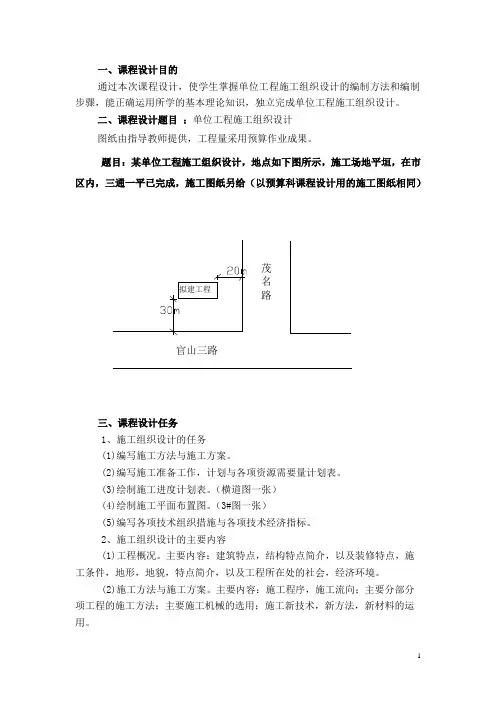
题目:某单位工程施工组织设计,地点如下图所示,施工场地平垣,在市区内,三通一平已完成,施工图纸另给(以预算科课程设计用的施工图纸相同)三、课程设计任务 1、施工组织设计的任务 (1)编写施工方法与施工方案。
(2)编写施工准备工作,计划与各项资源需要量计划表。
(3)绘制施工进度计划表。
(横道图一张) (4)绘制施工平面布置图。
(3#图一张)(5)编写各项技术组织措施与各项技术经济指标。
2、施工组织设计的主要内容(1)工程概况。
主要内容:建筑特点,结构特点简介,以及装修特点,施工条件,地形,地貌,特点简介,以及工程所在处的社会,经济环境。
(2)施工方法与施工方案。
主要内容:施工程序,施工流向;主要分部分项工程的施工方法;主要施工机械的选用;施工新技术,新方法,新材料的运用。
官山三路茂名路拟建工程(3)施工准备工作与施工进度计划表。
主要内容:施工准备工作计划表,分部分项工程的划分;进度控制的计划系统,进度控制实施计划,编制横道图。
(4)各项资源需要量计划表。
主要内容:水泥、砂、石砖、钢材以及各构配件需要计划表。
(5)施工平面图。
主要内容:水平及垂直运输机械的布置,主要材料及构配件的堆放,仓库,搅拌站的布置,临时设施的布置,施工现场道路,给排水,供电网络布置。
(6)各项技术组织措施与各项技术经济指标。
主要内容:文明施工各项措施、安全、质量措施,节约材料措施,各级技术管理人员职责等。
四、课程设计要求1、书写的清晰,条理清楚,内容符合实施施工要求,用4A纸书写。
2、进度计划表要用3#图纸绘制;横道图一张。
3、施工平面图用3#图纸绘制,应用标准图例绘制。
4、按设计内容顺序装订成册。