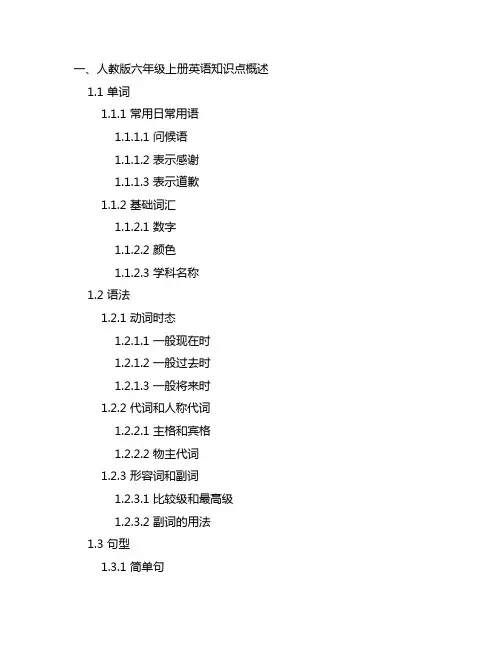
六年级英语知识点总结
- 格式:doc
- 大小:84.50 KB
- 文档页数:22
六年级英语知识点总结时态一般现在时含义结构动词变化现在进行时含义结构动词ing变化Be going to 含义结构be going to与will的对比一般过去时含义结构动词过去式变化词类动词行为动词Be动词情态动词助动词名词可数不可数名词所有格名词复数规则形容词副词比较级和最高级人称物主代词数量词基数序数句式否定句肯定句变否定句一般疑问句肯定句变一般疑问句特殊疑问句祈使句There be句型结构与have/has的对比时态一般现在时含义:1.表示现在的状态2.习惯、经常的动作,常与表频率的时间状语连用(I get up at six every day.)3.表主语性格、特征(The sky is blue.)4.客观事实、真理(The earth goes around the sun.)结构:1.be动词:肯定句:主语+be动词+其他He is a student.否定句:主语+be动词+not+其他He is not a student.一般疑问句:Be动词+主语+其他?Is he a student? Yes,he is./No,he is not.回答:Yes,主语+be动词+其他(可以省)No,主语+be动词+not+其他(可以省)特殊疑问句:疑问词+一般疑问句?Where is your bike?注:主语为第一人称,be动词用am第二人称及复数,be动词用are第三人称单数,be动词用is2.情态动词:肯定句:主语+情态动词+动词原形+其他Mary can speak Chinese.否定句:主语+情态动词+not+动词原形+其他Mary can not speak Chinese.一般疑问句:情态动词+主语+动词原形+其他?Can Mary speak Chinese? Yes,she can./No,she can’t.回答:Yes,主语+情态动词No,主语+情态动词+not特殊疑问句:疑问词+一般疑问句?What can they learn from you?3.行为动词肯定句:主语+动词原形(动词第三人称单数)+其他We study English. Mary likes Chinese.否定句:主语+do(does)+not+动词原形+其他I don’t like bread. He doesn’t often play football.一般疑问句:Do(does)+主语+动词原形+其他?Do you often play basketball? Yes,I do./No,I don’t.回答:Yes,主语+do(does) No,主语+do(does)+not 特殊疑问句:疑问词+do(does)开头的一般疑问句?Why do you like China?注:主语为第一、第二人称及复数,用动词原形和do第三人称单数,用动词第三人称单数和does动词变化:1.一般情况,直接+s (work,get,read)2.以s,x,sh,ch,o结尾的单词,+es (go,teach,wash)3.辅音+y结尾的单词,变y为i+es (study,try,carry)现在进行时含义:1.表动作正在进行(They are playing basketball.)2.现阶段正在进行的动作(We are studying English these days.)结构:肯定句:主语+be动词+动词ing+其他She is reading in the room.否定句:主语+be动词+not+动词ing+其他She isn’t reading in the room.一般疑问句:Be+主语+动词ing+其他?Is she reading in the room. Yes,she is./No,she isn’t.回答:Yes,主语+be动词No,主语+be动词+not 注:主语为第一人称,be动词用am第二人称及复数,be动词用are第三人称单数,be动词用is动词ing变化:1.一般情况,直接+ing (think,sleep,study,speak)2.以不发音的e结尾,去掉e+ing (wake,come,leave)3.元音+辅音结尾,双写辅音+ing(begin,get,run,forget)(visit直接加ing,travel变travelling)4.以ie结尾的单词,变ie为y+ing (die,lie)注:表示感觉、思想、状态、情感的动词没有ing形式See,hear,love,know,want,hope,thinkhave/has表示拥有时没有ing形式,表示开会、吃饭、玩的高兴时有ing形式I am having a good time.Be going to含义:表示将要发生、打算、计划、决定要做的事(going在这没有意,不是“去”),常与表示将来的时间状语连用。
如tomorrow,nextweek等He is going to write a letter tonight.结构:肯定句:主语+be going to+动词原形+其他I am going to play football.否定句:主语+be going to+not+动词原形+其他I am not going to play football.一般疑问句:Be+主语+going to+动词原形+其他?Are you going to play football this week? Yes,I am./No,I am not.回答:Yes,主语+be动词No,主语+be动词+not特殊疑问句:疑问词+be+主语+going to +动词原形+其他?What are you going to do this week?Be going to和will的对比:时间主客观Be going to 短时间内发生,将要主观,打算去做有计划will 不一定在短时间发生,将来客观,叙述一件将会发生的事无计划一般过去式含义:1.表示过去某个时间发生的动作或状态My father was very busy last week.2.过去常常或者反复发生的动作I got up at 5:30 in senior high school.3.常和表示过去的时间状语连用,如last week,yesterday…I played tennis last weekend.be动词变化:am/is变为was are变为were助动词变化:do,does变为did结构:1.be动词肯定句:主语+was/were+其他My father was very busy last week.否定句:主语+was/were+not+其他I was not very busy last week.一般疑问句:Was/Were+主语+其他?Was he very busy last week? Yes,he was./No,he wasn’t.回答:Yes,主语+was/were No,主语+was/were+not特殊疑问句:疑问词+一般疑问句?Why was he very busy last week?2.行为动词肯定句:主语+动词过去式+其他I played tennis last weekend.否定句:主语+did+not+动词原形+其他I didn’t play tennis last weekend.一般疑问句:Did+主语+动词原形+其他?Did you play tennis last weekend? Yes,I did./No,i\I didn’t.回答:Yes,主语+did No,主语+did+not特殊疑问句:疑问词+一般疑问句?When did you play tennis?注:疑问词做主语或修饰主语时,特殊疑问句结构为:疑问词+动词过去式+其他?或疑问词+was/were+其他成分?动词式变化:1.一般情况,直接+ed (work,play,want,ask)2.以e结尾+d (live,move,taste)3.元音+辅音结尾,双写辅音+ed (stop)4.辅音+y结尾,变y为i+ed (study,try,copy,carry)注:特殊词have/has-had, go-went, see-saw, say-said, give-gave, get-got, go-went, come-came, have-had, eat-ate, take-took, run-ran,sing-sang, put-put, make-made, read-read, write-wrote, draw-drew, drink-drank, fly-flew, ride-rode, speak-spoke, sweep-swept, swim-swam, sit-sat词类动词:1.行为动词:原形、动词+s/es、动词+ed、动词+ing2.be动词:am,is,are用于一般现在时、现在进行时、一般将来时Was,were用于一般过去时3.情态动词:can,must,should,would,may+动词原形,不受任何条件影响4.助动词:do,does,did名词:可数不可数意义能用个数计算不能用个数单复数形式有单数,有复数只有单数形式表示泛指时用a,an(元音音不能用a,an节开头)表示特指前面要用定冠词the 前面要用定冠词the表“一些,许多”用some, any, alot of, lots of 等用some, any, a lot of, lots of 等表数量时用具体的数词用"单位词+of”作主语时谓语和主语一致前有复数单位词,谓语用复数;没有用单数提问数量多少How many How much名词复数变化规则:1.一般情况,直接+s (book,mouth,house,girl)2.以s.x.sh.ch结尾的词,+es (class,box,match)3.辅音+y结尾,变y为i+es (city,party,factory)4.以f或fe结尾,变f,fe为ves (thief,wife,life,knife)注:特殊词:people-people, fish-fishman-men, woman-women, policeman-policemenfoot-feet,tooth-teethChinese-Chinese, Japanese-Japanesehero-heroes, potato-potatoes, tomato-tomatoes名词所有格1.一般情况,直接+ ’s (girl’s )2.以s结尾的复数名词,直接+ ’(boys’ ) 注:以s结尾的单数词,通常仍加’s (boss’s ,hostess’s)3.以s结尾的人名,可加’s 也可加’(Dickens’Charles’s)4.词组内,并列名词有各自的所有关系,须在各个名词后加's Tom’s and Jim’s rooms. 汤姆和杰米各自的房间。