
英国文学之十四行诗第十八首Sonnet18
- 格式:ppt
- 大小:681.00 KB
- 文档页数:52
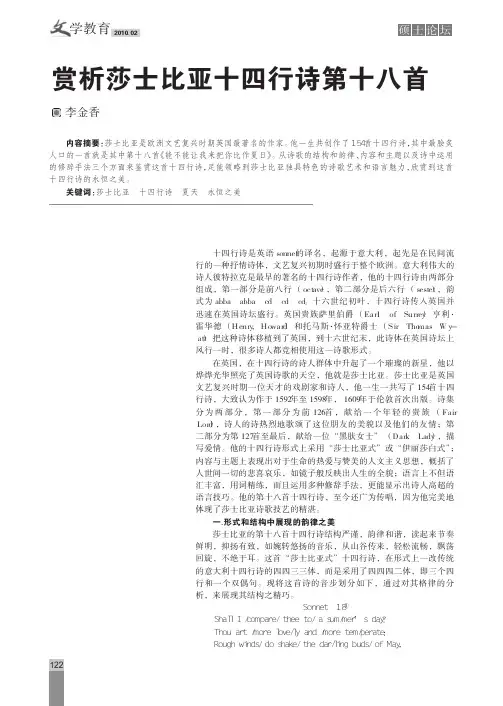
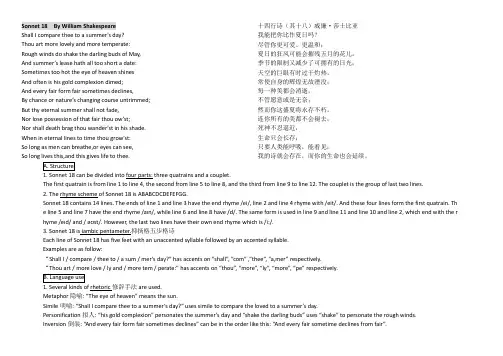
Sonnet 18By William ShakespeareShall I compare thee to a summer’s day?Thou art more lovely and more temperate: Rough winds do shake the darling buds of May, And summer’s lease hath all too short a date: Sometimes too hot the eye of heaven shines And often is his gold complexion dimed;And every fair form fair sometimes declines,By chance or natu re’s changing course untrimmed; But thy eternal summer shall not fade,Nor lose poss ession of that fair thou ow’st;Nor shall death br ag thou wander’st in his shade. When in eter nal lines to time thou grow’st:So long as men can breathe,or eyes can see,So long lives this,and this gives life to thee. 十四行诗(其十八)威廉·莎士比亚我能把你比作夏日吗?尽管你更可爱、更温和;夏日的狂风可能会摧残五月的花儿,季节的限制又减少了可拥有的日光;天空的巨眼有时过于灼热,常使自身的辉煌无故湮没;每一种美都会消逝,不管愿意或是无奈;然而你这盛夏将永存不朽,连你所有的美都不会褪去;死神不忍逼近,生命只会长存;只要人类能呼吸,能看见;我的诗就会存在,而你的生命也会延续。

莎士比亚的第十八首十四行诗是一首非常著名的诗,也是他最为人们熟知的一首。
这首诗的主题是爱与时间,诗人用简洁而富有感情的语言表达了对爱和时间的思考。
以下是对这首诗的分析:
诗的开头,“Sonnet 18”指的是这首诗是一首十四行诗,这是莎士比亚写的一组共154首的十四行诗中的第18首。
“Rough winds do shake the darling buds of May”描述的是五月的花在狂风中摇曳的景象,这可以看作是对美丽但脆弱生命的象征。
“And summer's lease hath all too short a date”则提到了夏天的短暂,暗示时间的无情流逝。
“Sometimes too hot the eys of heaven shines”和“And often is his gold complexion dimmed”进一步描述了自然景观的变化,表达了时间的无情和生命的短暂。
然而,尽管诗中充满了对生命无常和时间流逝的描绘,但最后几行却表达了乐观和永恒的观点。
“But thy eternal summer shall not fade”和“Nor shall death barge his all-corrective shallop”暗示了即使在时间的长河中,爱可以永存。
总的来说,莎士比亚在这首诗中通过自然景观的变化和生命的短暂,表达了对时间无情流逝的哀叹和对生命无常的感慨。
然而,他又以乐观和充满希望的态度暗示了爱的永恒。

莎⼠⽐亚⼗四⾏诗翻译和解读Sonnet 181. Shall I compare thee to a summer's day?Could I compare you to the time/days of summer?2. Thou art more lovely and more temperate:You are more lovely and more gentle and mild than the days.3. Rough winds do shake the darling buds of May,The wild wind shakes the favorite flowers of May.4. And summer's lease hath all too short a dateAnd the duration of summer has a limited period of time.5. Sometime too hot the eye of heaven shines,Sometimes the sun shinning is too hot.6. And often is his gold complexion dimmed,And his gold skin of the face will be dimmed by the clouds.7. And every fair from fair sometime declines,Every beautiful thing and person will decline from previous state of beauty.8. By chance, or nature's changing course untrimmed:(the beauty) will be stripped of by chance or changes of season in the nature.9. But thy eternal summer shall not fade,But your summer exists forever and will not lose color/freshness or vigor. 10. Nor lose possession of that fair thou ow'st,You will never lose your own beauty either.11. Nor shall death brag thou wander'st in his shade,The Death can’t boast that you wander in his shadow.12. When in eternal lines to time thou grow'st,You grow as time grows in the undying lines of my verse.13. So long as men can breathe, or eyes can see,So long as men can live in the world with sight and breath,14. So long lives this, and this gives life to thee.This poem will exist and you will live in it forever.Formal features14 lines4 stanzas: 3 quatrains + 1 coupletRhythm & meter: 10 syllables (5 feet) each line, iambic pentameterRhyme scheme: abab cdcd efef ggStructure:1st – 2nd quatrains: an introduction to and development of a problem3rd quatrain: a volta or a turn “突转”(a change in direction, thought, or emotion)the couplet: a summary or conclusionThe theme:The main theme is t he power of the speaker’s poem to defy time and last forever, carrying the beauty of the beloved down to future generations.What is it about?The speaker opens the poem with a question addressed to the beloved: “Shall I compare thee toa summer’s day?” The next eleven lines are devoted to such a comparison. Summer: (Line 3: rough winds;4:too short;5. too hot;6. too dimmed;7&8. beautiful things will die) Sonnet 18 is the first poem in the sonnets not to explicitly encourage the young man to have children. The “procreation” sequence of the first 17 sonnets ended with the speaker’s realization that the young man might not need children to preserve his beauty; he could also live forever in this poem.Figures of speechIn line (5 ) There is a Metaphor .In line ( 5+6 ) There is a Personification .( eye of Heaven shines ) : Eye of heaven = the sunThe sun became dark because dark of clouds .In Line (9+10+12 ) There is a Hyperbole .In Line ( 11 )There is a personification .In Line ( 14 ) There is an Inverted order .Analysis: (拓展)The poem works at a rather curious level of achieving its objective through dispraise.The summer's day is found to be lacking in so many respects (too short, too hot, too rough, and sometimes too dingy), but curiously enough one is left with the abiding impression that 'the lovely boy' is in fact like a summer's day at its best, fair, warm, sunny, temperate, one of the darling buds of May, and that all his beauty has been wonderfully highlighted by the comparison.Sonnet 1301. My mistress' eyes are nothing like the sun;My lady’s eyes aren’t like the sun at all.2. Coral is far more red, than her lips red:Coral is much redder than her lips.3. If snow be white, why then her breasts are dun;If snow is white, then her breasts are brown.4. If hairs be wires, black wires grow on her head.If hair is as coarse as threads, then her hair is full of black threads.5. I have seen roses damasked, red and white,I have seen the pinkish, red and white roses.6. But no such roses see I in her cheeks;But I can see such kinds of roses in her cheeks.7. And in some perfumes is there more delightThere is much tempting/attractive fragrance.8. Than in the breath that from my mistress reeks.The fragrance is more attractive than her steamy, sweaty and unsavory smells.9. I love to hear her speak, yet well I knowI like listening to her speaking, but I am also aware that10. That music hath a far more pleasing sound:The sound of music is much more favorable than her sound.11. I grant I never saw a goddess go,I admit that I never saw a goddess walking by.12. My mistress, when she walks, treads on the ground:My mistress stamps on the floor when she walks.13. And yet by heaven, I think my love as rare,But I can swear to God that my lover is as precious as15. As any she belied with false compare.As any woman who has been misrepresented by ridiculous comparisons.Formal features14 lines4 stanzas: 3 quatrains + 1 coupletRhythm & meter: 10 syllables (5 feet) each line, iambic pentameterRhyme scheme: abab cdcd efef ggStructure:1st – 2nd quatrains: an introduction to and development of a problem3rd quatrain: a volta or a turn “突转”(a change in direction, thought, or emotion)the couplet: a summary or conclusionThemeThe poet suggests their love is rare because he does not desire her to be something she is not.It's about finding love in spite of (or maybe even because of) physical flaws.It pokes fun at our obsession with looks and to show how ridiculous it is to ask any person to live up to some ideal of perfect beauty.Figures of speechNegative similesSimile may also be expressed in the negative form“My mistress’ eyes are nothing like the sun”Etc.Ironic toneThe sonnet appears to be humorous, but the couplet displays the deeply romantic tone of the poem.Analysis(拓展)In many ways, Shakespeare’s sonnets subvert and reverse the conventions of the Petrarchan love sequence: the idealizing love poems, for instance, are written not to a perfect woman but to an admittedly imperfect man, and the love poems to the dark lady are anything but idealizing, like this one. He describes the woman that he loves in extremely unflattering terms but claims that he truly loves her, which lends credibility to his claim because even though he does not find her attractive, he still declares his love for her.Sonnet 1291. The expense of spirit in a waste of shameThe expenditure of sexual energy in a desert of shameful moral decay2. Is lust in action: and till action, lustIs the lust/letch acting: and before having sexual intercourse, lust3. Is perjured, murderous, bloody, full of blame,Is dishonest, murderous, violent and blameworthy with a lot of guilt.4. Savage, extreme, rude, cruel, not to trust;Barbaric, extreme, rude, cruel, and untrustworthy.5. Enjoyed no sooner but despised straight;As soon as lust has been enjoyed, it is hated.6. Past reason hunted; and no sooner had,Lust is pursued beyond the control of reason, as soon as lust is fulfilled,7. Past reason hated, as a swallowed bait,It is hated irrationally like a bait that a fish swallows8. On purpose laid to make the taker mad.(The bait) set on purpose to make the trapped creature react with frenzy.9. Mad in pursuit and in possession so;10. Had, having, and in quest to have extreme;The taker is insane in pursuing one's lust and mad in possessing the object of lust: going to extremes in having had it, in the having of it, and in seeking to have it;11. A bliss in proof, and proved, a very woe;A heavenly sensation while it is being experienced. Once you are done, it is a true sorrow.12. Before, a joy proposed; behind a dream.An expected joy exists before having it; after having it, it seems like a dream.13. All this the world well knows; yet none knows wellEveryone in the world knows it very well, but no one knows14. To shun the heaven that leads men to this hell.To avoid the tempting sense of delight which leads men to hell.Formal features14 lines4 stanzas: 3 quatrains + 1 coupletRhythm & meter: 10 syllables (5 feet) each line, iambic pentameterRhyme scheme: abab cdcd efef ggStructure:1st – 2nd quatrains: an introduction to and development of a problem3rd quatrain: a volta or a turn “突转”(a change in direction, thought, or emotion)the couplet: a summary or conclusionThemeAbout lust.–Lines 1-2: lust in action (shameful and wasteful...)–Lines 3-4: lust before action (dishonest, murderous, bloody…)–Lines 5-8: a comparison between lust before and after action (enjoyed vs.despised; both are past-reason / mad) – lust causes madness!–Lines 9-12: a comparison between lust before and after action. (bliss vs. woe;joy vs. dream) – lust causes sadness and disillusionment.–Lines 13-14: a conclusion.Figures of speechSimile: taker of lust as a hooked fishPersonification: lust as a personContrasts: "before" vs. "behind" (after), "heaven" vs. "hell," and so on.Analysis (拓展)The profound hatred of sexuality, sexual pessimismIts hatred of sexuality derives from the Christian imperative of the virginal life and the dislike of all bodily functionsIt gives essentially a phallo-centric view of sexImpersonal tone: The speaker never says outright that he is writing about his own experience; instead, he presents the poem as an impersonal description, a catalogue of the kinds of experience offered by lust.。