
新概念英语第二册 lesson 2
- 格式:ppt
- 大小:2.42 MB
- 文档页数:36
(完整版)新概念英语第二册答案
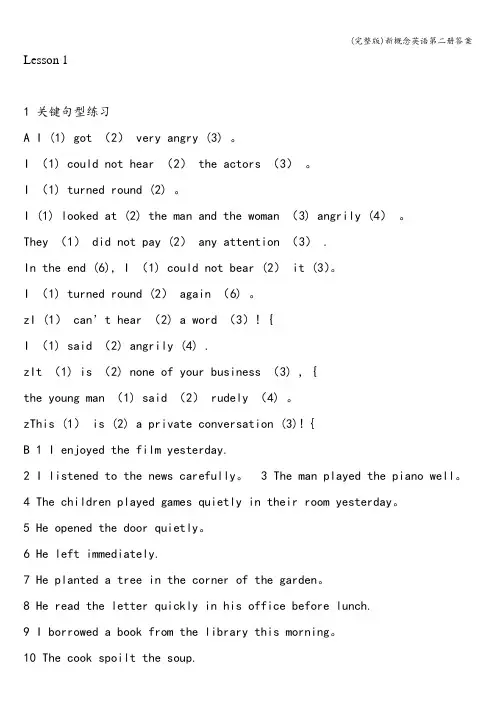
Lesson 1
1 关键句型练习
A I (1) got (2) very angry (3) 。
I (1) could not hear (2) the actors (3) 。
I (1) turned round (2) 。
I (1) looked at (2) the man and the woman (3) angrily (4) 。
They (1) did not pay (2) any attention (3) .
In the end (6), I (1) could not bear (2) it (3)。
I (1) turned round (2) again (6) 。
zI (1) can’t hear (2) a word (3)! {
I (1) said (2) angrily (4) .
zIt (1) is (2) none of your business (3) , {
the young man (1) said (2) rudely (4) 。
zThis (1) is (2) a private conversation (3)!{
B 1 I enjoyed the film yesterday.
2 I listened to the news carefully。 3 The man played the piano well。
4 The children played games quietly in their room yesterday。
5 He opened the door quietly。
6 He left immediately.
7 He planted a tree in the corner of the garden。

Lesson 1 A private conversation 私人谈话
Last week I went to the theatre. I had a very good seat. The play was very interesting.
I did not enjoy it. A young man and a young woman were sitting behind me. They
were talking loudly. I got very angry. I could not hear the actors. I turned round. I
looked at the man and the woman angrily. They did not pay any attention. In the end,
I could not bear it. I turned round again. 'I can't hear a word!' I said angrily. ‘It’s none
of your business,' the young man said rudely. 'This is a private conversation!'.
“” “”
“”
Lesson 2 Breakfast or lunch? 早餐还是午餐?
It was Sunday. I never get up early on Sundays. I sometimes stay in bed until lunch
time.
Last Sunday I got up very late. I looked out of the window. It was dark outside.
'What a day!' I thought. 'It's raining again.' Just then, the telephone rang. It was my
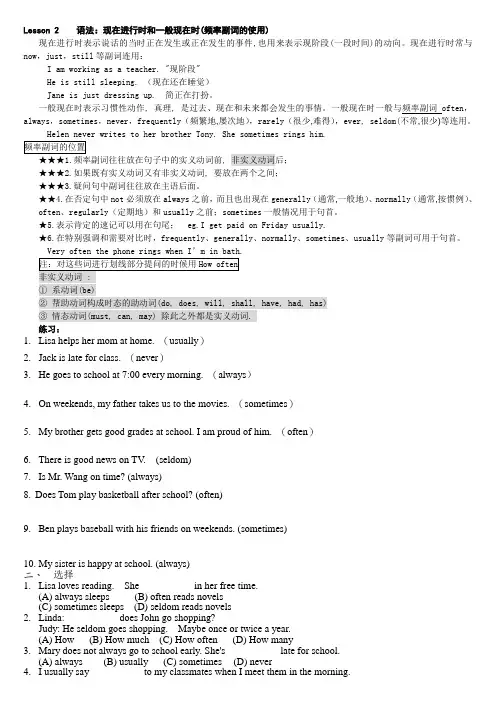
Lesson 2 语法:现在进行时和一般现在时(频率副词的使用)
现在进行时表示说话的当时正在发生或正在发生的事件,也用来表示现阶段(一段时间)的动向。现在进行时常与now,just,still等副词连用:
I am working as a teacher. "现阶段"
He is still sleeping. (现在还在睡觉)
Jane is just dressing up. 简正在打扮。
一般现在时表示习惯性动作, 真理, 是过去、现在和未来都会发生的事情。一般现在时一般与频率副词often,always,sometimes,never,frequently(频繁地,屡次地),rarely(很少,难得),ever, seldom(不常,很少)等连用。
Helen never writes to her brother Tony. She sometimes rings him.
频率副词的位置
★★★1.频率副词往往放在句子中的实义动词前, 非实义动词后;
★★★2.如果既有实义动词又有非实义动词, 要放在两个之间;
★★★3.疑问句中副词往往放在主语后面。
★★4.在否定句中not必须放在always之前,而且也出现在generally(通常,一般地)、normally(通常,按惯例)、often、regularly(定期地)和usually之前;sometimes一般情况用于句首。
★5.表示肯定的速记可以用在句尾; eg.I get paid on Friday usually.
★6.在特别强调和需要对比时,frequently、generally、normally、sometimes、usually等副词可用于句首。
Very often the phone rings when I’m in bath.
注:对这些词进行划线部分提问的时候用How often

L2Breakfast or lunch?
1 Never put off ______ tomorrow what you can eat today. A always B until C to D into
2She is very lazy and______ gets up early at weekends. A always B usually C never D also
3 Don’t worry . Your sister will come to see you _______ next month. A sometime B sometimes C some time D some times
4Hurry up! We have little time! I _____ A will come B come C shall come D am coming
5 Meimei’s handwriting is better than any other ________ in her class. A student B students C student’s D students’
6Chinese is the language spoken by the _____ number of the people in the word, but it’s not as_____ as English .
A largest widely spoken B large, wide spoken C larger ,widely speaking D largest, wide speaking
7 Do you know who _____ with at eight yesterday? A he is talking B was he talking C he was talking D is he talking