
单元音 练习题
- 格式:doc
- 大小:27.50 KB
- 文档页数:1


英语语音练习题及答案【篇一:英语语音学课后问答题答案】the making of(1) /t, d/ p57/t/ is a voiceless alveolar plosive consonant/d/ is a voiced alveolar plosive consonant/t/ the top of the tongue is raised to touch the teeth ridge or alveolus, the soft palate is raised, so that the nasal resonator is shut off. in this way, a closure is formed between the tip of the tongue and the teeth ridge. then the air from the lung is compressed behind this closure and then suddenly release the closure. the vocal folds are open or wide apart, while the vocal folds vibrate in producing the sound /d/.(2) /s, z/ p62/s/ is a voiceless blade- alveolar fricative sound/z/ is a voiced alveolar fricative consonantthe soft palate is raised, so that the nasal resonator is shut off. the tip and blade of the tongue make a light contact with upper teeth ridge. the air from the lung escapes through the narrow groove in the center of the tongue between the teeth.(3) /n/ p68/n/ is a voiced alveolar nasal consonanta. lower the soft palate to release the air through the nose;b. put the tip of the tongue against the upper front teeth-ridge and upper side teeth;c. keep the teeth slightly parted;d. vibrate the vocal cords.so that the airstream from the lung escapes through the narrow groove in the center of the tongue in producing the sound.(4) /l/ p65/l/ is a voiced alveolar lateral consonanta. close the nasal cavity by raising the soft palate;b. put the tip of the tongue against the upper front teeth-ridge for clear/l/, the front of the tongue being somewhat depressed;c. hold the air in the middle of the mouth;d. force the air out over both sides or one side of the tongue, making a lateral voiced sound.2. classify the vowels in different ways. p16-17the pure vowels can be classified according to different 4 principles.(2) according to the length of the vowels, they are divided into long vowels and short vowels. the pure vowels in transcription with two dots are long vowels. the diphthongs are also long. the rest are short ones.(3) according to the shape of the lips, the vowels can be divided into rounded vowels and uounded (spread) vowels. the rounded vowels are /?:/ /u:/ /?/ /?/ and the rest are uounded vowels.(4) according to the degree of tenseness of the muscles, the pure vowels are classified asthe eight diphthongs can be classified as closing diphthongs /e?/ /a?/ /??/ /??/ /a?/.and centring diphthongs /??/ /e?/ /??/.3. classify the consonants in different ways. p17-18there are 24 consonants in english. they are classified according to three different principles:1) the vibration of the vocal folds: those with the vibration of the vocal cords are called voiced consonants. those without the vibration of the vocal cords are called voiceless or breathed consonants.2) place of articulation: i.e., where the obstruction of the air passage is formed, the consonants can be distinguished as bilabial, labiodental, dental, alveolar, post-alveolar, palato-alveolar, palatal, velar, and glottal consonants.3) manner of articulation: they can be distinguished as plosives, fricatives, affricates, nasals, laterals, frictionless continuant and semi-vowels.4. how are /i:/ and /i/ produced? what’s the difference between them? p21-22/i:/: the front of the tongue is raised to a height slightly below and behind the front close position; the lips are spread; the tongue is tense; the side rims make a firm contact with the upper molars; it is generally long./i/: the rp vowel /i/ is pronounced with a part of the tongue nearer to the center than to front. it is raised just above the close-mid position; the lips are loosely spread; the tongue is lax; the side rims make a light contact with the upper molars; it is generally short.the difference is not merely the length of sound. there is also a difference in tongue position or quality. for /i:/ the part of the tongue that is highest is the centre of the “front” while for /i/ it is the hinder part of the “front”.5. what are the common features of the front vowels? p26(1) the front of the tongue is raised to various levels in the direction of the hard palate.(2) the tip of the tongue is usually kept down behind the lower teeth.(3) the lips are spread.6. how are the plosives produced? p56plosives are sounds resulting from a blocking or stopping effect on the airstream.6 plosives: /p/,/b/,/t/,/d/,/k/,/g//p/: a voiceless, bilabial plosive consonanta. raise the soft palate so that the nasal cavity is closed;b. breathe in the air and close the lips;c. hold the air behind the closure;d. part the lips open suddenly so that the air comes out of the mouth with a plosive sound;e. do not vibrate the vocal cords. /b/: a voiced bilabial consonantthe organic formation for /b/ is exactly the same as that for /p/ except that the air comes outof the mouth less forcefully and that the vocal cords vibrate./t/: a voiceless alveolar plosive consonanta. raise the soft palate so that the nasal cavity is closed;b. put the tip and blade of the tongue against the upper teeth ridge so that a closure isformed;c. hold the air behind the closure;d. release the closure and blade suddenly so that the air escapes with a plosive sound;e. do not vibrate the vocal folds. /d/: a voiced alveolar plosive consonantthe organic formation for /d/ is the same as that for /t/ except that the air is released less strongly and that the vocal folds vibrate./k/: a voiceless velar plosive consonant.a. raise the soft palate so that the nasal cavity is closed;b. lift the back of the tongue to touch the soft palate so that a closure is formed;c. stop the air stream behind the closure;d. break the closure and the plosive sound is heard;e. be careful not to vibrate the vocal folds./g/: a voiceless velar plosive consonantthe organic formation for /g/ is the same as that for /k/ except that the vocal cords vibrate when the air is released.7. how do you make the affricates /t?/and /d?/? p70/t?/: a voiceless palate-alveolar affricate consonanta. raise the soft palate to stop the air passage and put up the tip of the tongue to touch theback part of the teeth-ridge to form a retracted /t?/ closure;b. the main part of tongue is in position for /?/;c. release the closure slowly, and the air escapes all over the central part of the tongue withfriction;d. the lips are usually somewhat protruded;e. the vocal cords are not made to vibrate./d?/: a voiced palate-alveolar affricate consonantthe affricate /d?/ is formed like /t?/ except that the breath force is weaker and the vocal cords are made to vibrate.8. why are /w/ and /j/ called semi-vowels? p73the semi-vowels have both the features of vowels and consonants.9. please explain “open syllables” and “closed syllables”.p77open syllables are those without any consonant at the end. in british rp only a restricted set of vowels can occur.closed syllables are those that have one or more consonants at the end. all the vowels can appear in these circumstances.10. what is called incomplete plosion? p84when the release stage of a plosive sound is missing or delayed, it is known as incomplete plosion. it takes place in a word when a plosive is followed immediately by another plosive, or a fricative, or an affricate. it may also take place at the junction of words (unless they are separated by a pause).11. when do we have liaison? p86a. consonant (except r) + vowelthe final consonant of the preceding world is united tothe initial vowel of the next word in the same sense group.e.g. give it uphalf an hourb. –r or –re + vowelwhen a word ending with the letter”-r” or “-re” is followed by a wordbeginning with a vowel, the sound /r/ is usually inserted in the pronunciation.e.g. after all far and widec. vowel + vowelwhen a word ending in a vowel is followed by another word beginningwith a vowel, a short/j/ glide is inserted after /i:/, /i/, /ei/, /ai/ and /?i/, or a /w/ glide after /u:/,/u/,/?u/, and/au/e.g. at the endhurry up12. how do you explain assimilation? p95speech sounds seldom occur in isolation. in connected speech, under the influence of their neighbors, are replaced by other sounds. sometimes two neighboring sounds influence each other and are replaced by a new sound which is different from either of the two original sounds. this process is called assimilation.13. how many kinds of stress are there in a word? what are they? p107three principal kinds.(1) primary stress--heavily stressed, usually marked with a vertical stroke() on the upper left hand corner of a syllable carrying the stress, as in be’gin.(2) secondary stress--stressed but subordinate to the primary stress, usually marked with a vertical stroke (?) on the lower left hand corner of a syllable concerned, as in ?contribution.le stress or even stress. double stress can be marked by a high vertical stroke before each of the stressed syllable, as in /?f?f’ti:n/, /b ?:’l?n/, etc.14. how is sentence stress classified? for example. p115-119 three types: sense stress, logical stress, emotional stress.15. please define sense-groups. p140sense-groups are groups of words which are closely connected in meaning and grammar. each sense-group comprises a number of syllables. generally speaking, about six or seven syllables are considered appropriate.16. how many kinetic tones do you know? p153-154the tones which glide from one height to another are called kinetic tone. they are high fall, low fall; high rise, low rise; high fall-rise, and low fall-rise; rise-fall and rise-fall-rise.17. what is a tune? what are the features of the englishtune?p159,164the intonation of the whole tone-group is called a tune.a. normally a low prehead.b. normally a high head.c. in the body, the stressed syllables occupy mostly level pitches and they all fall downgradually in pitch. the unstressed syllables between the stresses ones have about the same height as the stressed syllable preceding them.d. the nucleus is usually at the end of the tune when something is uttered in isolation.e. the changes in the tail are determined by the nucleus. in a fall, the tail remains on a lowlevel pitch[ ]; in a rise or fall-rise, the tail rises gradually[ ]. 18. what’s the function of the falling-rising tune? p173it is used to show contrast, reservation, implication, disagreement, contradiction or warning, etc.1) declarative sentence: the falling-rising tune used in declarative sentences indicates incompleteness and implications, such as concession, gratitude, regret, apology, request, reproach and rebut, etc.2) interrogative sentences:a. special questions: the falling-rising tune used in the special question is stronger than the rising tune. it expresses surprise, interest, request, sympathy, disgust and disbelief, etc.b. general questions: the falling-rising tune used in the general question can express hesitation, request, agitation, exaggeration, etc. no answer is expected by the speaker. c. disjunctive question.3) imperative sentence: the falling-rising tune used in the imperative sentence expresses a warning or an urgent request.4) exclamatory sentence: the falling-rising tune is seldom used in exclamatory sentences. however, when used, it expresses enthusiasm, appreciation, sympathy, encouragement, regret and contempt, etc.【篇二:英语音标练习题—判断发音(含答案)[1]_2】>一、选出划线部分与其他三项发音不同的一项 ( c( a ( d ( b ( b ( a( d( b ( a ( c ( d ( c ( a ( b ( c( a ( d ( b ( a ( a ( b( c ( b ( c ( b ( d ( d ( c ( b( a ( b ( c ( c ( a( a ( b ( d ( d- 1 -- 2 -(((((((((((((((((((((((【篇三:英语语音练习题一】国际音标共48个音素,其中元音音素20个,辅音音素28个。

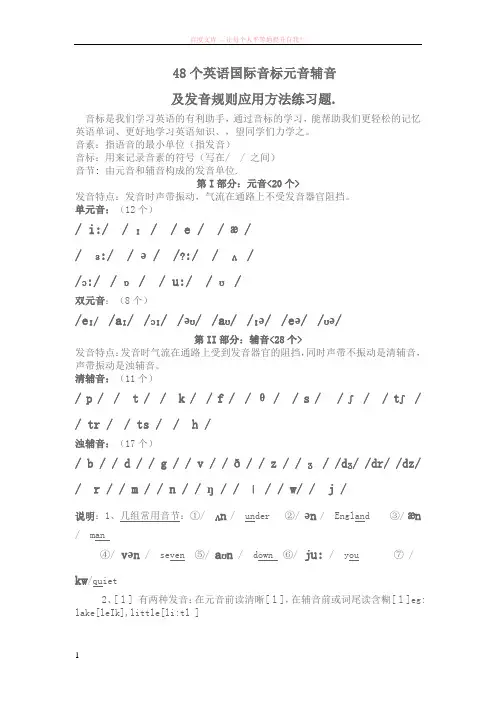
48个英语国际音标元音辅音及发音规则应用方法练习题.音标是我们学习英语的有利助手,通过音标的学习,能帮助我们更轻松的记忆英语单词、更好地学习英语知识、,望同学们力学之。
音素:指语音的最小单位(指发音)音标:用来记录音素的符号(写在/ / 之间)音节: 由元音和辅音构成的发音单位.第I部分:元音<20个>发音特点:发音时声带振动,气流在通路上不受发音器官阻挡。
单元音:(12个)/ i:/ / ɪ/ / e / / æ // ɜ:/ / ə / /?:/ / ʌ//ɔ:// ɒ/ / u:/ / ʊ/双元音:(8个)/eɪ//aɪ//ɔɪ//əʊ//aʊ//ɪə//eə//ʊə/第II部分:辅音<28个>发音特点:发音时气流在通路上受到发音器官的阻挡,同时声带不振动是清辅音,声带振动是浊辅音。
清辅音:(11个)/ p // t // k // f // θ / / s / / ʃ/ / tʃ/ / tr / / ts / / h /浊辅音:(17个)/ b / / d / / g / / v / / ð / / z / / ʒ/ /dʒ/ /dr/ /dz/ / r / / m / / n / / ŋ / / ǀ/ / w/ / j /说明:1、几组常用音节:①/ʌn/ un der ②/ən/ Englan d ③/ æn / man④/ vən / seven ⑤/ aʊn / down ⑥/ j u: / you ⑦ /kw/quiet2、[ l ] 有两种发音:在元音前读清晰[ l ],在辅音前或词尾读含糊[ l ]eg: lake[leIk],little[li:tl ]3、清音浊化:/sp/→ /sb/ spring, /st/→/sd/ stay, /sk/→ /sg/ skirt, /str/→ /sdr/ street.巩固部分:1、国际音标有多少个?其中元音多少个?辅音多少个?2、元音音素分哪两部分?各多少个?辅音分哪两部分?各多少个?3、标出以下音标中的元音音素:6个/ ɒ/ 、/ ɜ:/ 、/ k /、/ e / 、/dʒ/ 、/ɪə/、/ ?:/ 、/eə/、/ f /、/ tʃ/音标的使用学习了元音和辅音之后,这节课我们要进一步学习一下他们的使用技巧:A . 用音标读单词的方法:先找单词音标中的元音音素,之后与其前辅音拼读发音。

单元音练习题Lesson 1单元音[i] [i:] [e][æ] 学习[i]朗读五遍一、将下列单词中发 [i]这个音的字母划出来pig fish in fifteen six ship thin begin behind jacket basketballhappy heavy busy carry sunnylovely study twenty thirty windy rainy monkey money二、根据发音规则,圈出每组中划线的元音字母发音不相同的单词.1.sofa sit kick lip2.ink gift jam ship3。
hand picture big sister4.hot pick pig bill[i:]朗读五遍一、请将下列单词中发 [i:]这个音的字母划出来me be she he we eveningsweet bee sweep sheep see sleep three green meat leaf sea pea teach eat clean 二、圈出下列单词中划线的元音字母或字母组合组合发音相同的两个词。
1。
seat rain bean cat2.gift feet teacher dog3.pig star tree jeep4.sweet sea fish the[e] 朗读五遍一、请将下列单词中发[e] 这个音的字母或字母组合划出来egg bell desk leg pet ten pen bread head breakfast二、根据发音规则,找出每组中不发[e]的单词。
1.cat well leg pen2.sweat map pet elephant3.egg ten tall desk4.bread head bed toy[æ] 朗读五遍一、将单词中发[e]这个音的字母或字母组合划出来dad cap cat bad apple bag flaghand rabbit ant black fat hasstand rat map二、根据发音规则,找出每组中划线部分发[æ]的单词。