
Chapter 11 Facility Engineering & Maintenance
- 格式:ppt
- 大小:168.50 KB
- 文档页数:21


CHAPTER NINEOFFSHORE STRUCTURAL ENGINEERINGOffshore structural Engineering is a relatively new field of engineering concerned with the design and installation of offshore platforms for various purposes. It dates from about 1974, when the first steel structure was installed in the open waters of the Gulf of Mexico。
It differs from conventional structural engineering mainly in the special problems that have to be considered in the transportation of the structure to the offshore site,its installation,and its ability to withstand the severe environmental loading. The chief driving force behind this new technology has come from the oil industry and its need for fixed platforms for exploitation of the extensive hydrocarbon deposits existing offshore. Its use is,however,not limited solely to this industry and it has important applications also for military and navigational purposes。

Book reviewModeling,Simulation,and Control of Flexible Manufacturing Systems ±A Petri Net Approach;Meng Chu Zhou;Kurapati Venkatesh;Yushun Fan;World Scienti®c,Singapore,19991.IntroductionA ¯exible manufacturing system (FMS)is an automated,mid-volume,mid-va-riety,central computer-controlled manufacturing system.It can be used to produce a variety of products with virtually no time lost for changeover from one product to the next.FMS is a capital-investment intensive and complex system.In order to get the best economic bene®ts,the design,implementation and operation of FMS should be carefully made.A lot of researches have been done regarding the modeling,simulation,scheduling and control of FMS [1±6].From time to time,Petri net (PN)method has also been used as a tool by di erent researcher in studying the problems regarding the modeling,simulation,scheduling and control of FMS.A lot of papers and books have been published in this area [7±14].``Modeling,Simulation,and Control of Flexible Manufacturing Systems ±A PN Approach''is a new book written by Zhou and Venkatesh which is focused on studying FMS using PN as a systematic method and integrated tool.The book's contents can be classi®ed into four parts.The four parts are introduction part (Chapter 1to Chapter 4),PNs application part (Chapter 5to Chapter 8),new research results part (Chapter 9to Chapter 13),and future development trend part (Chapter 14).In the introduction part,the background,motivation and objectives of the book are described in Chapter 1.The brief history of manufacturing systems and PNs is also presented in Chapter 1.The basic de®nitions and problems in FMS design and implementation are introduced in Chapter 2.The authors divide FMS related problems into two major areas ±managerial and technical.In Chapter 4,basic de®nitions,properties,and analysis techniques of PNs are presented,Chapter 4can be used as the fundamentals of PNs for those who are not familiar with PN method.In Chapter 3,the authors presented their approach to studying FMS related prob-lems,the approach uses PNs as an integrated tool and methodology in FMS design and implementation.In Chapter 3,various applications in modeling,analysis,sim-ulation,performance evaluation,discrete event control,planning and scheduling of FMS using PNs are presented.Through reading the introduction part,the readers can obtain basic concepts and methods about FMS and PNs.The readers can also get a clear picture about the relationshipbetween FMS and PNs.Mechatronics 11(2001)947±9500957-4158/01/$-see front matter Ó2001Elsevier Science Ltd.All rights reserved.PII:S 0957-4158(00)00057-X948Book review/Mechatronics11(2001)947±950The second part of the book is about PNs applications.In this part,various applications of using PNs in solving FMS related problems are introduced.FMS modeling is the basis for simulation,analysis,planning and scheduling.In Chapter5, after introduction of several kinds of PNs,a general modeling method of FMS using PNs is given.The systematic bottom-up and top-down modeling method is pre-sented.The presented method is demonstrated by modeling a real FMS cell in New Jersey Institute of Technology.The application of PNs in FMS performance analysis is introduced in Chapter 6.The stochastic PNs and the time distributions are introduced in this Chapter. The analysis of a¯exible workstation performance using the PN tool called SPNP developed at Duke University is given in Section6.4.In Chapter7,the procedures and steps involved for discrete event simulation using PNs are discussed.The use of various modeling techniques such as queuing network models,state-transition models,high-level PNs,object-oriented models for simulations are brie¯y explained.A software package that is used to simulate PN models is introduced.Several CASE tools for PNs simulations are brie¯y intro-duced.In Chapter8,PNs application in studying the di erent e ects between push and pull paradigms is shown.The presented application method is useful for the selection of suitable management paradigm for manufacturing systems.A manufacturing system is modeled considering both push and pull paradigms in Section8.3which is used as a practical example.The general procedures for performance evaluation of FMS with pull paradigm are given in Section8.4.The third part of the book is mainly the research results of the authors in the area of PNs applications.In Chapter9,an augmented-timed PN is put forward. The proposed method is used to model the manufacturing systems with break-down handling.It is demonstrated using a¯exible assembly system in Section9.3. In Chapter10,a new class of PNs called Real-time PN is proposed.The pro-posed PN method is used to model and control the discrete event control sys-tems.The comparison of the proposed method and ladder logic diagrams is given in Chapter11.Due to the signi®cant advantages of Object-oriented method,it has been used in PNs to de®ne a new kind of PNs.In Chapter12,the authors propose an Object-oriented design methodology for the development of FMS control software.The OMT and PNs are integrated in order to developreusable, modi®able,and extendible control software.The proposed methodology is used in a FMS.The OMT is used to®nd the static relationshipamong di erent objects.The PN models are formulated to study the performance of the FMS.In Chapter12,the scheduling methods of FMS using PNs are introduced.Some examples are presented for automated manufacturing system and semiconductor test facility.In the last Chapter,the future research directions of PNs are pointed out.The contents include CASE tool environment,scheduling of large production system,su-pervisory control,multi-lifecycle engineering and benchmark studies.Book review/Mechatronics11(2001)947±950949 mentsAs a monograph in PNs and its applications in FMS,the book is abundant in contents.Besides the rich knowledge of PNs,the book covers almost every aspects regarding FMS design and analysis,such as modeling,simulation,performance evaluation,planning and scheduling,break down handling,real-time control,con-trol software development,etc.So,the reader can obtain much knowledge in PN, FMS,discrete event system control,system simulation,scheduling,as well as in software development.The book is a very good book in the combinations of PNs theory and prac-tical applications.Throughout the book,the integrated style is demonstrated.It is very well suited for the graduate students and beginners who are interested in using PN methods in studying their speci®c problems.The book is especially suited for the researchers working in the areas of FMS,CIMS,advanced man-ufacturing technologies.The feedback messages from our graduate students show that compared with other books about PNs,this book is more interested and easy to learn.It is easy to get a clear picture about what is PNs method and how it can be used in the FMS design and analysis.So,the book is a very good textbook for the graduate students whose majors are manufacturing systems, industrial engineering,factory automation,enterprise management,and computer applications.Both PNs and FMS are complex and research intensive areas.Due to the deep understanding for PNs,FMS,and the writing skills of the authors,the book has good advantages in describing complex problems and theories in a very easy read and understandable fashion.The easy understanding and abundant contents enable the book to be a good reference book both for the students and researchers. Through reading the book,the readers can also learn the new research results in PNs and its applications in FMS that do not contained in other books.Because the most new results given in the book are the study achievements of the authors,the readers can better know not only the results,but also the background,history,and research methodology of the related areas.This would helpthe researchers who are going to do the study to know the state-of-art of relevant areas,thus the researchers can begin the study in less preparing time and to get new results more earlier.As compared to other books,the organization of the book is very application oriented.The aims are to present new research results in FMS applications using PNs method,the organization of the book is cohesive to the topics.A lot of live examples have reinforced the presented methods.These advantages make the book to be a very good practical guide for the students and beginners to start their re-search in the related areas.The history and reference of related research given in this book provides the reader a good way to better know PNs methods and its applications in FMS.It is especially suited for the Ph.D.candidates who are determined to choose PNs as their thesis topics.950Book review/Mechatronics11(2001)947±9503.ConclusionsDue to the signi®cant importance of PNs and its applications,PNs have become a common background and basic method for the students and researchers to do re-search in modeling,planning and scheduling,performance analysis,discrete event system control,and shop-¯oor control software development.The book under re-view provides us a good approach to learn as well as to begin the research in PNs and its application in manufacturing systems.The integrated and application oriented style of book enables the book to be a very good book both for graduate students and researchers.The easy understanding and step-by-step deeper introduction of the contents makes it to be a good textbook for the graduate students.It is suited to the graduated students whose majors are manufacturing system,industrial engineering, enterprise management,computer application,and automation.References[1]Talavage J,Hannam RG.Flexible manufacturing systems in practice:application,design,andsimulation.New York:Marcel Dekker Inc.;1988.[2]Tetzla UAW.Optimal design of¯exible manufacturing systems.New York:Springer;1990.[3]Jha NK,editor.Handbook of¯exible manufacturing systems.San Diego:Academic Press,1991.[4]Carrie C.Simulation of manufacturing.New York:John Wiley&Sons;1988.[5]Gupta YP,Goyal S.Flexibility of manufacturing systems:concepts and measurements.EuropeanJournal of Operational Research1989;43:119±35.[6]Carter MF.Designing¯exibility into automated manufacturing systems.In:Stecke KE,Suri R,editors.Proceedings of the Second ORSA/TIMS Conference on FMS:Operations Research Models and Applications.New York:Elsevier;1986.p.107±18.[7]David R,Alla H.Petri nets and grafcet.New York:Prentice Hall;1992.[8]Zhou MC,DiCesare F.Petri net synthesis for discrete event control of manufacturing systems.Norwell,MA:Kluwer Academic Publishers;1993.[9]Desrochers AA,Al-Jaar RY.Applications of petri nets in manufacturing systems.New York:IEEEPress;1995.[10]Zhou MC,editor.Petri nets in¯exible and agile automation.Boston:Kluwer Academic Publishers,1995.[11]Lin C.Stochastic petri nets and system performance evaluations.Beijing:Tsinghua University Press;1999.[12]Peterson JL.Petri net theory and the modeling of systems.Englewood Cli s,NJ:Prentice-Hall;1981.[13]Resig W.Petri nets.New York:Springer;1985.[14]Jensen K.Coloured Petri Nets.Berlin:Springer;1992.Yushun FanDepartment of Automation,Tsinghua UniversityBeijing100084,People's Republic of ChinaE-mail address:*****************。

2023年河北省高考英语真题及答案解析本试卷共12页。
考试结束后, 将本试卷和答题卡一并交回。
注意事项: 1. 答题前, 考生先将自己的姓名、准考证号码填写清楚, 将条形码准确粘贴在考生信息条形码粘贴区。
2. 选择题必须使用2B铅笔填涂; 非选择题必须使用0.5毫米黑色字迹的签字笔书写, 字体工整、笔迹清楚。
3. 请按照题号顺序在答题卡各题目的答题区域内作答, 超出答题区域书写的答案无效; 在草稿纸、试卷上答题无效。
4. 作图可先使用铅笔画出, 确定后必须用黑色字迹的签字笔描黑。
5. 保持卡面清洁, 不要折叠, 不要弄破、弄皱, 不准使用涂改液、修正带、刮纸刀。
第一部分听力(1-20小题)在笔试结束后进行。
第二部分阅读(共两节,满分50分)第一节(共15小题;每小题2.5分,满分37.5分)阅读下列短文,从每题所给的A、B、C、D四个选项中选出最佳选项。
ABike Rental & Guided ToursWelcome to Amsterdam, welcome to MacBike. You see much more from the seat of a bike! Cycling is the most economical, sustainable and fun way to explore the city, with its beautiful canals, parks, squares and countless lights. You can also bike along lovely landscapes outside of Amsterdam.Why MacBikeMacBike has been around for almost 30 years and is the biggest bicycle rental company in Amsterdam. With over 2,500 bikes stored in our five rental shops at strategic locations, we make sure there is always a bike available for you. We offer the newest bicycles in a wide variety, including basic bikes with foot brake (刹车), bikes with hand brake and gears (排挡), bikes with child seats, and children’s bikes.PricesGuided City ToursThe 2.5-hour tour covers the Gooyer Windmill, the Skinny Bridge, the Rijksmuseum, Heineken Brewery and much more. The tour departs from Dam Square every hour on the hour, starting at 1:00 pm every day. You can buy your ticket in a MacBike shop or book online.1. What is an advantage of MacBike?A. It gives children a discount.B. It of offers many types of bikes.C. It organizes free cycle tours.D. It has over 2,500 rental shops.2. How much do you pay for renting a bike with hand brake and three gears for two days?A. €15.75.B. €19.50.C. €22.75.D. €29.50.3. Where does the guided city tour start?A. The Gooyer, Windmill.B. The Skinny Bridge.C. Heineken Brewery.D. Dam Square.BWhen John Todd was a child, he loved to explore the woods around his house, observing how nature solved problems. A dirty stream, for example, often became clear after flowing through plants and along rocks where tiny creatures lived. When he got older, John started to wonder if this process could be used to clean up the messes people were making.After studying agriculture, medicine, and fisheries in college, John went back to observing nature and asking questions. Why can certain plants trap harmful bacteria (细菌)? Which kinds of fish can eat cancer-causing chemicals? With the right combination of animals and plants, he figured, maybe he could clean up waste the way nature did. He decided to build what he would later call an eco-machine.The task John set for himself was to remove harmful substances from some sludge (污泥). First, he constructed a series of clear fiberglass tanks connected to each other. Then he went around to local ponds and streams and brought back some plants and animals. He placed them in the tanks and waited. Little by little, these different kinds of life got used to one another and formed their own ecosystem. After a few weeks, John added the sludge.He was amazed at the results. The plants and animals in the eco-machine took the sludge as food and began to eat it! Within weeks it had all been digested, and all that was left was pure water.Over the years, John has taken on many big jobs. He developed a greenhouse — like facility that treated sewage (污水) from 1,600 homes in South Burlington. He also designed an eco-machine to clean canal water in Fuzhou, a city in southeast China.“Ecological design” is the name John gives to what he does. “Life on Earth is kind of a box of spare parts for the inventor,” he says. “You put organisms in new relationships and observe what’s happening. Then you let these new systems develop their own ways to self-repair.”4. What can we learn about John from the first two paragraphs?A. He was fond of traveling.B. He enjoyed being alone.C. He had an inquiring mind.D. He longed to be a doctor.5. Why did John put the sludge into the tanks?A. To feed the animals.B. To build an ecosystem.C. To protect the plants.D. To test the eco-machine.6. What is the author’s purpose in mentioning Fuzhou?A. To review John’s research plans.B. To show an application of John’s idea.C. To compare John’s different jobs.D. To erase doubts about John’s invention.7. What is the basis for John’s work?A. Nature can repair itself.B. Organisms need water to survive.C. Life on Earth is diverse.D. Most tiny creatures live in groups.CThe goal of this book is to make the case for digital minimalism, including a detailed exploration of what it asks and why it works, and then to teach you how to adopt this philosophy if you decide it’s right for you.To do so, I divided the book into two parts. In part one, I describe the philosophical foundations of digital minimalism, starting with an examination of the forces that are making so many people’s digital lives increasingly intolerable, before moving on to a detailed discussion of the digital minimalism philosophy.Part one concludes by introducing my suggested method for adopting this philosophy: the digital declutter. This process requires you to step away from optional online activities for thirty days. At the end of the thirty days, you will then add back a small number of carefully chosen online activities that you believe will provide massive benefits to the things you value.In the final chapter of part one, I’ll guide you through carrying out your ow n digital declutter. In doing so, I’ll draw on an experiment I ran in 2018 in which over 1,600 people agreed to perform a digital declutter. You’ll hear these participants’ stories and learn what strategies worked well for them, and what traps they encountered that you should avoid.The second part of this book takes a closer look at some ideas that will help you cultivate (培养) a sustainable digital minimalism lifestyle. In these chapters, I examine issues such as the importance of solitude (独处) and the necessity of cultivating high-quality leisure to replace the time most now spend on mindless device use. Each chapter concludes with a collection of practices, which are designed to help you act on the big ideas of the chapter. You can view these practices as a toolbox meant to aid your efforts to build a minimalist lifestyle that words for your particular circumstances.8. What is the book aimed at?A. Teaching critical thinking skills.B. Advocating a simple digital lifestyle.C. Solving philosophical problems.D. Promoting the use of a digital device.9. What does the underlined word “declutter” in paragraph 3 mean?A. Clear-up.B. Add-on.C. Check-in.D.Take-over.10. What is presented in the final chapter of part one?A. Theoretical models.B. Statistical methods.C. Practical examples.D. Historical analyses.11. What does the author suggest readers do with the practices offered in part two?A. Use them as needed.B. Recommend them to friends.C. Evaluate their effects.D. Identify the ideas behind them.DOn March 7, 1907, the English statistician Francis Galton published a paper which illustrated what has come to be known as the “wisdom of crowds” effect. The experiment of estimation he conducted showed that in some cases, the average of a large number of independent estimates could be quite accurate.This effect capitalizes on the fact that when people make errors, those errors aren’t always the same. Some people will tend to overestimate, and some to underestimate. When enough of these errors are averaged together, they cancel each other out, resulting in a more accurate estimate. If people are similar and tend to make the same errors, then their errors won’t cancel each other out. In more technical terms, the wisdom of crowds requires that people’s esti mates be independent. If for whatever reasons, people’s errors become correlated or dependent, the accuracy of the estimate will go down.But a new study led by Joaquin Navajas offered an interesting twist (转折) on this classic phenomenon. The key finding of the study was that when crowds were further divided into smaller groups that were allowed to have a discussion, the averages from these groups were more accurate than those from an equal number of independent individuals. For instance, the average obtained from the estimates of four discussion groups of five was significantly more accurate than the average obtained from 20 independent individuals.In a follow-up study with 100 university students, the researchers tried to get a better sense of what the group members actually did in their discussion. Did they tend to go with those most confident about their estimates? Did they follow those least willing to change their minds? This happened some of the time, but it wasn’t the dominant response. Most frequent ly, the groups reported that they “shared arguments and reasoned together.” Somehow, these arguments and reasoning resulted in a global reduction in error. Although the studies led by Navajas have limitations and many questions remain the potential implications for group discussion and decision-making are enormous.12. What is paragraph 2 of the text mainly about?A. The methods of estimation.B. The underlying logic of the effect.C. The causes of people’s errors.D. The design of Galton’s experiment.13. Navajas’ study found that the average accuracy could increase even if ________.A. the crowds were relatively smallB. there were occasional underestimatesC. individuals did not communicateD. estimates were not fully independent14. What did the follow-up study focus on?A. The size of the groups.B. The dominant members.C. The discussion process.D. The individual estimates.15. What is the author’s attitude toward Navajas’ studies?A. Unclear.B. Dismissive.C. Doubtful.D. Approving.第二节(共5小题;每小题2.5分,满分12.5分)阅读下面短文,从短文后的选项中选出可以填入空白处的最佳选项。
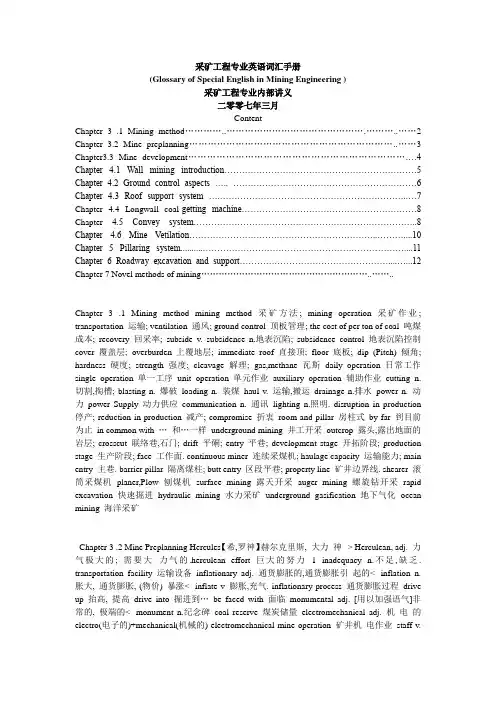
采矿工程专业英语词汇手册(Glossary of Special English in Mining Engineering )采矿工程专业内部讲义二零零七年三月ContentChapter 3 .1 Mining method (2)Chapter 3.2 Mine preplanning (3)Chapter3.3 Mine development (4)Chapter 4.1 Wall mining introduction (5)Chapter 4.2 Ground control aspects ..... (6)Chapter 4.3 Roof support system (7)Chapter 4.4 Longwall coal-getting machine (8)Chapter 4.5 Convey system (8)Chapter 4.6 Mine Vetilation (10)Chapter 5 Pillaring system (11)Chapter 6 Roadway excavation and support (12)Chapter 7 Novel methods of mining…………………………………………………..……..Chapter 3 .1 Mining method mining method 采矿方法; mining operation 采矿作业; transportation 运输; ventilation 通风; ground control 顶板管理; the cost of per ton of coal 吨煤成本; recovery 回采率; subside v. subsidence n.地表沉陷; subsidence control 地表沉陷控制cover 覆盖层; overburden 上覆地层; immediate roof 直接顶; floor 底板; dip (Pitch) 倾角; hardness 硬度; strength 强度; cleavage 解理; gas,methane 瓦斯daily operation 日常工作single operation 单一工序unit operation 单元作业auxiliary operation 辅助作业cutting n. 切割,掏槽; blasting n. 爆破loading n. 装煤haul v. 运输,搬运drainage n.排水power n. 动力power Supply 动力供应communication n. 通讯lighting n.照明. disruption in production 停产; reduction in production 减产; compromise 折衷room and pillar 房柱式by far 到目前为止in common with …和…一样underground mining 井工开采outcrop 露头,露出地面的岩层; crosscut 联络巷,石门; drift 平硐; entry 平巷; development stage 开拓阶段; production stage 生产阶段; face 工作面. continuous miner 连续采煤机; haulage capacity 运输能力; main entry 主巷. barrier pillar 隔离煤柱; butt entry 区段平巷; property line 矿井边界线. shearer 滚筒采煤机planer,Plow 刨煤机surface mining 露天开采auger mining 螺旋钻开采rapid excavation 快速掘进hydraulic mining 水力采矿underground gasification 地下气化ocean mining 海洋采矿Chapter 3 .2 Mine Preplanning Hercules【希,罗神】赫尔克里斯, 大力神--> Herculean, adj. 力气极大的; 需要大力气的.herculean effort 巨大的努力 1 inadequacy n.不足,缺乏. transportation facility 运输设备inflationary adj. 通货膨胀的,通货膨胀引起的<--inflation n.胀大, 通货膨胀, (物价) 暴涨<--inflate v 膨胀,充气. inflationary process 通货膨胀过程drive up 抬高, 提高drive into 掘进到…be faced with 面临monumental adj. [用以加强语气]非常的, 极端的<--monument n.纪念碑coal reserve 煤炭储量electromechanical adj. 机电的electro(电子的)+mechanical(机械的) electromechanical mine operation 矿井机电作业staff v.雇用,聘用season v 适用,适应coordinate n. 坐标.v. (使)互相配合, (使)协调, 调整. a multitude(n. 多数,多量) of 大量capital investment 基本建设投资. foremost 最主要的,最重要的, 1Billion = 1,000,000,000 即10 亿. Mt metric ton 公吨. 453.5Mt = 500 million tons 0.907Mt = 1 million ton put into operation 投产,投入使用raise 筹集the life of the property 矿产/井的使用年限. commercial value 市场价值,商业价值. for convenience 为了方便其见minability 可采性marketability 适销性,可销性coal reserve 煤矿nominal,名义上的,极小的. option 买卖选择权,优先购买权enter upon 开始preliminary examination 初步调查operating mine 生产矿井to the extent that 达到这种程度以致... ; 就...来说;在...方面来说; 2 adjacent to 邻近的surface topography 地面地形,表面地形coalfield 煤田measure 层组coal-bearing measure 含煤地层feature 特征;地貌. structural feature 构造特征surface improvement 地面上的改造tilled area 耕地reservoir 水库power line 电力线,输电线reservation n.保留地;自然保护区on record n.留有记录的,记录在案的preferred 优先〔选用〕的,首选的traverse 导线. traverse with compass 罗盘定位. system surveying 系统测量sampling 采样have a bearing on 对…有影响,与...有关available 有效的,可用的pricing schedule 定价方案preparation treatment 洗选加工selective adj.有选择性的,选择的a master plan of operation 总体生产计划. serve as 用作,作为,起到…作用. basis 基础,根据,依据since 引导原因状语从句justify 调整,证明,证明…是正确的, prospecting 勘探drilling pattern 钻孔布置,钻孔图式basic map 底图,基本地图log sheet 钻孔柱状图tabular adj. <==table tabular record 表格记录operating management 经营管理部门,经营管理life expectancy 预期使用年限,使用寿命delivery of supplies 材料供应estimate of the cost 成本估计sales department 销售部门Chapter 3.3 Mine development portal 井筒expected life of the mine 矿井的设计使用年限rail haulage 轨道运输as well as 即…又…be of +n. 具有…(性质) drift 平硐shaft 立井,竖井slope 斜井main shaft 主立井auxiliary shaft 副立井air shaft 风井transfer house 中转煤仓headframe 井架hoist house 提升机房,绞车房skip 箕斗cage 罐笼car dump 卸煤设备storage bin 井底煤仓deplete 耗尽,衰竭whether…or…是…还是…pressure drop 压降net effect 净效应,有效效应,实际结果capital cost 基建费用Chapter 4.1 Walling system introduction working face 工作面coalface:采煤工作面interconnection:切眼3 panel entry:区段平巷gate entry:工作面顺槽head gate:区段皮带巷,运输巷tail gate:区段轨道巷,回风巷headentry:工作面运输巷(下顺槽) tailentry:工作面回风巷(上顺槽) bleeder entry:区段回风巷cross-cut:联络巷gob, goaf:采空区end:端头Longwall mining 长壁采矿法Shortwall mining 短壁采矿法pillar system. 柱式系统longwall mining on strike 走向长壁采煤方法mining in advance / wall advancing mining 前进式采煤方法mining in retreat / wall retreating mining 后退式采煤方法inclined longwall mining 倾斜长壁开采underhand mining 俯采overhand mining 仰采Coal mining machine, coal-getting machine 采煤机; Shearer,滚筒采煤机Plow,planer 刨煤机Face conveyor 工作面运输机Pan line,"溜子" Chain conveyor 链式运输机Scraper chain conveyor 刮板输送机Armored chain conveyor 铠装运输机Roof support system:顶板支护系统Friction props:摩擦支柱Friction metal props:摩擦支柱Hydraulic prop:液压支柱Single/Individual hydraulic prop 单体液压支柱Hydraulic powered self-advanced support: 液压自移式支架roof support 顶板支架stage loader:转载机panel belt conveyor 区段皮带运输机electrical control 电力控制装置/设备hydraulic pump 液压泵站blast mining technology 爆破采煤工艺conventionally mechanized mining technology 普通机械化采煤fully mechanized mining technology 综合机械化采煤fully mechanized mining with sublevel caving technology 综采放顶煤方法Chapter 4.2 Ground control 工作面周围地层: Overlying strata 上覆地层: Main roof 老顶,基本顶 4 Immediate roof 直接顶Gob 采空区--Face—rib(煤壁) Floor 底板Underlying strata 下伏地层Ground control 顶板处理方式: (1)Caving;(2)Pack. Stable 切口,机窝dead work 准备工作,非生产性工作. Mobile belt conveyor 可移式胶带运输机No exception 无一例外regular maintenance n.日常修理,定期检修Downtime 停工期(由于损坏, 修理等原因造成的停机时间),停工时间,停机时间Clearance 空隙Immediate area of the face:工作面的直接区域Rib line 煤壁线,腰线heading 掘进头,平巷up to dip 沿倾斜上行Compression strength 压缩强度Underlying strata 下伏地层bed separation 离层On strike 沿走向Rad = radian,弧度Cleat 解理Hold true 有效,适用Half butt cutting 半垂直切割Angle of attack 冲角virgin conditions 原始条件; Harder roof strata Softer coal seam――uniformly distributed stress,the overburden weight Harder floor strata induced by mining 采动引起的Stress distribution 应力分布Deflect 偏斜,偏转,挠曲,下垂Cave in 冒顶,垮落Front abutment pressure 前方支承压力Side abutment pressure 侧向支承压力Rear abutment pressure 后方支承压力前方支承压力: 分布范围: 150m first felt/occur 出现,有反应,有感应; 45-60m pick up slightly 略有增长,略有加速; 15-21m increase rapidly 迅速增长; 1.5-5m 支承压力峰值peak abutment pressure magnitude of the peak abutment pressure 峰值大小:1.5-5 overburdern weight 后方压力:vertical pressure face area:far below the cover load gob area:gradually increase at last:the cover load 范围:0.3-0.4 the overburden thickness. No abutment pressure Side abutment First felt:At the same time as the front abutment pressure 范围:from the rib to 1/3 or 1/4 h largest at the ribside, decrease exponentially with distance from rib position of peak pressure:0.015h Magnitude depend on the thickness and length of the immediate roof hanging in the gob. Gob area 采空区稳定-- slip, sag, separate-- cave in Face area 工作面区Support the immediate roof Solid coal 实体煤5 Chapter 4 .3 Roof support system Face-to-gob distance 控顶距,工作面到采空区的距离. Yield pressure 屈服压力support resistance 支架阻力Face-to-tip distance 端面距Precut 预切割Frames 节式支架Stroke 行程Chock support 垛式支架Double-acting ram 双作用千斤顶Web cut 截深Shields 掩护式支架Double link 双键Lemniscate 双纽线,四联杆Roof canopy 顶梁Chock-Shield 支撑掩护式支架leg,prop 立柱canopy 顶梁forward canopy 前梁rear canopy 尾梁caving shield 掩护梁flipper,spauling shield 护帮板slider, jack board 插板ram ,cylinder,jack 千斤顶hose 油管emulsion 乳化液valve 阀support yielding 支架卸载Chapter 4.4 Longwall coal-getting machine miner,mining machine 采煤机continuous miner 连续采煤机shearer 滚筒采煤机motor 电动机,马达electric motor 电机haulage gearcase 牵引部gearhead 传动部cutter drum gearcase 滚筒截割部bedplate 底盘,底座control unit 控制装置chain 链条reducing gear box 减速箱pillboard 挡煤板cowl 挡煤板bit 截齿drum 滚筒ranging-arm 摇臂gear 齿轮track 轨道gear track 齿轨gearcase n.齿轮箱Rotor 转子Chapter 4.5 Conveying system 6 flexible flight conveyor / face chain conveyor 工作面可弯曲刮板输送机main components 主要部件drive head 机头部electric motor 电动机Hydraulic coupling 液力联轴器speed reducer 减速器chain wheel / sprocket 链轮drive head frame 机头架middle sections 中间部line pan 溜槽flight / scraper 刮板link chain 刮板链endless chain 无极链机尾部tail end 机尾架Drive end frame 链轮sprocket 附属装置auxiliary drives/units 挡煤板spillboard / spill plate (cowl 罩, 外壳) 铲煤板ramp plate 千斤顶jack chain drive 链式传动: classification according to chain arrangement 双边链double strand outboard chain 三链triple strand chain 单中链single middle chain 双中链double middle chain 新型刮板输送机侧卸式side-loading fight conveyor 垂直转弯式roller-curve fight conveyor 转载机Transfer conveyor A short heavy flexible flight conveyor 桥式转载机(bridge ) stage loader 区段皮带输送机Main components 皮带belt 托辊roller 支撑托辊supporting roller 机架frame 7 传动装置drive unit 电动机electric motor 联轴器coupling 减速器speed reducer 滚筒drum ①卸载滚筒unloaded drum ②机尾导向滚筒tail guide drum ③拉紧滚筒take-up drum ④机尾导向滚筒guide drum 拉紧装置take-up units 制动装置Braking devices 采区运输系统: 上山rise 下山dip Dip angle ≤15°belt conveyor 15°<Dip angle≤25°chain conveyor Dip angle>25°ceramic conveyor 水平运输系统水平运输大巷horizontal haulage entry belt conveyor 矿车trolley wagons 机车locomotive 电力机车trolley locomotive 蓄电池机车battery locomotive 矿车wagon 固定箱式矿车Fixed box wagon Tipping bucket wagon Front unloading wagon 底卸式矿车Bottom-dump wagon 立井提升系统矿井提升系统Mine hoist system 提升机Engine hoist 钢丝绳wire rope 天轮head sheave(n.滑轮) 箕斗skip 辅助运输auxiliary transportation Transportation of material, equipment, waste and personnel 材料,设备,矸石, 人员副井Auxiliary shaft Similar to main shaft 罐笼Cage――hoist container 斜井Slope In the slope, material and equipment are usually transported by direct rope hoist and endless rope hoist. While the waste is transported by skip and train according to the dip angle. The personnel are transported by a special man-car in the slope. 水平运输大巷horizontal haulage entry Electric locomotive haul the wagons to transport material, equipment, waste. Electric locomotive haul the special man-cars to transport miners. 采区上下山district rise and dip 1)有极绳提升Direct rope hoist dip angle:8-22 钢丝绳的一端与矿车相连,通过绞车(winch)放出和收回. 2)无极绳提升Endless rope hoist dip angle:≤10 区段运输Tail entry:wagons + wire rope Overhead monorail 单轨吊Overhead endless rope hoist Transfer conveyor 转载运输机Stage loader 桥式转载机Roller curve conveyor 滚轴转弯运输机Chapter 4.6 Ventilation system 风机:Ventilation fan 回风井:Return shaft 进风井:Intake shaft Working face Intake working 回风巷道:Return roadway 新鲜风:Fresh air Air flow 乏风:Dirty air 回风系统: 抽出式通风:Exhaust ventilation 负压negative pressure 压入式通风:Forced ventilation 正压Positive pressure 风机类型: 离心式风机:Centrifugal fan; 轴流式风机:Axial flow fan. 通风设施:Ventilating structures 风墙:V entilation wall 8 风门:Air door 风桥:Air bridge Air regulator 防尘,灭尘:Dust suppression water spray 洒水,mist spray 喷雾固定滚筒双向截割采煤机fixed-drum bi-directional shearer 单滚筒可调高采煤机single-drum ranging-arm shearer 双滚筒可调高采煤机double-dram ranging-arm shearer 矿井瓦斯:mine gas 瓦斯:gas,methane,firedamp All hazardous gases in underground coal mines, its major component is CH4. Colorless, odorless, nonpoisonous, Combustible. Its density is less than that of the air, so it often accumulates near the roof. Gassy mine 高瓦斯矿井Gas/methane control 瓦斯控制Chapter 5 Pillar system Two distinct phases of operation: First rooms and pillars are developed in a section. The second is mining pillars. Two basic mining methods: Conventional mining method.普通采煤方法Cutting 掏槽at the bottom of the coal seam a horizontal slot is 6-9 inch, 5-7feet deep Drilling 钻眼the optimum number and location of boreholes coal fragments after blasting neither too big nor too small for efficient loading. Blasting 爆破explosives are loaded into each borehole and detonated n.起爆Loading 装煤shuttle car section belt conveyor. Two shuttle cars are used. roof bolting 顶板锚杆支护为了充分发挥设备和人员的能力, 至少同时掘进5 个平行的巷道. 由于生产环节多,分散,逐渐被连续采煤方法取代. Continuous mining method.连续采煤方法I continuous miner + shuttle car 连续采煤机+梭车工艺+ section belt conveyor + roof bolting 间断运输工艺II continuous miner + (intermediate) conveyors 连续采煤机+输送机工艺+ section belt conveyor + roof bolting 连续的运输工艺Pillar recovery 回收煤柱There are three methods of extracting 9 pillars, open-end method, pocket and wing method and splitting method. open-end method 开端式pocket and wing method 袋翼式splitting 劈柱式pillar blocks lifts/slices 煤柱――块――切块Coal property 煤矿Area 盘区Set of entries 巷道群Engineer vt.设计Slough 脱落,剥落,碎落;崩落,坍塌, 滑坍Crush 压碎A function of 是…的函数,随…而变. Relative strength 相对强度Clearance 净空Block of coal Room work Cutting consequence 切割顺序Face mining cycle 工作面开采循环Mining practice 开采Colloquial [ kE5lEukwiEl ] adj.口语的, 通俗的Dictate 规定,制定Outline 形成…轮廓Incorporate …as …Ample 充足的,丰富的solid work chain pillar 巷道煤柱lessen 减少,减轻lift 小煤块, slice 切块physical condition n.实际条件post 柱子,支柱stump 煤柱slab 平板fender 煤柱,窄煤柱hand loading 人工装载common practice 惯例concurrently n.同时发生地,并行地in place 就地,原地;在地层内ride over 骑马来,跨在…上masonry n.砖石工程,砖石建筑砌筑. Masonry stopping 砌筑风墙Canvas stopping 帆布风帘Line Brattice 纵向风障Loading station 装车点Chapter 6 Roadway excavation and support 1 Roadway section 巷道断面掘进drive, tunnel, excavate 平巷掘进Drifting 巷道掘进roadway excavation 平巷掘进n. drifting 沉井,凿井n. sinking 上山掘进n. raising 下山掘进n. 1)The shape of roadway section 断面形状巷道断面形状主要取决于地层条件,服务年限和支护材料. The shape of roadway section depends mainly on strata conditions,the serving life and supporting materials. 井筒Shaft , circular 大巷Main entry , arched, horseshoe 上山rise, ladder-shaped, trapezoidal 顺槽Gateway , ladder-shaped, trapezoidal 2)The size of roadway section 断面尺寸巷道断面尺寸主要取决于巷道的用途. The size of roadway section depends mainly on its use. 它取决于运输或提升设备或其它设备的尺寸, 还要根据通风要求对巷道断面尺寸加以修改. It is dependent on haulage or hoisting equipment or other devices used,and it is modified according to the ventilation requirement. 净宽,net width;净高net height;净断面面积net section area. 2 Roadway excavation in rocks 岩巷掘进炮掘,爆破掘进:blasting excavation 装岩,除渣:mucking 掘进工艺包括主要作业和辅助作业,其中主要作业包括破岩,装岩,运输,支护,辅助10 作业包括通风,铺设轨道,挖掘排水沟,铺设管线等等. The excavation technique consists of main operations including breaking, loading, haulage and support, and auxiliary work including ventilation, laying the track, digging ditches and laying pipes etc. 1)Breaking 破岩打眼放炮是目前应用最广泛的破岩方法. Drilling and blasting is the most widely used method of rock breaking at present. (1)drilling Drill n. 钻机气动轻型钻机,风钻Air-jackleg 气腿式钻机Air-jack leg drill 架式钻机Drifter 钻车,凿岩台车Jumbo, drill carriage 湿式钻进Wet drilling 干式钻进Dry drilling 钻孔borehole (2)Blasting 爆破炸药:Explosive 装药:Load explosive in the borehole, charge 起爆:detonate 雷管:detonator;电雷管:electric detonator 炮眼布置方式:drilling pattern 掏槽眼:cut hole 辅助眼:auxiliary hole 周边眼:trim hole 顶眼:roof hole 帮眼:flank hole 底眼:Bottom hole 起爆顺序:firing sequence Cut auxiliary roof & flank bottom The type of explosive used, rock properties, and method of loading and sequence of firing the holes, affect hole depth, diameter, alignment and spacing. 采用的炸药的类型,岩石的特性,装岩方法,各个钻孔的起爆顺序,这些都影响着钻孔深度,直径,排列和间距的确定. A blast round consists of cut, relief, breast, and trim holes. 一个爆破炮眼组包括掏槽眼,辅助眼,压眼和边界眼. 2)Excavation face ventilation 掘进面通风Fan 风机Air pipe 风筒3)loading and haulage 装岩和运输铲斗装岩机Shovel mucker 11 耙斗装岩机Scraper mucker 机车+矿车Locomotive + wagons 4)support 支护 3 Roadway excavation in coals 煤巷掘进1)conventional excavation of coal drift 传统的煤层平巷掘进法Breaking is by means of drilling and blasting. 手持式电钻:handheld electric drill loading: hand loading 人工装煤scraper mucker:耙斗装煤机coal loader:装煤机扒抓,蟹抓 2 gathering-arms 刮板输送机:1 scraper conveyor 2)综掘fully mechanized excavation (1)gateway machine 平巷掘进机组成: 掘进头, (boom) cutterhead,cutting head 装煤装置:loading mechanism 扒抓,蟹抓gathering-arm 刮板输送机:scraper conveyor haulage: 皮带输送机:belt stage-loader mechanism 履带行走装置:crawler travel mechanism 支撑千斤顶:supporting cylinders,用来固定机器other cylinders,control cutterhead 液控箱hydraulic control box 操作: 操作时,首先驱动履带行走装置,使得切削头碰到煤壁; 然后,伸长导向千斤顶和后部千斤顶,支撑到巷道上; 这样就固定住了掘进机. 然后,切割头在掘进面底部的一侧钻入煤壁. 操作水平摆动千斤顶, 使切割头割到底部的另外一侧, 这就在掘进面底部完成了一刀作业. 操作升降千斤顶,使切割头向上割一定距离(切割头的直径) ,然后用相同的方法再割第二刀. 执行这个循环作业,直到割完整个断面. 平巷掘进机可以掘出任何形状和尺寸的断面,如圆形,马蹄形,拱形和长方形. Gateway machine can excavate any size and shape of cross section: circular, horseshoe, arched and rectangular. 12 (2)continuous miner 连续采煤机roof bolter 锚杆安装机,锚杆机. The roof bolter is a rubber-tired vehicle used to drill and insert bolts into the roof to support it. 锚杆机是一个用来打锚杆眼安装锚杆来支护顶板的机器,它是用胶轮行走的. 4 Roadway supporting 巷道支护永久性支护:permanent support 临时性支柱:temporary support 刚性支护:rigid support 柔性支护:yieldable support 主动支护:active support 被动支护:negetive support 类型: (1)木支架:timber support 梯形巷道:basic form:1 beam + 2 posts 基本形式:一梁二柱(2)钢支架:steel rib support 梯形巷道:1 beam + 2 posts, 工字钢:I-steel 拱形巷道:U-steel arch yieldable support U 形刚拱形可缩型支架(3)块石或混凝土砌碹:stone or concrete lining 直墙拱形:straight-sided arch (4)锚杆支护bolting support Enhance the self-supporting capability of surrounding rock. 提高了围岩的自承能力. 喷射混凝土:shotcreting 锚喷:bolting and shotcreting 锚网:bolting and metal mesh 锚索:anchored cable 锚注:bolting and injecting The length of time the rock safely can be left unsupported will greatly effect the overall drifting-operation cycle. 岩石开挖后无支护而且安全的时间长度, 即拱桥作用的时间, 对于整个平巷掘进工艺循环有着很大的影响. In some cases, no support is needed. In others, close support, or support ahead of the last set, is required. 在一些情况下,不需要进行巷道支护. 其它的情况,需要及时支护,或者超前最后一个支架进行支护. 13 超前支护:Advancing support 导管:Pipe spillingChapter 7 Novel mining methods Novel mining methods 新型采矿方法掘进drive, tunnel, excavate 巷道掘进roadway excavation 平巷掘进n. drifting 沉井,凿井n. sinking 上山掘进n. raising Term vt 称为;把…叫做Warrant n.许可证,保证,理由,执照; vt. 向...保证,批准, 使有正当理由Curiosity n.奇特性,好奇心,珍品Auger mining 螺旋钻开采法Leaching 溶浸法;leach vt. 过滤borehole mining 钻井采矿法oblivion n.遗忘, 湮没on the verge of 接近于, 濒临于technology transfer 技术推广,技术转让R&D 研发,研究和开发Stoping,回采,采矿法Sublevel,分段Commodity n.矿种,矿产Viability [ 7vaiE5biliti ] n.生存能力, 发育能力Tie to 依靠,依赖synthetic fuel 人造燃料,合成燃料cartel 企业联合,卡特尔intriguing adj.迷人的, 有迷惑力的unconsolidated 未固结的, 非胶结的, 疏松的extraterrestrial adj. 地球外的untried 未试过的Nonetheless adv.虽然如此, 但是Deterrent [ di`tE:rEnt ] n.阻碍,威胁力量Roadheader 巷道掘进机Mole 隧道全断面掘进机TBM 隧道掘进机SBM 井筒掘进机Coin v.创造,杜撰(新词) Overbreak,overexcavate 超挖欠挖alignment n.定线,准线,校正,定位pilot hole 导向钻孔,导洞in terms of 根据,在…方面14。