
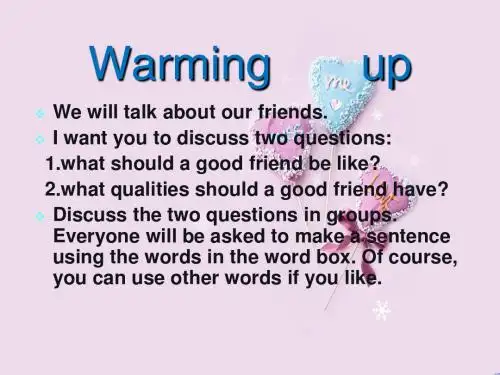
人教版高中必修一 Unit 1friendship warming up
- 格式:ppt
- 大小:710.00 KB
- 文档页数:24

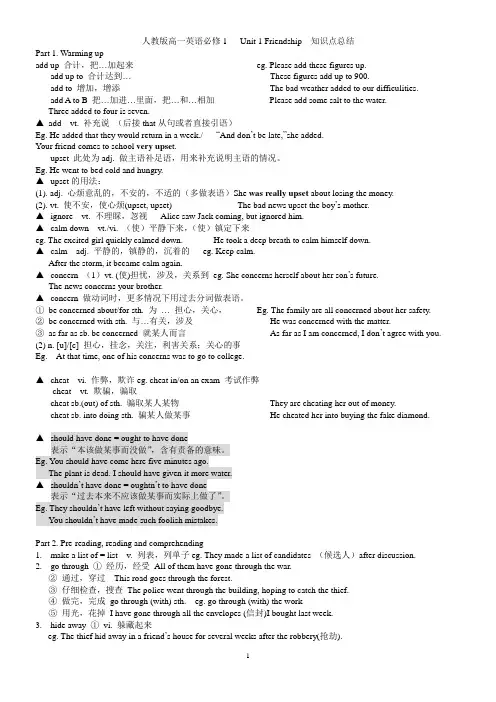
人教版高一英语必修1 Unit 1 Friendship 知识点总结Part 1. Warming upadd up 合计,把…加起来add up to 合计达到…add to 增加,增添add A to B 把…加进…里面,把…和…相加eg. Please add these figures up.These figures add up to 900.The bad weather added to our difficulities.Please add some salt to the water.Three added to four is seven.▲add vt. 补充说(后接that从句或者直接引语)Eg. He added that they would return in a week./ “And don’t be late,”she added.Your friend comes to school very upse t.upset 此处为adj. 做主语补足语,用来补充说明主语的情况。
Eg. He went to bed cold and hungry.▲upset的用法:(1). adj. 心烦意乱的,不安的,不适的(多做表语)She was really upset about losing the money.(2). vt. 使不安,使心烦(upset, upset) The bad news upset the boy’s mother.▲ignore vt. 不理睬,忽视Alice saw Jack coming, but ignored him.▲calm down vt./vi. (使)平静下来,(使)镇定下来eg. The excited girl quickly calmed down. He took a deep breath to calm himself down.▲calm adj. 平静的,镇静的,沉着的eg. Keep calm.After the storm, it became calm again.▲concern (1)vt. (使)担忧,涉及,关系到eg. She concerns herself about her son’s future.The news concerns your brother.▲concern 做动词时,更多情况下用过去分词做表语。
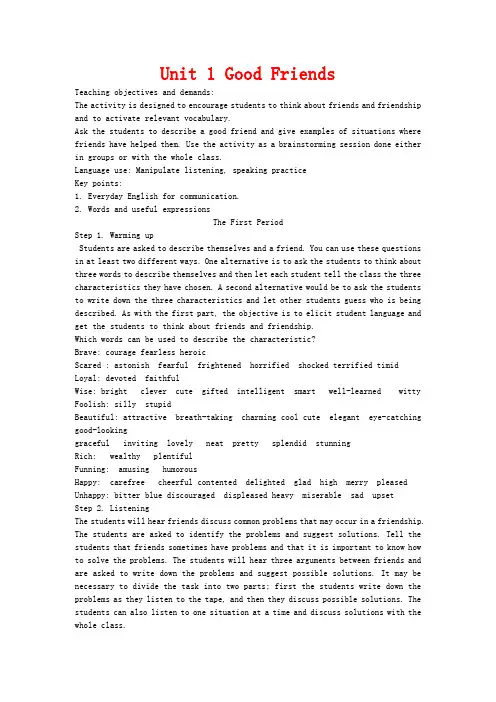
Unit 1 Good FriendsTeaching objectives and demands:The activity is designed to encourage students to think about friends and friendship and to activate relevant vocabulary.Ask the students to describe a good friend and give examples of situations where friends have helped them. Use the activity as a brainstorming session done either in groups or with the whole class.Language use: Manipulate listening, speaking practiceKey points:1. Everyday English for communication.2. Words and useful expressionsThe First PeriodStep 1. Warming upStudents are asked to describe themselves and a friend. You can use these questions in at least two different ways. One alternative is to ask the students to think about three words to describe themselves and then let each student tell the class the three characteristics they have chosen. A second alternative would be to ask the students to write down the three characteristics and let other students guess who is being described. As with the first part, the objective is to elicit student language and get the students to think about friends and friendship.Which words can be used to describe the characteristic?Brave: courage fearless heroicScared : astonish fearful frightened horrified shocked terrified timid Loyal: devoted faithfulWise: bright clever cute gifted intelligent smart well-learned witty Foolish: silly stupidBeautiful: attractive breath-taking charming cool cute elegant eye-catching good-lookinggraceful inviting lovely neat pretty splendid stunningRich: wealthy plentifulFunning: amusing humorousHappy: carefree cheerful contented delighted glad high merry pleased Unhappy: bitter blue discouraged displeased heavy miserable sad upsetStep 2. ListeningThe students will hear friends discuss common problems that may occur in a friendship. The students are asked to identify the problems and suggest solutions. Tell the students that friends sometimes have problems and that it is important to know how to solve the problems. The students will hear three arguments between friends and are asked to write down the problems and suggest possible solutions. It may be necessary to divide the task into two parts; first the students write down the problems as they listen to the tape, and then they discuss possible solutions. The students can also listen to one situation at a time and discuss solutions with the whole class.Key1.Peter is often late for football practice. I think that he should try to be on time in the future.2.Mary usually borrows things without asking and she doesn’t return things on time. She should ask the owner is she wants to borrow something and try to return it on time in the future.3.Adam borrowed John’s CD player yesterday and now it is broken. Adam can ask his uncle to fix it.Extension the students are asked to think of other situations/problems involving friends and role-play or discuss the issues. You may also ask the students to list or discuss what methods are most effective when you want to solve problems in a friendship.Workbook P85ListeningStudents will hear about problems friends may have and what can be done to solve such problems. The students are asked to write down the solutions mentioned on the tape and to think of other solutions. Ask the students to listen to the tape and write down the solutions suggested by the speaker. You can help the students prepare by first asking them to think about problems they may have had with their friends. The solutions mentioned on the tape are simple and general. Encourage the students to think of better, more specific solutions. What would they do if they had a quarrel with a friend? How do they talk to their friends about difficult things? How do they keep secrets from becoming rumors?Listening text Everybody needs friends. But being a good friend can sometimes be hard work. Learning how to solve problems in a friendship can make you a better friend and a happier person. A common problem between friends is that they don’t know how to talk to each other about difficult things. When they do talk, they often get mad with each other. What can they do? Well, it takes time to learn how to communicate well, and it is important to understand why a friend gets angry with you when you say something. If you know what it is that makes your friend angry, then you can try to talk about the problem in a different way.Another problem that many friends have to deal with is what to do after one of them gets angry or upset. If friends get angry with each other and say something bad because they are angry, they often find it difficult to apologize after the quarrel. The best way to apologize after a quarrel is simply to start by telling each other that you are sorry and then go from there. A simple apology is often enough and is a good starting point. What about friends who can’t keep a secret? Sometimes it seems impossible to keep a secret from becoming a rumour that everyone knows. Shouldn’t a good friend be able to keep a secret? Perhaps, but it is not always that easy to keep a secret, and telling a secret to someone will often put them in a difficult situation — they may have to lie to other friends to keep the secret. The best way to make sure that a secret doesn’t become a rumor is simply to keep it to yourself —don’t tell anyone.Answers to Exercise 1Problem: Friends get angry with each other when they try to talk about something difficult.Solution: Try to understand your friend/Try to talk about the problem in a different way.Problem: Friends don’t know how to apologize.Solution: Start by telling each other that you are sorry and take it from there.A simple apology is often enough.Problem: Some friends don’t know how to keep secrets.Solution: Keep your secrets to yourself.Step 3 SpeakingThe students will use the information about the people on SB page 2 to talk about likes and dislikes and to practice giving reasons for their opinions. Tell the students to work in pairs. Ask the students to complete the chart on page SB page 3 and then use the answers to talk about who could be friends and what they like or dislike. Ask each pair to decide who could be friends and give reasons for their decisions. When they have made their decision, ask them to compare and debate their ideas with other pairs. Encourage different answers, including strange ones.know. The students then use the list to identify likes and dislikes and characteristics and try to determine who could be friends.Step 4. Talking Workbook P85The students are given role cards based on three situations where friends are having problems. They are asked to act out the situations with the “useful expressions”. They are also asked to think of a fourth situation, prepare role cards for it, and act it out. Let the students role-play in pairs. Remind them that they should not write down a dialogue and then simply read the dialogue. Instead, they should try to act out the situation without rehearsing it. If they find it difficult to get started, you can let them prepare by practising part of a situation. You can also help by modeling part of a situation.Extension Friends often help each other. Ask the students to work in pairs and listexamples of situations where friends can help each other. The students can then write role cards for the situations and act out in pairs.Step 5. Homework(1) Finish off the exercises of Unit1 in the workbook.(2) Revise the key points of this unit.(3)List the friend they get to know in class and write down some thing they want to know.Evaluation of teaching:The Second PeriodTeaching objectives1. Develop the students’ comprehension of explorative passages, especially their ability of analyzing the structure of such kind of articles.Offer the students chances of self-culture by working in groups and seeking information about the film out-side the class.3. Infuse the students with basic knowledge about the friend and friendship4. Learn some words and useful expressions from the text.Teaching Approachmunicative Approach should be used throughout the class. Stress should be laid on:2.Learner-centeredness; learning-centeredness3.Task-based learning4.Activity-based teaching (class work; individual work; group work)Teaching type: Reading comprehensionTeaching ProcedureStep 1. Report in class A student is asked to report something interesting he or she picks up from newspaper or magazines.Step 2.Review and check Ss have a word dictation and check their homework in workbookExercise 2 Suggested sample sentences1) My friend Alan is brave. He once saved the life of a little girl who had fallen into a lake.2) My friend Bob is loyal. He wouldn’t talk to Charles whom I don’t like at all.3) My friend David is wise. He always gives me the best advice.4) My friend George i s a handsome boy, but he doesn’t like to study and always dreams of becoming a model.5) My friend Harry is a smart student. He always asks good questions in class. Step 3 Pre-reading Ss are asked to listen to the tape and find the things they are using or talking about.Practising on P87 vocabulary1 “The books are too heavy! I think it’s going to break.”2 “Oh no! I forgot where I put it! I have written down all the important phone numbers.”3 “Yum! You have bought it at last. We can have fried fish for dinner. Mmm (I)can’t wait to put this fish in it. ”4 “Hands up! Don’t move or I’ll shoot. Give me all your money!”5 “Ooooh! I look very nice in this new dress!!!”6 A: I think we’re lost. What should we do now? B: Don’t worry. I have it here and I know how to use it.7 “Ouch! I hit myself with it.”8 A: Hurry up! It’s so dark here. I can’t see anything.9 “It is shaking badly. Am I going to die? Help! … Oh, thank God!”10 “I feel sad when it comes to the part in which the two friends become enemies.”Answers 1 rope 2 notebook 3 pan 4 gun 5 mirror 6 compass 7 hammer 8 match 9 airplane 10 movieGet the students to think about what it would be like to be alone on a deserted island. The activity is not direct linked to a reading strategy or a structure in the reading, but is intended to be used as a preliminary activity related to the previous parts of the unit. The pre-reading exercise also gives the students an opportunity to practise giving opinions and making decisions.Explain the situation to the students and give them time to think about what they would bring. The activity should generate different choices and opinions, thus making it a good opportunity for discussion. Tell the students to work in groups. Ask them to describe the usefulness of each item in the box and then decide on the three most useful ones. Make sure that each group member gets an opportunity to speak. Encourage the students to use the structures I think… because…/ I could use it to…/ it could be used to …/ …would be more important than … because … Ask one student from each group to write their answers on the blackboard. Compare answers from different groups and have a short discussion. e.g. 1.I think a knife would be the most useful item, because I could use it to kill animals and cut the meat. It could also be used to cut wood. 2.I also think a box of matches would be useful because I could use the matches to make fire. If I had a fire, I could cook food, stay warm and keep wild animals away. More importantly, if someone saw the fire, they would come and save me. 3.I think a book would be more useful than a radio, because you don’t need batteries to read. And when I read, I would learn about life and the world and forget my loneliness.Extension 1: Ask the students to think about how the things could help them in other situations, for example, if they were lost in a desert or a forest. Extension 2: Let the students talk about how they would feel in an extreme situation. How would they feel if they were alone on a deserted island?(angry, desperate, lonely, hungry, worried, hopeful, happy, afraid etc.) What would they do to try to overcome these feelings? Extension 3: Ask the students if they have read books or seen movies about island life, for example, Robinson Crusoe, Cast Away, Six days and Seven Nights, etc. How did the main characters survive? How were they rescued? Extension 4 After the discussion, you can ask the students to consider the similarities and differences between spiritual and materialistic needs, i.e. the things we need and the social interaction we need.Step 4 Reading Listen to tape and finish the following itemsCHUCK’S FFRIENDBackground information on the reading :The film Cast Away, starring Tom Hanks, depicts a man’s struggle with s olitude and his journey towards self-knowledge. The film shows us how Chuck, a busy manager who never has “enough time,” ends up on an island with nothing but time. He manages to survive on the island and he realizes the importance of friends and friendship. The text, summarized below, describes his experience and the lessons he learns from his unusual friend, a volleyball he calls Wilson.Guess the meaning of a word or phrase in the text, tell them to mark the word or phrase. Ask the students to list word s or phrases that they don’t know. Explain important ones if necessary, but try offering more context of certain words until the students can guess the meaning. Don’t spend too much time going through the new words.Suggestion for teaching some of the vocabulary of the reading text:picture and retell the main idea of the text.1 Chuck Noland, a successful businessman, lands on a deserted island aftera plane crash.2 Chuck has to learn basic survival skills on the island. In order to cope with his loneliness, Chuck develops a friendship with a volleyball he calls Wilson.3 Five years’ life on the island teaches Chuck the importance of having friends and being a good friend. Wilson may just be a volleyball, but their friendship is real and in some ways better than Chuck’s friendships in the past.4 Human friends and unusual friends are important in our life. Friends and friendship help us understand who we are and how we should behave.Step 5 Post-reading Exx on Page 4 Ask the students to answer questions about the story. e.g. How can a volle yball become Chuck’s friend? What does Chuck learn about himself when he is alone on the island?Suggested answers to the questions1 He has to learn how to collect water, hunt for food, and make fire. More importantly, he has to learn to live without friends.2 He has learnt a lot about himself when he is alone on the island. For example, he has come to realize that friendship is important in his life, that he hasn’t been a good friend, and that he should care more about his friends. (The students may also use present tense, e.g. He learns a lot about himself. He realizes that…)3 Open for discussion. The students can list basic survival skills.Let the students discuss the question in groups. The question can be discussed in the form of a role-play where each student represents one of the four people and has to persuade the others that he or she should be given the parachute.5.Have a short discussion about one or more ideas in the text:1 ) What can we do to be good friends even if we are very busy?2 ) Does a successful man or woman need friends?3 ) The text talks about “giving” and “taking.” How do friends give and take?4 ) What do friends teach us?5 ) Is it better to have a human friend or an unusual friend such as a volleyball,a pen or a dog?Step 6 Language study Key to “Word study”:1 honest,2 classical3 sorrow/unhappiness4 argue/quarrel/disagree5 loyal/good/true6 hunt for7 fond of/interested in8 brave/fearless9 in order to/ so as to 10 smartStudent-centered vocabulary learning:It is very important for students to make their own choices and decisions about what they learn. You can help your students by letting them practise making such choices and decisions.Give the students a few minutes to make a list of words and expressions from the text that they want to learn. The list should not be too long.Ask the students to show their list to a partner and explain why they chose these words or expressions.There are many ways to help the students deal with new words. Begin by letting the students try on their own. If the students can discover the meaning of new words themselves—either by using clues, pair work, or group discussion they are more likely to develop a better understanding of the word. More importantly, the process will help them develop strategies and skills that they can use when they encounter new words. The teacher is responsible for providing guidance and assistance. Give the students time, help as little as possible and in a gradual way. Try to model and encourage positive behaviour—the best way to help is to provide clues and examples. If you “explain” the word or simply translate it, you are not giving the students an opportunity to learn.1 Encourage the students to try different ways to fix the words in their minds.2 Some words may have different meanings. You can help the students decide which meaning fits the context.Unit 1 背景材料:Cast Away 荒岛余生汤姆·汉克斯曾以《费城故事》和《阿甘正传》连续两度获奥斯卡最佳男演员奖殊荣,为自己和别人树立了两座高不可攀的丰碑。