
7B Unit2 Welcome to the unit
- 格式:ppt
- 大小:2.02 MB
- 文档页数:2


7B Unit 2 Neighbours Comic strip & Welcome to the unit(第一课时)问题导学单【温故知新】根据首字母或中文提示写出单词。
1.I have two new_______(邻居).They are kind.2. I_______(将)have noodles for supper.3.A lot of _______(参观者)come to visit our library.4. I'd like to live in a hotel l_______ this.5. The man is a w_______ in the restaurant.【预习导航】一、找出本课中的生词,猜测词义,并注上音标试着拼读,然后听磁带读会。
二、句型转换。
1.The boy is going to see his father.(改为一般疑问句)_______ the boy_______ to see his father?2.Mike is going to call his brother.(同义句转换)Mike_______ _______ his brother.3.I am afraid that l will meet the man.(同义句转换)I am afraid_______ _______ the man.4.Most students like pop music.(同义句转换)_______ _______ the students like pop music.5.Jack listens to new songs every week.(用next week改写句子)Jack_______ _______ _______ listen to new songs next week.三、听磁带预习P18-19。
每周一句:Well begun is half done 良好地开端是成功的一半。

牛津译林版英语七下Unit 2《Neighbours》(welcome to the unit)教学设计一. 教材分析牛津译林版英语七下Unit 2《Neighbours》主要讨论了与邻居相关的日常交流用语。
通过本单元的学习,学生将能够掌握与邻居交流的基本用语,描述邻居的特点以及日常生活中与邻居的互动。
本单元主要包括以下几个部分:welcome to the unit、read and write、listen and say、look and say、task、self-check以及word bank。
二. 学情分析学生在进入七年级下学期时,已经具备了一定的英语基础,能够进行简单的英语听说读写活动。
但部分学生对于日常英语交流仍感到困难,特别是在实际应用中,可能出现表达不准确或胆怯的情况。
因此,在教学过程中,需要关注学生的个体差异,鼓励他们积极参与课堂活动,提高他们的自信心。
三. 教学目标1.知识目标:学生能够掌握与邻居交流的基本用语,描述邻居的特点以及日常生活中与邻居的互动。
2.能力目标:学生能够在实际情景中运用所学知识进行日常英语交流,提高他们的口语表达能力。
3.情感目标:学生能够学会尊重他人,培养良好的邻里关系。
四. 教学重难点1.重点:学生能够掌握与邻居交流的基本用语,描述邻居的特点以及日常生活中与邻居的互动。
2.难点:学生在实际情景中运用所学知识进行日常英语交流,特别是听力和口语能力的运用。
五. 教学方法1.情境教学法:通过设置各种与邻居相关的实际情景,让学生在情境中学习与练习英语。
2.交际教学法:鼓励学生积极参与课堂互动,进行真实的英语交流。
3.任务型教学法:通过完成各种任务,让学生在实践中运用所学知识。
六. 教学准备1.教师准备:提前熟悉教材内容,了解学生的学习情况,设计合理的教学活动和任务。
2.学生准备:预习教材内容,了解本单元的学习目标。
七. 教学过程1.导入(5分钟)教师通过提问方式引导学生回顾上一单元学到的内容,如家庭成员的称呼和特点。
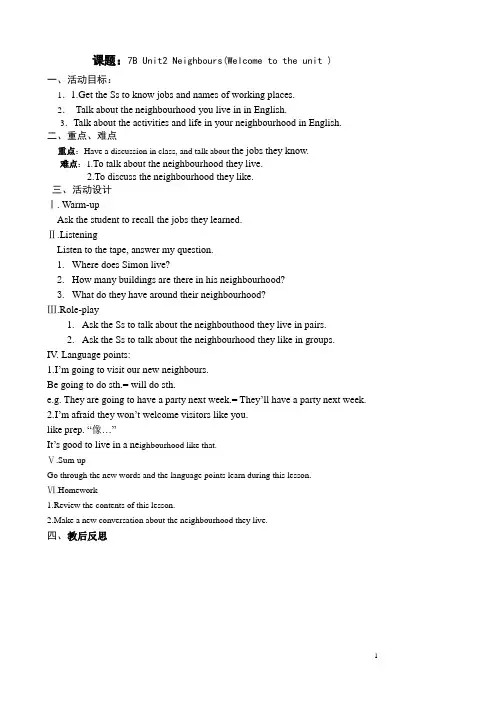
课题:7B Unit2 Neighbours(Welcome to the unit )一、活动目标:1.1.Get the Ss to know jobs and names of working places.2.Talk about the neighbourhood you live in in English.3.Talk about the activities and life in your neighbourhood in English.二、重点、难点重点:Have a discussion in class, and talk about the jobs they know.难点:1.To talk about the neighbourhood they live.2.To discuss the neighbourhood they like.三、活动设计Ⅰ. Warm-upAsk the student to recall the jobs they learned.Ⅱ.ListeningListen to the tape, answer my question.1.Where does Simon live?2.How many buildings are there in his neighbourhood?3.What do they have around their neighbourhood?Ⅲ.Role-play1.Ask the Ss to talk about the neighbouthood they live in pairs.2.Ask the Ss to talk about the neighbourhood they like in groups.IV. Language points:1.I’m going to visit our new neighbours.Be going to do sth.= will do sth.e.g. They are going to have a party next week.= They’ll have a party next week.2.I’m afraid they won’t welcome visitors like you.like prep. “像…”It’s good to live in a ne ighbourhood like that.Ⅴ.Sum-upGo through the new words and the language points learn during this lesson.Ⅵ.Homework1.Review the contents of this lesson.2.Make a new conversation about the neighbourhood they live.四、教后反思1。