英语句子的类型
- 格式:pdf
- 大小:310.05 KB
- 文档页数:11
每一个单词都检查过,请放心使用英语句子的类型 (1)1.1简单句的结构 (1)1.2并列句的结构 (1)1.3复合句的结构 (2)1.4主语从句 (2)1.5表语从句 (2)1.6宾语从句 (2)1.7直接引语与间接引语 (3)1.8定语从句 (5)1.9同位语从句 (7)1.10状语从句 (7)1.11句型的转换 (11)英语句子的类型1.1简单句的结构简单句(simple sentence)有“主语+谓语”、“主语+谓语+主语补语”、“主语+谓语+宾语”、“主语+谓语+宾语+宾语”、“主语+谓语+宾语+宾语补语“等五种基本结构。
其它各种句子基本上皆由此五种句型缩略或扩展而成。
1)“主语+谓语”句型可简称为主谓结构(SV),谓语是不及物动词。
如:(1)Day broke.天亮了。
(2)Things change.事物是变化的。
2)“主语+谓语+主语补语”句型可简称为主谓补结构(SVC)。
如:(3)He died young.他年轻时就死了。
(4)John was cast as Hamlet.约翰扮演哈姆莱特。
“主语+连系动词+表语“句型(SLP)实质上也是一种主、谓、主补结构。
如:(5)He and I are pretty good swimmers.他和我都游泳游得不错。
(6)The doctors seemed very capable.这些大夫好像都很能干。
3)“主语+谓语+宾语”句型可简称为主、谓、宾结构(SVO),其谓语一般皆是及物动词,其宾语多是直接宾语。
如:(7)Robbie didn’t deny the facts.罗比不否认这些事实。
(8)She heard whisperings.她听到了一阵沙沙声。
4)“主语+谓语+宾语+宾语”句型可简称为主谓宾宾结构(SVOO),其谓语须是可有双宾语的及物动词,即所谓的与格动词(dative ver),两个宾语多一是间接宾语,一是直接宾语。
如:(9)We gave the baby a bath.我们给婴孩洗了个澡。
(10)Judith paid me a visit.朱迪思来看望了我。
有时可有两个直接宾语。
如:(11)He asked her a question.他问了她一个问题。
5)“主语+谓语+宾语+宾语补语”句型可简称为主、谓、宾、宾补结构(SVOC),其谓语须是可有这种复合宾语与宾语一起构成复合宾语。
如:(12)I found this book easy.我发现此书不难。
(形容词easy用作宾语补语)(13)They held him hostage.他们将他扣作人质。
(名词hostage用作宾语补语)(14)He watched the maid come in.他看着女佣人进来了。
(15)I heard him coming up the stairs slowly, as if he were carrying something heavy.我听见他慢慢上楼来,好像扛着什么重的东西。
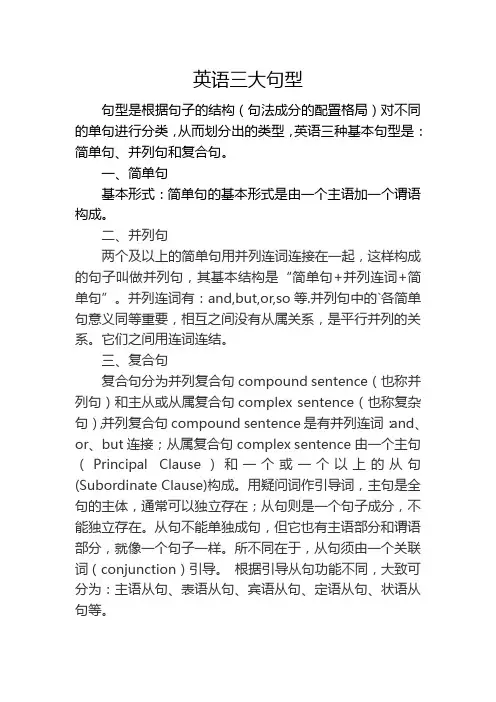
1.2并列句的结构并列句(compound sentence)由两个或两个以上的简单句并列而成。
常见的并列句结构是:简单句+等立连词+简单句。
这种简单句常被叫做分句。
等立连词之前可用逗号,也可不用逗号。
如:(1)They were happy and they deserved their happiness.他们是幸福的,他们也该得到幸福。
(等立连词是and)(2)The signal was given, and the steamer moved slowly from the dock.信号发出了,轮船缓缓驶出码头。
(等立连词是and,前有逗号)(3)Hurry or you won’t make the train.赶快,不然你就赶不上火车。
(等立连词是or)(4)Honey is sweet, but the bee stings.蜜是甜的,但蜜蜂却会蜇人。
(等立连词是but)有时亦可不用等立连词,只用逗号、分号、冒号等把分句隔开。
如:(5)He is cruel, he is lustful, he is immensely cunning.他残忍,他好色,他非常狡猾。
(用逗号连接)(6)Heavy clouds rose slowly from the horizon; thunder drummed in the distance.浓去从地平线缓缓升起,远处雷声隆隆。
(用分号连接)(7)He knocked at the door again and again: there was no answer.他一再敲门,但无人应门。
(用冒号连接,表结果)两个或两个以上的简单句的关系如不很紧密,等立连词可引导单独一个句子。
如:(8)You’re alive! And she’s dead.你活着!而她却死了。
(等立连词and引导单独句子)(9)I’m sorry to trouble you. But can you direct me to the nearest post office?对不起打扰一下。
你可以告诉我最近的邮局在哪儿吗?(等立连词but引导单独句子)并列句的分句亦可用连接副词连接。
如:(10)I had a drink, then I went home.我喝了杯酒,然后回到了家。
(连接副词是then)(11)It rained, therefore the game was called off.由于有雨,因而那场球赛取消了。
(连接副词是therefor)(12)He was angry, nevertheless he listened to me.他生气了,但听我的话。
(连接副词是nevertheless)(13)I want to go to the party – however, I have no transtransport.我想去参加聚会,但我没有交通工具。
(连接副词是however)(14)I have only an old car; still it is better than nothing.我只有一辆旧车,但了比没有好。
(连接副词是still)(15)I am busy today, so can you come tomorrow?我今日很忙,那你能明天来吗?(连接副词是so)1.3复合句的结构复合句(complex sentence)由一个主句(principal clause)和一个或一个以上的从句(subordinate clause)构成。
主句是全句的主体,往往可以独立存在;而从句仅是全句的一个句子成分,故不能独立存在。
如:(1)We met where the road crossed.我们是在十字路口遇见的。
(we met是主句,where the roads crossed是从句)(2)I forgot to post the letter which I wrote yesterday.我忘了把昨天写好的信投邮了。
(I forgot to post the letter是主句,which I wrote yesterday是从句)从句虽不能单独成句,但它也有主语部分和谓语部分。
从句须由一个关系词(connective)引导。
引导从句的关联词共有七类:1)从属连词:有wherther, when, although, because, if等。
如:(3)He will get the letter tomorrow if you send it off now.如果你现在就把信发出,他明天就会收到。
(4)I don’t know whether she will be able to come.我不知道他明天是否能来。
2)疑问代词:who, whom, whose, which, what。
如:(5)Who he is doesn’t concern me.他是谁与我无关。
(6)I don’t know what you mean.我不知道你是什么意思。
3)疑问副词:when, where, why, how。
如:(7)I asked how he was getting on.我问他近况如何。
(8)I can’t understand why he was so late.我不明白他为什么来得这么晚。
4)关系代词:who, whom, whose, which, that。
如:(9)Nobody who understands the subject would say such a thing.懂得这一行的人是不会说这种话的。
(10)Water that is impure often causes serious illness.水不洁常会引起重病。
5)关系副词:when, where, why。
如:(11)July and August are the months when the weather is hot.七八月是天气很热的月份。
(12)She would like to live in a country where it never snows.她喜欢住在不下雪的地区。
6)缩合连接代词:what, whatever, who, whoever, that, whichever。
如:(13)Show me what you have written.把你所写的东西给我看看。
(14)Whoever does wrong is punished in the end.恶有恶报。
7)缩合连接副词:Whenever, where, wherever, however。
如:(15)Whenever he goes out, he always takes his umbrella.他每逢出门总是带伞。
(16)Sit wherever you like.你爱坐哪儿都成。
从句分主语从句、表语从句、宾语从句、同位语从句、定语从句和状语从句六类。
由于主语从句、表语从句和宾语从句在句子中的功用相当于名词,故这三种从句又统称为名词性从句。
名词性从句所用的关联词大抵相同。
而且其前一般不用逗号。
[注]还有一种比较复杂的并列句,叫做并列复合句。
并列复合句的分句有一个或多个为复合句。
如:①The policeman looked at me suspiciously, and he asked me what I wanted.那警察用怀疑的眼光看着我,并问我要干什么。
②While the men worked to strengthen the dam, the rain continued to fall; and the river, which was already well above its normal level, rose highter and highter.当人们正在加固河堤的时候,雨还在不停地下,已经远远超过正常水位的河水涨得越来越高了。